
Ernst Gombrich
Sir Ernst Hans Josef Gombrich (German: [ˈgɔmbʁɪç]; 30 March 1909 – 3 November 2001) was an Austrian-born art historian. After settling in England in 1936, he became a naturalised British citizen in 1947 and spent most of his working life in the United Kingdom. The author of many works of cultural history and art history, most notably The Story of Art, a book widely regarded as one of the most accessible introductions to the visual arts, and Art and Illusion, a major work in the psychology of perception that influenced thinkers as diverse as Carlo Ginzburg, Nelson Goodman, Umberto Eco, Thomas Kuhn and David Summers.
Ernst Gombrich
![Collectie / Archief: Fotocollectie Anefo Reportage / Serie: [onbekend] Beschrijving: Prins Bernhard reikt Erasmusprijs uit in Van Goghmuseum aan Sir Ernst Gombrich en jhr. W. Sandberg; Sandberg, Prins Bernhard Datum: 19 september 1975 Trefwoorden: prijzen Persoonsnaam: Bernhard (prins Nederland), Margriet, prinses Fotograaf: Verhoeff, Bert / Anefo Auteursrechthebbende: Nationaal Archief](https://upload.wikimedia.org/wikipedia/commons/thumb/5/52/Prins_Bernhard_reikt_Erasmusprijs_uit_in_Van_Goghmuseum_aan_Sir_Ernst_Gombrich_en_jhr._W._Sandberg%2C_Bestanddeelnr_928-1609_%28cropped%29.jpg/433px-Prins_Bernhard_reikt_Erasmusprijs_uit_in_Van_Goghmuseum_aan_Sir_Ernst_Gombrich_en_jhr._W._Sandberg%2C_Bestanddeelnr_928-1609_%28cropped%29.jpg)
Bert Verhoeff for Anefo · CC0
- Full name
- Ernst Hans Josef Gombrich.
- Died
- 2001. · London.
- Nationality
- United Kingdom and Austria.
- Occupation
- writer, professor, aesthetician and historian.
- Fields
- art theory, art history and popular science literature.
- Education
- University of Vienna and Theresianum.
- Honours
- Pour le Mérite for Sciences and Arts order, Commander of the Order of the British Empire, Erasmus Prize, Balzan Prize, Goethe Prize of the City of Frankfurt and Hegel Prize.
- Languages
- English.
VALÉORINE Encyclopedia
VALÉORINE documentary reading
Documentary summary
Sir Ernst Hans Josef Gombrich (German: [ˈgɔmbʁɪç]; 30 March 1909 – 3 November 2001) was an Austrian-born art historian. After settling in England in 1936, he became a naturalised British citizen in 1947 and spent most of his working life in the United Kingdom. The author of many works of cultural history and art history, most notably The Story of Art, a book widely regarded as one of the most accessible introductions to the visual arts, and Art and Illusion, a major work in the psychology of perception that influenced thinkers as diverse as Carlo Ginzburg, Nelson Goodman, Umberto Eco, Thomas Kuhn and David Summers.
Admitted source layer · organised and presented by VALÉORINE
Note VALÉORINE
No house-authored Note is published until its assertions and sources pass the VALÉORINE evidence contract. The documentary article remains available in full while that enrichment is being consolidated.
Documentary enrichment in progress · no unsupported statement published
Reference Check
Propose documentary evidence for Ernst Gombrich. A contribution is never written directly as fact: identity, source, rights and evidence gates still decide.
Sign in to contribute
World of VALÉORINE
Documentary connections
Only confirmed graph relationships appear here. Images are shown only when their identity and reuse rights both pass the documentary gate.

Documentary evidence
Evidence Panel
not yet certified
- Identity
- resolved
- Independent source families
- 0
- Admitted assertions
- 0
- Open conflicts
- 0
Authority files
wikidata · Q78504 · wikipedia · Ernst Gombrich
In this article
Biography
Biography
Ernst Gombrich studied at University of Vienna and Theresianum. Sixten Ringbom is recorded as having studied under Ernst Gombrich. The recorded working language is English. The field of work recorded is art theory, art history and popular science literature. Places of work recorded in the authority are Vienna and London. Employment is recorded with University of London, University of Vienna and Warburg Institute. Distinctions recorded are Pour le Mérite for Sciences and Arts order, Commander of the Order of the British Empire, Erasmus Prize and Balzan Prize.
The son of Karl Gombrich and Leonie Hock, Gombrich was born in Vienna, Austria-Hungary, into an upper middle class family of assimilated Jews who were part of a sophisticated social and musical milieu. His father was a lawyer and former classmate of Hugo von Hofmannsthal and his mother was a distinguished pianist who graduated from the Vienna Conservatoire with the School's Medal of Distinction. At the Conservatoire she was a pupil of, amongst others, Anton Bruckner. However, rather than follow a career as a concert pianist (which would have been difficult to combine with her family life in this period) she became an assistant of Theodor Leschetizky. She also knew Arnold Schoenberg, Gustav Mahler, Hugo Wolf and Johannes Brahms. Rudolf Serkin was a close family friend. Adolf Busch and members of the Busch Quartet regularly met and played in the family home. Throughout his life Gombrich maintained a deep love and knowledge of classical music. He was a competent cellist and in later life at home in London regularly played the chamber music of Haydn, Mozart, Schubert, Beethoven and others with his wife and his elder sister Dea Forsdyke, a concert violinist. Gombrich was educated at the Theresianum and at the University of Vienna, where he studied art history under Hans Tietze, Karl Maria Swoboda, Julius von Schlosser and Josef Strzygowski, completing a PhD thesis on the Mannerist architecture of Giulio Romano, supervised by Schlosser. Specialised in caricature, he was invited to help Ernst Kris, who was then keeper of decorative arts at the Kunsthistorisches Museum, on his graduating in 1933. In 1936, he married Ilse Heller (1910–2006), a pupil of his mother, and herself an accomplished pianist. Their only child, the Indologist Richard Gombrich, was born in 1937. They had two grandchildren: the educationalist Carl Gombrich, (b. 1965) and Leonie Gombrich (b. 1966), who is his literary executor. After publishing his first book A Little History of the World in German in 1936, written for children and adolescents, and seeing it become a hit only to be banned by the Nazis for pacifism and attempts at discrediting the historicity of the accepted longevity-spans of both Italian and German societies, he fled to Britain in 1936 to take up a post as a research assistant at the Warburg Institute, University of London. During World War II, Gombrich worked for the BBC World Service, monitoring German radio broadcasts. When in 1945 an upcoming announcement was prefaced by the Adagio of Bruckner's seventh symphony, written for Richard Wagner's death, Gombrich guessed correctly that Adolf Hitler was dead and promptly broke the news to Churchill. Gombrich returned to the Warburg Institute in November 1945, where he became Senior Research Fellow (1946), Lecturer (1948), Reader (1954), and eventually Professor of the History of the Classical Tradition and director of the institute (1959–76). He was elected a Fellow of the British Academy in 1960, appointed Commander of the Order of the British Empire (CBE) in the 1966 New Year Honours, knighted in the 1972 Birthday Honours, and appointed a member of the Order of Merit in 1988. He continued his work at the University of London until close to his death in 2001. He was the recipient of numerous additional honours, including Goethe Prize 1994 and Balzan Prize in 1985 for History of Western Art. Gombrich was close to a number of Austrian émigrés who fled to the West prior to the Anschluss, among them Karl Popper (to whom he was especially close), Friedrich Hayek and Max Perutz. He was instrumental in bringing to publication Popper's magnum opus The Open Society and Its Enemies. Each had known the other only fleetingly in Vienna, as Gombrich's father served his law apprenticeship with Popper's father. They became lifelong friends in exile.
Work
Work
Gombrich remarked that he had two very different publics: amongst scholars he was known particularly for his work on the Renaissance and the psychology of perception, but also his thoughts on cultural history and tradition; to a wider, non-specialist audience he was known for the accessibility and immediacy of his writing and his ability to present scholarly work in a clear and unfussy manner. Gombrich's first book, and the only one he did not write in English, was Eine kurze Weltgeschichte für junge Leser ("A short history of the world for young readers"), published in Germany in 1936. It was very popular and translated into several languages, but was not available in English until 2005, when a translation of a revised edition was published as A Little History of the World. He did most of this translation and revision himself, and it was completed by his long-time assistant and secretary Caroline Mustill and his granddaughter Leonie Gombrich after his death. The Story of Art, first published in 1950 and currently in its 16th edition, is widely regarded as one of the most accessible introductions to the history of visual arts. Originally intended for adolescent readers, it has sold millions of copies and been translated into more than 30 languages. He became the director of the Warburg Institute in 1959, holding that position until 1976–making his tenure as director the longest-standing in the institution’s history. The following year he published Art and Illusion (1960), regarded by critics to be his most influential and far-reaching work. Shortly thereafter a group of Gombrich’s essays were gathered for his anthology Meditations on a Hobby Horse (1963). Other important books are Aby Warburg: An Intellectual Biography (1970), The Sense of Order (1979), The Image and the Eye (1981), and The Preference for the Primitive (posthumously in 2002). The complete list of his publications, E. H. Gombrich: A Bibliography, was published by Joseph Burney Trapp in 2000.
Psychology of perception
Psychology of perception
When Gombrich arrived in England in 1936, the discipline of art history was largely centred around connoisseurship. Gombrich, however, had been brought up in the Viennese culture of Bildung and was concerned with wider issues of cultural tradition and the relationship between science and art. This latter breadth of interest can be seen both in his working relationship with the Austrian psychoanalyst and art historian, Ernst Kris, concerning the art of caricature and his later books, The Sense of Order (1979) (in which information theory is discussed in its relation to patterns and ornaments in art) and the classic Art and Illusion (1960). It was in Art and Illusion that he introduced the ideas of 'schemata', 'making and matching', 'correction' and 'trial and error' influenced by 'conjecture and refutation', in Popper's philosophy of science. In Gombrich's view, the artist compares what he has drawn or painted with what he is trying to draw/paint, and by a 'feedback loop' gradually corrects the drawing/painting to look more like what he is seeing. The process does not start from scratch, however. Each artist inherits '"schemata" that designate reality by force of convention'. These schemata, plus the techniques and works of previous masters, are the starting points from which the artist begins her own process of trial and error. "This [Popperian description of conjecture and refutation, trial and error] is eminently applicable to the story of visual discoveries in art. Our formula of schema and correction, in fact, illustrates this very procedure. You must have a starting point, a standard of comparison, to begin that process of making and matching and remaking which finally becomes embodied in the finished image. The artist cannot start from scratch, but he can criticise his forerunners" The philosophical conceptions developed by Popper for a philosophy of science meshed well with Gombrich's ideas for a more robust explanation of the history of art. Gombrich had written his first major work The Story of Art in 1950, ten years before Art and Illusion. The earlier book has been described as viewing the history of art as a narrative moving 'from what ancient artists "knew" to what later artists "saw"'. And as Gombrich was always more concerned with the individual rather than mass movements (the famous first line of The Story of Art is 'There really is no such thing as Art. There are only artists'), he saw the use of scientific and psychological explanations as key to understanding how these individual artists 'saw', and how they built upon the traditions they had inherited and of which they were a part. With the dialectics of making and matching, schema and correction, Gombrich sought to ground artistic development on more universal truths, closer to those of science, than on what he regarded as fashionable or vacuous terms such as 'zeitgeist' and other 'abstractions'.
Renaissance studies
Renaissance studies
Gombrich's contribution to the study of Renaissance art began with his doctoral dissertation on mannerism. In this he argues that the work of Giulio Romano, at the Palazzo del Tè, was not the work of a decadent Renaissance artist but rather showed how the painter responded to the demands of a patron 'eager for fashionable novelty'. The four-volume series Studies in the Art of the Renaissance (1966) comprises the volumes Norm and Form; Symbolic Images; The Heritage of Apelles; and New Light on Old Masters, and made a major contribution to the study of symbolism in the work of this period. Gombrich was a great admirer of Leonardo da Vinci and wrote extensively on him, both in these volumes and elsewhere.
Life and career
Dated record
Life and career
Explore 1909–2001
The full dated record · 3 entries
1909
Ernst Gombrich was born in 1909 at Vienna.
1990
Sir Ernst Gombrich and Sir G Porter is dated Jun 1990 and held by Wellcome Collection.
2001
Ernst Gombrich died in 2001 at London.
Places
Named by the record
Places
Only places the record itself states, plotted where the house gazetteer settles their coordinates. Nothing is inferred from a name or a nationality.
Vienna.
Birth place
London.
Death place
Selected publications
The Preference for the Primitive. Episodes in the History of Western Taste and Art. London: Phaidon 2002 The Uses of Images. Studies in the Social Function of Art and Visual Communication. London: Phaidon 1999 Topics of Our Time. Twentieth-Century Issues in Learning and in Art. London: Phaidon. 1991. ISBN 978-0-520-07516-0 – via Internet Archive. Woodfield, Richard, ed. (1987). Reflections on the History of Art: Views and Reviews. Oxford: Phaidon. ISBN 978-0-520-06189-7 – via Internet Archive. Tributes. Interpreters of our Cultural Tradition. Oxford: Phaidon. 1984. ISBN 978-0-8014-1703-0 – via Internet Archive. Ideals & Idols. Essays on Values in History and Art. Oxford: Phaidon 1979 The Sense of Order. a Study in the Psychology of Decorative Art. Oxford: Phaidon 1979 Aby Warburg, an Intellectual Biography. London: The Warburg Institute 1970 The Image and the Eye: Further Studies in the Psychology of Pictorial Representation. Oxford: Phaidon 1982, ISBN 0-7148-2245-0 Studies in the Art of the Renaissance. London: Phaidon 1967–1986 (also published as: Gombrich on the Renaissance.) 1: Norm and Form. 1967 2: Symbolic Images. 1972 3: The Heritage of Apelles. 1976 4: New Light on Old Masters. 1986 – via Internet Archive. In Search of Cultural History: The Philip Maurice Deneke Lecture 1967. Oxford: Clarendon Press. 1969. ISBN 978-0-19-817168-3 – via Internet Archive. Meditations on a Hobbyhorse and other Essays on the Theory of Art. London: Phaidon 1963 Art and Illusion. A Study in the Psychology of Pictorial Representation London: Phaidon 1960 The Story of Art. London: Phaidon 1950 Weltgeschichte von der Urzeit bis zur Gegenwart. Wenen: s.n. 1935 (also published as: Eine kurze Weltgeschichte für junge Leser. Von der Urzeit bis zur Gegenwart.) English translation: A Little History of the World.
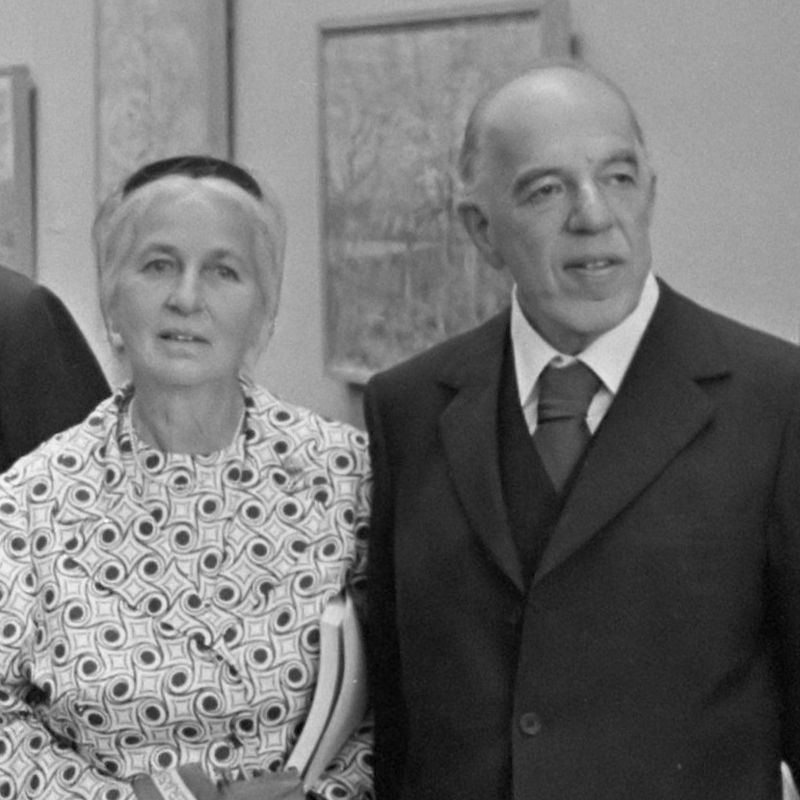
Prins Bernhard reikt Erasmusprijs uit in Van Goghmuseum aan Sir Ernst Gombrich en jhr. W. Sandberg; Sandberg, Prins Bernhard 19 september 1975
Bert Verhoeff for Anefo · Derived from Nationaal Archief
Influence
Influence
Gombrich has been called 'the best known art historian in Britain, perhaps in the world' and also 'one of the most influential scholars and thinkers of the 20th century'. In October 2014 an English Heritage blue plaque for Gombrich was unveiled by sculptor Antony Gormley at 19 Briardale Gardens, Hampstead, alongside Sir Peter Bazalgette, chair of the Arts Council and blue plaque panel member, Richard Gombrich and the art historian Prof David Freedberg. The plaque reads: "E. H. Gombrich (1909 – 2001) Art Historian lived here 1952 to 2001." Gormley lived as a child a couple of doors down from the house.
Criticism
Criticism
Gombrich was sensitive to the criticism that he did not like modern art and was obliged to defend his position on occasion. He has also been criticised for taking what is now viewed as a eurocentric—not to say neo-colonialist—view of art, and for not including female artists in much of his writing on Western art. His answer to the latter was that he was writing a history of art as it was, and that women artists did not feature widely in the West before the 20th century. He admired 20th-century female artists such as Bridget Riley, whose work was included in a revised edition of The Story of Art. While several works of Gombrich (especially Art and Illusion in 1960) had enormous impact on art history and other fields, his categorical attacks on historism have been accused (by Carlo Ginzburg) of leading to "barren" scholarship; many of his methodological arguments have been superseded by the work of art historians like Svetlana Alpers and his own student Michael Baxandall.
Honours and awards
Master-Mind Lecture of the British Academy (1957) Elected to the American Academy of Arts and Sciences (1964) Commander of the Order of the British Empire (1966) Elected to the American Philosophical Society (1968) Knight Bachelor (1972) Austrian Cross of Honour for Science and Art, 1st class (1975) Hegel Prize (1976) Pour le Mérite for Sciences and Arts (1977) Order of Merit (1988) Balzan Prize for History of Art of the West (1985) Goethe Prize (1994) City of Vienna Prize for Humanities (1986) Ludwig Wittgenstein Prize of the Austrian Science Foundation (1988) honorary doctorate from the University of Vienna (1999) Leverhulme Medal of the British Academy (2002) In the Favoriten (10th District) of Vienna, the Gombrichgasse was named for him in 2009.
Notes from the source article
Cited by Wikipedia
Notes from the source article
These works are cited by the source article, in its own numbering. They are recorded as its citations, not as sources VALÉORINE has verified.
- 1.Podro, Michael. Proceedings of the British Academy. The British Academy. 120. 175–198. 2003.
- 2.Lyons, M. (2013). Books: a living history. London: Thames & Hudson.
- 3.Liukkonen, Petri. Ernst Gombrich. Books and Writers (kirjasto.sci.fi). Kuusankoski Public Library.
- 4.William Skidelsky. Classics corner: The Story of Art by EH Gombrich. The Observer. 17 May 2009.
- 5.Shone, Richard and Stonard, John-Paul, eds.. The Books That Shaped Art History: From Gombrich and Greenberg to Alpers and Krauss, chapter 9. London: Thames & Hudson, 2013.
- 6.Ginzburg, Carlo. "From Aby Warburg to E. H. Gombrich". In Clues, Myths, and the Historical Method, 46. Baltimore: JHU Press, 1989.
- 7.N. Goodman: Languages of Art, Indianapolis and Cambridge, 1976.
- 8.U. Eco: Theory of Semiotics, Bloomington, 1976, pp. 204–205.
- 9.T. S. Kuhn 1962/2012. Structure of Scientific Revolutions, 4th Edition. Chicago: University of Chicago Press, page 160, Ftnt. 1
- 10.Summers, David. 'Form', Nineteenth-Century Metaphysics, and the Problem of Art Historical Description. Critical Inquiry. 15. 2. 372–406. Winter 1989. 10.1086/448489.
- 11.Summers, David. Real Spaces: World Art History and the Rise of Western Modernism. Phaidon. 2003. 0-7148-4244-3.
- 12.Reed Elsevier. Marquis Who's Who in the World. 775. 1999.
- 13.Eribon, D. A Lifelong Interest London: Thames & Hudson;
- 14.Vienna. Gombrich, Sir Ernst(Hans Josef). 30 March 1909.
- 15.Warburg Institute. The Warburg Institute Archive. 13 May 2016.
- 16.United Kingdom list:
- 17.United Kingdom list:
- 18.London Gazette issue=51246 date=19 February 1988 pages=1999
- 19.E.H. Bombrich. In Pursuit of Truth: Essays on the Philosophy of Karl Popper on the Occasion of His 80th Birthday. Humanities Press; Harvester Press. 203–220. 1982. 0-391-02609-7.
- 20.Leonie Gombrich in the Preface to A Little History of the World New Haven and London: Yale University Press,
- 21.Kris, Ernst. THE PRINCIPLES OF CARICATURE 1. British Journal of Medical Psychology. 17. 3–4. 319–342. 1938. 0007-1129.
- 22.E H Gombrich. Art and Illusion Princeton:Princeton University Press,
- 23.Richter, P. "On Professor Gombrich's Model of Schema and Correction", British Journal of Aesthetics (1976) 16 (4): 338–346
- 24.Wood, Christopher S., "E. H. Gombrich's Art and Illusion: A Study in the Psychology of Pictorial Representation, 1960" , The Burlington Magazine, December 2009
- 25.Richmond, Sheldon Saul. Sheldon Saul Richmond Aesthetic Criteria: Gombrich and the Philosophies of Popper and Polanyi. Rodopi. 1994. 978-90-5183-618-9.
- 26.Sir Ernst Gombrich OM. The Daily Telegraph. 6 November 2001.
- 27.Gombrich, E H. The Story of Art London:Phaidon Press Ltd,
- 28.Sir Ernst Gombrich OM. The Daily Telegraph. 6 November 2001.
- 29.Ernst Gombrich.
- 30.The Mystery of Leonardo. New York Review of Books.
- 31.Sir Ernst Gombrich OM. The Daily Telegraph. 6 November 2001.
- 32.Gombrich, E. H. The Essential Gombrich. Phaidon Press. 5 September 1996. 0-7148-3009-7.
- 33.Antony Gormley Unveils Art Historian E.H. Gombrich Blue Plaque. Artlyst.
- 34.Kimmelman, Michael. E. H. Gombrich, Author and Theorist Who Redefined Art History, Is Dead at 92. The New York Times. 7 November 2001.
- 35.Ginzburg, Carlo. "From Aby Warburg to E. H. Gombrich." In Clues, Myths, and the Historical Method, 43. Baltimore: JHU Press, 1989.
- 36.Shone, Richard and Stonard, John-Paul, eds.. The Books That Shaped Art History: From Gombrich and Greenberg to Alpers and Krauss, chapter 13. London: Thames & Hudson, 2013.
- 37.Gombrich, E. H. Lessing. Proceedings of the British Academy. 43. 133–156. 1958.
- 38.Schneider, Heinrich. Reviewed Work: Lessing. Lecture on a Master Mind by E. H. Gombrich. The Journal of English and Germanic Philology. 60. 2. 378–381. April 1961. 27713841.
- 39.Ernst Hans Josef Gombrich. American Academy of Arts & Sciences.
- 40.APS Member History. search.amphilsoc.org.
- 41.Reply to a parliamentary question. 427.
- 42.Hegel-Preis der Landeshauptstadt Stuttgart. Landeshauptstadt Stuttgart. 13 January 2025.
Bibliography printed in the source article · 10
- Richmond, Sheldon. Aesthetic Criteria: Gombrich and the Philosophies of Science of Popper and Polanyi. Amsterdam and Atlanta, Georgia: Rodopi, 1994. 152 pp. .
- Woodfield, Richard. Gombrich on Art and Psychology. Manchester and New York: Manchester University Press, 1996. 271 pp. .
- Trapp, J. B. E. H. Gombrich: A Bibliography. London, Phaidon 2000.
- Gombrich, E. H. J. & Eribon, D. Conversations on Art and Science. New York: Abrams 1993 (also published as: A Lifelong Interest.)
- Onians J. (ed.). Sight & Insight. Essays in honour of E. H. Gombrich. London: Phaidon 1994
- McGrath, Elizabeth. "E. H. Gombrich", The Burlington Magazine, 144 (2002), 111–112
- Carlo Ginzburg, "From Aby Warburg to E. H. Gombrich: A Problem of Method", Clues, Myths, and the Historical Method, John and Anne C. Tedeschi, trans, Baltimore: The Johns Hopkins University Press, 1986, 17–59
- Ginzburg, Carlo, Safran, Yehuda, Sherer Daniel. "An Interview with Carlo Ginzburg, by Yehuda Safran and Daniel Sherer." Potlatch 5 (2022), special issue on Carlo Ginzburg. Extensive discussion of Gombrich.
- Sybille Moser-Ernst (Ed.), ART and the MIND – Ernst H. GOMBRICH. Mit dem Steckenpferd unterwegs. V&R unipress, Göttingen 2018.
- Tononi, Fabio, “Ernst Gombrich and the Concept of ‘Ill-Defined Area’: Perception and Filling-In”, Journal of Art Historiography, 29: 2 (2023), pp. 1–27.
References
Citations
References
Each reference names the institution holding it, so a reader may go to the document itself.
reference work
Wikidata, structured authority record Q78504: Ernst GombrichWikimedia Foundation
Partially resolvedreference work
Partially resolved
The Encyclopedia exists whether or not anything is for sale. Corrections are recorded rather than overwritten, and every version of this record is kept. Published 14 August 2026.
Elsewhere in Books
38,661 published records in this field, each with its sources named.
- Ernst EnnoAuthor
- Ernst FischerAuthor
- Ernst Florian WinterAuthor
- Ernst GlaeserAuthor
- Ernst Gottlieb von SteudelAuthor
- Ernst HanfstaenglAuthor
- Ernst HardtAuthor
- Ernst HenriciAuthor
Best supported in this field
For owners
Own a work by Ernst Gombrich?
A specialist will read what you send and tell you what the house can establish, what it cannot, and whether the object is suited to sale. There is no charge and no obligation. The object stays with you throughout; nothing is shipped to us unless it is arranged in writing beforehand.