
Edward Linley Sambourne
Illustration — 1891 self-portrait Edward Linley Sambourne (4 January 18443 August 1910) was an English cartoonist and illustrator most famous for being a draughtsman for the satirical magazine Punch for more than forty years and rising to the position of "First Cartoonist" in his final decade.
Also recorded as E. Linley Sambourne · Linley Sambourne
Edward Linley Sambourne
Edward Linley Sambourne · Wellcome Collection, London · Wellcome Collection · Public Domain Mark
- Born
- 1844. · London.
- Died
- 1910. · London.
- Nationality
- United Kingdom of Great Britain and Ireland.
- Occupation
- cartoonist, illustrator, caricaturist, painter and printmaker.
- Languages
- English.
VALÉORINE Encyclopedia
VALÉORINE documentary reading
Documentary summary
Illustration — 1891 self-portrait Edward Linley Sambourne (4 January 18443 August 1910) was an English cartoonist and illustrator most famous for being a draughtsman for the satirical magazine Punch for more than forty years and rising to the position of "First Cartoonist" in his final decade.
Admitted source layer · organised and presented by VALÉORINE
Reference Check
Propose documentary evidence for Edward Linley Sambourne. A contribution is never written directly as fact: identity, source, rights and evidence gates still decide.
Sign in to contribute
World of VALÉORINE
Documentary connections
Only confirmed graph relationships appear here. Images are shown only when their identity and reuse rights both pass the documentary gate.

Documentary evidence
Documentary basis
Authority files
wikidata · Q504621 · wikipedia · Edward Linley Sambourne
In this article
Early life and education
Early life and education
Edward Linley Sambourne was born in the family home at 15 Lloyd Square in Pentonville, London 4 January 1844. He was the only surviving child of Edward Mott Sambourne, a furrier merchant in the City of London. His mother Frances Linley was the daughter of Peter Linley, who followed into the family business of scythe manufacture near Sheffield. Linley was educated at various schools throughout England. Aged 10 or 11 he enrolled as a pupil in the City of London School, but by 1857 he was at a school in Sheffield. From late 1857 to 1860 he was enrolled in a new school, the Chester Training College, where he was encouraged to pursue his talent for drawing. In 1860, aged 16, Linley enrolled in the South Kensington School of Art, but stayed only a couple of months.
Punch
Punch
• Illustration — Self portrait of Linley Sambourne modelling (10 January 1895) for Punch cartoon "Quite English, You Know!" In 1861 Sambourne was apprenticed to John Penn and Sons, marine engineers of Greenwich. Initially he worked under the founder's son, John Penn Jr, but was moved to the drawing office when his employer discovered his aptitude for draft drawing. In his spare time Sambourne continued to draw caricatures and study the great graphic artists such as William Hogarth and Albrecht Dürer. One version Sambourne recounts about the events leading to his introduction to Punchs editor Mark Lemon is that his friend and fellow employee at Penn's, Alfred German Reed, showed one of his sketches to his father, the theatrical impresario Thomas German Reed. At his son's urging Thomas to pass the drawing on to Mark Lemon. Lemon was sufficiently impressed by the sketch that he encouraged Sambourne to take art lessons and consult the engraver Joseph Swain about drawing on wood. Pleased with the results, Lemon published a drawing by Sambourne in the 27 April 1867 issue of Punch. This was an initial letter 'T' showing the politician John Bright striking a quintain. Initially employed on a casual basis by Lemon, Sambourne was asked to supply the decorated initial letters that stood at head of articles, stories and poems incorporating the first letter into a fanciful design. Between 1867 and 1874 Sambourne contributed 350 initial letters. Although Sambourne's distinctive style emerged only slowly, he became a regular staff member of Punch in 1871. At the beginning he made his name by his "social" drawings while continuing to provide his highly elaborated initial letters. He drew his first political cartoon, properly so-called, in 1884, and ten years later began regularly to design the weekly second cartoon. At the end of John Tenniel's long occupancy in 1901, he became the magazine's chief principal cartoonist. Unusually for an artist working in black and white, Sambourne used a huge library of photographic images to give accuracy to his work, which was characterized by a vivid and decisive linearity as well as an artistic inventiveness that took his images far beyond the simple concept of a cartoon or "comic cut". The quality of his work for Punch was acknowledged by the Royal Academy, which exhibited his drawings over a 20-year period.
Other works
Other works
While his work for Punch occupied most of his energy, it was not Sambourne's only source of income, as he would often accept commissions for individuals, books, magazines and advertisements. These include:
Diploma
Diploma
• International Fisheries Exhibition Diploma, 1883–84, referred to by the Encyclopædia Britannica Eleventh Edition, as "of its kind one of the most extraordinary things in English art".
Invitations
Invitations
• Invitation to the Lord Mayor's Banquet, 1888
Advertisements
Advertisements
• Apenta aperient water • Philip Morris cigarettes, 1889 • Rose's lime juice • Mazawatte tea • Lancashire Railway
Covers
Covers
• The Naval and Military Gazette • The Pall Mall Gazette • The Sketch • The Sphere
Examples of his work
Examples of his work
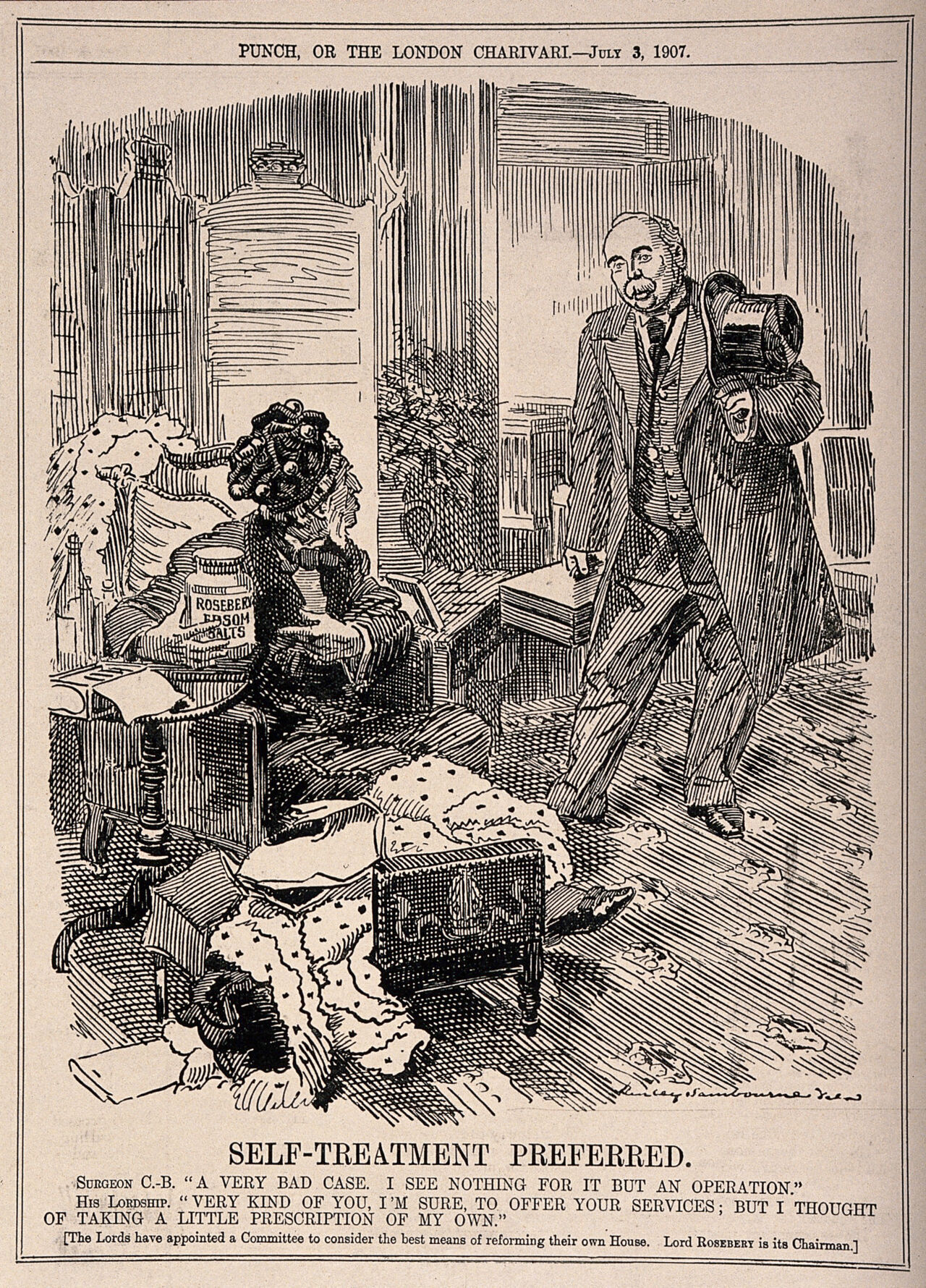
Examples from his series of caricatures in Punch 1881–82, "Punch Fancy Portraits": • Illustration — William Howard Russell • Illustration — Charles Bradlaugh • Illustration — W. S. Gilbert • Illustration — The Rhodes Colossus More of Sambourne's caricatures from this series can be seen in the articles for William Harrison Ainsworth, Emma Albani, Matthew Arnold, Lord Charles Beresford, William Black, George Granville Bradley, Robert Browning, Hugh Childers, Lord Randolph Churchill, Henry Drummond Wolff, Henry Fawcett, James Anthony Froude, George Joachim Goschen, John Holker, Henry Labouchère, Henry Parry Liddon, John Lubbock, 1st Baron Avebury, Henry Edward Manning, Oscar Wilde, Ouida, James Payn, George Augustus Henry Sala, Eyre Massey Shaw, Arthur Sullivan, William James Erasmus Wilson, and Garnet Wolseley, 1st Viscount Wolseley. See also: Phylloxera, Cecil Rhodes.
Descendants
Descendants
Edward Linley Sambourne married Mary Ann (Marion) Herapath (1851–1914) in 1874. She was the eldest daughter of the nine children of Spencer Herapath, a successful stockbroker, and his wife Mary Ann Walker. The couple had two children: Maud (born 1875) and Mawdley, also known as Roy (born 1878). Mawdley (Roy) Herapath Sambourne (1878–1946) did not marry. In 1898 his sister Maud Frances Sambourne (1875–1960) married Leonard Messel, a young stockbroker and collector. They had three children: Linley (born 1899), Anne born 1902 (first married to Major Ronald Armstrong-Jones, later to Michael Parsons, 6th Earl of Rosse), and Oliver Messel (an acclaimed set designer and architect) born 1904. Further descendants of Edward Linley Sambourne include: his great-grandson Antony Armstrong-Jones, 1st Earl of Snowdon (the photographer and documentary filmmaker), and great-great-grandson David Armstrong-Jones, 2nd Earl of Snowdon (the furniture designer and chairman of Christie's auction house). Susan ZalkindDue to the number of photographs taken of himself posing as a model for drawings, Boston-based journalist Susan Clare Zalkind has suggested that her great-great-great-grandfather, Sambourne, is the "grandfather of the selfie."
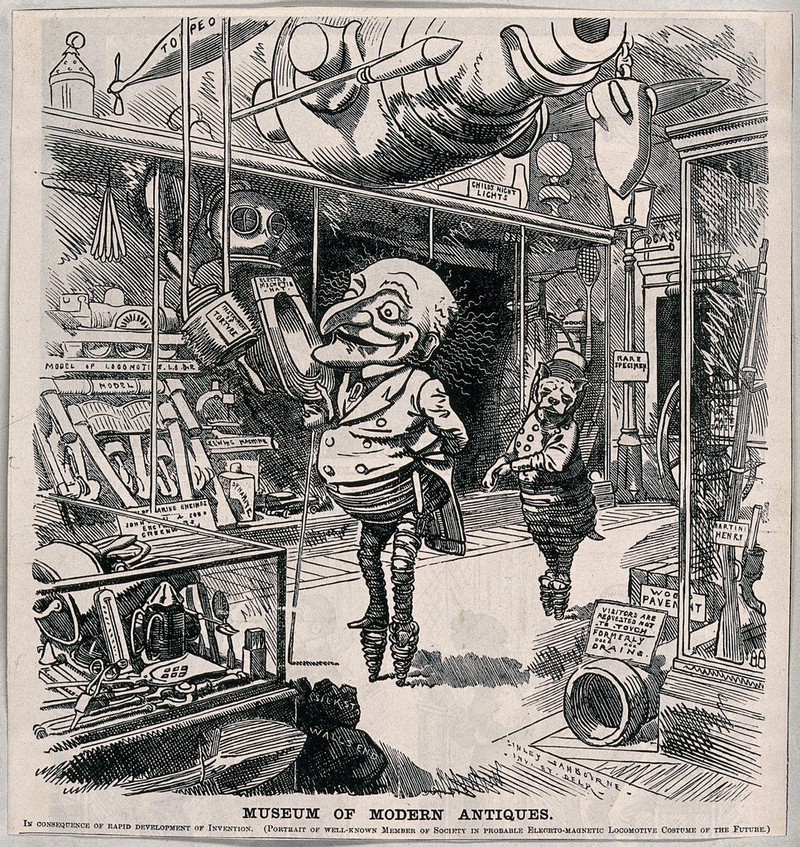
Two figures, Mr Punch and his cat, with springs on their feet, standing in a museum of modern inventions. Wood engraving after L. Sambourne, 1878., 1878, by Edward Linley Sambourne
Edward Linley Sambourne · Wellcome Collection, London · Wellcome Collection
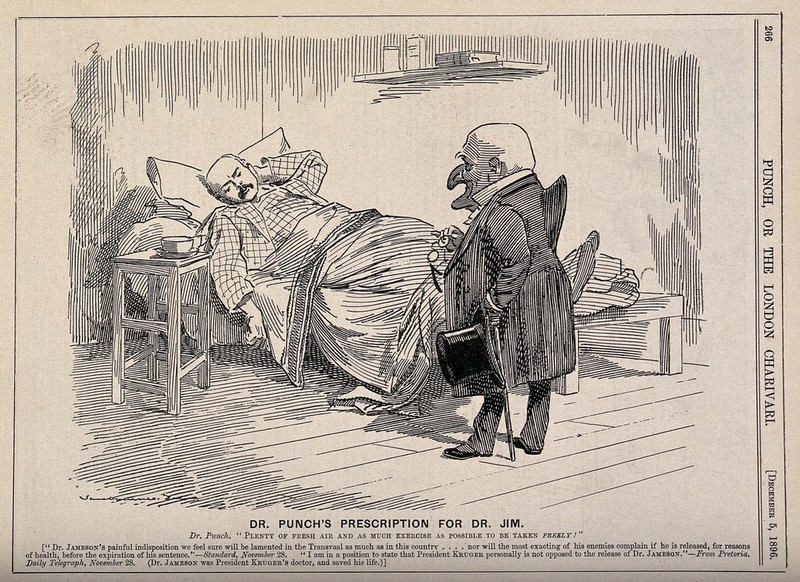
Sir Leander Jameson ill in bed being visited by Dr. Punch; representing Jameson's involvement with the disastrous Transvaal campaign which heralded the Boer War. Wood engraving after Sir E.L. Sambourne, 1896., 1896, by Edward Linley Sambourne
Edward Linley Sambourne · Wellcome Collection, London · Wellcome Collection
Book illustrations
Book illustrations
• Military Men I have met..., Edward Dyne Fenton, 1872 • Our Autumn Holiday on French Rivers..., James Lynam Molly, 1874 • Our Holiday in the Scottish Highlands, Arthur à Beckett, 1876 • The Royal Umbrella. [A tale.]..., Alfred Frederick Pollock Harcourt, 1879 • The Modern Arabian Nights, Arthur a' Beckett, 1877 • Poems of Edgar Allan Poe, 1881 • The Water Babies, Charles Kingsley, 1885 • Sherryana, F. W. Cosens, 1886 • Friends and Foes from Fairy Land, Edward Knatchbull-Hugessen, 1886 • The Green Above The Red: More Blarney Ballads, Charles L. Graves, 1889 • The Real Adventures of Robinson Crusoe, F. C. Burnand, 1893
Illustrations
Illustrations
• Black and White, 1891 • The British Workman • The Illustrated London News • The Piccadilly Magazine • The Pictorial World
Primary material
Documents and archives
scholarly publication
- Edward Linley Sambourne (1844–1910), History of Photography, 1993
Scholarly · Crossref registry · 1993
- Linley Sambourne, Illustrator and ‘Punch Cartoonist, Modern Language Review, 2011
Scholarly · Crossref registry · 2011
authority record
- Wikidata, structured authority record Q504621: Edward Linley Sambourne
General reference · Wikidata
reference work
- “Edward Linley Sambourne”, English Wikipedia, consulted as further reading
Reputable secondary · Wikipedia
Notes from the source article
Cited by Wikipedia
Notes from the source article
These works are cited by the source article, in its own numbering. They are recorded as its citations, not as sources VALÉORINE has verified.
- 1.Sambourne, Edward Linley. 24. 113–114.
- 2.Meet Lady Margarita's family: a who's who of the Tatler cover star's clan – from Princess Margaret to Lady Sarah Chatto. Tatler. 23 March 2023.
- 3.Zalkind, Susan. Grandfather of the Selfie. The Baffler. 29. 2015.
Bibliography printed in the source article · 6
- McMaster, Juliet. That Mighty Art of Black-And-White: Linley Sambourne, Punch, and the Royal Academy. Ad Hoc Press. 2009.
- Nicholson, Shirley. A Victorian Household: Based on the Diaries of Marion Sambourne. Barwis Press. 2010. 978-0-902242-78-4.
- Nicholson, Shirley. An Edwardian Bachelor: Roy Sambourne. The Victorian Society. 1999. 0-901657-30-1.
- Nicholson, Shirley. Nymans: The Story of a Sussex Garden. Alan Sutton in association with the National Trust. 1992. 978-0750902045.
- Ormond, Leonee. Linley Sambourne: Illustrator and Punch Cartoonist. Paul Holberton Pub. 2010. 978-1-907372-03-2.
- Scully, Richard. Eminent Victorian Cartoonists, Volume III: Heirs and Successors. Political Cartoon Society. 2018. 978-1-9996468-2-0.
References
Citations
References
Each reference names the institution holding it, so a reader may go to the document itself.
scholarly publication
Edward Linley Sambourne (1844–1910), History of Photography, 1993Crossref registry
Institutional witnessscholarly publication
Institutional witnessauthority record
Secondary witnessreference work
Secondary witness
The Encyclopedia exists whether or not anything is for sale. Corrections are recorded rather than overwritten, and every version of this record is kept. Published 16 August 2026.
Elsewhere in Comics and comic art
9,920 published records in this field, each with its sources named.
- Eduardo WaghornArtist
- Edward Ambrose DysonArtist
- Edward BarkerArtist
- Edward JumpArtist
- Edward Samuel GoodnowArtist
- Edward SorelArtist
- Edward Tennyson ReedArtist
- Edward WilsonArtist
Best supported in this field
For owners
Own a work by Edward Linley Sambourne?
A specialist will read what you send and tell you what the house can establish, what it cannot, and whether the object is suited to sale. There is no charge and no obligation. The object stays with you throughout; nothing is shipped to us unless it is arranged in writing beforehand.