
Edward Daniel Clarke
Edward Daniel Clarke (5 June 17699 March 1822) was an English clergyman, naturalist, mineralogist, and traveller.
Also recorded as E.D.Clarke
Edward Daniel Clarke
Edward Daniel Clarke · Wellcome Collection, London · Wellcome Collection · Public Domain Mark
- Name
- Edward Daniel Clarke
- Born
- 5 June 1769
- Birthplace
- Willingdon, Sussex, England, Great Britain
- Place of death
- London, England, United Kingdom
- Field
- Natural history, mineralogy
- Died
- 1822 · London.
- Nationality
- United Kingdom of Great Britain and Ireland · United Kingdom
- Occupation
- botanist · librarian · university teacher · archaeologist · explorer · writer · mineralogist · chemist
- Fields
- botany
- Education
- Jesus College
- Teachers
- William Frend
- Languages
- English
VALÉORINE Encyclopedia
VALÉORINE documentary reading
Documentary summary
Edward Daniel Clarke (5 June 17699 March 1822) was an English clergyman, naturalist, mineralogist, and traveller.
Admitted source layer · organised and presented by VALÉORINE
Note VALÉORINE
Edward Daniel Clarke (1769–1822) was a British and British archaeologist, botanist and chemist, among other activities. Born in Sussex, the archaeologist died in London.
Edward Daniel Clarke studied at Jesus College. The archaeologist worked for University of Cambridge and was a member of Royal Prussian Academy of Sciences. Edward Daniel Clarke held the position of professor and worked in Helsinki, Tornio and Turku. The archaeologist lived in England. Edward Daniel Clarke was active in botany. Languages used include English.
Composed from admitted, traceable facts · 01 October 2026
VALÉORINE
Reference Check
Propose documentary evidence for Edward Daniel Clarke. A contribution is never written directly as fact: identity, source, rights and evidence gates still decide.
Sign in to contribute
World of VALÉORINE
Documentary connections
Only confirmed graph relationships appear here. Images are shown only when their identity and reuse rights both pass the documentary gate.

Documentary evidence
Documentary basis
Authority files
wikidata · Q962778 · wikipedia · Edward Daniel Clarke
In this article
Biography
Biography
Edward Daniel Clarke studied at Jesus College. Training under William Frend is recorded. The recorded working language is English. The field of work recorded is botany. Places of work recorded in the authority are Tornio, Turku and Helsinki. Residence is recorded at England. Employment is recorded with University of Cambridge. Positions recorded include professor.
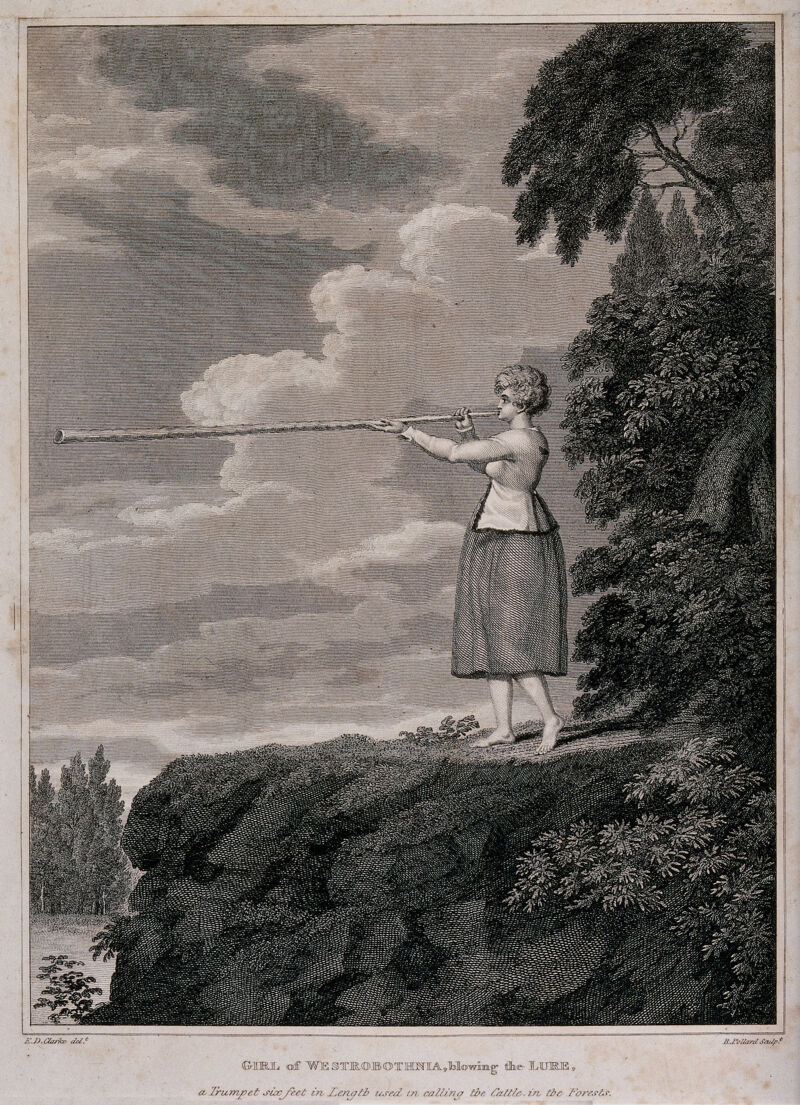
A Swedish woman standing on the edge of a cliff, blowing on a long pipe. Engraving by R. Pollard after E.D. Clarke., Jany 1. 1819, by Edward Daniel Clarke
Edward Daniel Clarke · Wellcome Collection, London · Wellcome Collection
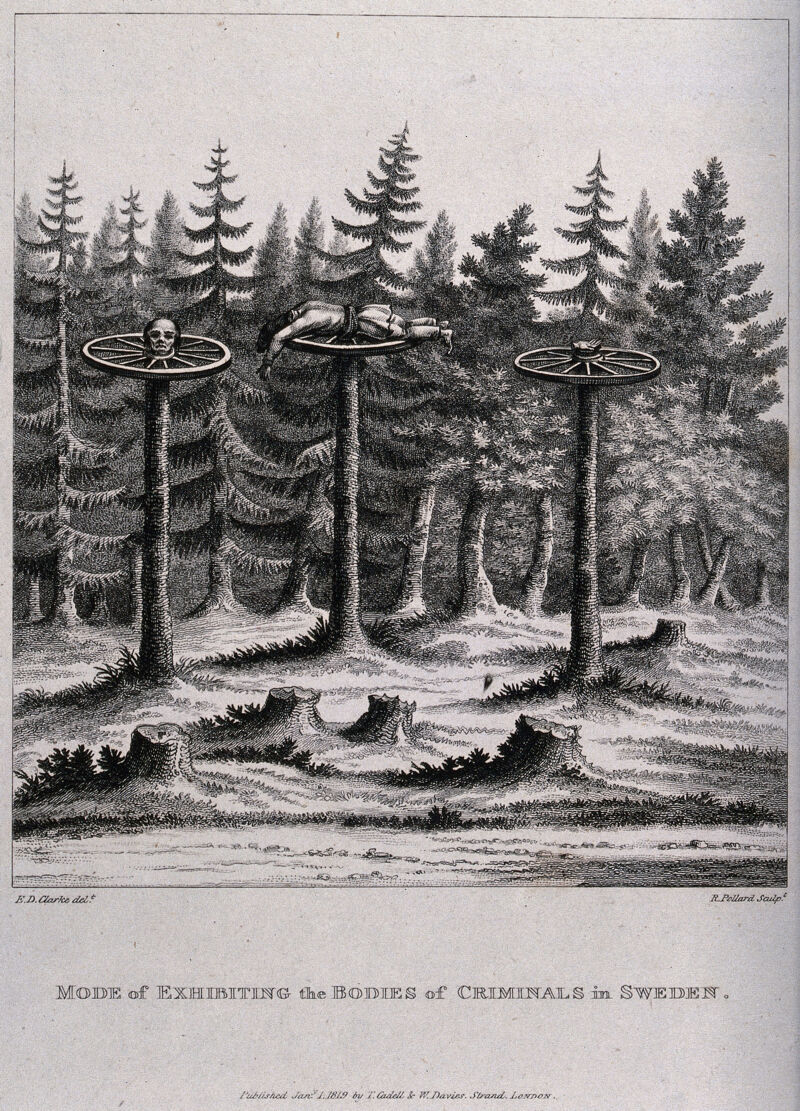
A head, a hand and a torso of a criminal, each deposited on a cartwheel on top of a stripped tree-trunk. Engraving by R. Pollard after E.D. Clarke, 1819., 1 January 1819, by Edward Daniel Clarke
Edward Daniel Clarke · Wellcome Collection, London · Wellcome Collection
Key facts
Key facts
• Name — Edward Daniel Clarke • Born — 5 June 1769 • Birthplace — Willingdon, Sussex, England, Great Britain • Place of death — London, England, United Kingdom • Field — Natural history, mineralogy
Life
Life
Edward Daniel Clarke was born at Willingdon, Sussex, and educated first at Uckfield School and then at Tonbridge. In 1786 he obtained the office of chapel clerk at Jesus College, Cambridge, but the loss of his father at this time involved him in difficulties. In 1790 he took his degree, and soon after became private tutor to Henry Tufton, nephew of the Duke of Dorset. In 1792 he obtained an engagement to travel with Lord Berwick through Germany, Switzerland and Italy. After crossing the Alps, and visiting a few of the principal cities of Italy, including Rome, he went to Naples, where he remained nearly two years. While in Naples, Clarke climbed Vesuvius on numerous occasions, to take guests to the summit and observe the state of activity of the volcano. He also constructed a model of Vesuvius, which Sir William Hamilton declared to be the 'best ever produced'. This model was later transported to Lord Berwick's seat at Attingham Park. Having returned to England in the summer of 1794, he became a tutor to several distinguished families. In 1799 he set out with John Marten Cripps on a tour through the continent of Europe, beginning with Norway and Sweden, whence they proceeded through the Russian Empire—including Ukraine and Crimea—to Constantinople, Rhodes, and afterwards to Egypt and Palestine. After the capitulation of Alexandria, Clarke helped to secure for England a number of statues, sarcophagi, maps, manuscripts and other antiquities which had been collected by French savants in the city. Greece was the next country they visited. From Athens, the travellers proceeded by land to Constantinople, and after a short stay in that city directed their course homewards through Rumelia, Austria, Germany and France. Clarke, who had now obtained considerable reputation, took up his residence at Cambridge. He received the degree of LL.D. shortly after his return in 1803, on account of the valuable donations, including a colossal statue of the Eleusinian Ceres, which he had made to the university. He was also presented to the college living of Harlton, near Cambridge, in 1805. Four years later, his father-in-law added that of Yeldham, Essex. Towards the end of 1808 Clarke was appointed to the newly created Professorship of mineralogy in Cambridge. His perseverance as a traveller and collector was also rewarded financially: the manuscripts which he had collected in the course of his travels, among them the celebrated Clarke Codex of Plato's dialogues (895 CE), were sold to the Bodleian Library for £1000; and by the publication of his travels he realized altogether a clear profit of £6595. Besides lecturing on mineralogy and discharging his clerical duties, made several discoveries in chemistry, principally by means of the gas blow-pipe, which he had brought to a high degree of perfection. He was also appointed university librarian in 1817, and was one of the founders of the Cambridge Philosophical Society in 1819. He died in London on 9 March 1822.
Greek artefacts
Greek artefacts
In 1801, Clarke and his assistant John Marten Cripps, obtained an authorisation from the governor of Athens for the removal of a statue of the goddess Demeter at Eleusis, with the intervention of Italian artist Giovanni Battista Lusieri who was Elgin's assistant at the time. The statue had been discovered in 1676 by the traveller George Wheler, and several ambassadors had submitted unsuccessful applications for its removal. Clarke was the one to remove the statue by force, after bribing the waiwode of Athens and obtaining an edict, despite the objections of the local population who unofficially, and against the traditions of the iconoclastic Church, worshipped the statue as the uncanonised Saint Demetra (Greek: Αγία Δήμητρα). The people would adorn the statue with garlands, and believed that the goddess was able to bring fertility to their fields and that the removal of the statue would cause that benefit to disappear. Clarke also removed other marbles from Greece including a statue of Pan, a figure of Eros, a comic mask and various reliefs and funerary steles. Clarke donated these to the University of Cambridge and in 1803 the statue of Demeter was displayed at the university library. The collection was later moved to the Fitzwilliam Museum in Cambridge where it formed one of the two main collections of the institution.
Selected works
Selected works
• Testimony of Authors respecting the Colossal Statue of Ceres in the Public Library, Cambridge (8vo, 1801–1803) • The Tomb of Alexander, a Dissertation on the Sarcophagus brought from Alexandria, and now in the British Museum (4to, 1805) • A Methodical Distribution of the Mineral Kingdom (fol., Lewes, 1807) • A Description of the Greek Marbles brought from the Shores of the Euxine, Archipelago and Mediterranean, and deposited in the University Library, Cambridge (8vo, 1809) • The gas blow-pipe, or art of fusion, by burning the gaseous constituents of water (1819) • Travels in various Countries of Europe, Asia and Africa (4to, 1810–1819; 2nd ed., 1811–1823; 4th ed., 1817–1824) • 1816. Part I Vol. I (15 chapters + 2 appendices). Part the first. Russia Tahtary and Turkey. Fourth edition. Volume the first. London, MDCCCXVI. xi +? + 533 pages. 1839. Part I (26 chapters + appendices). Travels in Russia, Tartary and Turkey by Edward Daniel Clarke. 140 pages / PIBN 10027007. ISBN 978-1-330-32300-7 (pdf), ISBN 978-0-266-70888-9 (Hardcover) Forgotten Books 1848. Part I (26 chapters). Travels in Russia, Tartary and Turkey. 383 pages. • Part II. Greece, Egypt and Palestyne • Part III.Travels in Various Countries of Scandinavia Including Denmark, Sweden, Norway, Lapland and Finland (Travels in various Countries of Europe, Asia and Africa. Part The Third, Scandinavia, Section The Second) MDCCCXXIII (1823) / 611 pages. PIBN 10531518, ISBN 978-1-333-65393-4, ISBN 978-0-265-57029-6 (Hardcover) Forgotten Books
Family
Family
In 1806, Clarke married Angelica, fifth daughter of Sir William Beaumaris Rush. She was the younger sister of Charlotte Rush, whom John Marten Cripps had married on 1 January 1806.
Identity
Identity
Edward Daniel Clarke is recorded with the occupation university teacher. What Edward Daniel Clarke did, and where. Clarke worked at Helsinki. Clarke worked at Tornio. Clarke worked at Turku. Recorded as having studied at Jesus College. Career and activity. Clarke worked in botany. He was employed by University of Cambridge. Recorded position is professor. He belonged to Royal Prussian Academy of Sciences. He worked at Tornio, Turku, Helsinki and England.
Life and career
Dated record
Life and career
The full dated record · 2 entries
1769
Edward Daniel Clarke was born on 1 January 1769.
1822
Edward Daniel Clarke died on 1 January 1822.
Places
Named by the record
Places
Only places the record itself states, plotted where the house gazetteer settles their coordinates. Nothing is inferred from a name or a nationality.
- England
Named but not plotted · 2
Sussex.
Birth place
London.
Death place
Primary material
Documents and archives
reference work
- “Edward Daniel Clarke”, English Wikipedia, consulted as further reading
Reputable secondary · Wikipedia
authority record
- Wikidata, structured authority record Q962778: Edward Daniel Clarke
General reference · Wikidata
Notes from the source article
Cited by Wikipedia
Notes from the source article
These works are cited by the source article, in its own numbering. They are recorded as its citations, not as sources VALÉORINE has verified.
- 1."Anthony Saunders, D.D." in Mark Antony Lower, The Worthies of Sussex (1865), p. 63: "In fact, Uckfield school enjoyed considerable celebrity. During the mastership of the Rev. Robert Gerison, Dr. James Stanier Clarke, and his brother Edward Daniel Clarke, the well-known traveller, received their rudimentary education there..."
- 2.Clarke, Edward Daniel.
- 3.Roller, Duane W. Edward Daniel Clarke: The First Professor of Mineralogy at Cambridge. Earth Sciences History. 7. 2. 146–150. 1988. 10.17704/eshi.7.2.m0wtnn4115u72465.
- 4.Edward-Daniel Clarke, Travels in Various Countries of Europe, Asia and Africa (London: Cadell and Davies, 1814), third edition, second part, second section, pp. 345–36, 349, 361–62.
- 5.Brian Fagan. From Stonehenge to Samarkand: An Anthology of Archaeological Travel Writing. Oxford University Press. 54. 2006. 978-0-19-516091-8.
- 6.Wroth, Warwick William. 10. 422. 1887.
- 7.Nigel Spivey. Greek Sculpture. Cambridge University Press. 92. 2013. 978-1-107-06704-2.
- 8.John Cuthbert Lawson. Modern Greek Folklore and Ancient Greek Religion: A Study in Survivals. Cambridge University Press. 79–80. 2012. 978-1-107-67703-6.
- 9.Patrick Leigh Fermor. Mani: Travels in the Southern Peloponnese. Penguin Books. 180. 1984. 978-0-14-011511-6.
- 10.The Fitzwilliam Museum. Edward Daniel Clarke (1769–1822).
- 11.Adolf Theodor F. Michaelis. Ancient marbles in Great Britain, tr. by C.A.M. Fennell. 244. 1882.
- 12.Tahtary on pages n10, n28, n49 and 394, 399–418 Chap. XIV, 448; Kuban Tahtary on pages 425, 441, but Kuban Tartary on Map of Reymann on page n36, Nagay Tartars on p. 439, Tartaria on p. 447. Jonas Hanway: Kieva, Khieva and Khiva, page vii (n34).
- 13.McConnell, Anita. Clarke, Edward Daniel.
- 14.Gordon Goodwin, "Cripps, John Marten", Dictionary of National Biography, Volume 13, at WikiSource
References
Citations
References
Each reference names the institution holding it, so a reader may go to the document itself.
reference work
Secondary witnessauthority record
General reference
The Encyclopedia exists whether or not anything is for sale. Corrections are recorded rather than overwritten, and every version of this record is kept. Published 17 August 2026.
Elsewhere in Books
38,988 published records in this field, each with its sources named.
- Edward ColettiAuthor
- Edward Coote PinkneyAuthor
- Edward D. HochAuthor
- Edward DahlbergAuthor
- Edward DavisonAuthor
- Edward de Vere, 17th Earl of OxfordAuthor
- Edward DębickiAuthor
- Edward Denison RossAuthor
Best supported in this field
For owners
Own a work by Edward Daniel Clarke?
A specialist will read what you send and tell you what the house can establish, what it cannot, and whether the object is suited to sale. There is no charge and no obligation. The object stays with you throughout; nothing is shipped to us unless it is arranged in writing beforehand.