
Edgar G. Ulmer
Edgar Georg Ulmer (17 September 1904 – 30 September 1972) was an Austrian film director who worked mainly in Hollywood B movies and other low-budget productions, eventually earning the epithet 'The King of PRC', due to his extremely prolific output for the Poverty Row studios. His stylish and eccentric works came to be appreciated by auteur theory-espousing film critics in the years following his retirement. Ulmer's most famous productions include the horror film The Black Cat (1934) and the film noir Detour (1945).
Also recorded as Edgar George Ulmer · Edgar Georg Ulmer
Edgar G. Ulmer
Michal Maňas · CC BY 2.5
- Name
- Edgar G.
- Born
- 17 September 1904
- Birthplace
- Olomouc, Moravia, Austria-Hungary
- Died
- 30 September 1972
- Place of death
- Woodland Hills, California, U.S.
- Occupation
- Film director, screenwriter, set designer
- Spouse
- Shirley Ulmer (married 1935 -)
- Nationality
- United States · Austria
- Fields
- film direction · acting · visual arts · film production
- Languages
- English
VALÉORINE Encyclopedia
VALÉORINE documentary reading
Documentary summary
Edgar Georg Ulmer (17 September 1904 – 30 September 1972) was an Austrian film director who worked mainly in Hollywood B movies and other low-budget productions, eventually earning the epithet 'The King of PRC', due to his extremely prolific output for the Poverty Row studios. His stylish and eccentric works came to be appreciated by auteur theory-espousing film critics in the years following his retirement. Ulmer's most famous productions include the horror film The Black Cat (1934) and the film noir Detour (1945).
Admitted source layer · organised and presented by VALÉORINE
Note VALÉORINE
Edgar G. Ulmer (1904–1972) was an Austrian and American actor, artist and cinematographer, among other activities. Born in Olomouc, the actor died in Woodland Hills. Edgar G. Ulmer was also known as John Warner.
Edgar G. Ulmer worked in United States. The actor was active in acting, film direction and film production. Languages used include English.
Composed from admitted, traceable facts · 01 October 2026
VALÉORINE
Reference Check
Propose documentary evidence for Edgar G. Ulmer. A contribution is never written directly as fact: identity, source, rights and evidence gates still decide.
Sign in to contribute
World of VALÉORINE
Documentary connections
Only confirmed graph relationships appear here. Images are shown only when their identity and reuse rights both pass the documentary gate.
Documentary evidence
Documentary basis
Authority files
wikidata · Q1283902 · wikipedia · Edgar G. Ulmer
In this article
Key facts
Key facts
• Name — Edgar G. Ulmer • Born — 17 September 1904 • Birthplace — Olomouc, Moravia, Austria-Hungary • Died — 30 September 1972 • Place of death — Woodland Hills, California, U.S. • Occupation — Film director, screenwriter, set designer • Notable Works — * The Black Cat (1934) • Detour (1945) • Spouse — Shirley Ulmer (married 1935 -) • Children — Arianne Ulmer • Illustration — Play full film; runtime 01:07:59.
Biography
Biography
Ulmer was born in Olomouc, Moravia, Austria-Hungary (now the Czech Republic). His family were Moravian Jews. As a young man he lived in Vienna, where he worked as a stage actor and set designer while studying architecture and philosophy. He did set design for Max Reinhardt's theater, served his apprenticeship with F. W. Murnau, and worked with directors including Robert Siodmak, Billy Wilder, Fred Zinnemann and cinematographer Eugen Schüfftan, inventor of the Schüfftan process. He also claimed to have worked on Der Golem (1920), Metropolis (1927), and M (1931), but there is no evidence to support this. Ulmer came to Hollywood with Murnau in 1926 to assist with the art direction on Sunrise: A Song of Two Humans (1927). In an interview with Peter Bogdanovich, he also recalled making two-reel westerns in Hollywood around this time.
Death
Death
Ulmer died in 1972 in Woodland Hills, California, after a crippling stroke. He is interred in the Hall of David Mausoleum in the Hollywood Forever Cemetery in Hollywood, CA. His wife, Shirley Ulmer, is interred nearby.
Partial filmography
Partial filmography
As set designer (disputed) • Der Golem, wie er in die Welt kam (1920) • Sodom und Gomorrha (1922) • Metropolis (1927) • M (1931) As co-director • People on Sunday (1930) As director
Personal quotes
Personal quotes
• "I really am looking for absolution for all the things I had to do for money's sake."
Identity and origins
Identity and origins
He also worked under the name John Warner. The authorities additionally record the headings Edgar George Ulmer and Edgar Georg Ulmer. His recorded language was English. He married Shirley Ulmer.

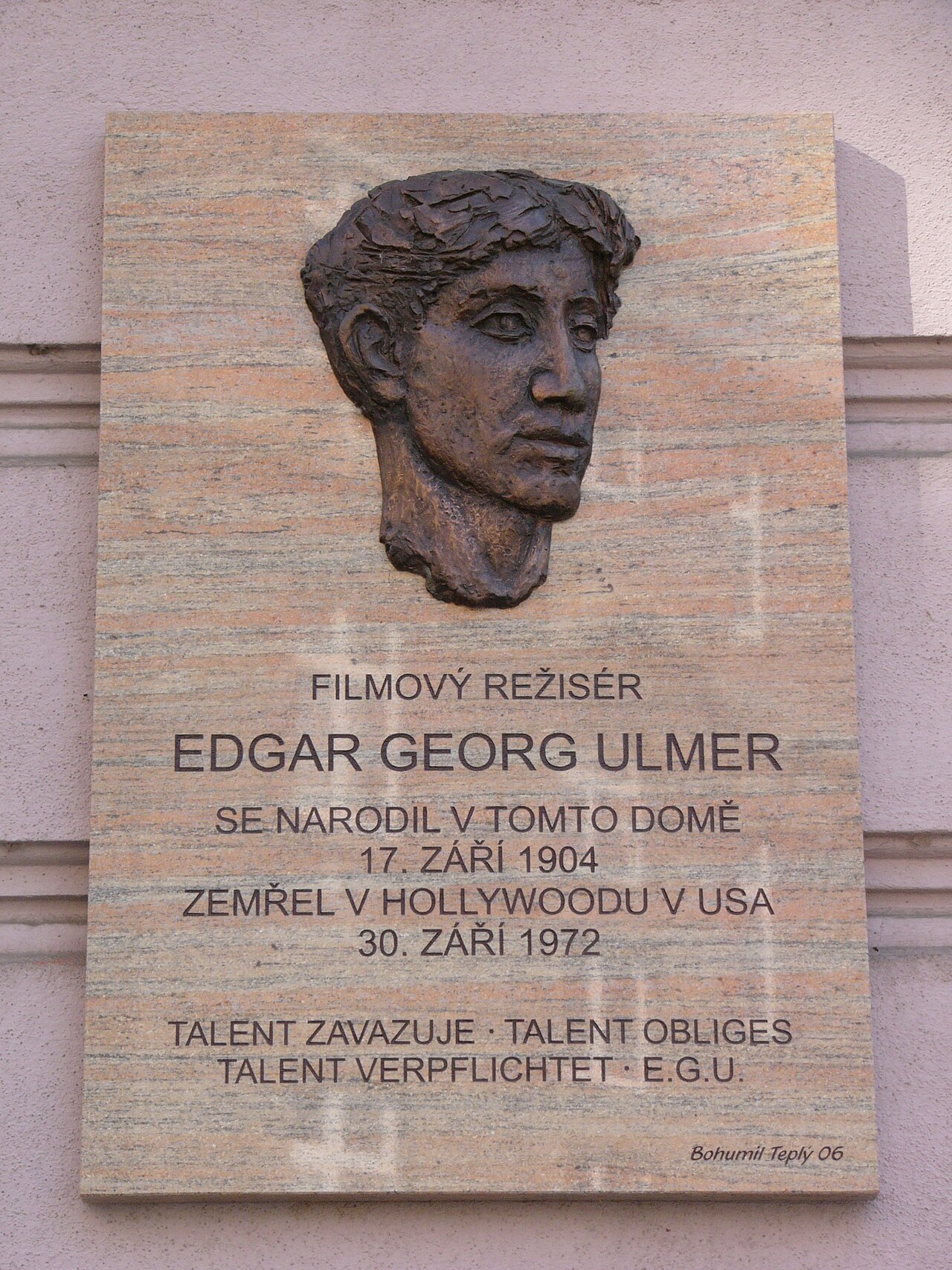
Detail of memorial plaque devoted to film director Edgar G. Ulmer in 1 Resslova street in Olomouc, the Czech Republic
Michal Maňas

Birthplace of film director Edgar G. Ulmer in 1 Resslova street in Olomouc, the Czech Republic
Michal Maňas
Life and career
Dated record
Life and career
The full dated record · 1 entries
1972
Edgar G. Ulmer died at Woodland Hills.
Places
Named by the record
Places
Only places the record itself states, plotted where the house gazetteer settles their coordinates. Nothing is inferred from a name or a nationality.
Olomouc.
Birth place
Woodland Hills.
Death place
Film director
The first feature he directed in North America, Damaged Lives (1933), was a low-budget exploitation film exposing the horrors of venereal disease. His next film, The Black Cat (1934), starring Béla Lugosi and Boris Karloff, was made for Universal Pictures. Demonstrating the striking visual style that would be Ulmer's hallmark, the film was Universal's biggest hit of the season. Ulmer, however, had begun an affair with Shirley Beatrice Kassler, who had been married since 1933 to independent producer Max Alexander, nephew of Universal studio head Carl Laemmle. Kassler's divorce in 1936 and her marriage to Ulmer later the same year led to his being exiled from the major Hollywood studios. Ulmer was relegated to making B movies at Poverty Row production houses. His wife, now Shirley Ulmer, acted as script supervisor on nearly all of these films, and she wrote the screenplays for several. Their daughter, Arianne, appeared as an extra in several of his films. • Illustration — Memorial plaque devoted to Ulmer in Olomouc Consigned to the fringes of the U.S. motion picture industry, for a time Ulmer specialized first in "ethnic films," in Ukrainian—Natalka Poltavka (1937), Cossacks in Exile (1939)—and Yiddish—The Light Ahead (1939), Americaner Shadchen (1940). The best-known of these ethnic films is the Yiddish Green Fields (1937), co-directed with Jacob Ben-Ami. Ulmer eventually found a niche making melodramas on tiny budgets and with often unpromising scripts and actors for Producers Releasing Corporation (PRC), with Ulmer describing himself as "the Frank Capra of PRC". His PRC thriller Detour (1945) has won considerable acclaim as a prime example of low-budget film noir, and it was selected by the Library of Congress among the first group of 100 American films worthy of special preservation efforts. In 1947, Ulmer made Carnegie Hall with the help of conductor Fritz Reiner, godfather of the Ulmers' daughter, Arianné. The film features performances by many leading figures in classical music, including Reiner, Jascha Heifetz, Artur Rubinstein, Gregor Piatigorsky and Lily Pons. Ulmer did get a chance to direct two films with substantial budgets, The Strange Woman (1946) and Ruthless (1948). The former, featuring a strong performance by Hedy Lamarr, is regarded by critics as one of Ulmer's best. He directed a low-budget science-fiction film with a noirish tone, The Man from Planet X (1951). His last film, The Cavern (1964), was shot in Italy.
Legacy
Commemorating the 30th anniversary of his death, a three-day symposium of lectures and screenings was held at New York City's New School in November 2002. In 2005, researcher Bernd Herzogenrath uncovered the address where Ulmer was born in Olomouc. A memorial plaque commemorating Ulmer's birth home was unveiled on 17 September 2006, on the occasion of Ulmerfest 2006—the first European academic conference devoted to Ulmer's work. The moving image collection of Edgar G. Ulmer is held at the Academy Film Archive. The film material at the Academy Film Archive is complemented by material in the Edgar G. Ulmer papers at the Academy's Margaret Herrick Library.
Primary material
Documents and archives
reference work
- Wikidata, structured authority record Q1283902: Edgar G. Ulmer
Reputable secondary · Wikidata
- “Edgar G. Ulmer”, English Wikipedia, consulted as further reading
Reputable secondary · Wikipedia
authority file
- VIAF cluster 76514013 for Edgar G. Ulmer, aggregating national library name authorities.
General reference · OCLC
Literature
Scholarly footprint
A count of publications is evidence of attention, not of standing, and is given here only as a measure.
Notes from the source article
Cited by Wikipedia
Notes from the source article
These works are cited by the source article, in its own numbering. They are recorded as its citations, not as sources VALÉORINE has verified.
- 1.Ebert, Roger. Great Movies: Detour. rogerebert.com. 7 June 1998.
- 2.Year of Jewish Culture – 100 Years of the Jewish Museum in Prague
- 3.Edgar G. Ulmer American director. Encyclopedia Britannica.
- 4.Bogdanovich, Peter (1997) (New York: Knopf)
- 5.Mank, Gregory William (1990). Karloff and Lugosi: The Story of a Haunting Collaboration (Jefferson, N.C.: McFarland), p. 81.
- 6.Cantor, Paul A. (2006). "Film Noir and the Frankfurt School: America as Wasteland in Edgar G. Ulmer's Detour," in The Philosophy of Film Noir, ed. Mark T. Conard (Lexington: University Press of Kentucky), p. 143. .
- 7.Turan, Kenneth (2004). Never Coming To A Theater Near You: A Celebration of a Certain Kind of Movie (New York: PublicAffairs), p. 364. .
- 8.p. 62 Robson, Eddie Edgar G. Ulmer Interview in Film Noir Virgin, 2005
- 9.p.241 Norman, Barry The Story of Hollywood New American Library, 1988
- 10.Cantor (2006), p. 150.
- 11.Edgar G. Ulmer Collection. Academy Film Archive.
- 12.Bogdanovich (1997), p. 603.
Bibliography printed in the source article · 5
- Bernd Herzogenrath: Edgar G. Ulmer. Essays on the King of the B's. Jefferson, NC 2009,
- Bernd Herzogenrath: The Films of Edgar G. Ulmer. The Scarecrow Press, Inc. (2009)
- Noah Isenberg: Detour. London: BFI Film Classics, 2008.
- Noah Isenberg: Edgar G. Ulmer: A Filmmaker at the Margins. Berkeley: University of California Press, 2014.
- Tony Tracy: "The Gateway to America": Assimilation and Art in Carnegie Hall (1947)" in Gary D. Rhodes, Edgar G. Ulmer: Detour on Poverty Row. Lexington Books, 2008.
References
Citations
References
Each reference names the institution holding it, so a reader may go to the document itself.
authority file
Secondary witnessreference work
Secondary witnessreference work
Secondary witness
The Encyclopedia exists whether or not anything is for sale. Corrections are recorded rather than overwritten, and every version of this record is kept. Published 15 August 2026.
Elsewhere in Film memorabilia
37,604 published records in this field, each with its sources named.
- Eden SherPerson
- Edgar BarrierPerson
- Edgar BuchananPerson
- Edgar ElbakyanPerson
- Edgar KennedyPerson
- Edgar LewisPerson
- Edgar MoraisPerson
- Edgar MorinPerson
Best supported in this field
For owners
Own a work by Edgar G. Ulmer?
A specialist will read what you send and tell you what the house can establish, what it cannot, and whether the object is suited to sale. There is no charge and no obligation. The object stays with you throughout; nothing is shipped to us unless it is arranged in writing beforehand.