
Eberhard Kieser
Eberhard Kieser (December 2, 1583 in Kastellaun – November 1631, in Frankfurt am Main) was a German engraver and publisher.
Eberhard Kieser

Eberhard Kieser · Public domain
- Born
- 1583. · Kastellaun.
- Died
- 1631. · Frankfurt.
- Nationality
- Germany.
- Occupation
- printmaker, editor, artist, copper engraver and publisher.
- Languages
- German and Latin.
VALÉORINE Encyclopedia
VALÉORINE documentary reading
Documentary summary
Eberhard Kieser (December 2, 1583 in Kastellaun – November 1631, in Frankfurt am Main) was a German engraver and publisher.
Admitted source layer · organised and presented by VALÉORINE
Reference Check
Propose documentary evidence for Eberhard Kieser. A contribution is never written directly as fact: identity, source, rights and evidence gates still decide.
Sign in to contribute
World of VALÉORINE
Documentary connections
Only confirmed graph relationships appear here. Images are shown only when their identity and reuse rights both pass the documentary gate.
Documentary evidence
Documentary basis
Authority files
wikidata · Q1279150 · wikipedia · Eberhard Kieser
In this article
Personal
Personal
The recorded working language is German and Latin. The field of work recorded is visual arts, book design and copper engraving technique. Places of work recorded in the authority are Frankfurt. Work by Eberhard Kieser is recorded in the collections of City Museum of Münster and Musea Brugge.
Kieser was the son of a pastor. He learned the goldsmith's trade. In the early summer of 1609, through his marriage with Anna Christina Hoffmann, a painter's daughter, he received citizen's rights in Frankfurt am Main, worked as a goldsmith in Sachsenhausen and began to draw and engrave. From 1612 he illustrated and published books and produced illustrative prints in his publishing workshop with several engravers as assistants.
Work
Work
His most important work is a Dance of Death after Holbein, consisting of 60 small-format etchings from 1617. Kieser is also known for the Thesaurus philopoliticus (German title: Politisches Schatzkästlein guter Herren und bestendiger Freund), a collection of copperplate engravings with city views, which Kieser and Daniel Meisner (1585–1625), originally from Bohemia, produced and successfully published. These engravings appeared in 16 books with 831 city images until 1631. Each picture has a motto in Latin and German, written by Meisner. It is not certain that Kieser produced printing plates for the thesaurus in addition to his publishing activities. From 1617/18 Sebastian Furck, and later Georg Keller, Matthäus Merian, and Johann Eckard Löffler worked for Kieser. In 1631 the printing plates were acquired by Nuremberg publisher Paul Fürst after Kieser's death. In 1638/42 Fürst published around 800 of the engravings in the work Sciographia Cosmica in 8 volumes; In 1678 and 1700 further editions followed from the widow and son-in-law of Fürst. • Illustration — Coronation procession of Matthias on June 13, 1612 in front of the Römer in Frankfurt In addition to the Thesaurus philopoliticus, the type of engravings and etchings suggest Georg Keller as an artist: • Krönungsdiarium Maximilians II., 1612 • Johann Jacob Wallhausen's Ritterkunst, Frankfurt 1616 • Johann Jacob Wallhausen's Romantische Kriegskunst, Frankfurt 1616 • Österreichischer Lorbeerkranz, 1625 • Illustration — Vinzenz Fettmilch, Conrad Gerngroß and Conrad Schopp, leaders of The Fettmilch Rising on an engraving from 1614 In addition, Kieser published a 78-sheet series of emperors, electors and nobles on horseback as well as portraits of Fettmilch, Schopp, Gerngros and Ebel (leaders of the Fettmilch uprising) in the style of Sebastian Furck.

STADEN in der Wetteraw aus Daniel Meisner/ Eberhard
Eberhard Kieser
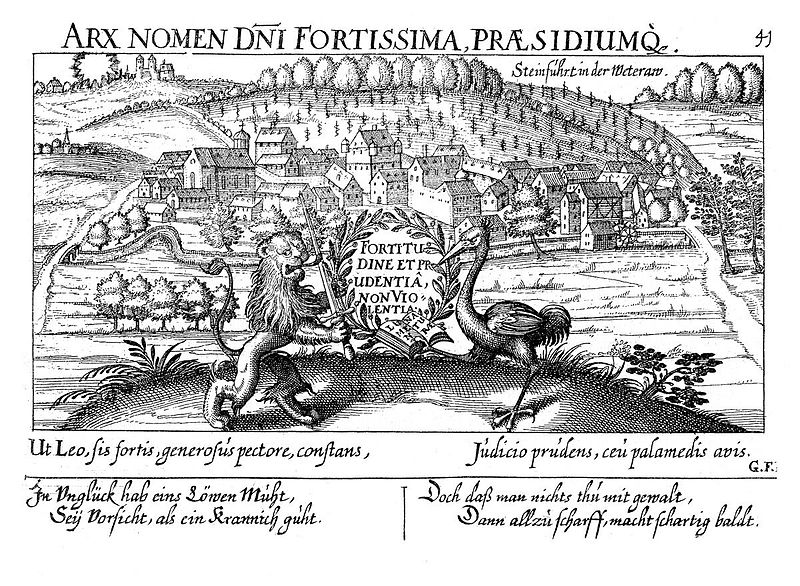
Daniel Meisner/ Eberhard Kieser, Thesaurus Philopoliticus oder Politisches Schatzkästlein Bd. 1, Faksimile-Neudruck der Ausgabe Frankfurt/ Main 1625-1626 u. 1627-1631, Nördlingen 1992, Buch 3, Nr. 40
Eberhard Kieser
Places
Named by the record
Places
Only places the record itself states, plotted where the house gazetteer settles their coordinates. Nothing is inferred from a name or a nationality.
Kastellaun.
Birth place
Frankfurt.
Death place
Notes from the source article
Cited by Wikipedia
Notes from the source article
These works are cited by the source article, in its own numbering. They are recorded as its citations, not as sources VALÉORINE has verified.
- 1.Prinz, Stephen. Juristische Embleme; Rechtsmotive in den Emblemata des 16. bis 18. Jahrhunderts. LIT Verlag. 85. 2009. 978-3-643-10133-4.
- 2.Gwinner, Friedrich. Kunst und Künstler in Frankfurt am Main: vom dreizehnten Jahrhundert bis zur Eröffnung des Städel'schen Kunstinstituts. Verlag Joseph Baer. 128. 1862. 1-148-40794-4.
References
Citations
References
Each reference names the institution holding it, so a reader may go to the document itself.
reference work
Secondary witnessreference work
Secondary witness
The Encyclopedia exists whether or not anything is for sale. Corrections are recorded rather than overwritten, and every version of this record is kept. Published 17 August 2026.
Elsewhere in Prints
4,138 published records in this field, each with its sources named.
- E.M.O'R. DickeyEngraver
- Earl StrohEngraver
- Ebba HolmEngraver
- Eberhard HavekostEngraver
- Ed BerealEngraver
- Ed MellEngraver
- Ed MosesEngraver
- Ed RuschaEngraver
Best supported in this field
For owners
Own a work by Eberhard Kieser?
A specialist will read what you send and tell you what the house can establish, what it cannot, and whether the object is suited to sale. There is no charge and no obligation. The object stays with you throughout; nothing is shipped to us unless it is arranged in writing beforehand.