
Duke University
Duke University is a private research university in Durham, North Carolina, United States. Founded by Methodists and Quakers in the present-day city of Trinity in 1838, the school moved to Durham in 1892. In 1924, tobacco and electric power industrialist James Buchanan Duke established the Duke Endowment and the institution changed its name to honor his deceased father, Washington Duke.
Duke University
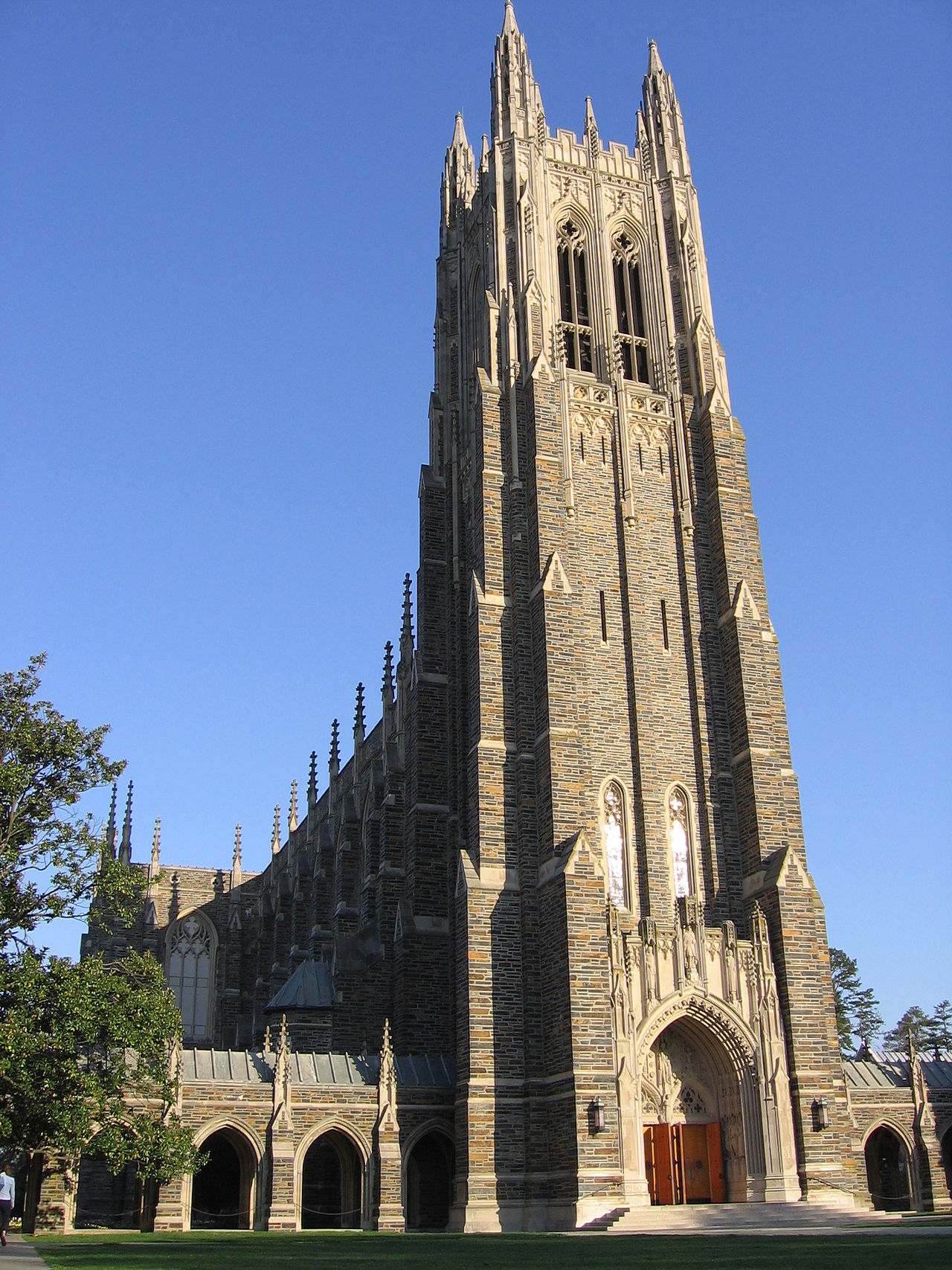
Wikimedia Commons · Public domain
- Founded
- 1838.
- Founder
- James Buchanan Duke.
- Headquarters
- Durham.
- Activity
- higher education.
VALÉORINE Encyclopedia
VALÉORINE documentary reading
Documentary summary
Duke University is a private research university in Durham, North Carolina, United States. Founded by Methodists and Quakers in the present-day city of Trinity in 1838, the school moved to Durham in 1892. In 1924, tobacco and electric power industrialist James Buchanan Duke established the Duke Endowment and the institution changed its name to honor his deceased father, Washington Duke.
Admitted source layer · organised and presented by VALÉORINE
Note VALÉORINE
No house-authored Note is published until its assertions and sources pass the VALÉORINE evidence contract. The documentary article remains available in full while that enrichment is being consolidated.
Documentary enrichment in progress · no unsupported statement published
Reference Check
Propose documentary evidence for Duke University. A contribution is never written directly as fact: identity, source, rights and evidence gates still decide.
Sign in to contribute
World of VALÉORINE
Documentary connections
Only confirmed graph relationships appear here. Images are shown only when their identity and reuse rights both pass the documentary gate.
Educated At · incoming
Aaron Lazar
Person
Educated At · incoming
Ade Hassan
Designer
Educated At · incoming
Amy Scurria
Person
Educated At · incoming
Anne Tyler
Author
Educated At · incoming
Arthur B. Rickerby
Photographer
Educated At · incoming
Arthur Talmage Abernethy
Author

Educated At · incoming
Bailey Chase
Person
Bailey Chase

Educated At · incoming
Ben Fountain
Author
Own work

Educated At · incoming
Bill Cunliffe
Person
19° International Jazz Festival of Punta del Este | 150111-1994-jikatu
Educated At · incoming
Carmel Berkson
Artist
Educated At · incoming
Christopher Adler
Person
Educated At · incoming
Constance Hunting
Author
Educated At · incoming
Craig S. Keener
Author

Educated At · incoming
Creed Taylor
Person
Personal email from the owner for use on wikipedia/media

Educated At · incoming
Dan Clancy
Person
Dan Clancy

Educated At · incoming
Eric Greitens
Author
https://www.flickr.com/photos/missouristatearchives/52976934923/in/album-72177720309071161/
Documentary evidence
Evidence Panel
not yet certified
- Identity
- resolved
- Independent source families
- 0
- Admitted assertions
- 0
- Open conflicts
- 0
Authority files
gnd · 42506-0 · wikidata · Q168751 · wikipedia · Duke University
In this article
Beginnings
Beginnings
The campus spans over 8,600 acres (3,500 hectares) on three contiguous sub-campuses in Durham, and a marine lab in Beaufort. The West Campus—designed largely by architect Julian Abele—incorporates Gothic architecture with the 210-foot (64-meter) Duke Chapel at the campus' center and highest point of elevation, is adjacent to the Medical Center. East Campus, 1.5 miles (2.4 kilometers) away, home to all first-years, contains Georgian-style architecture. The university also administers two concurrent schools in Asia, Duke–NUS Medical School in Singapore (established in 2005) and Duke Kunshan University in Kunshan, China (established in 2013). Duke forms one of the corners of the Research Triangle region together with North Carolina State University in Raleigh and the University of North Carolina at Chapel Hill. In 2024, Duke spent more than $1.5 billion on research. Its endowment is $11.9 billion, making it the twelfth-wealthiest private academic institution in the United States. Duke's athletic teams are known as the Blue Devils and compete in 27 NCAA Division I intercollegiate sports. Duke is a charter member of the Atlantic Coast Conference (ACC), and has won 17 NCAA team championships and 24 individual national championships.
It is associated with United States. The record gives 1838 as its date of establishment or first appearance. Its recorded founders are James Buchanan Duke. Its recorded seat is Durham. The recorded field of activity is higher education. It is recorded in the collection of Duke University campus.
Duke first opened in 1838 as Brown's Schoolhouse, a private subscription school founded in Randolph County, North Carolina, in the present-day town of Trinity. Organized by the Union Institute Society, a group of Methodists and Quakers, Brown's Schoolhouse became the Union Institute Academy in 1841 when North Carolina issued a charter. The academy was renamed Normal College in 1851, and then Trinity College in 1859 because of support from the Methodist Church. In 1892, Trinity College moved to Durham, largely due to the generosity of Julian S. Carr and Washington Duke, powerful and respected Methodists who had grown wealthy through the tobacco and electrical industries. Carr, already a "long-time trustee and the largest benefactor of the college" having donated $10,000 ($358,300 adjusted for inflation) in 1887, donated a 62-acre tract of land known as Blackwell Park valued at $50,000 ($1,792,000 adjusted for inflation) for the original Durham campus, which is now known as East Campus. At the same time, Washington Duke gave the school $85,000 ($3,046,000 adjusted for inflation), $50,000 of which "for the erection of the main central Building" and " the remainder to be applied to the Endowment Fund"—later augmenting his generosity with three separate $100,000 contributions in 1896, 1899, and 1900—with the stipulation that the college "open its doors to women, placing them on an equal footing with men." As noted by Duke's Department of History in 2018: "Duke and Carr chose to... support an educational institution in a state where education had not been a priority. Both men also supported women’s rights." Duke would accelerate its mission to become a global university in 1910 with the promotion of William Preston Few as the new president of Trinity College, who sought to establish the university as a southern counterpart to Yale and Harvard. In 1924, Washington Duke's son, James B. Duke, established The Duke Endowment with a $40 million trust fund. Income from the fund was to be distributed to hospitals, orphanages, the Methodist Church, and four colleges (including Trinity College). Few, who remained president of Trinity, insisted that the institution be renamed Duke University to honor the family's generosity and to distinguish it from the myriad other colleges and universities carrying the "Trinity" name. At first, James B. Duke thought the name change would come off as self-serving, but eventually, he accepted Few's proposal as a memorial to his father. Money from the endowment allowed the university to grow quickly. Duke's original campus, East Campus, was rebuilt from 1925 to 1927 with Georgian-style buildings. By 1930, the majority of the Collegiate Gothic-style buildings on the campus one mile (1.6 km) west were completed, and construction on West Campus culminated with the completion of Duke Chapel in 1935. In 1878, Trinity (in Randolph County) awarded A.B. degrees to three sisters—Mary, Persis, and Theresa Giles—who had studied both with private tutors and in classes with men. With the relocation of the college in 1892, the board of trustees voted to again allow women to be formally admitted to classes as day students. At the time of Washington Duke's donation in 1896, which carried the requirement that women be placed "on an equal footing with men" at the college, four women were enrolled; three of the four were faculty members' children. In 1903 Washington Duke wrote to the board of trustees withdrawing the provision, noting that it had been the only limitation he had ever put on a donation to the college. A woman's residential dormitory was built in 1897 and named the Mary Duke Building, after Washington Duke's daughter. By 1904, 54 women were enrolled in the college. In 1930, the Woman's College was established as a coordinate to the men's undergraduate college, which had been established and named Trinity College in 1924. According to Duke University Human Rights Center, the school's "policy in the 1920s excluded Blacks from admissions and also restricted Blacks from using certain campus facilities such as the dining halls and dorm housing... In 1948, a group of divinity school students petitioned the divinity school to desegregate – the first concerted effort to push for the desegregation of Duke's admission policy."
Expansion and growth
Expansion and growth
Engineering, which had been taught at Duke since 1903, became a separate school in 1939. The university president's official residence, the J. Deryl Hart House, was completed in 1934. In athletics, Duke hosted and competed in the first Rose Bowl ever played outside California in Wallace Wade Stadium in 1942; the second such game was played in Arlington, Texas, in 2021, moved as a result of the COVID-19 pandemic. During World War II, Duke was one of 131 colleges and universities nationally that took part in the V-12 Navy College Training Program which offered students a path to a navy commission. In 1963 the Board of Trustees officially desegregated the undergraduate college. Duke enrolled its first Black graduate students in 1961. The school did not admit Black undergraduates until September 1963. The teaching staff remained all-white until 1966. Increased activism on campus during the 1960s prompted Martin Luther King Jr. to speak at the university in November 1964 on the progress of the Civil Rights Movement. Following Douglas Knight's resignation from the office of university president, Terry Sanford, the former governor of North Carolina, was elected president of the university in 1969, propelling The Fuqua School of Business' opening, the William R. Perkins library completion, and the founding of the Institute of Policy Sciences and Public Affairs (now the Sanford School of Public Policy). The separate Woman's College merged back with Trinity as the liberal arts college for both men and women in 1972. Beginning in the 1970s, Duke administrators began a long-term effort to strengthen Duke's reputation both nationally and internationally. Interdisciplinary work was emphasized, as was recruiting minority faculty and students. During this time it also became the birthplace of the first Physician Assistant degree program in the United States. Duke University Hospital was finished in 1980 and the student union building was fully constructed two years later. In 1986 the men's soccer team captured Duke's first National Collegiate Athletic Association (NCAA) championship, and the men's basketball team followed shortly thereafter with championships in 1991 and 1992, then again in 2001, 2010, and 2015. Duke Forward, a seven-year fundraising campaign, raised $3.85 billion by August 2017.
Recent history
Recent history
In 2014, Duke removed the name of Charles B. Aycock, a white supremacist governor of North Carolina, from an undergraduate dormitory. It is now known as the East Residence Hall. On August 19, 2017, following the violent clashes at the Unite the Right rally in Charlottesville, Virginia, the statue of Confederate Gen. Robert E. Lee was removed from the entrance to Duke University Chapel, after having been vandalized by protesters. In August 2020, the first undergraduates from Duke Kunshan University arrived for their study abroad on Duke's campus. Due to COVID-19, Chinese Duke undergraduate and graduate students unable to travel to the United States were reciprocally hosted at Duke Kunshan campus.
Rape hoax against lacrosse players
Rape hoax against lacrosse players
In 2006, three men's lacrosse team members were falsely accused of rape by convicted felon Crystal Mangum, which garnered significant media attention. On April 11, 2007, North Carolina Attorney General Roy Cooper dropped all charges and declared the three players innocent. Cooper stated that the charged players were victims of a "tragic rush to accuse." The District Attorney, Mike Nifong, was subsequently disbarred., while Duke administration and faculty were condemned for their actions against the falsely accused. In December 2024, Mangum admitted, during a December 11, 2024 podcast interview, that she "made up a story that wasn't true" about the white lacrosse players who attended a party where she was hired to be a stripper.
Research misconduct
Research misconduct
On November 9, 2015, the Office of Research Integrity (ORI) found that former Duke University associate professor and cancer researcher, Anil Potti along with Joseph Nevins, had engaged in research misconduct including falsifying data and fraud., which 60 Minutes described the case as "one of the biggest medical research frauds ever". Potti engaged in scientific misconduct while a cancer researcher at both Duke University's Medical Center and School of Medicine. He resigned in November 2010 after Duke put him on administrative leave, terminated the clinical trials based on his research and retracted his published data. Despite Duke University becoming aware of the suspicions of research misconduct by 2008, when a medical student working with Potti and Nevins withdrew his name from the research and submitted a memorandum entitled "Research Concerns" to the administration, the administration denied any misconduct and convinced the student not to report his experiences to the funding agency, Howard Hughes Medical Institute. Duke later falsely claimed that there had not been a whistleblower involved in the issue. Duke settled lawsuits by eight patients harmed by Potti, which was speculated "to be substantial, given the depth of the research misconduct and damaging evidence discovered in the lawsuit, including a whistleblower who alerted Duke to the misconduct in 2008 but went ignored." In 2019, Duke paid $112.5 million to settle False Claims Act allegations related to scientific research misconduct. A researcher at the school was falsifying or fabricating research data in order to win grants for financial gain. The researcher was arrested in 2013 on charges of embezzling funds from the university. The scheme was exposed by the allegations made through a lawsuit, filed by a whistleblower, who had worked as a Duke employee, and discovered the false data. In response to the misconduct settlement, Duke established an advisory panel of academics from Caltech, Stanford and Rockefeller University. Based on the recommendations of this panel, Duke Office of Scientific Integrity (DOSI) was established under the leadership of Lawrence Carin, an engineering professor with experience in machine learning and artificial intelligence. The establishment of this office brings Duke's research practices in line with those at peer institutions like Johns Hopkins University.
University Chapel
University Chapel
Duke University currently owns 245 buildings on 8,693 acres (35.18 km2) of land, which includes the 7,044 acres (28.51 km2) Duke Forest. The campus is divided into four main areas: West, East, and Central campuses and the Medical Center, which are all connected via a free bus service. On the Atlantic coast in Beaufort, Duke owns 15 acres (61,000 m2) as part of its marine lab. One of the major public attractions on the main campus is the 54-acre (220,000 m2) Sarah P. Duke Gardens, established in the 1930s. Duke students often refer to the West Campus as "the Gothic Wonderland", a nickname referring to the Collegiate Gothic architecture of West Campus, a style chosen by the Campus's founders after campus visits to the University of Chicago, Yale, and Princeton. Much of the campus was designed by Julian Abele, one of the first prominent African-American architects and the chief designer in the offices of architect Horace Trumbauer. The residential quadrangles are of an early and somewhat unadorned design, while the buildings in the academic quadrangles show influences of the more elaborate late French and Italian styles. The first-year campus, known as East Campus, is composed of buildings in the Georgian architecture style. In 2011, Travel+Leisure listed Duke among the most beautiful college campuses in the United States. Duke Chapel stands at the center of West Campus on the highest ridge. Constructed from 1930 to 1935 from Duke stone, the chapel seats 1,600 people and, at 210 feet (64 m) is one of the tallest buildings in Durham County.
West, East, and Central Campuses
West, East, and Central Campuses
West Campus, considered the main campus of the university, houses the sophomores and juniors, along with most seniors. Most of the academic and administrative centers are located there. Main West Campus, with Duke Chapel at its center, contains the majority of residential quads to the south, while the main academic quad, library, and Medical Center are to the north. The campus, spanning 720 acres (2.9 km2), includes Science Drive, which is the location of science and engineering buildings. The residential quads on West Campus are Craven Quad, Crowell Quad, Edens Quad, Few Quad, Keohane Quad, Kilgo Quad, and Wannamaker Quad. Most of the campus eateries and sports facilities – including the historic basketball stadium, Cameron Indoor Stadium – are on West Campus. East Campus, the original location of Duke after it moved to Durham, functions as a first-year campus, housing the university's first-year dormitories as well as several academic departments. Since the 1995–96 academic year, all first-years—and only first-years, except for upperlcass students serving as Resident Assistants—have lived on East Campus, an effort to build class unity. The campus encompasses 172 acres (700,000 m2) and is 1.5 miles (2.4 km) from West Campus. Art History, History, Cultural Anthropology, Literature, Music, Philosophy, and Women's Studies are housed on East. Programs such as dance, drama, education, film, and the University Writing Program reside on East. The self-sufficient East Campus contains the first-year residence halls, a dining hall, coffee shop, post office, Lilly Library, Baldwin Auditorium, a theater, Brodie Gym, tennis courts, several disc golf baskets, and a walking track as well as several academic buildings. The East Campus dorms are Alspaugh, Basset, Bell Tower, Blackwell, Brown, East House (formerly known as Aycock), Epworth, Gilbert-Addoms, Giles, West House (formerly known as Jarvis), Pegram, Randolph, Southgate, Trinity, and Wilson. Separated from downtown by a short walk, the area was the site of the Women's College from 1930 to 1972. Central Campus, consisting of 122 acres (0.49 km2) between East and West campuses, housed around 1,000 sophomores, juniors, and seniors, as well as around 200 professional students in double or quadruple apartments. However, the housing of undergraduates on Central Campus ended after the 2018–2019 school year and the respective buildings were demolished. Central Campus is home to the Nasher Museum of Art, the Freeman Center for Jewish Life, the Center for Muslim Life, the Campus Police Department, Office of Disability Management, a Ronald McDonald House, and administrative departments such as Duke Residence Life and Housing Services. Central Campus has several recreation and social facilities such as basketball courts, a sand volleyball court, barbecue grills and picnic shelters, a general gathering building called "Devil's Den", a restaurant known as "Devil's Bistro", a convenience store called Uncle Harry's, and the Mill Village. The Mill Village consists of a gym and group study rooms. In December 2016, Duke University purchased an apartment complex, now known as 300 Swift. Swift houses upperclassmen, in addition to the West Campus area, and is located between East and West Campus.
Duke University Hospital and Health System
Duke University Hospital and Health System
Duke University Hospital is a 957-acute care bed academic tertiary care facility located in Durham, North Carolina. Established in 1930, it is the flagship teaching hospital for Duke University Health System, a network of physicians and hospitals serving Durham County and Wake County, North Carolina, and surrounding areas, as well as one of three Level I referral centers for the Research Triangle of North Carolina (the other two are UNC Hospitals in nearby Chapel Hill and WakeMed Raleigh in Raleigh). Duke University Health System combines Duke University School of Medicine, Duke University School of Nursing, Duke Clinic, and the member hospitals into a system of research, clinical care, and education. In early 2012, Duke Cancer Center opened next to Duke Hospital in Durham. The patient care facility consolidates nearly all of Duke's outpatient clinical care services.
Other key places
Other key places
Duke Forest, established in 1931, consists of 7,044 acres (28.51 km2) in six divisions, just west of West Campus. The largest private research forest in North Carolina and one of the largest in the nation, Duke Forest demonstrates a variety of forest stand types and silvicultural treatments. Duke Forest is used extensively for research and includes the Aquatic Research Facility, Forest Carbon Transfer and Storage (FACTS-I) research facility, two permanent towers suitable for micrometeorological studies, and other areas designated for animal behavior and ecosystem study. More than 30 miles (48 km) of trails are open to the public for hiking, cycling, and horseback riding. Duke Lemur Center, located inside Duke Forest, is the world's largest sanctuary for rare and endangered strepsirrhine primates. Founded in 1966, Duke Lemur Center spans 85 acres (34 ha) and contains nearly 300 animals of 25 different species of lemurs, galagos and lorises. The Sarah P. Duke Gardens, established in the early 1930s, is situated between West Campus and Central Campus. The gardens occupy 55 acres (22 ha), divided into four major sections: the original Terraces and their surroundings; the H.L. Blomquist Garden of Native Plants, devoted to flora of the Southeastern United States; the W.L. Culberson Asiatic Arboretum, housing plants of Eastern Asia, as well as disjunct species found in Eastern Asia and Eastern North America; and the Doris Duke Center Gardens. There are five miles (8.0 km) of allées and paths throughout the gardens. Duke University Allen Building was the site of student protest in the late 1960s. In 1969, six years after the university began to allow African-American students to enroll, dozens of Black students overtook the Allen Building and barricaded themselves inside of it. Their justification included a "white top and a Black bottom" power structure, according to the former director of employee relations; the university's gradualist and arguably complacent approach to civil rights; high attrition rates for Black students; lack of unionization rights for nonacademic employees; lack of institutional power and self-determination for a Black studies department; "police harassment for Black students"; "racist living conditions"; and "tokenism of Black representation in university power structures" among others. Their underlying demand was "to be taken seriously as human beings and to be treated as any respected human being would be treated." Provost Marcus E. Hobbes complained that the African-American students "wanted to run the University." At around 8 a.m., these students entered the Allen Building, asked everyone inside to leave and promptly barricaded themselves inside. The university called the police and, almost before law enforcement entered the building (it was widely understood by students and administration that the police would have likely brutally beat and possibly killed the unarmed Black students), the students exited with their trenchcoats over their faces. Meanwhile, white students and faculty had formed a human shield around the building and a brawl between the police and students ensued, sending a handful of students to the hospital. University president Vincent Price labelled the Takeover as "one of the most pivotal moments in our university's history," claiming that the protestors "changed this place for the better and improved the lives of many who followed." Duke University Marine Laboratory, located in the town of Beaufort, North Carolina, is also technically part of Duke's campus. The marine lab is situated on Pivers Island on the Outer Banks of North Carolina, 150 yards (140 m) across the channel from Beaufort. Duke's interest in the area began in the early 1930s and the first buildings were erected in 1938. The resident faculty represent the disciplines of oceanography, marine biology, marine biomedicine, marine biotechnology, and coastal marine policy and management. The Marine Laboratory is a member of the National Association of Marine Laboratories. In May 2014, the newly built Orrin H. Pilkey Marine Research Laboratory was dedicated.
Duke stone
Duke stone
The distinctive stone used for West Campus and other Duke buildings is said to have seven primary colors and seventeen shades of color. The use of Duke stone has been given partial credit for the university's success: "Duke in fact became a great university in part because it looked like one from the start". During the planning of the Collegiate Gothic buildings, James B. Duke initially suggested the use of stone from the Princeton quarry, but the plans were later amended to purchase a local quarry in Hillsborough to reduce costs. After a search for a locally sourced stone suitable for construction in a style "that made it look like the university was growing out of the ground, like it had been here forever," Duke stone and its source quarry in Hillsborough were identified by Duke University Comptroller Frank Clyde Brown and purchased by the university in 1925. Comptroller Brown, who oversaw the planning and construction of the Gothic buildings, wrote that Duke stone "is much warmer and softer in coloring than the Princeton, and it will look very much older and have a much more attractive antique effect." Duke stone is a type of Carolina 'slate' or 'bluestone', a metamorphic phyllite rock, with both andesite and dacite mineral composition. Dacitic phyllite is a predominant type of rock found through the Carolina Slate Belt. Duke stone and the Carolina Slate Belt, like the greater Carolina Terrane, are thought to have formed in the Iapetus Ocean off the coast of Gondwana by a chain of volcanic islands known as 'Carolinia', starting around 650 million years ago. The Carolina Slate Belt contains stone of both meta-volcanic and meta-sedimentary origin. The geological literature finds the pre-metamorphosis origin of Duke stone to be variously volcanic and sedimentary: it was likely originally formed by sedimentation of volcanic material. A USGS geologist concludes: "The Duke quarry phyllite was derived from argillite, tuff or tuffaceous sandstone, and volcanic breccia. Occurrence of laminated argillites suggests marine deposition. … There is insufficient evidence to determine if the volcanic material was deposited directly by igneous action or if it was re-worked by sedimentary processes. Presence of lava flows and very coarse breccias in Orange County suggest that the volcanic centers were relatively near." A UNC geologist concurred that "original features of the phyllite have been obscured by deformation and recrystallization, but the rock apparently was derived from argillites and tuffs," and that "sedimentary reworking of volcanic materials is to be expected." After its initial formation, Duke stone underwent several metamorphic events, including the collision of Carolinia with Laurentia. The Carolinia-Laurentia collision started around 375 Mya, which coincides with timing of the Acadian orogeny that formed the Appalachian Mountains. Though Duke stone contains no fossils, other areas of the Carolina Terrane contain fossilized corals and trilobites that were used to establish that this formation is exotic to the main North American (Laurentia) landmass. The Duke stone quarry now occupies a five-acre (2.0 ha) section of the Hillsboro Division of the Duke Forest. In new construction and repairs on Duke campus, the use of Duke stone is strictly regulated: "All stones shall be laid on their natural beds, with 20 percent of stone being split face and 80 percent seam face, mixed proportionately to show variations of stone coloring". In recent years, high cost of quarrying the stone, and the irregular knapped ashlar shapes with its associated high stonemasonry costs has led to the university establishing a mix of bricks to imitate the Duke stone colors.
Recent construction
Recent construction
A number of construction projects in recent years include renovations to Duke Chapel, Wallace Wade Stadium (football) and Cameron Indoor Stadium (basketball). In early 2014, the Nicholas School of the Environment opened a new home, Environmental Hall, now called Grainger Hall, a five-story, glass-and-concrete building that incorporates the highest sustainable features and technologies, and meets or exceeds the criteria for LEED platinum certification. The School of Nursing in April 2014 opened a new 45,000 sq ft (4,200 m2) addition to the Christine Siegler Pearson Building. In summer 2014, a number of construction projects were completed. The project is part of the final phase of renovations to Duke's West Campus libraries that have transformed one of the university's oldest and most recognizable buildings into a state-of-the-art research facility. The David M. Rubenstein Rare Book and Manuscript Library reopened in August 2015 after about $60 million in renovations to the sections of the building built in 1928 and 1948. The renovations include more space, technology upgrades and new exhibits. In 2013, construction projects included transforming buildings like Gross Hall and Baldwin Auditorium, plus new construction such as the Events Pavilion. About 125,000 sq ft (11,600 m2) was updated at Gross Hall, including new lighting and windows and a skylight. Baldwin's upgrades include a larger stage, more efficient air conditioning for performers and audience and enhanced acoustics that will allow for the space to be "tuned" to each individual performance. The 25,000 sq ft (2,300 m2) Events Pavilion opened to students in 2013 and serves as temporary dining space while the West Campus Union undergoes major renovations, expected to be completed in the spring of 2016. From February 2001 to November 2005, Duke spent $835 million on 34 major construction projects as part of a five-year strategic plan, "Building on Excellence". Completed projects since 2002 include major additions to the business, law, nursing, and divinity schools, a new library, the Nasher Museum of Art, a football training facility, two residential buildings, an engineering complex, a public policy building, an eye institute, two genetic research buildings, a student plaza, the French Family Science Center, and two new medical-research buildings.
Singapore and China
Singapore and China
In April 2005, Duke and the National University of Singapore signed a formal agreement under which the two institutions would partner to establish Duke-NUS Medical School in Singapore. Duke-NUS is intended to complement the National University of Singapore's existing undergraduate medical school, and had its first entering class in 2007. The curriculum is based on that of Duke University School of Medicine. Sixty percent of matriculates are from Singapore and 40% are from over 20 countries. The school is part of the National University of Singapore system, but distinct in that it is overseen by a governing board, including a Duke representative who has veto power over any academic decision made by the board. In 2013, Duke Kunshan University (abbreviated "DKU"), a partnership between Duke University, Wuhan University, and the city of Kunshan, was established in Kunshan, China. The university runs Duke degree graduate programs and an undergraduate liberal arts college. Undergraduates are awarded degrees from both Duke Kunshan University and Duke University upon graduation and become members of Duke and DKU's alumni organizations. DKU conducted research projects on climate change, health-care policy and tuberculosis prevention and control.
Administration and organization
Administration and organization
Duke University has 12 schools and institutes, three of which host undergraduate programs: Trinity College of Arts and Sciences, Pratt School of Engineering, and Duke Kunshan University. The university has "historical, formal, ongoing, and symbolic ties" with the United Methodist Church, but is a nonsectarian and independent institution. Duke's endowment had a market value of $11.9 billion in the fiscal year that ended June 30, 2024. The university's special academic facilities include an art museum, several language labs, Duke Forest, Duke Herbarium, a lemur center, a phytotron, a free-electron laser, a nuclear magnetic resonance machine, a nuclear lab, and a marine lab. Duke is a leading participant in the National Lambda Rail Network and runs a program for gifted children known as the Talent Identification Program.
Undergraduate admissions
Undergraduate admissions
Admission to Duke is defined by U.S. News & World Report as "most selective." Duke received nearly 55,000 applications for the Class of 2028, with an overall acceptance rate of 5.1%. The yield rate (the percentage of accepted students who choose to attend) for the Class of 2023 was 54%. The Class of 2024 had a median ACT range of 34–35 and an SAT range of 1500–1570. (Test score ranges account for the 25th–75th percentile of accepted students.) During the 2020–21 academic year, Duke began adopting a test-optional policy. From 2001 to 2011, Duke has had the sixth highest number of Fulbright, Rhodes, Truman, and Goldwater scholarships in the nation among private universities. The university practices need-blind admissions and meets 100% of admitted students' demonstrated needs. About 50 percent of all Duke students receive some form of financial aid, which includes need-based aid, athletic aid, and merit aid. The average need-based grant for the 2023–2024 academic year was $63,590. In 2020, a study by the Chronicle of Higher Education ranked Duke first on its list of "Colleges That Are the Most Generous to the Financially Neediest Students." Roughly 60 merit-based full-tuition scholarships are offered, including the Angier B. Duke Memorial Scholarship awarded for academic excellence, the Benjamin N. Duke Scholarship awarded for community service, and the Robertson Scholars Leadership Program, a joint scholarship and leadership development program granting full student privileges at both Duke and UNC-Chapel Hill. Other scholarships are geared toward students in North Carolina, African-American students, children of alumni, and high-achieving students requiring financial aid. Duke's president, Vincent Price, has described efforts to ban legacy admissions as "troublesome". A 2022 survey by The Chronicle found about 22% of first-year students were the child or sibling of a Duke alumnus.
Graduate profile
Graduate profile
In 2023, the School of Medicine received more than 7,000 applications and accepted approximately 2.9% of them, while the average GPA and MCAT scores for accepted students in 2023 were 3.92 and 520, respectively. The School of Law accepted approximately 10.5% of its applicants for the Class of 2026, while enrolling students had a median GPA of 3.87 and median LSAT of 170. The university's graduate and professional schools include the Graduate School, Pratt School of Engineering, Nicholas School of the Environment, School of Medicine, Duke-NUS Medical School, School of Nursing, the Fuqua School of Business, School of Law, Divinity School, and Sanford School of Public Policy.
Undergraduate curriculum
Undergraduate curriculum
Duke offers 57 arts and sciences majors, six engineering majors, 62 minors (including one in engineering) and Program II, which allows students to design their own interdisciplinary major in arts & sciences, and IDEAS, which allows students to design their own engineering major. Twenty-two certificate programs also are available. Students pursue a major and can pursue a combination of a total of up to three, including minors, certificates, and/or a second major. Eighty percent of undergraduates enroll in the Trinity College of Arts and Sciences. The balance enroll in Duke's Pratt School of Engineering. Undergraduates at Duke Kunshan can choose from 15 interdisciplinary majors approved by Duke and the Chinese Ministry of Education, and more majors are in the process of approval, including a major in behavioral science.
Trinity College of Arts and Sciences
Trinity College of Arts and Sciences
At Duke, the undergraduate experience centers around Trinity College, with Engineering students taking approximately half of their Duke common curriculum within Trinity. Engineering students are able to enroll in any classes within the liberal arts college, and Trinity students are able to enroll in any classes within the engineering college. The undergraduate curriculum includes a focus on the humanities. The Graduate School trains roughly 1200 doctoral and masters students in the arts and sciences as well as in divinity, engineering, business, and environmental and earth sciences. Trinity's curriculum operates under the "Arts & Sciences Curriculum". The curriculum aims to help students develop critical faculties and judgment by learning how to access, synthesize, and communicate knowledge effectively. The intent is to assist students in acquiring perspective on current and historical events, conducting research and solving problems, and developing tenacity and a capacity for hard and sustained work. All first-year students participate in a First-Year Experience, which consists of a set of three interconnected courses that explore a topic from multiple perspectives (including one first-year writing course) as well as experiential activities. First-year students can elect to participate in Constellations or FOCUS clusters to fulfill their first-year experience requirement.
Duke Kunshan University
Duke Kunshan University
Duke Kunshan hosts the newest of Duke's undergraduate programs, with its curriculum focused heavily on interdisciplinary coursework and majors—described as a "research-inflected liberal arts experience". The curriculum is rooted in seven "animating principles", among them Rooted Globalism, Collaborative Problem-Solving, Research and Practice, Lucid Communication, Independence and Creativity, Wise Leadership, and A Purposeful Life. Noah M. Pickus, former Associate Provost and Senior Advisor at Duke and Dean of Undergraduate Curricula Affairs and Faculty Development at Duke Kunshan University, oversaw the development of the university's future-focused, internationalized curriculum. The campus also hosts five Master's programs administered by Duke's graduate schools, including Medical Physics, Global Health, Environmental Policy, Management Studies and Electrical and Computer Engineering.
Libraries and museums
Libraries and museums
Duke Libraries includes the Perkins, Bostock, and Rubenstein Libraries on West Campus, the Lilly and Music Libraries on East Campus, and the separately administered libraries serving the schools of business, divinity, law, medicine, and Duke Kunshan University. Duke's art collections are housed at the Nasher Museum of Art on Central Campus. The museum was designed by Rafael Viñoly and is named for Duke alumnus and art collector Raymond Nasher. The museum opened in 2005 at a cost of over $23 million and contains over 13,000 works of art, including works by William Cordova, Marlene Dumas, Olafur Eliasson, David Hammons, Barkley L. Hendricks, Christian Marclay, Kerry James Marshall, Alma Thomas, Hank Willis Thomas, Bob Thompson, Kara Walker, Andy Warhol, Carrie Mae Weems, Ai Weiwei, Fred Wilson, and Lynette Yiadom Boakye.
Research
Research
The National Science Foundation ranked Duke 9th among American universities for research and development expenditures in 2022 with $1.39 billion. In fiscal year 2021, Duke received $608 million in funding from the National Institutes of Health, ranked third in the nation. Duke is classified among "R1: Doctoral Universities – Very high research activity." Throughout the school's history, Duke researchers have made breakthroughs, including the biomedical engineering department's development of the world's first real-time, three-dimensional ultrasound diagnostic system and the first engineered blood vessels and stents. In 2015, Paul Modrich shared the Nobel Prize in Chemistry for the discovery of mechanism of DNA repairs. In 2012, Robert Lefkowitz along with Brian Kobilka, who is also a former affiliate, shared the Nobel Prize in chemistry for their work on cell surface receptors. Duke has pioneered studies involving nonlinear dynamics, chaos, and complex systems in physics. In May 2006 Duke researchers mapped the final human chromosome, which made world news as it marked the completion of the Human Genome Project. Reports of Duke researchers' involvement in new AIDS vaccine research surfaced in June 2006. The biology department combines two historically strong programs in botany and zoology, while one of the divinity school's leading theologians is Stanley Hauerwas, whom Time named "America's Best Theologian" in 2001. The graduate program in literature boasts several internationally renowned figures, including Fredric Jameson, Michael Hardt, and Rey Chow, while philosophers Robert Brandon and Lakatos Award-winner Alexander Rosenberg contribute to Duke's ranking as the nation's best program in philosophy of biology, according to the Philosophical Gourmet Report.
Undergraduate rankings
Undergraduate rankings
In 2016, The Washington Post ranked Duke seventh overall based on the accumulated weighted average of the rankings from U.S. News & World Report, Washington Monthly, Wall Street Journal/Times Higher Education, Times Higher Education (global), Money and Forbes. Duke is accredited by the Southern Association of Colleges and Schools. Duke is often labeled as an Ivy Plus and Southern Ivy institution due to its similar academic excellence and social prestige of the eight Northeast Ivy League universities and institutions. In 2021, Duke was ranked fifth in the Wall Street Journal/Times Higher Education College Rankings, having risen five places in the past year. In addition, Duke was ranked second for student outcomes, tied with Harvard, M.I.T., and Stanford. The rankings take into account graduation rate, teaching reputation, graduate salaries, and student debt. In 2020, Duke was ranked 22nd in the world by U.S. News & World Report and 20th in the world by the Times Higher Education World University Rankings. QS World University Rankings ranked Duke 61st in the world for its 2025 rankings. Center for World University Rankings (CWUR) ranked Duke 20th globally in its 2020–21 report. Duke was ranked 28th best globally by the Academic Ranking of World Universities (ARWU) in 2019, focusing on quality of scientific research and the number of Nobel Prizes. The 2010 report by the Center for Measuring University Performance puts Duke at sixth in the nation. Duke also ranked 34th in the world and 12th in the country on Times Higher Education's global employability ranking in 2021. Duke ranks fifth among national universities to have produced Rhodes, Marshall, Truman, Goldwater, and Udall Scholars. As of 2022, Duke graduates have received 20 Churchill Scholarships to the University of Cambridge. As of 2020, Duke has produced 8 Mitchell Scholars. Kiplinger's 50 Best Values in Private Universities 2013–14 ranks Duke at fifth best overall after taking financial aid into consideration. In a 2016 study by Forbes, Duke ranked 11th among universities in the United States that have produced billionaires and first among universities in the South. Forbes magazine ranked Duke seventh in the world on its list of 'power factories' in 2012. Duke was ranked 17th on Thomson Reuters' list of the world's most innovative universities in 2015. The ranking graded universities based on patent volume and research output among other factors. In 2015, NPR ranked Duke first on its list of "schools that make financial sense". In 2016, Forbes ranked Duke sixth on its list of "Expensive Schools Worth Every Penny".
Student body
Student body
Duke's student body consists of 6,525 undergraduates and 10,800 graduate and professional students (as of fall 2025). The median family income of Duke students is $186,700, with 56% of students coming from the top 10% highest-earning families and 17% from the bottom 60% as of 2013. The New York Times described Duke in 2023 as the least economically diverse top-ranked college in the U.S.
Residential life
Residential life
Duke requires its students to live on campus for the first three years of undergraduate life, except for a small percentage of second-semester juniors who are exempted by a lottery system. This requirement is justified by the administration as an effort to help students connect more closely with one another and sustain a sense of belonging within Duke. Thus, 85% of undergraduates live on campus. All first-year students are housed in one of 14 residences on East Campus. These buildings range in occupancy size from 50 (Epworth—the oldest residence hall, built in 1892 as "the Inn"), which has not been used as a student dorm since the 2017–2018 school year, to 250 residents (Trinity). Most of these are in the Georgian style typical of the East Campus architecture. Although the newer residence halls differ in style, they still relate to East's Georgian heritage. Learning communities connect the residential component of East Campus with students of similar academic and social interests. Similarly, students in FOCUS, a first-year program that features courses clustered around a specific theme, live together in the same residence hall as other students in their cluster. Sophomores and juniors reside on West Campus, while the majority of undergraduate seniors choose to live off campus. West Campus contains seven quadrangles—the four along "Main" West were built in the 1930s, while three newer ones have since been added. Central Campus provided housing for over 1,000 students in apartment buildings, until 2019. All housing on West Campus is organized into "houses"—sections of residence halls—to which students can return each year. House residents create their house identities. There are houses of unaffiliated students, as well as wellness houses and living-learning communities that adopt a theme such as the arts or foreign languages. There are also numerous "selective living groups" on campus for students wanting self-selected living arrangements. SLGs are residential groups similar to fraternities or sororities, except they are generally co-ed and unaffiliated with any national organization. Many of them also revolve around a particular interest such as entrepreneurship, civic engagement or African-American or Asian culture. Fifteen fraternities and nine sororities also are housed on campus. Most of the non-fraternity selective living groups are coeducational. In 2021, Duke introduced a new residential system called QuadEX, which would enhance students to develop a more tight-knit community among their peer students.
Greek and social life
Student organizations
Student organizations
More than 400 student clubs and organizations operate on Duke's campus. These include numerous student government, special interest, and service organizations. Duke Student Government (DSG) charters and provides most of the funding for other student groups and represents students' interests when dealing with the administration. Duke University Union (DUU) is the school's primary programming organization, serving a center of social, cultural, intellectual and recreational life. There are a number of student-run businesses operating on campus, including Campus Enterprises, which offer students real-world business experience. Cultural groups are provided funding directly from the university via the Multicultural Center as well as other institutional funding sources. One of the most popular activities on campus is competing in sports. Duke has 37 sports clubs, and several intramural teams that are officially recognized. Performance groups such as Duke Players; Hoof 'n' Horn, the country's second-oldest student-run musical theater organization; a cappella groups; student bands; and other theater organizations are also prominent on campus. As of the 2016–17 school year, there are seven a cappella groups recognized by Duke University A Cappella Council: Deja Blue, Lady Blue, Out of the Blue, the Pitchforks, Rhythm & Blue, Something Borrowed Something Blue, and Speak of the Devil. Duke University mock trial team won the national championship in 2012. Duke University Student Dining Advisory Committee provides guidance to the administration on issues regarding student dining, life, and restaurant choices. Cultural groups on campus include the Asian Students Association, ASEAN (Alliance of Southeast Asian Nations), Blue Devils United (the student lesbian, gay, bisexual and transgender group), Black Student Alliance, Diya (South Asian Association), International Association/International Council, Jewish Life at Duke, KUSA (Korean Undergraduate Student Association), Mi Gente (Latino Student Association), LangDorm, LASO (Latin American Student Organization), Muslim Student Association, Native American Student Coalition, Newman Catholic Student Center, and Students of the Caribbean. Duke's chapter of Students Supporting Israel (SSI), an international pro-Israel movement, was denied recognition by the Duke Student Government (DSG) in November 2021. The incident attracted national media attention, with organizations such as The Louis D. Brandeis Center for Human Rights Under Law and the Zionist Organization of America advocating on behalf of Duke SSI after Duke's chapter of Students for Justice in Palestine challenged its existence. The Brandeis Center sent a letter to President Price alleging that the derecognition of Duke SSI constituted discrimination against a Jewish student organization. Duke SSI was officially recognized as a student organization in February 2022 after the student government reconsidered the group's application.
Civic engagement
Civic engagement
More than 75 percent of Duke students pursue service-learning opportunities in Durham and around the world through DukeEngage and other programs that advance the university's mission of "knowledge in service to society." Launched in 2007, DukeEngage provides full funding for select Duke undergraduates who wish to pursue an immersive summer of service in partnership with a U.S. or international community. As of summer 2013, more than 2,400 Duke students had volunteered through DukeEngage in 75 nations on six continents. Duke students have created more than 30 service organizations in Durham and the surrounding area. Examples include a weeklong camp for children of cancer patients (Camp Kesem) and a group that promotes awareness about sexual health, rape prevention, alcohol and drug use, and eating disorders (Healthy Devils). Duke-Durham Neighborhood Partnership, started by the Office of Community Affairs in 1996, attempts to address major concerns of local residents and schools by leveraging university resources. Another community project, "Scholarship with a Civic Mission", is a joint program between the Hart Leadership Program and the Kenan Institute for Ethics. Another program includes Project CHILD, a tutoring program involving 80 first-year volunteers; and an after-school program for at-risk students in Durham that was started with a $2.25 million grant from the Kellogg Foundation in 2002. Two prominent civic engagement pre-orientation programs also exist for incoming first-year students: Project CHANGE and Project BUILD. Project CHANGE is a free weeklong program co-sponsored by the Kenan Institute for Ethics and Duke Women's Center with the focus on ethical leadership and social change in the Durham community; students are challenged in a variety of ways and work closely with local non-profits. Project BUILD is a first-year volunteering group that dedicates 3,300 hours of service to a variety of projects such as schools, Habitat for Humanity, food banks, substance rehabilitation centers, homeless shelters. Some courses at Duke incorporate service as part of the curriculum to augment material learned in class such as in psychology or education courses (known as service learning courses).
Reserve Officers' Training Corps (ROTC)
Reserve Officers' Training Corps (ROTC)
Duke's Reserve Officers' Training Corps has three wings: Army, Air Force & Space Force, and Navy & Marines. Duke University Army Reserve Officers' Training Corps (AROTC) students who receive a scholarship or enter the Army ROTC Advanced Course (Junior and Senior Year) must agree to complete an eight-year period of service with the US Army. Duke's Air Force Reserve Officer Training Corps (AFROTC) Detachment 585 includes members from Duke University and North Carolina Central University. Established in 1951, Detachment 585 is located at Trent Hall on Duke University campus. This program is designed to provide men and women the opportunity to become military officers while earning a degree. Upon graduation, students who have successfully completed this program will receive a commission in either the US Air Force or US Space Force.
Student media
Student media
The Chronicle, Duke's independent undergraduate daily newspaper, has been continually published since 1905. Its editors are responsible for selecting the term "Blue Devil". The newspaper won Best in Show in the tabloid division at the 2005 Associated Collegiate Press National College Media Convention. Cable 13, established in 1976, is Duke's student-run television station. It is a popular activity for students interested in film production and media. WXDU, licensed in 1983, is the university's nationally recognized, noncommercial FM radio station, operated by student and community volunteers. The Chanticleer is Duke University's undergraduate yearbook. It was founded while the institution was still Trinity College in 1911, and was first published in 1912. The yearbook been published continually ever since, apart from 1918 when many students left for military service in World War I. In 1919 the yearbook was titled The Victory to mark the war's end.
Athletics
Athletics
Teams for then Trinity College were known originally as the Trinity Eleven, the Blue and White or the Methodists. William H. Lander, as editor-in-chief, and Mike Bradshaw, as managing editor, of the Trinity Chronicle began the academic year 1922–23 referring to the athletic teams as the Blue Devils. The Chronicle staff continued its use and through repetition, Blue Devils eventually caught on. Duke University Athletic Association chairs 27 sports and more than 650 student-athletes. The Blue Devils are members of the National Collegiate Athletic Association (NCAA) Division I level, the Football Bowl Subdivision (FBS) and the Atlantic Coast Conference (ACC). Men's sports include baseball, basketball, cross country, fencing, football, golf, lacrosse, soccer, swimming & diving, tennis, track & field, and wrestling; women's sports include basketball, cross country, fencing, field hockey, golf, lacrosse, rowing, soccer, softball, swimming & diving, tennis, track & field, and volleyball. Duke's teams have won 17 NCAA team national championships—the women's golf team has won seven (1999, 2002, 2005, 2006, 2007, 2014 and 2019), the men's basketball team has won five (1991, 1992, 2001, 2010, and 2015), the men's lacrosse team has won three (2010, 2013, and 2014), and the men's soccer (1986) and women's tennis (2009) teams have won one each. Duke consistently ranks among the top in the National Association of Collegiate Directors of Athletics (NACDA) Directors' Cup, an overall measure of an institution's athletic success. For Division I in 2015, Duke finished 20th overall and fifth in the ACC. The Blue Devils have finished within the top 10 six times since the inception of the Cup in 1993–94. Also, Athletic Director Kevin White earned multiple awards in 2014, including the National Football Foundation's John L. Toner Award. On the academic front, nine Duke varsity athletics programs registered a perfect 1,000 score in the NCAA's multi-year Academic Progress Report (APR) released in April 2016.
Men's basketball
Men's basketball
Duke's men's basketball team is one of the nation's most successful basketball programs, having won five NCAA national championships. The team's success was particularly outstanding during its 42 years (1980–2022) under coach Mike Krzyzewski (often simply called "Coach K"). The team holds the record for the most Atlantic Coast Conference tournament titles with twenty three. Coach K has also coached the USA men's national basketball team since 2006 and led the team to Olympic golds in 2008, 2012, and 2016. His teams also won World Championship gold in 2010 and 2014. Overall, 32 Duke players have been selected in the first round of the NBA draft in the Coach K era. More than 50 Duke players have been selected in the NBA draft. Former national players of the year in men's basketball include: Dick Groat, Art Heyman, Johnny Dawkins, Danny Ferry, Christian Laettner, Elton Brand, Jay Williams (twice), Shane Battier, JJ Redick (twice), Marvin Bagley III, RJ Barrett, Zion Williamson, Cooper Flagg, and Cameron Boozer. In 2021, Jon Scheyer was named the team's next head coach following Coach K's retirement at the end of the 2021–22 season.
Football
Football
The Blue Devils have won eight ACC Football Championships, have had ten players honored as ACC Player of the Year (the most in the ACC), and have had three Pro Football Hall of Famers come through the program (second in the ACC to only Miami's four). The Blue Devils have produced 11 College Football Hall of Famers, which is tied for the second most in the ACC. Duke has also won 19 total conference championships (8 ACC, 9 Southern Conference, and 1 Big Five Conference). That total is tied with Clemson for the highest in the ACC.
Women's golf
Women's golf
While the men's basketball team gets the most press, the women's golf team has been the most successful team on campus since 2000. In the 2000–2005 seasons, Duke's head-to-head record was 796–45–3, a winning percentage of.945. The team won national championships in 1999, 2002, 2005, 2006, 2007, 2014, and 2019 as well as 13 consecutive ACC championships from 1995 to 2008. A number of successful professional golfers have gone through Duke's program. Jenny Chuasiriporn and Brittany Lang finished as runners-up in the U.S. Women's Open while still undergraduates in 1998 and 2005, respectively. Laetitia Beck, who won the Israeli championship at the age of 12 and was named ACC Rookie of the Year in 2011, played for the team. In 2014, Beck became the first Israeli to qualify for a major professional golf tour.
Track and field
Track and field
Duke track and field athletes have won over 60 individual ACC championships and 81 All-America selections since 2003. A new facility, the Morris Williams Track and Field Stadium, opened in 2015.
Alumni
Alumni
Sixteen Nobel laureates (three alumni), three Turing Award winners, and fifty Rhodes Scholars have been affiliated with the university. Duke is also the alma mater of one president of the United States, one president of Chile, twenty-five U.S. cabinet members, six U.S. governors, many members of United States Congress and U.S. diplomats, twenty-seven college presidents, four foreign royalties, and fourteen living billionaires, as of early 2020. Duke's active alumni base of more than 145,000 devote themselves to the university through organizations and events such as the annual Reunion Weekend and Homecoming. There are 75 Duke clubs in the U.S. and 38 such international clubs. For the 2008–09 fiscal year, Duke tied for third in alumni giving rate among U.S. colleges and universities according to U.S. News & World Report. Based on statistics compiled by PayScale in 2011, Duke alumni rank seventh in mid-career median salary among all U.S. colleges and universities. Duke alumni in politics and government include U.S. President Richard Nixon; Chilean President Ricardo Lagos; former and current cabinet members David Addington; Danielle C. Gray; Reggie Love; Juanita M. Kreps; Stephen Miller; Ken Starr and Daniel C. Roper; past and current Senators and Representatives Elizabeth Dole; Mo Cowan; Shelley Moore Capito; Rand Paul; Bob Krueger; Angela Alsobrooks; Ted Kaufman; Ron Paul; Mo Brooks; Ben Quayle; Nick Rahall; Nick Galifianakis; Mike Levin; and Erica Lee Carter; U.S. Governors JB Pritzker; Bob Wise; and Eric Greitens; U.S. State Officials Susan Bysiewicz; Jason Carter; Justin Fairfax and Kelli Ward; Attorneys Andrew McCabe; Jeffrey Lichtman and Marc Elias. Notable business alumni include philanthropist Melinda French Gates; former owner of the Baltimore Orioles (John P. Angelos); senior vice president of Ralph Lauren Corporation (David Lauren); the chief executive officer of Apple (Tim Cook), Procter and Gamble (David S. Taylor), Bear Stearns (Alan Schwartz), Morgan Stanley (John J. Mack), Pfizer (Edmund T. Pratt Jr.), McDonald's (Chris Kempczinski) and General Motors Corporation (Rick Wagoner); and National Basketball Association commissioner Adam Silver. Notable alumni media personalities include Dan Abrams, the former general manager of MSNBC; Jay Bilas, a commentator on ESPN; Sean McManus, the president of CBS News and CBS Sports; Charlie Rose, the former host of his eponymous PBS talk show and a 60 Minutes contributor; Former White House correspondent for CNN John Harwood; Bloomberg columnist and CNN reporter Nia-Malika Henderson; and Judy Woodruff, an anchor at PBS; actor and actresses Richard Brake, Jared Harris; Ken Jeong; Rita Volk and Annabeth Gish. In the sporting arena, alumni include basketball players Art Heyman, Johnny Dawkins, Mike Gminski, Danny Ferry, Grant Hill, Christian Laettner, Bobby Hurley, Shane Battier, Elton Brand, Mike Dunleavy Jr., Jay Williams, Carlos Boozer, Luol Deng, JJ Redick, Kyrie Irving, Jabari Parker, Jahlil Okafor, Grayson Allen, Brandon Ingram, Jayson Tatum, Marvin Bagley III, Zion Williamson, Paolo Banchero and Cooper Flagg football players Sonny Jurgenson, George McAfee, Ace Parker, Daniel Jones, and Jamison Crowder, baseball players Marcus Stroman, Matt Mervis, Bryce Jarvis, Dick Groat, Ryan Jackson and Nate Freiman, olympians Shannon Rowbury, Rebecca Ward, Nancy Hogshead-Makar, Randy Jones, Ibtihaj Muhammad and Abigail Johnston among others. Current and former faculty include Manny Azenberg, a Broadway producer whose productions have won 40 Tony Awards; Adrian Bejan, namesake of the Bejan number; and David Brooks, a columnist for The New York Times; Walter E. Dellinger III, formerly the United States Solicitor General, Assistant Attorney General, and head of the Office of Legal Counsel under Bill Clinton, served as a law professor. Novelist and playwright Ariel Dorfman won the 1992 Laurence Olivier Award, while Peter Feaver was a member of the National Security Council under Clinton and George W. Bush; David Gergen served as an advisor to Presidents Richard Nixon, Gerald Ford, Ronald Reagan, and Bill Clinton; literary critic and historian Henry Louis Gates; John Hope Franklin was awarded the Presidential Medal of Freedom by Bill Clinton, while William Raspberry, a syndicated columnist for The Washington Post, won the Pulitzer Prize in 1994.
Duke Alumni Association
Duke Alumni Association
Duke Alumni Association (DAA) is an alumni association automatically available to all Duke graduates. Benefits include alumni events, a global network of regional DAA alumni chapters, educational and travel opportunities and communications such as The Blue Note, social media and Duke Magazine. It provides access to Duke Lemur Center, Nasher Museum of Art, Duke Rec Centers and other campus facilities.
Institutional history
Dated record
Institutional history
The full dated record · 2 entries
1838
Duke University established.
1838
Duke University is recorded from 1838.
Pratt School of Engineering
Pratt School of Engineering
The curriculum of Duke's Pratt School of Engineering, significantly transformed in recent years, immerses students in design, computing, research, and entrepreneurship — but still accommodates educational opportunities, including double majors, in a variety of disciplines from across Duke. The school emphasizes undergraduate research opportunities with faculty. Research and design opportunities arise through a real-world design course for first-year students, internships, independent study and research fellowships, and through design-focused capstone courses. More than 60 percent of Duke Engineering undergraduates have an intensive research experience during their four years, and nearly a fifth publish or present a research paper off-campus. Nearly 54 percent of Duke Engineering undergraduates intern or study abroad. Eighty-five percent have jobs or job offers at the time of graduation. Since July 2018, Duke engineering students have held the Guinness World Record for inventing the world's most fuel-efficient vehicle – powered by a fuel cell, it achieved 14,573 miles per gallon equivalent. In 2019, Duke Engineering students earned a second Guinness World Record for the world's most efficient all-electric vehicle – 797 miles per kilowatt-hour. Research expenditures at Duke Engineering exceed $88 million per year. Its faculty is highly ranked in overall research productivity among U.S. engineering schools by Academic Analytics. More than 30 Duke alumni and faculty have been elected to the prestigious National Academy of Engineering since its founding in 1964. The school was created by Duke's board of trustees in 1939. It was named in 1999 following a $35 million gift by Edmund T. Pratt Jr., a 1947 graduate and former chief executive of Pfizer. Duke University Pratt School of Engineering celebrated its 75th anniversary in 2014–2015. Hudson Hall is the oldest engineering building at Duke, constructed in 1948. It was renamed to honor Fitzgerald S. "Jerry" Hudson (E'46) in 1992. The Fitzpatrick Center for Interdisciplinary Engineering, Medicine and Applied Sciences (FCIEMAS) opened in August 2004. Research facilities focus on the fields of photonics, bioengineering, communications, and materials science and materials engineering. The aim of the building was to emphasize interdisciplinary activities and encourage cross-departmental interactions. The building houses numerous wet bench laboratories (highlighted by a world-class nanotechnology research wing), offices, teaching spaces, and a café. FCIEMAS is also home to the Master of Engineering Management Program offices. The construction of FCIEMAS took more than three years and cost more than $97 million. The newest building is the Wilkinson Building which is a 150,000-square-foot building opened for classes in early 2021 with new spaces for education and research related to interdisciplinary themes of improving human health, advancing computing and intelligent systems, and sustainability. It is located at Research Drive and Telcom Drive next to Bostock Library, also houses Duke Engineering's entrepreneurship initiatives. The building's name recognizes lifetime philanthropic and service contributions of Duke Engineering alumnus Jerry C. Wilkinson and family.
Graduate school rankings
Graduate school rankings
Duke has been named one of the top universities for graduate outcomes several years in a row, having tied with Harvard University and Yale University. In U.S. News & World Report's "America's Best Graduate Schools 2023–2024", Duke's medical school ranked 5th in research. The School of Law was also ranked 5th in those same rankings, with Duke's nursing school ranked 2nd while the Sanford School of Public Policy ranked fifth in Public Policy Analysis for 2019. Among business schools in the United States, the Fuqua School of Business is ranked tied for tenth overall by U.S. News & World Report for 2020, while BusinessWeek ranked its full-time MBA program first in the nation in 2014. The graduate programs of Duke's Pratt School of Engineering ranked 24th in the U.S. by U.S. News & World Report in its 2020 rankings. The Nicholas School of the Environment was ranked 3rd in the country in 2026 by U.S. News & World Report for its environmental policy program.
Documents and archives
Primary material
Documents and archives
reference work
- Wikidata, structured authority record Q168751: Duke University
Reputable secondary · Wikidata
- “Duke University”, English Wikipedia, consulted as further reading
Reputable secondary · Wikipedia
authority file
- Gemeinsame Normdatei 42506-0, Duke University.
Unverified · Deutsche Nationalbibliothek
People and holdings
Knowledge graph
People and holdings
Those recorded as working within this institution, and the records it holds or is connected with.
Studied at
17- Ben FountainAuthor
Established from a fact already recorded on a verified source.
- Bill CunliffePerson
Established from a fact already recorded on a verified source.
- Carmel BerksonArtist
Established from a fact already recorded on a verified source.
- Creed TaylorPerson
Established from a fact already recorded on a verified source.
- George WitteAuthor
Established from a fact already recorded on a verified source.
- Gérard Louis-DreyfusAuthor
Established from a fact already recorded on a verified source.
Notes from the source article
Cited by Wikipedia
Notes from the source article
These works are cited by the source article, in its own numbering. They are recorded as its citations, not as sources VALÉORINE has verified.
- 1.King, William E. Shield, Seal and Motto. Duke University Archives.
- 2.Search. Internet Archive.
- 3.Duke University. Duke University's Relation to the Methodist Church: the basics. 2002.
- 4.United Methodist Church. Sponsoring Colleges and Universities. UMC.org.
- 5.National Association of College and University Business Officers (NACUBO). U.S. and Canadian 2025 NCSE Participating Institutions Listed by Fiscal Year 2025 Endowment Market Value.
- 6.A First Day as President-Elect Is a Memorable One. December 3, 2016.
- 7.Duke University. Alec Gallimore Named Duke's Next Provost, Chief Academic Officer. Duke Today. March 24, 2023.
- 8.IPEDS-Duke University.
- 9.Color Palette.
- 10.King, William E. Duke University: A Brief Narrative History. Duke University Archives.
- 11.Sparks, Evan. Duke of Carolina. Philanthropy Roundtable.
- 12.Loftus, Sarah. Duke Marine Lab Opens Doors to Visitors. Coastal Review. July 15, 2019.
- 13.Duke University. Julian Abele, Designer of Duke's West Campus.
- 14.McGuinness, William. Duke Readies for China Campus Amid Controversy. HuffPost. January 2, 2013.
- 15.OR&I Annual Report 2023-2024.
- 16.Degen, Courtney. Duke University endowment returns 8% for fiscal year. Pensions & Investments. October 7, 2024.
- 17.Duke University. Endowment – Giving to Duke.
- 18.Duke University Archives. A Chronology of Significant Events in Duke University's History.
- 19.Trinity College / Duke's East Campus Open Durham. www.opendurham.org.
- 20.Carr Building – Memory and History.
- 21.Hollomon, J. A. COLLEGE MADE RICH And Within the Last Six Years BY ENVIRONMENTS, OLD 'TRINITY' AT DURHAM, NORTH CAROLINA: Washington Duke, Cigarette King, and Julian S. Carr, of 'Durham Bull' Fame, Rivals in Business But of the Same Faith, Have Heaped Wealth Upon It. The Atlanta Journal. 15. December 19, 1896.
- 22.Duke University Archives, David M. Rubenstein Rare Book & Manuscript Library, Duke University.
- 23.Pyatt, Tim. Retrospective: Selections from University Archives. Duke Magazine. Duke Office of Alumni Affairs. 92. 6. November–December 2006.
- 24.Edwards, Laura. The History that Duke Does Not Memorialize. history.duke.edu. Duke University. June 29, 2018.
- 25.History of The Congregation At Duke University Chapel. The Congregation at Duke University Chapel.
- 26.Duke University Chapel – History . Friends of Duke Chapel. Retrieved July 5, 2011.
- 27.King, William E. Washington Duke and the Education of Women. University Archives. David M. Rubenstein Rare Book & Manuscript Library. 1997.
- 28.Twu, Marianne. Slavery and Segregation. humanrights.fhi.duke.edu. Duke University.
- 29.Witz, Billy. In Pasadena, Moving the Rose Bowl Makes For Unusual Rancor. The New York Times. January 1, 2021 cbignore.
- 30.Durham, North Carolina: Duke University. Navy V-12 Program. 2011.
- 31.Twu, Marianne. Slavery and Segregation. Duke Human Rights Center. 2010.
- 32.Celebrating the Past, Charting the Future: Commemorating 50 Years of Black Students at Duke University.
- 33.Duke University. The Road to Desegregation.
- 34.Duke University. King at Duke: King's 1964 speech at Duke (Audio).
- 35.Duke University. Douglas M. Knight, Fifth Duke President, Dies at 83. Duke Today. January 23, 2005.
- 36.Nordheimer, Jon. Sanford: A Politician on the Campus. The New York Times. October 11, 1970.
- 37.Duke Annual Report 2000/2001-Interdisciplinary . Duke University Annual Report, 2001. Retrieved January 12, 2011.
- 38.Rogalski, Jim. Breaking the Barrier: A History of African-Americans at Duke University School of Medicine. Inside DUMC, February 20, 2006. Retrieved January 12, 2011.
- 39.Mock, Geoffrey. Duke's Black Faculty Initiative Reaches Goal Early. Duke University Office of News and Communication, November 21, 2002. Retrieved January 12, 2011.
- 40.Duke Blue Devils. On This Date: Duke Captures 1986 NCAA Title. December 13, 2020.
- 41.Duke University. Back to Back: Documentary Tells the Story of the '91–'92 NCAA Men's Basketball Championships. Duke Today. March 7, 2012.
- 42.Curtis, Ben. Blast from the past: Duke men's basketball defeats Arizona to claim third national championship. Duke Chronicle. March 25, 2025.
- 43.Thamel, Pete. Duke Holds Off Butler to Win 4th N.C.A.A. Title. The New York Times. April 6, 2010.
- 44.Keith, Ted. Duke wins national championship, beating Wisconsin in title game. Sports Illustrated. April 6, 2015.
- 45.Duke University. Duke Campaign Raises $3.85 Billion to Empower Service to Society. Duke Today. August 9, 2017.
- 46.Academic, Cultural and Research Centers . Duke University Admissions. Retrieved April 3, 2011.
- 47.Phillip, Abby. This Duke dorm is no longer named after a white supremacist former governor. Washington Post. June 17, 2014.
- 48.NPR. Duke University Removes Robert E. Lee Statue From Chapel Entrance.
- 49.Duke University removes contentious Confederate statue after vandalism. Reuters. August 19, 2017.
- 50.Drew, Jonathan. Duke University removes damaged Robert E. Lee statue. Associated Press News. August 19, 2017.
- 51.Class of 2024 international students who face travel restrictions can spend Fall semester at DKU. The Chronicle. April 30, 2020.
- 52.North Carolina: Woman in Duke case guilty in killing. The New York Times. Associated Press. November 22, 2013.
- 53.Yamato, Jen. The stripper who cried 'rape': Revisiting the Duke lacrosse case ten years later. The Daily Beast. March 12, 2016.
- 54.Deitsch, Richard. New ESPN 30 for 30 documentary to look back at Duke lacrosse case. Sports Illustrated. March 9, 2016.
- 55.CNN. N.C. attorney general: Duke players 'innocent'. April 11, 2007.
- 56.Beard, Aaron. Prosecutors Drop Charges in Duke Case. The San Francisco Chronicle. Associated Press. April 11, 2007.
- 57.Setrakian, Lara. Former Duke Prosecutor Nifong Disbarred. ABC News. June 16, 2007.
- 58.Woman who falsely accused US lacrosse players of rape admits she lied. www.9news.com.au. 2024-12-14.
- 59.Woman who accused Duke lacrosse players of rape in 2006 now admits she lied. NBC News. 2024-12-15.
- 60.Federal Register :: Findings of Research Misconduct. 9 November 2015.
- 61.Neff, Joseph. Duke University settles suit with cancer patients over clinical trials. The News & Observer. May 2, 2015.
- 62."Anil Potti, Duke Cancer Researcher Accused of Misconduct, Resigns". November 19, 2010.
- 63.Singer, Natasha. Duke Scientist Suspended Over Rhodes Scholarship Claim. The New York Times. 20 July 2010.
- 64."Suspended cancer trials terminated". November 9, 2010.
- 65.Kaiser, Jocelyn. Duke University officials rebuffed medical student's allegations of research problems. Science. 12 January 2015.
- 66.Duke University Agrees to Pay U.S. $112.5 Million to Settle False Claims Act Allegations Related to Scientific Research Misconduct. www.justice.gov. March 25, 2019.
- 67.Duke University pays $112.5 million in fake research case sparked by whistleblower , Reuters March 25, 2019
- 68.Duke Today. August 7, 2019.
- 69.Duke Chronicle. September 27, 2019.
- 70.Duke University. Duke Facts.
- 71.Rubin, Brad. Campus Correspondence : Separate by Choice: Racial Segregation at Duke. Los Angeles Times. October 17, 1993.
- 72.Williams, Ryan. Dear Duke administration: Do better. The Chronicle. August 29, 2018.
- 73.Facilities. Duke's Architecture Facilities. facilities.duke.edu.
- 74.Julian Abele, Architect . Duke University Archives. Retrieved June 21, 2011.
- 75.America's most beautiful college campuses. Travel+Leisure. September 2011.
- 76.History & Architecture. Duke University Chapel.
- 77.Duke University West Campus Quads.
- 78.Cameron Indoor Stadium. Duke University. Retrieved June 21, 2011.
- 79.Duke University East Campus Quads.
- 80.Duke University Libraries. East Campus: History of East Campus.
- 81.Duke University. Duke University Central Campus.
- 82.The days of Central Campus student housing at Duke University are drawing to close. heraldsun.
- 83.Central Campus: Past, Present and Future. Duke Today. 2019-08-13.
- 84.Central Campus . Duke Student Affairs. Retrieved May 3, 2011.
- 85.Bey, Nadia. Nebulous and poorly attended to': Swift residents lament recurring maintenance issues. Duke Chronicle. October 22, 2021.
- 86.About Duke University Hospital Duke University Hospital Duke Health. www.dukehealth.org.
- 87.Muoio, Danielle. Cancer Center opens this week. The Chronicle. February 23, 2012.
- 88.75 Years of Duke Forest . Duke Today, October 6, 2006. Retrieved July 18, 2011.
- 89.Duke Forest . Duke Forest. Retrieved June 21, 2011.
- 90.Duke University Admissions: Duke Forest . Duke Admissions. Retrieved May 3, 2011.
- 91.Duke's Secret in the Forest. The Herald-Sun. 2010.
- 92.Lillard, Margaret. Duke lemur center has new research focus . The Associated Press, June 4, 2006. Retrieved June 21, 2011.
- 93.The Sarah P. Duke Gardens History. Duke Gardens. Retrieved July 5, 2011.
- 94.Segal, Theodore. Point of Reckoning: The Fight forRacial Justice At Duke University. Duke University Press. 2021.
- 95.Duke University Marine Lab . Duke Marine Lab. Retrieved June 21, 2011.
- 96.Duke University. Marine Lab's Newest Research Building Showcases Sustainable Coastal Design. May 12, 2014.
- 97.King, William E. If Gargoyles Could Talk: Sketches of Duke University. Carolina Academic Press. May 2023. 9780890898147.
- 98.McDonald, Amy. Faux Duke Stone. The Devil's Tale. Duke University Libraries. July 29, 2013.
- 99.Tricoli, Christen. The Value of a College Degree in a Recession. Duke University. April 1, 2011.
- 100.Duke University. Duke's Architecture.
- 101.King, William E. DukeStone. Duke University Historical Notes.
- 102.Schramm, Stephen. Duke Stone: From Quarry to Campus. Duke Today. June 18, 2018.
- 103.Duke Quarry / New Quarry. Open Orange.
- 104.Marr, Kayla. Duke's Inspiration from other Institutions. April 16, 2020.
- 105.Duke Stone: A Story in Stone | We have just uncovered this 2002 video telling the history of the famous Duke stone, which comes from a quarry in the Duke Forest. The video features an. | By Duke Forest | Facebook. Facebook.com.
- 106.Allen, Eldon P. Geology and Mineral Resources of Orange County, North Carolina. North Carolina Department of Conservation and Development. Bulletin 81. 1968.
- 107.Rogers, John. The Carolina Slate Belt. Archaeology University of North Carolina at Chapel Hill.
- 108.North Carolina Environmental Quality. Expansive soils (shrink swell clays).
- 109.Geologic History of the Southeastern United States. Earth@Home.org.
- 110.Volcanoes. NCpedia.
- 111.Slate Belt. NCpedia.
- 112.Secor, Donald T. Confirmation of the Carolina Slate Belt as an Exotic Terrane. Science. 221. 4611. 649–651. 1983. 10.1126/science.221.4611.649.
- 113.Carolina Geological Society. Road Log of the Chatham, Randolph and Orange County Areas, North Carolina. 1964.
- 114.Southeastern Geology. 4. 3. February 1963.
- 115.Hibbard, J. The Carolina Zone: Overview of Neoproterozoic to Early Paleozoic peri-Gondwanan terranes along the eastern Flank of the southern Appalachians. Earth-Science Reviews. 57. 3–4. 299–339. 2002. 10.1016/S0012-8252(01)00079-4.
- 116.Duke Forest. 11 Interesting Facts About the Duke Forest.
- 117.Duke University. Duke University Construction Standards. Duke Facilities.
- 118.Ramkumar, Amrith. Wallace Wade renovations on track as Cameron Indoor addition begins. The Chronicle. June 15, 2015.
- 119.Environment Hall – Nicholas School.
- 120.Locations & Facilities. nicholas.duke.edu.
- 121.Dedication Ceremony for the New Wing of the Christine Siegler Pearson Building. Duke University School of Nursing. March 26, 2014.
- 122.Rubenstein Library Renovation. blogs.library.duke.edu.
- 123.Renovated Rubenstein Library ready for students. August 25, 2015.
- 124.Construction Highlights Duke's Summer. August 18, 2013.
- 125.New Awards for Historic Baldwin Auditorium. February 19, 2014.
- 126.Mueller, Jared. Campus reaps benefits of facilities boom. The Chronicle, November 1, 2005. Retrieved January 12, 2011.
- 127.Dagger, Jacob. Stones, Bricks, and Mortar: Building for Success . Duke Magazine, March–April 2006. Retrieved January 12, 2011.
- 128.Duke NUS Story. duke-nus.edu.sg.
- 129.Duke NUS Medical School. duke-nus.edu.sg.
- 130.Duke University Partners with National University of Singapore to Establish New Medical School . Duke Medicine News and Communications. Retrieved August 15, 2011.
- 131.Duke NUS Story. www.duke-nus.edu.sg.
- 132.Duke Kunshan. dukekunshan.edu.
- 133.About Duke Kunshan University. dukekunshan.edu.cn.
- 134.Oleniacz, Laura. Duke Kunshan University campus in China nears opening. The Herald-Sun. August 8, 2014.
- 135.About Trinity College. Duke University Trinity College of Arts & Sciences Department.
- 136.Duke Law School History. Duke Law School.
- 137.Duke Graduate School at a Glance. Duke Graduate School.
- 138.About the School – Duke Divinity School. Duke Divinity School.
- 139.About the School – Duke University School of Medicine. Duke University School of Medicine.
- 140.About Duke University School of Nursing. Duke University School of Nursing. October 2023.
- 141.Our Mission & History – Nicholas School of the Environment. Nicholas School of the Environment.
- 142.History of Pratt. Pratt School of Engineering.
- 143.About Fuqua Business School. Duke University Fuqua School of Business.
- 144.Our Sanford School Story. Duke University Sanford School of Public Policy.
- 145.About Duke-NUS. Duke-NUS Medical School.
- 146.Duke University's Office of News & Communications. Duke at a Glance.
- 147.Duke Kunshan University. Undergraduate Degree – Duke Kunshan University.
- 148.The United Methodist Church. United Methodist schools score high in rankings.
- 149.Our Sunday Visitor. Separated brethren: a review of Protestant, Anglican, Eastern Orthodox & other religions in the United States. February 2023. 978-1-931709-05-7.
- 150.International Association of Methodist-related Schools, Colleges, and Universities (IAMSCU). Duke University.
- 151.Duke University. Duke University's Relation to the Methodist Church: the basics. 2002.
- 152.Pensions & Investments. Duke University endowment returns 8% for fiscal year. October 7, 2024.
- 153.Kolenovsky, Zoe. Faculty allege decision to close Duke Herbarium motivated by departmental competition, 'limited resources'. The Chronicle. February 27, 2024.
- 154."UCAR joins National Lambda Rail" . SCD News. Retrieved June 12, 2011.
- 155.Duke Tip Academy . Duke TIP. Retrieved July 4, 2011.
- 156.Duke University. Common Data Set 2020–2021.
- 157.Duke University. Common Data Set 2015–2016.
- 158.Duke admits record-low 4.1% of RD applicants to Class of 2028, overall acceptance rate 5.1%. Duke Today.
- 159.Satisky, Jake. Duke Breaks its Record for Number of Applications Received. Duke Chronicle.
- 160.Data. admissions.duke.edu.
- 161.Duke University. Statement on Duke Going Test Optional for Admissions in 2021. Duke Today. June 17, 2020.
- 162.Murphy, Kate. Duke University goes test-optional for first-year students applying for Fall 2021. The News & Observer. June 18, 2020.
- 163.Recently Elected U.S. Rhodes Scholars . The Rhodes Trust. Retrieved January 12, 2011.
- 164.The Gates Cambridge Scholarship. Duke Gates Scholar 2007.
- 165.Twenty-two Duke Graduates, Grad Students Receive Fulbright Scholarships. Duke News & Communications, September 26, 2005. Retrieved January 12, 2011.
- 166.Dunning, Denise. Trinity Juniors receive Truman scholarships. The Chronicle, March 22, 1996. Retrieved May 23, 2011.
- 167.Colleges That Are the Most Generous to the Financially Neediest Students. The Chronicle of Higher Education. January 26, 2020.
- 168.Financial Aid Statistics . Duke Financial Aid. Retrieved May 3, 2011.
- 169.Saul, Stephanie. The Quiet Fight to Keep Legacy Admissions. The New York Times. July 13, 2022. 0362-4331.
- 170.President Price discusses Duke's centennial, legacy admissions, DKU in annual address to Academic Council. The Chronicle. March 18, 2022.
- 171.The Class of 2025's paths to Duke based on family background, type of high school, among other factors. The Chronicle. January 19, 2022.
- 172.2023 MD Admissions Statistics | Duke University School of Medicine. medschool.duke.edu.
- 173.Check out Duke Law and see what current applicants are saying about it (and every other law school) on LSD.Law. www.lsd.law.
- 174.Duke homepage – Schools tab , Duke University. Retrieved June 12, 2011.
- 175.Majors, Minors, Certificates.
- 176.Majors, Minors & Schools . Duke Admissions, 2012. Retrieved November 26, 2012.
- 177.Trinity Sophomores Declare They Are Halfway There. March 27, 2025.
- 178.MAJORS Duke Kunshan University. undergrad.dukekunshan.edu.cn.
- 179.McIntosh, Craig. New behavioral science major to attract students with global, cross-cultural mindset Duke Kunshan University. dukekunshan.edu.cn. June 23, 2020.
- 180.The First Year. Duke Pratt School of Engineering. March 20, 2012.
- 181.About the Graduate School. gradschool.duke.edu.
- 182.Arts & Sciences Curriculum.
- 183.First-Year Experience Trinity College of Arts & Sciences. trinity.duke.edu.
- 184.Constellations.
- 185.FOCUS Program.
- 186.Duke University. Duke Pratt School of Engineering-Inspiring Engineers. pratt.duke.edu. March 7, 2018.
- 187.Duke University. Real-World Design. pratt.duke.edu.
- 188.Duke University. Research Fellowships and Independent Study. pratt.duke.edu. March 19, 2012.
- 189.Duke University. About Duke Engineering. pratt.duke.edu. March 14, 2012.
- 190.Duke students set world record with electric vehicle. ABC11 Raleigh-Durham. July 11, 2019.
- 191.Duke Pratt School of Engineering. About Duke Engineering. March 14, 2012.
- 192.Duke Pratt School of Engineering. Duke Members of the National Academy of Engineering. May 8, 2015.
- 193.Duke Magazine Duke. alumni.duke.edu.
- 194.Duke Pratt School of Engineering. Duke Engineering: A History. January 23, 2014.
- 195.Duke Pratt School of Engineering. Facilities. March 20, 2012.
- 196.Duke Engineering New Building.
- 197.Duke Pratt School of Engineering. Duke's New Engineering Building Named to Honor Wilkinson Family. October 15, 2020.
- 198.Duke Kunshan University. Academics.
- 199.OVERVIEW Duke Kunshan University. undergrad.dukekunshan.edu.cn.
- 200.Stanford d.school. Just Released — Uncharted Territory: A Guide to Reimagining Higher Education.
- 201.Duke Kunshan University. Duke Kunshan University Library.
- 202.Nasher Museum of Art at Duke University . Nasher Museum of Art at Duke University. Retrieved June 21, 2011.
- 203.Universities Report Largest Growth in Federally Funded R&D Expenditures since FY 2011 NSF - National Science Foundation. ncses.nsf.gov.
- 204.Zalaznick, Matt. Billion-dollar business: These are higher ed's top 30 R&D performers. University Business. 2023-01-06.
- 205.National Institutes of Health. NIH Awards by Location & Organization.
- 206.Center for Postsecondary Education. Carnegie Classifications Institution Lookup. carnegieclassifications.iu.edu.
- 207.Research Duke BME . Pratt School of Engineering. Retrieved January 12, 2011.
- 208.The Nobel Prize in Chemistry 2015. NobelPrize.org.
- 209.Robert Lefkowitz Shares Nobel Prize in Chemistry. Duke Today. October 10, 2012.
- 210.BBC News. Final genome 'chapter' published. May 18, 2006.
- 211."AIDS Vaccine Research Offers New Insights On Survival" . Medical News Today, June 13, 2006. Retrieved January 12, 2011.
- 212.Elshtain, Jean Bethke. An Honored Prophet: Stanley Hauerwas: "America's Best Theologian" . Touchstone Journal. Retrieved July 4, 2011.
- 213.Fredric Jameson, William A. Lane Professor of Comparative Literature and Romance Studies . Duke University. Retrieved June 12, 2011.
- 214.Vulliamy, Ed. The Observer Profile: Michael Hardt . The Observer, July 15, 2001. Retrieved June 12, 2011.
- 215.Philosophical Gourmet Report: Breakdown: Philosophy of Biology. Philosophical Gourmet Report. Retrieved July 4, 2011.
- 216.Duke University – U.S. News Best Grad School Rankings. U.S. News & World Report.
- 217.Duke University – U.S. News Best Global University Rankings. U.S. News & World Report.
- 218.Anderson, Nick. Here's a New College Ranking, Based Entirely on Other College Rankings. The Washington Post. October 20, 2016.
- 219.Southern Association of Colleges and Schools. Duke University – SACS.
- 220.Saul, Derek. 25 Top Colleges And Universities In The South 2019, Ranked By Academics And Outcomes. Forbes. August 15, 2019.
- 221.Whitford, Emma. The New Ivies: As Employers Sour On The Super-Elite, These 20 Colleges Shine. Forbes.
- 222.Zawel, Marc. Untangling the Ivy League. College Prowler. 9. September 1, 2005. 1-59658-500-5.
- 223.Aisch, Gregor. Some Colleges Have More Students From the Top 1 Percent Than the Bottom 60. Find Yours. New York Times. January 18, 2017.
- 224.WSJ/THE US College Rankings 2021: Duke and Carnegie Mellon rise. Times Higher Education (THE). September 18, 2020.
- 225.2021 Best Colleges in America. Niche.
- 226.Top Global Universities.
- 227.World University Rankings. Times Higher Education (THE). August 20, 2019.
- 228.QS Ranking 2025.
- 229.Center for World University Rankings (CWUR). World University Rankings 2020–21.
- 230.Duke University Academic Ranking of World Universities – 2019 Shanghai Ranking – 2019. www.shanghairanking.com.
- 231.Center for Measuring University Performance. The Top American Research Universities. 2010.
- 232.Best universities for graduate jobs: Global University Employability Ranking 2021. Times Higher Education (THE). November 24, 2021.
- 233.Kansas State University. Top Scholar Rankings: 1986–2015. 2015.
- 234.Churchill Scholarship. 2021-04-15.
- 235.DUKE SENIOR AWARDED GEORGE J. MITCHELL SCHOLARSHIP TO STUDY IN IRELAND. Duke Today. November 22, 2020.
- 236.Kiplinger's Sortable Rankings of Private College Values . Kiplinger. Retrieved July 6, 2011.
- 237.Peterson-Withorn, Chase. The 28 Schools That Mint The Most Billionaire Alumni. Forbes.
- 238.Power Factories. Forbes.
- 239.The World's Most Innovative Universities. Thomson Reuters. March 9, 2016.
- 240.NPR. Obama Won't Rate Colleges, So We Did. September 15, 2015.
- 241.Expensive Schools Worth Every Penny. Forbes.
- 242.WSJ rankings place Duke in No. 1 spot for graduate outcomes. The Chronicle. December 29, 2017.
- 243.Satisky, Jake. Duke ties with Harvard and Yale in Wall Street Journal student outcomes ranking. The Chronicle. September 10, 2018.
- 244.https://www.usnews.com/best-graduate-schools/top-medical-schools/research-rankings U.S. News & World Report.
- 245.Best Law Schools 2023. U.S. News & World Report.
- 246.Best Nursing Schools 2018 . U.S. News & World Report.
- 247.Best Public Policy Analysis Programs 2019 . U.S. News & World Report.
- 248.America's Best Graduate Schools 2018 . U.S. News & World Report.
- 249.The Complete 2014 Business Schools Ranking . Bloomberg Businessweek.
- 250.https://www.usnews.com/best-graduate-schools/top-engineering-schools/duke-university-02130 . U.S. News & World Report.
- 251.Environmental Policy Programs. July 23, 2026.
- 252.United States Department of Education. College Scorecard: Duke University.
- 253.Aisch, Gregor. Economic diversity and student outcomes at Duke. The New York Times. January 18, 2017.
- 254.Leonhardt, David. Why Does Duke Have So Few Low-Income Students?. The New York Times. September 7, 2023.
- 255.RLHS: Housing . Duke Residence Life and Housing Services. Retrieved May 3, 2011.
- 256.RLHS: Mission . Duke Residence Life and Housing Services. Retrieved May 3, 2011.
- 257.Campus Life. U.S. News & World Report. Retrieved January 12, 2011.
- 258.Epworth . Duke Residence Life and Housing Services. Retrieved May 3, 2011.
- 259.Gilbert-Addoms . Duke Residence Life and Housing Services. Retrieved May 3, 2011.
- 260.RLHS: Communities . Duke Residence Life and Housing Services. Retrieved May 3, 2011.
- 261.About FOCUS . Duke University. Retrieved August 1, 2011.
- 262.Bishop, Eric. Record number of seniors to leave campus housing . The Chronicle, July 19, 2005. Retrieved July 7, 2011.
- 263.Central Campus . Duke Residence Life and Housing Services. Retrieved July 7, 2011.
- 264.Living Groups on Campus . Duke Residence Life and Housing Services. Retrieved July 7, 2011.
- 265.Mock, Geoffrey. Duke Announces QuadEx, the Future of Residential Living and Learning at Duke. Duke Today. September 30, 2021.
- 266.National Pan-Hellenic Council . Duke University. Retrieved June 28, 2011.
- 267.Inter-Greek Council . Duke University. Retrieved June 28, 2011.
- 268.Current Living Groups. Duke University Student Affairs. Retrieved February 23, 2014.
- 269.Duke Student Affairs. Selective Living Groups.
- 270.Fraternity Housing Sections , Duke Office of Fraternity & Sorority Life. Retrieved July 4, 2011.
- 271.Hafner, Katie. How Thursday Became the New Friday. The New York Times. November 6, 2005. 0362-4331.
- 272.Moulton, Jessica (March 17, 1996). "Keg prices reduced by $10; bartenders remain expensive". The Chronicle. Retrieved January 12, 2011.
- 273.DeLuca, Jerry and Vrettos, Christopher. Honestly, the administration wants no kegs . The Chronicle. Retrieved January 12, 2011.
- 274.Mueller, Jared. Buchanan Blues . The Chronicle, April 29, 2006. Retrieved January 12, 2011.
- 275.Eaglin, Adam (June 1, 2006). "Duke to sell 5 off-East houses". The Chronicle. . Retrieved April 17, 2011.
- 276.Englander, Dan. University buys off-East houses. The Chronicle. February 28, 2006.
- 277.Cameron's Craziest . ESPN, 2002. Retrieved January 12, 2011.
- 278.Nathan, Vignesh. K-Ville Bills: One Student's Plan to Better Tenting . Towerview Magazine, February 9, 2011.
- 279.McCartney, Ryan. DSG presents a revised draft of tenting policy . The Chronicle, October 26, 2005. Retrieved August 1, 2011.
- 280.Brill, Bill. "Duke Basketball: 100 seasons: A Legacy of Achievement". , p. 97. Sports Publishing L.L.C, 2004. Retrieved August 25, 2011.
- 281.McDonald, Amy. A Fiery Duke Tradition. Duke University Library. February 17, 2015.
- 282.Kilgallen, Ryan. Benches and bonfires: The origins and history of a devilish tradition. Duke Chronicle. September 24, 2024.
- 283.Walia, Arman. Duke Students Burn Benches in Celebration After National Championship Win. Bleacher Report. April 7, 2015.
- 284.Duke Student Organizations . Duke Student Affairs. Retrieved July 4, 2011.
- 285.Non-profit organization. , Duke University Office of Student Activities and Facilities, July 1, 2009. Retrieved July 1, 2011.
- 286.Duke Student Government. Duke Student Government. Retrieved January 12, 2011.
- 287.About DUU. Duke University Union. Retrieved August 22, 2011.
- 288.Hoof 'n' Horn . Duke Hoof 'n' Horn. Retrieved July 4, 2011.
- 289.Duke A Cappella Council . Duke University A Cappella Council. Retrieved April 17, 2017.
- 290.American Mock Trial Association. National Championship Final Round Results.
- 291.DukeGroups directory . Duke University. Retrieved July 4, 2011.
- 292.DSG President Christina Wang vetoes recognition of Students Supporting Israel, citing inappropriate social media conduct. The Chronicle. November 15, 2021.
- 293.Savage, Sean. Legal group says Duke University must grant pro-Israel campus group recognition under federal law. JNS.org. December 15, 2021.
- 294.Shafer, Jackie. ZOA to Duke U.: Rectify Antisemitism at Duke & Override Student Govt.'s Refusal to Recognize a Pro-Israel Student Group. Zionist Organization of America. December 15, 2021.
- 295.Louis D. Brandeis Center to Duke: SSI must be recognized. The Jerusalem Post. December 18, 2021.
- 296.Lapin, Andrew. After outcry, Duke University student government recognizes campus Zionist group. The Times of Israel. 26 February 2022.
- 297.Duke University Community Engagement . Duke Office of Durham & Regional Affairs. Retrieved August 1, 2011.
- 298.Research Service Learning – Scholarship with a Civic Mission . Duke University. Retrieved August 1, 2011.
- 299.Civic Engagement Directory. Duke University Division of Student Affairs. Retrieved July 6, 2011.
- 300.Kenan Institute for Ethics – Project Change . Kenan Institute for Ethics. Retrieved June 27, 2012.
- 301.Dean, Ashley. Duke Students Mix Service With Academics . The New York Times, November 11, 2005. Retrieved January 12, 2011.
- 302.Front Page DUKE UNIVERSITY AIR FORCE ROTC. afrotc.duke.edu.
- 303.The Chronicle: About Us . The Chronicle. Retrieved June 28, 2011.
- 304.The Chronicle heralded at conference . The Chronicle, October 31, 2005. Retrieved January 12, 2011.
- 305.Cable 13 . Cable 13. Retrieved January 12, 2011.
- 306.WXDU Durham, 88.7 fm: Station . WXDU. Retrieved July 4, 2011.
- 307.Raleigh-Durham Radio Waves. RDU Radio Waves. Retrieved June 21, 2011.
- 308.Harkins, Tom. The Chanticleer, Duke's Student Yearbook. library.duke.edu. August 12, 2013.
- 309.Duke Blue Devils. The Story of the Blue Devil.
- 310.Duke University Blue Devils Official Athletics Site – GoDuke.com. www.goduke.com.
- 311.Duke University. Duke National Championships. June 18, 2008.
- 312.Foundation, National Football. Duke AD Kevin White Named 2014 Recipient of NFF John L. Toner Award > National Football Foundation > NewsDetail. www.footballfoundation.org.
- 313.Nine Duke Teams Post Perfect APR Scores. April 20, 2016.
- 314.All-Time Winningest Teams . NCAA, 2009. Retrieved June 28, 2011.
- 315.Beard, Aaron. Duke: Lakers, Krzyzewski discussing coaching vacancy . Associated Press, July 2, 2004. Retrieved May 24, 2011.
- 316.Duke Blue Devils. Mike Krzyzewski – Ambassador to Duke University – Men's Basketball.
- 317.Duke Blue Devils. Quick Facts: Duke at ACC Tournament.
- 318.Duke Blue Devils. Team Redeemed: USA Tops Spain 118-107 for Gold Medal. August 24, 2008.
- 319.Duke Athletics. Coach K Leads U.S. to Gold in London. August 13, 2012.
- 320.Duke Blue Devils. Coach K, U.S. Win Historic Third Straight Gold. August 22, 2016.
- 321.Duke Players in the NBA – RealGM. basketball.realgm.com.
- 322.Duke Blue Devils. Duke National Players of the Year.
- 323.Duke Blue Devils. Krzyzewski Announces 2021–22 As final season, Scheyer named next head coach. GoDuke.com.
- 324.Atlantic Coast Conference. ACC Champions. 2007 Atlantic Coast Conference Media Guide. 93. 2007.
- 325.Colleges – Pro Football Hall of Fame . Pro Football Hall of Fame, 2011. Retrieved July 4, 2011.
- 326.Golf-first ranking . Golf Digest. Sept 2005.
- 327.Duke's ACC Championships. goduke.com. 3 November 2005.
- 328.Beck, Duncan Take Top Honors for ACC Women's Golf. goduke.com. 2 May 2011.
- 329.Norm Ogilvie Bio. goduke.com.
- 330.Morris Williams Track & Field Stadium Opens Monday. goduke.com. January 16, 2015.
- 331.A Look at Duke's Nobel Laureates. Duke Today. October 5, 2020.
- 332.Elkins, Kathleen. Billionaire Universities. Forbes.
- 333.Duke University Alumni . Duke University. Retrieved July 29, 2011.
- 334.Duke Regional Networks . Duke Alumni Association. Retrieved July 4, 2011.
- 335.Alumni Giving Rates. U.S. News & World Report. Retrieved July 29, 2011.
- 336.Top US Colleges – Graduate Salary Statistics . PayScale. Retrieved July 29, 2011.
- 337.Riddle, Lyn. In a Salute, Duke Law School Will Make Peace With Nixon. The New York Times. May 6, 1994.
- 338.Carlson, Robert. What Duke can learn from retiring ex-president Ricardo Lagos. Duke Chronicle. February 16, 2024.
- 339.Landry, Donna. Juanita Kreps A 'No Woman' At Commerce. The Washington Post. February 17, 1977.
- 340.Kolenovsky, Zoe. Duke alumnus Stephen Miller named deputy chief of staff for policy in second Trump administration. Duke Chronicle. November 11, 2024.
- 341.Sullivan, Becky. Ken Starr, the prosecutor on the Clinton Whitewater investigation, has died at 76. NPR. September 13, 2022.
- 342.William (Mo) Cowan. Biographical Directory of the United States Congress.
- 343.Shelley Moore Capito. Biographical Directory of the United States Congress.
- 344.Bob Krueger. Biographical Directory of the United States Congress.
- 345.Angela Alsobrooks. Biographical Directory of the United States Congress.
- 346.Ted Kaufman. Biographical Directory of the United States Congress.
- 347.Ron Paul. Biographical Directory of the United States Congress.
- 348.Mo Brooks. Biographical Directory of the United States Congress.
- 349.Ben Quayle. Biographical Directory of the United States Congress.
- 350.Nick Rahall. Biographical Directory of the United States Congress.
- 351.Nick Galifianakis. Biographical Directory of the United States Congress.
- 352.Mike Levin. Biographical Directory of the United States Congress.
- 353.Erica Lee Carter. Biographical Directory of the United States Congress.
- 354.Gov. JB Pritzker. National Governor's Association.
- 355.Gov. Bob Wise. National Governor's Association. January 18, 2021.
- 356.Gov. Eric Greitens. National Governor's Association. January 11, 2021.
- 357.About Lt. Governor Susan Bysiewicz. CT.gov.
- 358.Paviour, Ben. Accused Of Assaults He Denies, Justin Fairfax's Run For Va. Governor Tests #MeToo. NPR. May 31, 2021.
- 359.Representative Kelli Ward. Arizona Legislature.
- 360.Goldman, Adam. F.B.I. Official Fired Under Trump Wins Back His Pension. The New York Times. October 14, 2021.
- 361.Finn, Robin. For a Lawyer Who's Angry, a Gotti Is Therapy. The New York Times. September 30, 2005.
- 362.Vogel, Kenneth. Democratic Lawyer Stymied Trump in 2020. Other Efforts Played Into G.O.P. Hands. The New York Times. October 30, 2024.
- 363.Barker, Jeff. Taking charge of the Orioles, John Angelos emerges from his father's shadow into a harsh spotlight. The Baltimore Sun. October 7, 2023.
- 364.Lustcombe, Belinda. David Lauren on Having His Father as His Boss and Letting People Live in a Ralph Lauren Ad. Time Magazine. June 2026.
- 365.Tim Cook B'88 – Duke Board of Trustees. Duke University Board of Trustees.
- 366.The Legendary Career Of John J. Mack. Business Insider. September 14, 2009.
- 367.Chris Kempczinski: McDonald's President and Chief Executive Officer. McDonald's.
- 368.Duke awards highest honor to DKU Advisory Board Chair Rick Wagoner. Duke Kunshan University. September 15, 2021.
- 369.Duke University. Duke Trustees Elect Silver as Next Chair. Duke Today. February 26, 2024.
- 370.Charlie Rose '68 to speak at Law School's hooding ceremony. Duke University School of Law.
- 371.Talk to The Times: Political Writer John Harwood. The New York Times. August 3, 2009.
- 372.Nia-Malika Henderson. The Washington Post.
- 373.Duke University. Judy Woodruff: PBS Newshour, Anchor and Editor Q&A. Trinity College of Arts & Sciences.
- 374.Diaz, Sarah. From Duke to Hollywood: Actor, comedian and physician Ken Jeong reflects on a dynamic career and his Blue Devil roots. Duke Career Hub. Duke University. April 17, 2025.
- 375.Duke NBA Players. Basketball-Reference.com.
- 376.Duke Blue Devils. Duke in the NFL.
- 377.Duke Blue Devils. Duke Olympians.
- 378.Stabinksy, Aviv. New York Times columnist David Brooks discusses importance of strong social skills in a polarized society. Duke Chronicle. October 30, 2024.
- 379.Professor Walter Dellinger, renowned constitutional lawyer and scholar, dies at 80. Duke University School of Law. February 16, 2022.
- 380.David Feaver – Professor of Political Science. Sanford School of Public Policy.
- 381.Eilers, Annie. David Gergen, trusted voice in politics and former Duke professor, dies at 83. Duke Chronicle. July 13, 2025.
- 382.Halley, Phenix. The Amazing Story of 'Finding Your Roots' Host Henry Louis Gates Jr. The Root. November 25, 2025.
- 383.Young Historians Follow in John Hope Franklin's Tradition. Duke Today. June 25, 2025.
- 384.Schudel, Matt. William Raspberry dies at 76: Washington Post columnist wrote about social issues including race, poverty. The Washington Post. July 17, 2012.
- 385.The White House. Richard M. Nixon.
- 386.Wang, Audrey. Richard Nixon, the Blue Devil: The making of the only Duke alumnus to become president of the United States. Duke Chronicle. January 9, 2025.
- 387.Apple Leadership – Tim Cook – Chief Executive Officer. Apple.com.
- 388.Hart, Jordan. Melinda French Gates reveals why she chose Duke over Notre Dame for college. Business Insider. April 15, 2025.
- 389.Biographical Directory of the United States Congress. Elizabeth Dole.
- 390.Duke Blue Devils. Sonny Jurgensen: An Inside Look at the former Duke Great. August 31, 2000.
- 391.Duke Blue Devils. Grant Hill (2016) – Duke Athletics Hall of Fame.
- 392.Biographical Directory of the United States Congress. Rand Paul.
- 393.Nicholas School of the Environment. Five Questions on Corporate Sustainability with McDonald's CEO Chris Kempczinski. August 2, 2021.
- 394.Kolenovsky, Zoe. Duke alumnus and philanthropist David Rubenstein receives Presidential Medal of Freedom. Duke Chronicle. January 4, 2025.
- 395.Duke Alumni Association. Alumni Benefits. Duke. June 24, 2015.
Bibliography printed in the source article · 7
- Bryan, John M. (2000). Duke University: An Architectural Tour. Princeton Architectural Press.
- Durden, Robert F. (1993). The Launching of Duke University, 1924–1949.
- Durden, Robert F. (1994). "Donnybrook at Duke: The Gross-Edens Affair of 1960: Part I". North Carolina Historical Review 71.3: 331–357.
- Kean, Melissa (2008). Desegregating Private Higher Education in the South: Duke, Emory, Rice, Tulane, and Vanderbilt. LSU Press.
- Longfield, Bradley J. (1996). Eruditio et Religio': religion at Duke between the world wars". Methodist History 35.1: 43–56.
- Patel, Amit (2006). "A Great Leap Forward: Department-Building in the Sciences at Duke University and the Medical School".
- Segal, Theodore D. (2021). Point of Reckoning: The Fight for Racial Justice at Duke University. Duke University Press.
References
Citations
References
Each reference names the institution holding it, so a reader may go to the document itself.
authority file
Gemeinsame Normdatei 42506-0, Duke University.Deutsche Nationalbibliothek
Partially resolvedreference work
Partially resolvedreference work
Partially resolved
The Encyclopedia exists whether or not anything is for sale. Corrections are recorded rather than overwritten, and every version of this record is kept. Published 14 August 2026.
Elsewhere in Publishers and printers
5,459 published records in this field, each with its sources named.
- Dublin City LibrariesOrganisation
- Dublin Institute for Advanced StudiesOrganisation
- Dublin Institute of TechnologyOrganisation
- Duckworth BooksOrganisation
- Duke University LibrariesOrganisation
- Duke University PressOrganisation
- Dumbarton OaksOrganisation
- DuMont LaboratoriesOrganisation
Best supported in this field
For owners
Own an object connected with Duke University?
A specialist will read what you send and tell you what the house can establish, what it cannot, and whether the object is suited to sale. There is no charge and no obligation. The object stays with you throughout; nothing is shipped to us unless it is arranged in writing beforehand.