
Dmitry Ukhtomsky
Prince Dmitry Vasilyevich Ukhtomsky (1719–1774) was the chief architect of Moscow, Russian Empire during the reign of Empress Elizabeth of Russia.
Dmitry Ukhtomsky
Jean-Baptiste Arnout · Library of Congress / Site: Library of Congress · Public domain
- Name
- Dmitry Vasilyevich Ukhtomsky
- Born
- 1719
- Birthplace
- Semyonovskoye, Poshekhonsky District of Yaroslavl Oblast
- Died
- October 15, 1774
- Place of death
- Own estate in Odoyevsky District of Tula Oblast
- Nationality
- Russian Empire.
- Occupation
- architect.
- Known for
- Church of Saint Nikita Martyr in Basmannaya Sloboda.
VALÉORINE Encyclopedia
VALÉORINE documentary reading
Documentary summary
Prince Dmitry Vasilyevich Ukhtomsky (1719–1774) was the chief architect of Moscow, Russian Empire during the reign of Empress Elizabeth of Russia.
Admitted source layer · organised and presented by VALÉORINE
Reference Check
Propose documentary evidence for Dmitry Ukhtomsky. A contribution is never written directly as fact: identity, source, rights and evidence gates still decide.
Sign in to contribute
World of VALÉORINE
Documentary connections
Only confirmed graph relationships appear here. Images are shown only when their identity and reuse rights both pass the documentary gate.
Documentary evidence
Documentary basis
Authority files
wikidata · Q2533900 · wikipedia · Dmitry Ukhtomsky
In this article
Key facts
Key facts
• Name — Dmitry Vasilyevich Ukhtomsky • Born — 1719 • Birthplace — Semyonovskoye, Poshekhonsky District of Yaroslavl Oblast • Died — October 15, 1774 • Place of death — Own estate in Odoyevsky District of Tula Oblast • Significant Buildings — Red Gates Church of Martyr Nikita in Basmanny District
Biography
Biography
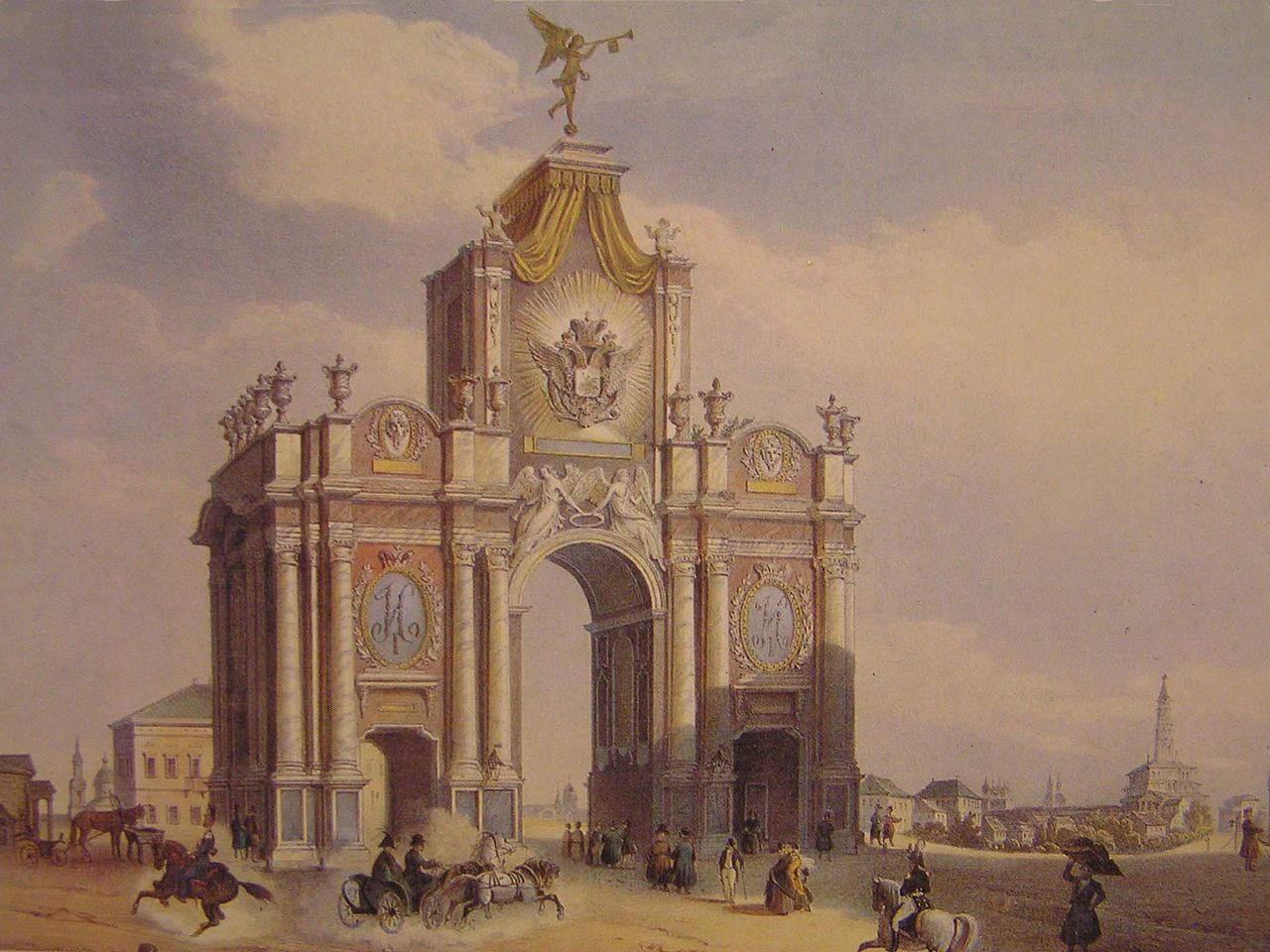
Ukhtomsky was born in a village to the north of the city Yaroslavl, where his Rurikid ancestors used to be rulers. At the age of 12, he moved to Moscow and studied there at the School of Mathematics and Navigation until 1733. He studied architecture and worked at Ivan Michurin's workshop until 1741, later working for Ivan Korobov (1741–1743). In 1742, Korobov supported Ukhtomsky's nomination for his first professional title and delegated him the management of a firm. In 1744, Ukhtomsky acquired a full architect's license and the rank of captain in state hierarchy. Ukhtomsky's first public successes were the temporary pavilions and arched for the coronation of Empress Elisabeth I of Russia in 1742. In 1753-1757 he rebuild one of these arched into landmark Red Gates, which stood until 1927. Since the 1740s, he built numerous buildings in nearby Basmanny District, notably the extant Church of Martyr Nikita, the largest mature Baroque building in Moscow. • Illustration — Church of Martyr Nikita, one of the few extant buildings by Ukhtomsky The grand bell-tower of the Troitse-Sergiyeva Lavra, 81 meters tall, was one of several projects where Ukhtomsky worked first with his mentor Michurin, and then independently until 1760. Present-day Kuznetsky Most, literally Blacksmith's Bridge, stands on the site of a 120 m bridge over Neglinnaya River, also designed by Ukhtomsky. The bridge, the palace in German Quarter and many other buildings by Ukhtomsky were destroyed by accidental fires, rebuilt beyond recognition or demolished. For the first time in history of Moscow, Ukhtomsky produced master plans for redevelopment of areas destroyed by the fires of 1748 and 1752. Ukhtomsky also supervised repairs in Moscow Kremlin in the 1750s. He trained and influenced Matvei Kazakov, Ivan Starov, Alexander Kokorinov, and other noted masters who graduated from the architectural school founded by Ukhtomsky in Moscow in 1749. In 1760, Ukhtomsky was accused of fraud and dismissed from his job; his school was closed in 1764. In 1767 he left Moscow forever; despite a 1770 verdict in his favor, he never returned to practical construction and education.
Works
Works
• Illustration — The Apraksin-Trubetskoy palace, 2009
Moscow
Moscow
• Church of Martyr Nikita, 1745–1751, Staraya Basmannaya, 16 • City estate of Count Alexey Petrovich Bestuzhev-Ryumin, 2-ya Baumanskaya st., 5 (rebuilt) • Church of St. Sergius of Radonezh in Krapivniki, 1749–1750, Krapivenskiy lane, 4 • gatehouse church for St Pachomius at Vysokopetrovsky Monastery, 1750–1755, Petrovka st., 28/3 • city estate of the Dolgorukovs, 1751–1758, Kolpachny lane, 6 (rebuilt) • Church of St. Nicholas in Zayaitskom, 1741–1759, 2 Raushsky lane, 1 • Apraksin-Trubetskoy palace, 1752–1769, Pokrovka st., 22/1 • the Red Gate, 1753—1757 • the Fanagorian Barracks, 1753–1757, Baumanskaya st., 61 • restoration and reconstruction of the Kremlin Arsenal, 1754—1759 • the bell tower and the refectory in St Clement's Church, 1756–1758.
Other Cities
Other Cities
• Khutyn Monastery belfry, 1758—1761
Life and career
Dated record
Life and career
Explore 1719–1774
The full dated record · 3 entries
1719
Dmitry Ukhtomsky born.
1753
Intercession Cathedral in Okhtyrka is dated 1753.
1774
Dmitry Ukhtomsky died at Odoyev Uyezd.
References
Citations
References
Each reference names the institution holding it, so a reader may go to the document itself.
reference work
Wikidata, structured authority record Q2533900: Dmitry UkhtomskyWikimedia Foundation
Secondary witnessreference work
Secondary witness
Further particulars
Held on the record
Further particulars
Open the remaining particulars
Formation and teaching. Each of those relationships is stated by the authority record rather than inferred from style. Recorded as architect.
Intercession Cathedral in Okhtyrka
1753
The Encyclopedia exists whether or not anything is for sale. Corrections are recorded rather than overwritten, and every version of this record is kept. Published 16 August 2026.
Elsewhere in Design
11,558 published records in this field, each with its sources named.
- Dirk BrouwerDesigner
- Dita Roque-GouraryDesigner
- Dmitri BrunsDesigner
- Dmitry ShvidkovskyDesigner
- Doan OgdenDesigner
- Dobrivoje ToškovićDesigner
- Dobroslava MenclováDesigner
- Doğan KubanDesigner
Best supported in this field
For owners
Own a work by Dmitry Ukhtomsky?
A specialist will read what you send and tell you what the house can establish, what it cannot, and whether the object is suited to sale. There is no charge and no obligation. The object stays with you throughout; nothing is shipped to us unless it is arranged in writing beforehand.