
Desiderio Hernández Xochitiotzin
Desiderio Hernández Xochitiotzin (born San Bernardino Contla, February 11, 1922 – died Tlaxcala, September 14, 2007) was a Mexican artist best known for his large-scale mural work inside the State Government Palace in the state of Tlaxcala, Mexico, the last large scale mural of the Mexican muralism movement.
Also recorded as Desiderio Hernandez Xochitiotzin
Desiderio Hernández Xochitiotzin

Public domain
- Name
- Desiderio Hernández Xochitiotzin
- Born
- 11 February 1922
- Birthplace
- San Bernardino Contla, Tlaxcala
- Died
- 14 September 2007
- Place of death
- Tlaxcala
- Occupation
- Muralist
- Nationality
- Mexico
- Languages
- Spanish
VALÉORINE Encyclopedia
VALÉORINE documentary reading
Documentary summary
Desiderio Hernández Xochitiotzin (born San Bernardino Contla, February 11, 1922 – died Tlaxcala, September 14, 2007) was a Mexican artist best known for his large-scale mural work inside the State Government Palace in the state of Tlaxcala, Mexico, the last large scale mural of the Mexican muralism movement.
Admitted source layer · organised and presented by VALÉORINE
Note VALÉORINE
Desiderio Hernández Xochitiotzin (1922–2007) was a painter, printmaker and vexillologist, of Mexican nationality. The painter was born in Contla and died in Tlaxcala de Xicoténcatl.
Languages used include Spanish. Works are held at Museum of Modern Art.
Composed from admitted, traceable facts · 26 September 2026
VALÉORINE
Reference Check
Propose documentary evidence for Desiderio Hernández Xochitiotzin. A contribution is never written directly as fact: identity, source, rights and evidence gates still decide.
Sign in to contribute
Documentary evidence
Documentary basis
Authority files
wikidata · Q379980 · wikipedia · Desiderio Hernández Xochitiotzin
In this article
Key facts
Key facts
• Name — Desiderio Hernández Xochitiotzin • Born — 11 February 1922 • Birthplace — San Bernardino Contla, Tlaxcala • Died — 14 September 2007 • Place of death — Tlaxcala • Occupation — Muralist
Life
Life
Desiderio Hernández Xochitiotzin was born in Santa María Tlacatecpac de San Bernardino Contla, Tlaxcala in 1922. His artistic training began in his family's handcraft shop and then at the Academia de Bellas Artes de Puebla. After traveling in various parts of Mexico and Europe to live and work, he returned permanently in Tlaxcala in 1957. The rest of his career was dedicated to painting the history and culture of his home state. He died of respiratory failure on September 14, 2007. Before his death, he planned along with his daughter Citlalli to form a foundation named after him, with the aim of preserving his work and authenticate his artistic production. His daughter currently heads the organization whose activities include social and cultural events and research about the painter. The foundation sponsored an exhibit of his work in the United States in 2011.
The mural at the State Government Palace in Tlaxcala
The mural at the State Government Palace in Tlaxcala
• Illustration — Section of State Palace mural depicting the emperor Camaxtli. • Illustration — Section of the mural post Independence Hernández Xochitiotzin's most important work was the creation of the mural La historia de Tlaxcala y su contribución a lo mexicano (The history of Tlaxcala and its contribution to Mexican identity) inside the State Government Palace of Tlaxcala. The project to create a mural that tells the history of Tlaxcala was promoted to the state by poet Miguel N. Lira and preparation work was begun in 1957. The first section, La Conquista, was painted between 1967 and 1968, with work continuing in stages over four decades. The work shows influence from Rivera's mural at the National Palace, but Hernández Xochitiotzin did not paint the original Tlaxcalans as traitors for their role in the Spanish conquest of the Aztec Empire. The entire mural covers over 500 meters squared and is the last grand-scale mural to be created as part of the Mexican muralism movement. However, the work was never fully completed before his death in 2007. Before this time, Hernández Xochitiotzin's asked state authorities to allow his son, Cuauhtlatohuac H. Xochitiotzin to continue the work on the mural but the state never responded. The mural is one of the most important cultural and tourist attractions of the state, bringing visitors from Mexico and abroad. However, the mural work has been damaged due to the effects of humidity and time, with several sections visibly affected. These include El señor de los tlaxcaltecas, Ritual en honor al Dios Camaxtli, Sacrificio gladiatorio, del general Tlahuicole en Tenochtitlan and Deidad Tlaxcalteca, with the most severe damage at the main entrance to the building.
Other work
Other work
• Illustration — Self-portrait of Desiderio Hernández Pintando, the Goddess of Corn, seeing an old Codex, his Grandfather is sitting next to his father who is standing. Hernández Xochitiotzin's life's work including various drawing and engravings, especially in his early career. He was also a writer, architect, chronicler, teacher, researcher and art restoration expert. He had his first important individual exhibition in 1947 while still in school. Before 1957, he had expositions in Mexico, the Vatican, Harvard University, Sorbonne University and the Stockholm University. He illustrated books such as a catalog of the works of Ernesto de la Torre in 1999 and Pintura mural de México la época prehispánica, el virreinato y los grandes artistas de nuestro siglo by Rafael Carrillo Azpéitia. In addition to the mural at the State Government Palace, he also painted an important one at the municipal palace in Huamantla, Tlaxcala in 1968. Others include a fresco in Tehuacán, Puebla and a mural of the history of Reynosa, Tamaulipas in that city. The research he did to prepare murals led him to become an expert on the history and culture of Tlaxcala, becoming a teacher and speaker at conferences. He was the official historian of the city of Tlaxcala, investigating the history of the architecture of city in preparation for their naming as historic monuments in the 1970s and 1980s. Although without formal training, he did work as an architect. Projects including the remodeling of the Ocotlan Basilica, and the remodeling of the atriums of churches in Zacatelco and Texoloc as well as designing the chapel at the Tlaxcala Seminary. He co-designed a building located in the historic center of Puebla located across from the Puebla Cathedral. He also worked on numerous restorations and remodeling of various historic buildings in Tlaxcala and Puebla. He founded the architecture school at Benemérita Universidad Autónoma de Puebla and was a professor there until 1968. Other notable work includes the design of the municipal seal of Xaloztoc in 1973 for the municipality's centennial, and was a founding member of the Salón de la Plástica Mexicana. Harvard and the University of Oklahoma named him as the best Mexican muralist of the 20th century. He was given an honorary degree in architecture by Universidad Popular Autónoma del Estado de Puebla.
Artistry
Artistry
He was part of the second generation of Mexican muralism movement and the last to use the fresco technique extensively. Influences include José Guadalupe Posada, Agustín Arrieta, Francisco Goitia as well as Mexican muralists José Clemente Orozco, David Alfaro Siqueiros and especially Diego Rivera. Recurrent themes in his work include history, landscapes, festivals, local customs, religion and rural life. His most important work has themes related to the state of Tlaxcala and its history. His work tends to contain strong colors and realistic figures. • Illustration — Discussions between Tlaxcaltecs and Hernán Cortés. • Illustration — Tlaxcaltec gets a Spanish province (1545) • Illustration — Destruction of the indian gods by the Spanish conquest. • Illustration — Maximiliano I of Mexico and Carlota of Mexico • Illustration — Flower Wars Tlaxcaltecan warriors fighting against warrior from Texcoco, Cuauhtepec and Ocelotepec. • Illustration — Aboriginal merchants in the Tlaxcala market • Illustration — History of Mexico since its Independence
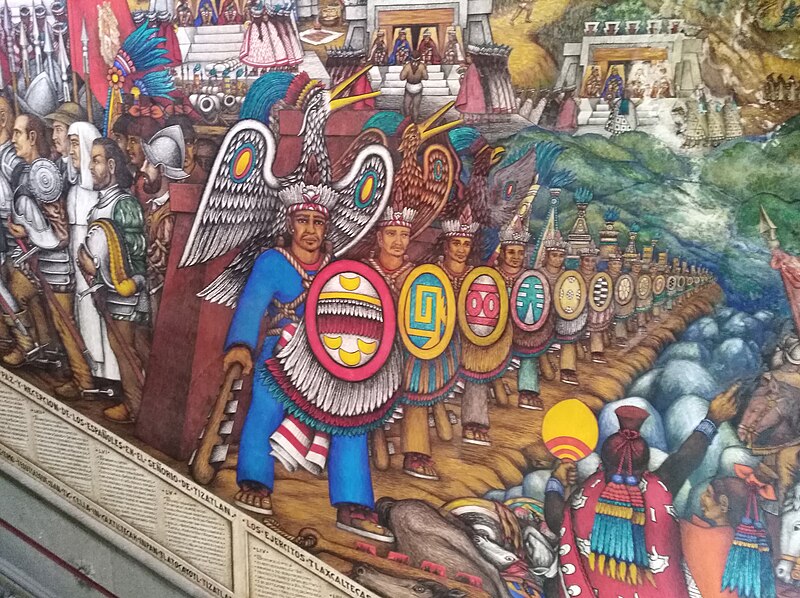
en palacio de gobierno
Koffermejia

Detalle de mural palacio de gobierno tlaxcala del maestro Desiderio Hernández Xochitiotzin
Ajenoalien
Places
Named by the record
Places
Only places the record itself states, plotted where the house gazetteer settles their coordinates. Nothing is inferred from a name or a nationality.
Contla.
Birth place
Tlaxcala de Xicoténcatl.
Death place
Notes from the source article
Cited by Wikipedia
Notes from the source article
These works are cited by the source article, in its own numbering. They are recorded as its citations, not as sources VALÉORINE has verified.
- 1.Artes e Historia magazine. Desiderio Hernández Xochitiotzin.
- 2.Rafael Doniz. Desiderio Hernández X., pintor de la historia de Tlaxcala. Mexico Desconocido magazine.
- 3.Adriana Aurioles. Exposición Desiderio Hernández Xochitiotzin. El Sol de Puebla. December 17, 2007.
- 4.Humedad deteriora los murales de Xochitiotzin. Milenio. October 2, 2011.
- 5.Victor Hugo Varela Loyola. Crean Fundación Desiderio Hernández. La Jornada Oriente. March 8, 2010.
- 6.Alejandro Zenteno. Un codice contemporaneo. Reforma. 8. August 13, 2000.
- 7.Maria Adriana Cabrera Haro. En riesgo mural de Hernández Xochitiotzin en Tlaxcala. Milenio. August 25, 2010.
- 8.Salon de la Plástica Mexicana. Miembros Fundadores del Salón de la Plástica Mexicana.
References
Citations
References
Each reference names the institution holding it, so a reader may go to the document itself.
reference work
Secondary witnessreference work
Secondary witness
The Encyclopedia exists whether or not anything is for sale. Corrections are recorded rather than overwritten, and every version of this record is kept. Published 16 August 2026.
Elsewhere in Prints
4,138 published records in this field, each with its sources named.
- Denise CoplandEngraver
- Denise DuchateauEngraver
- Denzen AōdōEngraver
- Derek Michael BesantEngraver
- Désiré AcketEngraver
- Dhuwarrwarr MarikaEngraver
- Diana ScultoriEngraver
- Diane GamboaEngraver
Best supported in this field
For owners
Own a work by Desiderio Hernández Xochitiotzin?
A specialist will read what you send and tell you what the house can establish, what it cannot, and whether the object is suited to sale. There is no charge and no obligation. The object stays with you throughout; nothing is shipped to us unless it is arranged in writing beforehand.