
Daniel Tammet
Daniel Paul Tammet (born Daniel Paul Corney; 31 January 1979) is an English writer and savant. Tammet's second book, Embracing the Wide Sky, was one of France's best-selling books of 2009. His third book, Thinking in Numbers, was published in 2012 by Hodder & Stoughton in the United Kingdom and in 2013 by Little, Brown and Company in the United States and Canada.
Also recorded as Daniel Paul Tammet · Daniel Paul Corney
Daniel Tammet

De Lorelei · extracted from File:Daniel Tammet PI Palais de la découverte Paris.jpg · CC BY-SA 4.0
- Born
- 1979.
- Nationality
- United Kingdom.
- Occupation
- writer, Esperantist, computer scientist, poet and pedagogue.
- Known for
- Born on a Blue Day, Embracing the Wide Sky and Every Word is a Bird We Teach to Sing.
VALÉORINE Encyclopedia
VALÉORINE documentary reading
Documentary summary
Daniel Paul Tammet (born Daniel Paul Corney; 31 January 1979) is an English writer and savant. Tammet's second book, Embracing the Wide Sky, was one of France's best-selling books of 2009. His third book, Thinking in Numbers, was published in 2012 by Hodder & Stoughton in the United Kingdom and in 2013 by Little, Brown and Company in the United States and Canada.
Admitted source layer · organised and presented by VALÉORINE
Note VALÉORINE
Daniel Tammet (born 1979) is a computer scientist, Esperantist and pedagogue, among other activities, of British nationality. Among the works is Embracing the Wide Sky.
Composed from admitted, traceable facts · 27 September 2026
VALÉORINE
Reference Check
Propose documentary evidence for Daniel Tammet. A contribution is never written directly as fact: identity, source, rights and evidence gates still decide.
Sign in to contribute
World of VALÉORINE
Documentary connections
Only confirmed graph relationships appear here. Images are shown only when their identity and reuse rights both pass the documentary gate.

Documentary evidence
Evidence Panel
not yet certified
- Identity
- resolved
- Independent source families
- 0
- Admitted assertions
- 0
- Open conflicts
- 0
Authority files
wikidata · Q12857 · wikipedia · Daniel Tammet
In this article
Early life
Early life
Tammet's books have been published in over 20 languages. Tammet was elected in 2012 to serve as a fellow of the Royal Society of Arts.
Tammet was born Daniel Paul Corney on 31 January 1979. He was the eldest of nine children and was raised in Barking and Dagenham, East London. As a young child, Tammet had epileptic seizures, which remitted following medical treatment. Tammet participated twice in the World Memory Championships in London under his birth name, placing 11th in 1999 and fourth in 2000. Tammet changed his birth name by deed poll because "it didn't fit with the way he saw himself", according to The Guardian. He took the Estonian surname Tammet, which is related to "oak trees". At age 25, Tammet was diagnosed with Asperger syndrome by Simon Baron-Cohen of the University of Cambridge Autism Research Centre. He is one of fewer than a hundred "prodigious savants" according to Darold Treffert, the world's leading researcher in the study of savant syndrome. Tammet was the subject of a documentary film titled Extraordinary People: The Boy with the Incredible Brain, first broadcast on Channel 4 on 23 May 2005.
Career
Career
In 2002, Tammet launched the website, Optimnem. The site offered language courses (as of 2015, French and Spanish) and had been an approved member of the UK National Grid for Learning since 2006. The website has been offline since January 2022, as of November 2023 redirecting to a "domain is for sale" page. Born on a Blue Day received international media attention and critical praise. Booklist magazine contributing reviewer Ray Olson stated that Tammet's autobiography was "as fascinating as Benjamin Franklin's and John Stuart Mill's" and that Tammet wrote "some of the clearest prose this side of Hemingway". Kirkus Reviews stated that the book "transcends the disability memoir genre". For his US book tour, Tammet appeared on several television and radio talk shows and specials, including 60 Minutes and the Late Show with David Letterman. In February 2007, Born on a Blue Day was serialised as BBC Radio 4's Book of the Week in the United Kingdom. Tammet's second book, Embracing the Wide Sky, was published in 2009. Allan Snyder, director of the University of Sydney Centre for the Mind, called the work 'an extraordinary and monumental achievement'. Tammet argues that savant abilities are not "supernatural" but "an outgrowth" of "natural, instinctive ways of thinking about numbers and words". He suggests that the brains of savants can to some extent be retrained, and that normal brains could be taught to develop some savant abilities. Thinking in Numbers, a collection of essays, was first published in 2012 and serialised as BBC Radio 4's Book of the Week in the United Kingdom. Tammet's translation into French of a selection of poetry by Les Murray was published by L'Iconoclaste in France in 2014. Tammet's first novel, Mishenka, was published in France and Quebec in 2016. Every Word Is a Bird We Teach to Sing, a collection of essays on language, was published in the UK, US, and France in 2017. In a review of the book for The Wall Street Journal, Brad Leithauser noted that "in terms of literary genres, something new and enthralling is going on inside his books" and that the author showed "a grasp of language and a sweep of vocabulary that any poet would envy". Portraits, a bilingual first poetry collection, was published in French and English in 2018. Written in French as a letter to a non-believing friend, the creative non-fiction work Fragments de paradis ("Fragments of Heaven") was published in France and Canada in 2020.
Scientific study
Scientific study
After the World Memory Championships, Tammet participated in a group study, later published in the New Year 2003 edition of Nature Neuroscience. The researchers investigated the reasons for the memory champions' superior performance. They reported that he used "strategies for encoding information with the sole purpose of making it more memorable", and concluded that superior memory was not driven by exceptional intellectual ability or differences in brain structure. In another study, Baron-Cohen and others at the Autism Research Centre tested Tammet's abilities in around 2005. Tammet was found to have synaesthesia, according to the "Test of Genuineness-Revised", which tests the subjects' consistency in reporting descriptions of their synaesthesia. He performed well on tests of short-term memory (with a digit-span of 11.5, where 6.5 is typical). Conversely, test results showed his memory for faces scored at the level expected of a 6- to 8-year-old child in this task. The authors of the study speculated that his savant memory could be a result of synaesthesia combined with Asperger syndrome, or it could be the result of mnemonic strategies. In a further study published in Neurocase in 2008, Baron-Cohen, Bor, and Billington investigated whether Tammet's synaesthesia and Asperger syndrome explained his savant memory abilities. They concluded that his abilities might be explained by hyperactivity in one brain region (the left prefrontal cortex), which results from his Asperger syndrome and synaesthesia. On the Navon task, relative to non-autistic controls, Tammet was found to be faster at finding a target at the local level and to be less distracted by interference from the global level. In an fMRI scan, "Tammet did not activate extra-striate regions of the brain normally associated with synaesthesia, suggesting that he has an unusual and more abstract and conceptual form of synaesthesia". Published in Cerebral Cortex (2011), an fMRI study led by Jean-Michel Hupé at the University of Toulouse (France) observed no activation of colour areas in ten synaesthetes. Hupé suggests that synaesthetic colour experience lies not in the brain's colour system, but instead results from "a complex construction of meaning in the brain, involving not only perception, but language, memory and emotion". In his book Moonwalking with Einstein (2011), Joshua Foer, a science journalist and former US Memory Champion, speculates that Tammet's study of conventional mnemonic approaches has played a role in the savant's feats of memory. While accepting that Tammet meets the standard definition of a prodigious savant, Foer suggests that his abilities may simply reflect intensive training using memory techniques, rather than any abnormal psychology or neurology. In a review of his book for The New York Times, psychologist Alexandra Horowitz described Foer's speculation as among the few "missteps" in his book. She questioned whether it would matter if Tammet had used such strategies or not.
Savantism
Savantism
Tammet has been studied by researchers in Britain and the United States, and has been the subject of several peer-reviewed scientific papers. Allan Snyder at the Australian National University has said of him: "Savants can't usually tell us how they do what they do. It just comes to them. Daniel can describe what he sees in his head. That's why he's exciting. He could be the Rosetta Stone." In his mind, Tammet says, each positive integer up to 10,000 has its own unique shape, colour, texture and feel. He has described his visual image of 289 as particularly ugly, 333 as particularly attractive, and pi, though not an integer, as beautiful. The number 6 apparently has no distinct image yet what he describes as an almost small nothingness, opposite to the number 9, which he says is large, towering, and quite intimidating. Tammet describes the number 117 as "a handsome number. It's tall, it's a lanky number, a little bit wobbly." He described David Letterman with the number 117 in these terms when interviewed on the Late Show with David Letterman. In his memoir, Tammet describes undergoing a synaesthetic and emotional response for numbers and words. Tammet set the European record for reciting pi from memory on 14 March 2004 – recounting to 22,514 digits in five hours and nine minutes. He revealed in a French talk show on Radio Classique on 29 April 2016, that this event inspired Kate Bush's song "Pi" from her album Aerial. Tammet is a polyglot. In Born on a Blue Day, he writes that he knows 10 languages: English, Estonian, Finnish, French, German, Lithuanian, Esperanto, Spanish, Romanian, Icelandic, and Welsh. In Embracing the Wide Sky, Tammet wrote that he learned conversational Icelandic in a week, and appeared on an interview on Kastljós on RÚV speaking the language.
Personal life
Personal life
Tammet met software engineer Neil Mitchell in 2000 and they started a relationship. They lived in Kent. He and Mitchell operated the online e-learning company Optimnem, where they created and published language courses. In 2002, after attending the Herne Bay Baptist Church, Tammet became a Christian. Tammet now lives in Paris with his husband Jérôme Tabet, a photographer whom he met while promoting his autobiography. Tammet is a graduate of the Open University with a Bachelor of Arts degree with first-class honours in the humanities.
Non-fiction
Non-fiction
Born on a Blue Day (2006) Embracing the Wide Sky (2009) Thinking in Numbers (2012) Every Word Is a Bird We Teach to Sing (2017) Fragments de paradis (2020), in French How to be ‘Normal’ - Notes on the Eccentricities of Modern Life (2020) Nine Minds: Inner Lives on the Spectrum (2025)
Essays
Essays
"What It Feels Like to Be a Savant" in Esquire (August 2005) "Open Letter to Barack Obama" in The Advocate (December 2008) "Olympics: Are the Fastest and Strongest Reaching Their Mathematical Limits?" in The Guardian (August 2012) "What I'm Thinking About... Tolstoy and Maths" in The Guardian (August 2012) "The Sultan's Sudoku" in Aeon digital magazine (December 2012) "Languages Revealing Worlds and Selves" in The Times Literary Supplement (September 2017)
Mänti
Mänti
Mänti (MAN-tee) is a constructed language that Tammet published in 2006. The word Mänti comes from the Finnish word for "pine tree" (mänty, pronounced [ˈmænty]). Mänti uses vocabulary and grammar from the Finnic languages.
Life and career
Dated record
Life and career
The full dated record · 2 entries
1979
Daniel Tammet was born in 1979.
2011
Daniel Tammet: Different ways of knowing (TED).
Primary material
Documents and archives
reference work
- “Daniel Tammet”, English Wikipedia, consulted as further reading
Reputable secondary · Wikipedia
authority record
- Wikidata, structured authority record Q12857: Daniel Tammet
Unverified · Wikidata
Awards
American Library Association Booklist magazine "Editors' Choice Adult Books" (2007) for "Born on a Blue Day" The Sunday Times "Top Choice of Books" for Born on a Blue Day American Library Association Young Adult Library Services magazine Best Books for Young Adults" (2008) Ann Arbor/Ypsilanti Reads Archived 11 January 2016 at the Wayback Machine "Selection for 2012" (2011) Fellow of the Royal Society of Arts (2012) American Library Association Booklist magazine "Editors' Choice Adult Books" (2017) for "Every Word Is a Bird We Teach to Sing" New Zealand Listener The 100 Best Books of 2017 for "Every Word Is a Bird We Teach to Sing"
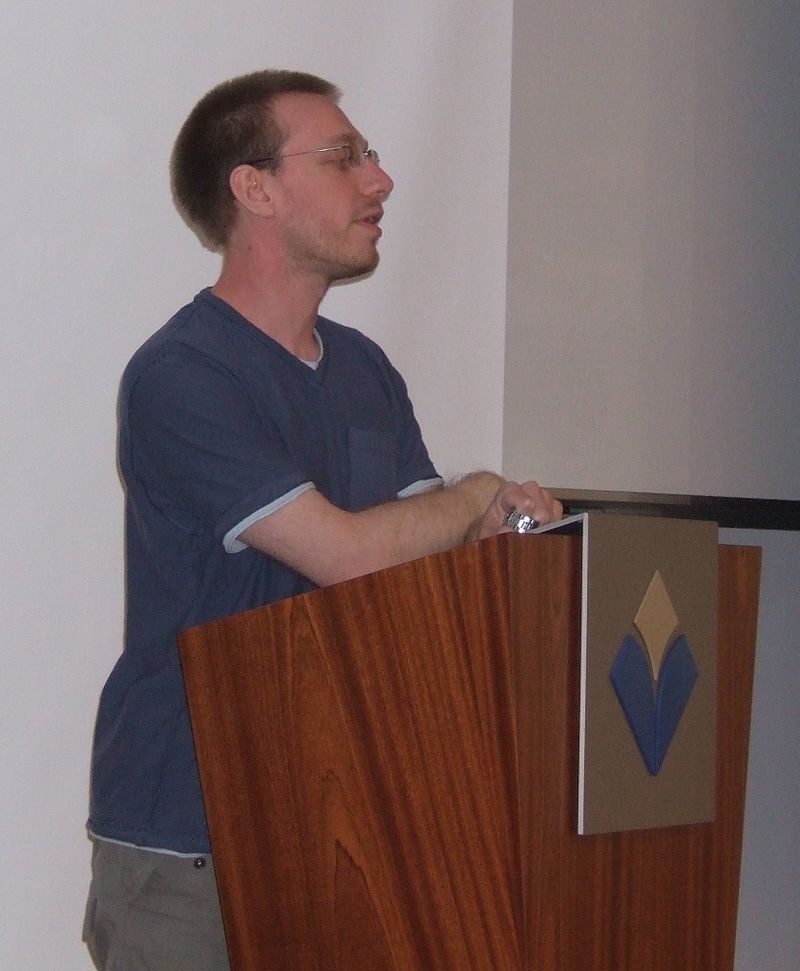
en:Daniel Tammet giving a speech at en:Reykjavík University on 21 June, 2007. Picture taken by Haukurth. Cropped with GIMP but otherwise unedited.
Haukurth at English Wikipedia · Haukurth
![Daniel Tammet (born Daniel Paul Corney[1] on 31 January 1979) is a British writer with high-functioning autism and savant syndrome.](https://upload.wikimedia.org/wikipedia/commons/thumb/c/ce/Daniel_Tammet_on_a_meeting.jpg/800px-Daniel_Tammet_on_a_meeting.jpg)
Daniel Tammet (born Daniel Paul Corney[1] on 31 January 1979) is a British writer with high-functioning autism and savant syndrome.
jurvets · Born on a Blue Day
Notes from the source article
Cited by Wikipedia
Notes from the source article
These works are cited by the source article, in its own numbering. They are recorded as its citations, not as sources VALÉORINE has verified.
- 1.American Library Association. ALA 2008 Best Books for Young Adults. 2008-01-15.
- 2.Livres: Les best-sellers de l'année 2009 réunis au Fouquet's. L'Express. 23 March 2010.
- 3.Andrew Lownie Literary Agency.
- 4.Daniel Tammet. Fellow of the Royal Society of Arts. Thinking in Numbers: The Blog of Daniel Tammet. 19 December 2012.
- 5.Foer, Joshua. Moonwalking with Einstein. Penguin Books. July 2019. 978-0141952277 Dead link.
- 6.Jonathan Sale. Passed/Failed: An education in the life of the autistic savant Daniel Tammet. Independent. 9 August 2006.
- 7.Michael Gloschewski. Contestant 'Daniel Corney'.
- 8.Johnson, Richard. A genius explains. The Guardian. 12 February 2005.
- 9.Thinking in Numbers: The Blog of Daniel Tammet: Mänti. 13 July 2006.
- 10.Tammet, Daniel. Born on a Blue Day. Hodder Paperbacks. 22 February 2007. 978-0340899755.
- 11.Lyall, Sarah. Brainman at Rest in His Oasis. The New York Times. 15 February 2007.
- 12.Real Stories. Brain Man: The Boy With The Incredible Brain (Superhuman Documentary). 22 August 2015.
- 13.Martin Weitz. Extraordinary People: The Boy with the Incredible Brain. IMDb. 23 May 2005.
- 14.Daniel Tammet. Optimnem: Foreign Language Courses.
- 15.Optimnem An Error Occurred.
- 16.Redirect. www.optimnem.co.uk.
- 17.Optimnem.co.uk. ww01.optimnem.co.uk.
- 18.A Look at an Autistic Savant's Brilliant Mind. NPR Talk of the Nation. 15 January 2007.
- 19.CBC Television. The Hour. 2 February 2009.
- 20.Peter Wilson. A Savvy Savant finds his voice. The Australian. 31 January 2009.
- 21.Daniel Tammet. Thinking in Numbers. 2012.
- 22.L'Iconoclaste. C'est une chose serieuse que d'etre parmi les hommes. 24 September 2014.
- 23.RadioCanada. Daniel Tammet : un regard poétique sur les nombres et les échecs. 16 April 2016.
- 24.Daniel Tammet. Every Word Is a Bird We Teach to Sing. 2017.
- 25.Brad Leithauser. Words in Flight. The Wall Street Journal. 6 October 2017.
- 26.Daniel Tammet. Portraits. 2018.
- 27.Le Devoir. Littérature française - le génie des maths qui croyait en dieu. 2020.
- 28.Darold Treffert, M.D. Daniel Tammet – Brainman: 'Numbers are my friends'. Wisconsin Medical Society.
- 29.Maguire, Eleanor A. Routes to remembering: the brains behind superior memory. Nature Neuroscience. 6. 1. 90–95. January 2003. 10.1038/nn988.
- 30.Baron-Cohen, Simon. Savant Memory in a Man with Colour Form-Number Synaesthesia nd Asperger. Journal of Consciousness Studies. 14. 9–10. 237–251. 2007.
- 31.Bor, Daniel. Savant Memory for Digits in a Case of Synaesthesia and Asperger Syndrome is Related to Hyperactivity in the Lateral Prefrontal Cortex. Neurocase: The Neural Basis of Cognition. 13. 5–6. 311–319. 2008. 10.1080/13554790701844945.
- 32.Hupé, Jean Michel. The Neural Bases of Grapheme-Color Synesthesia Are Not Localized in Real Color-Sensitive Areas. Cereb. Cortex. 22. 7. 1622–1633. 2012. 10.1093/cercor/bhr236.
- 33.Hupé, J-M. Neural basis of grapheme-colour synaesthesia. Perception. 40. ECVP Abstract Supplement. 1622–1633. 2011. 10.1093/cercor/bhr236.
- 34.Horowitz, Alexandra. How To Memorize Everything. The New York Times. 11 March 2011.
- 35.Tammet, Daniel. Embracing the Wide Sky. Hodder & Stoughton. 2009. 978-0-340-96132-2.
- 36.Johnson, Richard. A genius explains. The Guardian. 12 February 2005.
- 37.Morley Safer. Brain Man. CBS News. 26 January 2007.
- 38.David Letterman Mathematics Genius Prodigy Daniel Tammet Math 3.14 Pi Day, Letterman, accessed 2010-02-01
- 39.Big slice of pi sets new record. BBC News. 15 March 2004.
- 40.Oxford University. Pi memory feat. 15 March 2004.
- 41.'Rain Man' finds numbers easy as Pi. The Scotsman. 15 March 2004.
- 42.Pi recital enters record books. The Guardian. 16 March 2004.
- 43.Pi-man sets record. The Age. 16 March 2004.
- 44.Bethge, Philip. Who Needs Berlitz?. Der Spiegel. 3 May 2009.
- 45.Caroline Scott. Daniel Tammet. The Sunday Times. 13 August 2006.
- 46.Alexia Vidot, Daniel Tammet : Dieu est sa valeur absolue, lavie.fr, France, February 12, 2020
- 47.Lucia Sillig et Peter Greenwood. Mise au Point. Radio Télévision Suisse. 3 April 2016.
- 48.Eléonore Sulser. Face à la parole nue. 10 May 2019.
- 49.Daniel Tammet. About the author. 2017.
- 50.Tammet, Daniel. Olympics: Are the fastest and strongest reaching their mathematical limits?. The Guardian. 11 August 2012.
- 51.Tammet, Daniel. Olympics: What I'm thinking about … Tolstoy and maths. The Guardian. 23 August 2012.
- 52.Daniel Tammet. The Sultan's sudoku. Aeon. 10 December 2012.
- 53.Daniel Tammet. Languages revealing worlds and selves. TLS. 5 September 2017.
- 54.Burgel, Thomas. Florent Marchet: Il y a un cosmos intérieur encore inexploré. Les InRocks. 12 December 2013.
- 55.Thibaut Buccellato. THE UNIVERSE AND ME - French Subtitles. YouTube. 11 October 2017.
- 56.Daniel Tammet. Mänti. Optimnem. 13 July 2006.
- 57.Booklist Editors' Choice Adult Books (2007). 1 January 2008.
- 58.Ann Arbor/Ypsilanti Reads Announces Selection for 2012. 27 October 2011.
- 59.Booklist Editors' Choice Adult Books (2017). 1 January 2018.
- 60.The Listener The 100 Best Books of 2017. March 2022.
References
Citations
References
Each reference names the institution holding it, so a reader may go to the document itself.
reference work
Partially resolvedauthority record
Unverified
The Encyclopedia exists whether or not anything is for sale. Corrections are recorded rather than overwritten, and every version of this record is kept. Published 14 August 2026.
Elsewhere in Books
38,661 published records in this field, each with its sources named.
- Daniel SloateAuthor
- Daniel SolanderAuthor
- Daniel SternAuthor
- Daniel StrožAuthor
- Daniel TerniAuthor
- Daniel TobinAuthor
- Daniél ua LíahaitiAuthor
- Daniel VarujanAuthor
Best supported in this field
For owners
Own a work by Daniel Tammet?
A specialist will read what you send and tell you what the house can establish, what it cannot, and whether the object is suited to sale. There is no charge and no obligation. The object stays with you throughout; nothing is shipped to us unless it is arranged in writing beforehand.