
Daini no Sanmi
Daini no Sanmi was a Japanese waka poet of the mid-Heian period.
Also recorded as Daini no Sammi · Fujiwara no Kenshi · Fujiwara no Kataiko
Daini no Sanmi

Print artist: Utagawa Kuniyoshi (歌川国芳) Print artist: Utagawa Hiroshige (歌川広重) Print artist: Utagawa Kunisada (歌川国貞 Toyokuni III) · Public domain
- Name
- Daini no Sanmi
- Born
- c. 999
- Occupation
- Lady-in-waiting to Empress Shōshi, poet, wet nurse to Emperor Go-Reizei
- Spouse
- Takashina no Nariakira
- Died
- 1082.
- Nationality
- Japan.
- Languages
- Japanese.
Reference Check
Propose documentary evidence for Daini no Sanmi. A contribution is never written directly as fact: identity, source, rights and evidence gates still decide.
Sign in to contribute
Documentary evidence
Documentary basis
Authority files
wikidata · Q3012130 · wikipedia · Daini no Sanmi
In this article
Key facts
Key facts
• Name — Daini no Sanmi • Born — c. 999 • Occupation — Lady-in-waiting to Empress Shōshi, poet, wet nurse to Emperor Go-Reizei • Spouse — Takashina no Nariakira • Children — Son by spouse, and daughter with Fujiwara no Kanetaka (unknown identity) • Father — Fujiwara no Nobutaka • Mother — Murasaki Shikibu
Biography
Biography
She was the daughter of Murasaki Shikibu and Fujiwara no Nobutaka. Her given name was Katako, although the kanji can also be read as Kenshi. In 1017, she joined to the court and served as a lady-in-waiting for Grand Empress Dowager Shoshi, the mother of Emperor Go-Ichijo. She was married to Takashina no Nariakira and produced a son in 1038, and she had a daughter with Fujiwara no Kanetaka in 1026. She also served as the nurse of Imperial Princess Teishi and Emperor Go-Reizei. When Emperor Go-Reizei ascended the throne, she was promoted.
Poetry
Poetry
Thirty-seven or thirty-eight of her poems were included in imperial anthologies from the Goshūi Wakashū onward. One of her poems was included as the fifty-eighth in the Ogura Hyakunin Isshu: She also produced a private collection called the Daini no Sanmi-shū.
Possible partial authorship of The Tale of Genji
Identity and origins
Identity and origins
The authorities additionally record the headings Daini no Sammi, Fujiwara no Kenshi and Fujiwara no Kataiko. Her recorded language was Japanese. She was the child of Fujiwara no Nobutaka and Murasaki Shikibu. She married Fujiwara no Kanetaka and Takashina no Nariaki. 3 children are recorded: Takashina Tamie, Wife of Minamoto no Yoshimune and Daughter of Takashina no Nariaki, wife of Fujiwara no Tsūmune.
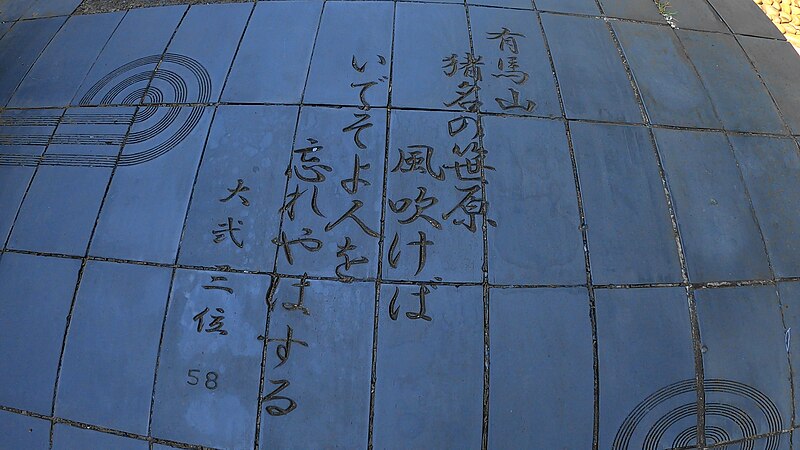
東京都世田谷区「 用賀プロムナード 」の歩道に敷かれた小倉百人一首の一つ。
Doricono
Life and career
Dated record
Life and career
The full dated record · 2 entries
999
Daini no Sanmi born at Japan.
1082
Daini no Sanmi died.
Text attribution
Licensing
Text attribution
Part of the biographical narrative on this page reuses licensed material. Its origin, revision and licence are recorded here.
The biographical narrative on this page is based on the Wikipedia article Daini no Sanmi, revision 1294144468 (EN edition), by its contributors. VALÉORINE has edited that text and built its own documentary record around it. The reused material is available under CC BY-SA 4.0, and this page's reuse of it is offered under the same licence. Everything else on this page — the chronology, the holdings, the evidence, the plates and the connections — is VALÉORINE's own record. Sources and licences.
References
Citations
References
Each reference names the institution holding it, so a reader may go to the document itself.
reference work
Secondary witnessreference work
Secondary witness
The Encyclopedia exists whether or not anything is for sale. Corrections are recorded rather than overwritten, and every version of this record is kept. Published 15 August 2026.
Elsewhere in Books
39,529 published records in this field, each with its sources named.
- Dai ShulunAuthor
- Dai WangshuAuthor
- Dáibhí Ó BruadairAuthor
- Daína ChavianoAuthor
- Dainius RazauskasAuthor
- Daisaku IkedaAuthor
- Daisy Al-AmirAuthor
- Daisy BatesAuthor
Best supported in this field
For owners
Own a work by Daini no Sanmi?
A specialist will read what you send and tell you what the house can establish, what it cannot, and whether the object is suited to sale. There is no charge and no obligation. The object stays with you throughout; nothing is shipped to us unless it is arranged in writing beforehand.