
cutlass
A cutlass is a short, broad sabre or slashing sword with a straight or slightly curved blade sharpened on the cutting edge and a hilt often featuring a solid cupped or basket-shaped guard. It was a common naval weapon during the Age of Sail.
cutlass
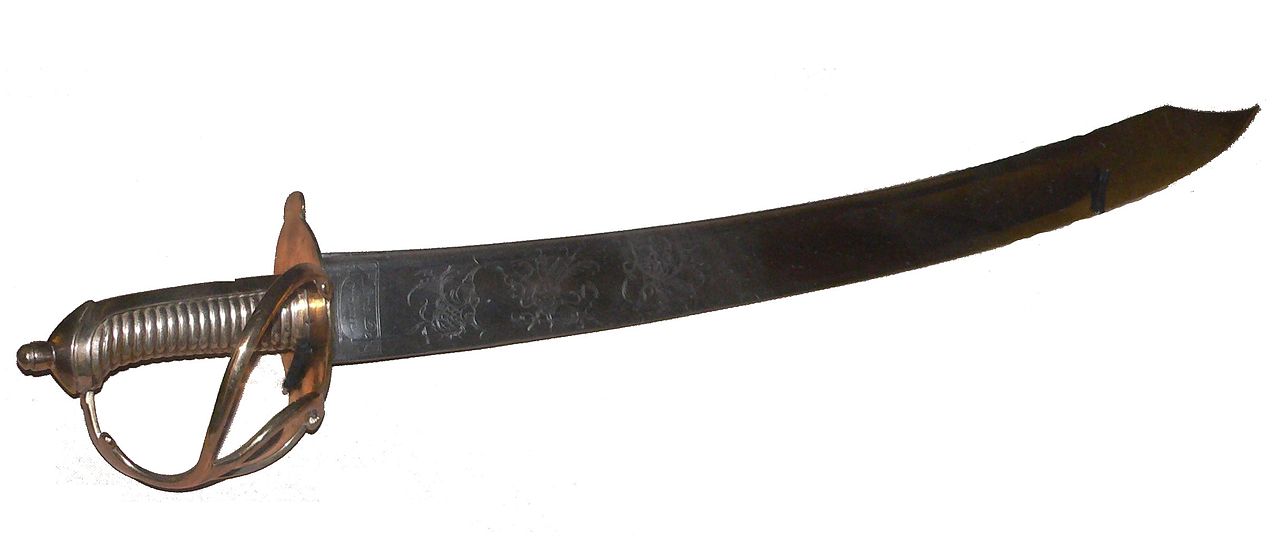
Rama · CC BY-SA 3.0 fr
- Field
- saber and boarding saber.
- Region
- Europe.
VALÉORINE Encyclopedia
VALÉORINE documentary reading
Documentary summary
A cutlass is a short, broad sabre or slashing sword with a straight or slightly curved blade sharpened on the cutting edge and a hilt often featuring a solid cupped or basket-shaped guard. It was a common naval weapon during the Age of Sail.
Admitted source layer · organised and presented by VALÉORINE
Note VALÉORINE
No house-authored Note is published until its assertions and sources pass the VALÉORINE evidence contract. The documentary article remains available in full while that enrichment is being consolidated.
Documentary enrichment in progress · no unsupported statement published
Reference Check
Propose documentary evidence for cutlass. A contribution is never written directly as fact: identity, source, rights and evidence gates still decide.
Sign in to contribute
World of VALÉORINE
Documentary connections
Only confirmed graph relationships appear here. Images are shown only when their identity and reuse rights both pass the documentary gate.


Documentary evidence
Evidence Panel
wikipedia incomplete · checked 25 September 2026
- Identity
- resolved
- Independent source families
- 0
- Admitted assertions
- 0
- Open conflicts
- 0
Authority files
gnd · 135033268 · wikidata · Q1344629 · wikipedia · Cutlass
In this article
Etymology
Etymology
The word "cutlass" developed from the 17th-century English use of coutelas, a 16th-century French word for a machete-like mid-length single-edged blade (the modern French for "knife", in general, is couteau; in 17th- and 18th-century English the word was often spelled "cuttoe"). The French word coutelas may be a convergent development from a Latin root, along with the Italian coltellaccio or cortelazo, meaning "large knife". In Italy, the cortelazo was a similar short, broad-bladed sabre popular during the 16th century. The root coltello, for "knife", derived ultimately from the Latin cultellus meaning "smaller knife", which is the common Latin root for both the Italian and French words. In the English-speaking Caribbean, the word "cutlass" is also used as a word for machete.
History and use
History and use
• Illustration — Cutlasses aboard the frigate Grand Turk • Illustration — François l'Olonnais with a cutlass
Origin
Origin
The cutlass is a 17th-century descendant of the edged short sword, exemplified by the medieval falchion. Woodsmen and soldiers in the 17th and 18th centuries used a similar short and broad backsword called a hanger, or in German a Messer, meaning "knife". Often occurring with the full tang (i.e. slab tang) more typical of daggers than swords in Europe, these blades may ultimately derive through the falchion (facon, falcon, fauchard) from the falx or seax. In England, about 1685 the rather long straight-bladed sword formerly in use began to be superseded by the "hanger". This weapon had a short and more or less curved single-edged blade with a brass hilt of a rather flat double-shell and knuckle-bow. The grip was generally of wood, bound with wire, but some specimens show a brass grip with spiral grooves. These are probably early models. The length of the blade is usually about 24 inches.
History
History
Although also used on land, the cutlass is best known as the sailor's preferred weapon, as it was robust enough to hack or cut through heavy ropes, thick canvas, and dense vegetation while being short enough to be used in relatively close quarters combat, such as during boarding actions, in the rigging, or below decks. Another advantage to the cutlass was its simplicity of use, as it required less training than that required to master a rapier or small sword. Cutlasses are famous for being used by pirates, although there is no reason to believe that Caribbean buccaneers invented them, as has occasionally been claimed. However, the subsequent use of cutlasses by pirates is well documented in contemporary sources, notably by the pirate crews of William Fly, William Kidd, and Stede Bonnet. French historian Alexandre Exquemelin reports the buccaneer François l'Ollonais using a cutlass as early as 1667. Pirates used these weapons for intimidation as much as for combat, often needing no more than to grip their hilts to induce a crew to surrender, or beating captives with the flat of the blade to force their compliance or responsiveness to interrogation. Owing to its versatility, the cutlass was as often an agricultural implement and tool as it was a weapon (cf. machete, to which the same comment applies). It was used commonly in rain forest and sugarcane areas, such as the Caribbean and Central America. In their most simplified form they are held to have become the machete of the Caribbean. The leadcutter sword was a weapon modelled on the cutlass, designed for use in shows and demonstrations of swordsmanship in the late Victorian era. Wilkinson Sword made these swords in four sizes, no. 1 to no. 4, of increasing weight to suit the strength of the user. The leadcutter was so named because in demonstrations it was used to cut a lead bar in half. Wilkinson included a mould for the lead bar with each purchase of their swords.
Modern history
Modern history
In 1830, after a constable of the London Metropolitan Police was shot and stabbed while on duty, the Home Secretary ordered that each police officer in the force "should be issued with a cutlass for his defence"; training in their use was provided at Wellington Barracks. Initially carried while on night duty, they were soon relegated to being kept in the local inspector's office for use in an emergency. Provincial police forces sometimes deployed cutlasses during public disorder, using the hilts and flat edges of the blades to strike rioters, but there is no record of anyone being killed with one. The last recorded issue of police cutlasses was during the Tottenham Outrage, an armed robbery in 1909. In 1936, the British Royal Navy announced that from then on cutlasses would be carried only for ceremonial duties and not used in landing parties. The last recorded use of cutlasses by the Royal Navy is often said to be on 16 February 1940 during the boarding action known as the Altmark Incident. However, this is disbelieved by the majority of the HMS Cossack Association (Cossack was the ship that boarded Altmark) and the authors of British Naval Swords and Swordsmanship. The authors point to another claim, a boarding by HMS Armada in 1952, but disbelieve this one too. In their view, the last use of cutlasses by the Royal Navy was by a shore party in China in 1900. Cutlasses continue to be worn in the Royal Navy by Chief Petty Officers when escorting the White Ensign and by Senior or Leading Ratings as part of an escort at a court-martial. The cutlass remained an official weapon in the United States Navy until it was stricken from the Navy's active inventory in 1949. The cutlass was seldom used for weapons training after the early 1930s. The last new model of cutlass adopted by the US Navy was the US M1917 cutlass, adopted during World War I; it was based on the Dutch M1898 klewang. Although cutlasses were still being made during World War II under the US M1941 designation, this was only a slightly modified variant of the US M1917 cutlass. A US Marine Combat Engineer NCO is reported to have killed an enemy combatant with a US M1941 cutlass at the Battle of Inchon during the Korean War. A cutlass is still carried by the recruit designated as the Recruit Chief Petty Officer for each recruit division while at the US Navy Recruit Training Command. In a message released 31 March 2010, the US Navy approved optional wear of a ceremonial cutlass as part of the Chief Petty Officer dress uniform, pending final design approval. That approval came in January 2011, and the cutlass was made available for ceremonial wear by Chief Petty Officers in August of that same year.
Places
Named by the record
Places
Only places the record itself states, plotted where the house gazetteer settles their coordinates. Nothing is inferred from a name or a nationality.
Europe.
Country
cutlass is associated with Europe.
Country
Primary material
Documents and archives
institutional register
- Wikidata, structured authority record Q1344629: cutlass
Unverified · Wikimedia Foundation
reference work
- “Cutlass”, English Wikipedia, consulted as further reading
Reputable secondary · Wikipedia
Notes from the source article
Cited by Wikipedia
Notes from the source article
These works are cited by the source article, in its own numbering. They are recorded as its citations, not as sources VALÉORINE has verified.
- 1.Wedgwood, Hensleigh. On False Etymologies. Transactions of the Philological Society. 6. 66. 1855.
- 2.Ossian, Rob, The Cutlass (accessed Jan. 25, 2015)
- 3.Cutlass | Etymology, origin and meaning of cutlass by etymonline.
- 4.John Klein, "What Is a Machete, Anyway?", The Atlantic, Oct 21, 2013 (accessed Jan 25 2015)
- 5.Teresa P Blair, A–Z of Jamaican Patois (Patwah), Page 49 Google Books Result
- 6.Robert W. Jones, “The Falchion,” in A Cultural History of the Medieval Sword (Boydell & Brewer, 2023)
- 7.Grotkamp-Schepers et al., The Sword: Form and Thought (Solingen, 2015)
- 8.Ewart Oakeshott, European Weapons and Armour (London, 1980)
- 9.Hopkinson, E. C. The Swords of the British Army. Journal of the Society for Army Historical Research. 11. 44. 238–247. October 1932. 44226060.
- 10.Pirate Weapons. Brethren of the Coast.
- 11.Lawson, John Davis. American State Trials. F.H. Thomas Law Book Co. 668. 1915.
- 12.John Richard Stephens. Captured by Pirates. Barnes & Noble. 6. 2006. 0-7607-8537-6.
- 13.John Richard Stephens. Captured by Pirates. Barnes & Noble. 9. 2006. 0-7607-8537-6.
- 14.John Richard Stephens. Captured by Pirates. Barnes & Noble. 40. 2006. 0-7607-8537-6.
- 15.Mark Barton, John McGrath, British Naval Swords and Swordsmanship, pp. 100–102, Seaforth Publishing, 2013
- 16.Mike Loades, Swords and Swordsmen, ch. 14, Casemate Publishers, 2011
- 17.Ingleton, Roy. Arming the British Police: The Great Debate. Routledge. 1997. 978-0714647418.
- 18.Evans, Donald. Jack the Ripper: Scotland Yard Investigates. The History Press. 2010. 978-0750942294.
- 19.Emsly, Clive. A Short History of Police and Policing. Oxford University Press. 110. 2021. 978-0198844600.
- 20.Royal Navy. 47514. 17. 1936-10-24.
- 21.Mark Barton, John McGrath, British Naval Swords and Swordsmanship, p. 21, Seaforth Publishers, 2013 .
- 22.Royal Navy Digital. RN DRESS TABLES (39A-2). www.royalnavy.mod.uk. October 2013.
- 23.Wagner, Rick. Focus on the M1917/M1941 Cutlass. The Swordcollector.
- 24.Gilkerson, Bill. Boarders Away. Andrew Mowbray Inc. 1: With Steel. 1991. 978-0-917218-50-7.
- 25.Press release (2010-03-31). Uniform Changes Include CPO Cutlass, Ball Caps. United States Navy. Retrieved 2011-01-11.
- 26.Press release (2011-01-25). NAVADMIN 025/11 - Uniform Board Update. United States Navy. Retrieved 2012-03-18.
References
Citations
References
Each reference names the institution holding it, so a reader may go to the document itself.
institutional register
Wikidata, structured authority record Q1344629: cutlassWikimedia Foundation
Partially resolvedreference work
Partially resolved
The Encyclopedia exists whether or not anything is for sale. Corrections are recorded rather than overwritten, and every version of this record is kept. Published 14 August 2026.
Elsewhere in Militaria
6,095 published records in this field, each with its sources named.
- CS/LR4Terminology
- Cugir machine gunTerminology
- culaculaTerminology
- culverinTerminology
- cyberweaponTerminology
- CZ 100Terminology
- CZ 110Terminology
- CZ 2075 RAMITerminology
Best supported in this field
For owners
Own an object connected with cutlass?
A specialist will read what you send and tell you what the house can establish, what it cannot, and whether the object is suited to sale. There is no charge and no obligation. The object stays with you throughout; nothing is shipped to us unless it is arranged in writing beforehand.