
cuíca
The cuíca is a Brazilian friction drum with a large pitch range, produced by changing tension on the head of the drum. Portuguese for the gray four-eyed opossum (Philander opossum) which is known for its high-pitched cry. The cuíca is frequently used in carnivals, as well as often in samba music.
Also recorded as cuica
cuíca

Alno · Self-photographed · CC BY-SA 3.0
- Name
- Cuíca
- Field
- friction drum
- Period
- 1899
- Region
- Brazil
VALÉORINE Encyclopedia
VALÉORINE documentary reading
Documentary summary
The cuíca is a Brazilian friction drum with a large pitch range, produced by changing tension on the head of the drum. Portuguese for the gray four-eyed opossum (Philander opossum) which is known for its high-pitched cry. The cuíca is frequently used in carnivals, as well as often in samba music.
Admitted source layer · organised and presented by VALÉORINE
Note VALÉORINE
No house-authored Note is published until its assertions and sources pass the VALÉORINE evidence contract. The documentary article remains available in full while that enrichment is being consolidated.
Documentary enrichment in progress · no unsupported statement published
Reference Check
Propose documentary evidence for cuíca. A contribution is never written directly as fact: identity, source, rights and evidence gates still decide.
Sign in to contribute
World of VALÉORINE
Documentary connections
Only confirmed graph relationships appear here. Images are shown only when their identity and reuse rights both pass the documentary gate.

Documentary evidence
Evidence Panel
not yet certified
- Identity
- resolved
- Independent source families
- 0
- Admitted assertions
- 0
- Open conflicts
- 0
Authority files
wikidata · Q176926 · wikipedia · Cuíca
In this article
Overview
Overview
The tone it produces has a high-pitched squeaky timbre. It has been called a 'laughing gourd' due to this sound. The General MIDI drum kit provides cuíca sounds at the notes F 5 and G 5. • Illustration — Cuica sound
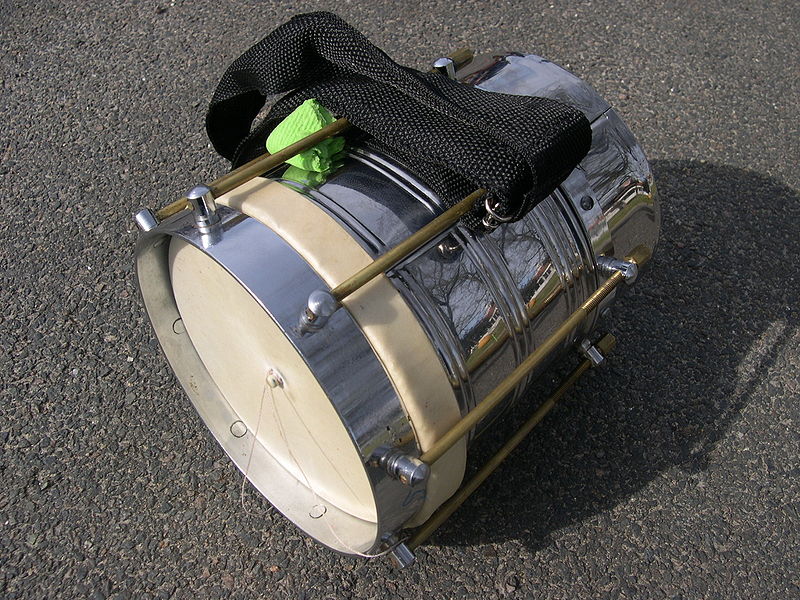
Cuica - Side view.
Alno · Self-photographed
Key facts
Key facts
• Name — Cuíca • Names — Puíta, Quíca • Background — percussion • Classification — Membranophone, single-head tubular drum, conical, ring-screw-mount hardware • Developed — Brazil
History
History
There are a number of styles of pt-BR found around the globe. Its origins are disputed: Different sources trace it to enslaved Bantu people, with instruments like the pwita/kipuita in Angola, to Spain, and to Muslim traders – structurally it is identical, among other instruments in the same category, to the Portuguese sarronca, Spanish zambomba, Catalan simbomba and Balearic ximbomba.
Characteristics
Characteristics
• Illustration — Bottom view and stick of a cuíca The cuíca has a wooden or bamboo stick fastened at one end inside the drum in the center of, and perpendicular to, the drumhead. This stick is rosined and rubbed with a cloth. Changing the pressure on the head of the drum from the outside produces the different pitches and timbres. The body of the cuíca is normally made of metal, gourd or synthetic material. It has a single head, normally 6 to in diameter, made of animal skin. The instrument is held under one arm at chest height with the help of a shoulder strap. To play the cuíca, the stick is rubbed up and down with a wet cloth held in one hand while using the fingers of the other hand to press down on the skin of the drum near the place where the stick is attached. The rubbing motion produces the sound and the pitch is increased or decreased by changing the pressure on the head.
Usage
Usage
The cuíca is used to accompany a variety of different folk and urban popular dances. For example, it may be part of the instrumental ensemble for the Dança de Santa Cruz (Dance of the Holy Cross) celebrated every May in Santa Cruz, California or for the moçambique (Mozambique) dramatic dance, bailado, in Minas Gerais. It also is used in Feast of the Cross (Feast Of The Holy Cross) dances and processions and in samba music and dance performances in rural São Paulo. The cuíca plays an important rhythmic role in samba music of all kinds. It is particularly notable as a fixture of Rio de Janeiro's Carnival groups, which feature entire sections of cuíca players. It is so commonly used in radio-oriented samba music that in the absence of a cuíca player, Brazilian singers or other musicians imitate the sound of the cuíca with their voices. An example of this imitation can be heard on the intro part of Dizzy Gillespie's version of "Chega de Saudade" (from the "Dizzy on the French Riviera" album, 1965) composed by Antônio Carlos Jobim. The cuíca can also be heard played by the Brazilian percussionist Airto Moreira on the 1999 reissue bonus track "Feio", on Miles Davis' album Bitches Brew. The instrument was also used in "Could You Be Loved" by Bob Marley and The Wailers, "Soul Bossa Nova" by Quincy Jones, "Bird of Beauty" by Stevie Wonder, and "Me and Julio Down by the Schoolyard" by Paul Simon. Along with samba, the cuíca is one of the mainly used Brazilian instruments in jazz-rock, free jazz, and Latin jazz.
Chronology
Dated record
Chronology
The full dated record · 2 entries
1899
cuíca first recorded.
1899
cuíca is recorded from 1899.
Places
Named by the record
Places
Only places the record itself states, plotted where the house gazetteer settles their coordinates. Nothing is inferred from a name or a nationality.
- Brazil
Notes from the source article
Cited by Wikipedia
Notes from the source article
These works are cited by the source article, in its own numbering. They are recorded as its citations, not as sources VALÉORINE has verified.
- 1.Schechter, John. Cuica. Grove Music Online. Oxford Music Online. July 2020.
- 2.Cuica. BBC Guide Entry. June 2008.
- 3.Cuica. Grinnell College Music Instrument Collection.
- 4.cuica · Grinnell College Musical Instrument Collection · Grinnell College Libraries. omeka-s.grinnell.edu.
- 5.Kernfeild, Barry. Cuica. The New Grove Dictionary of Jazz, 2nd Edition. Oxford Music Online.
References
Citations
References
Each reference names the institution holding it, so a reader may go to the document itself.
reference work
Partially resolvedreference work
Partially resolved
The Encyclopedia exists whether or not anything is for sale. Corrections are recorded rather than overwritten, and every version of this record is kept. Published 14 August 2026.
Elsewhere in Collectables
20,755 published records in this field, each with its sources named.
- CubittOrganisation
- CuboidWork
- Cuddles the MonkeyTerminology
- CudellOrganisation
- CuldceptWork
- Culdcept RevoltWork
- Culdcept SagaWork
- Culdcept SecondWork
Best supported in this field
For owners
Own an object connected with cuíca?
A specialist will read what you send and tell you what the house can establish, what it cannot, and whether the object is suited to sale. There is no charge and no obligation. The object stays with you throughout; nothing is shipped to us unless it is arranged in writing beforehand.