
Crispijn van de Passe the Younger
Illustration — Backgammon players, first half of the 17th century. Amsterdam University Library • Illustration — Illustration of a narcissus from the Hortus Floridus, published in 1614—1616 • Illustration — Sinne-beeld, tot ’s vaderlands welvaert, 1665. Caricature by Van de Passe showing William III of Orange as the saviour of the fatherland.
Also recorded as Crispijn de Passe (II) · Crispijn de Passe · Crispyn de Pas · Crispyn de Pas (II)
Crispijn van de Passe the Younger
![Serva Modum, “Keep in Measure” (i.e., square your actions) [1]](https://upload.wikimedia.org/wikipedia/commons/thumb/a/a2/Serva_Modum%2C_%E2%80%9CKeep_in_Measure%E2%80%9D_%28i.e.%2C_square_your_actions%29.jpg/554px-Serva_Modum%2C_%E2%80%9CKeep_in_Measure%E2%80%9D_%28i.e.%2C_square_your_actions%29.jpg)
Passe, Crispijn van de-1670 (Engraver) Rollenhagen, Gabriel (1583-1619) (Author) · Public domain
- Nationality
- Germany · Dutch Republic
- Occupation
- engraver · draftsperson · painter · graphic artist · art theorist · publisher · illustrator
- Fields
- allegory · history · portrait
- Languages
- French
VALÉORINE Encyclopedia
VALÉORINE documentary reading
Documentary summary
Illustration — Backgammon players, first half of the 17th century. Amsterdam University Library • Illustration — Illustration of a narcissus from the Hortus Floridus, published in 1614—1616 • Illustration — Sinne-beeld, tot ’s vaderlands welvaert, 1665. Caricature by Van de Passe showing William III of Orange as the saviour of the fatherland.
Admitted source layer · organised and presented by VALÉORINE
Reference Check
Propose documentary evidence for Crispijn van de Passe the Younger. A contribution is never written directly as fact: identity, source, rights and evidence gates still decide.
Sign in to contribute
World of VALÉORINE
Documentary connections
Only confirmed graph relationships appear here. Images are shown only when their identity and reuse rights both pass the documentary gate.
Documentary evidence
Documentary basis
Authority files
wikidata · Q1140201 · wikipedia · Crispijn van de Passe the Younger
In this article
Work
Work
The Dutch Maiden lies sick in bed. After the original print was banned from publication in 1665, Van de Passe created a new version. Rijksmuseum Crispijn (van) de Passe (born 1594/1595 in Cologne — buried 19 January 1670 in Amsterdam), also known as Crispijn (van) de Passe the Younger (Dutch: Crispijn (van) de Passe de Jonge) or Crispijn (van) de Passe (II), was a Dutch Golden Age engraver, draughtsman and publisher of prints. He was a member of the large printmaking Van de Passe family, son of the engraver and print publisher Crispijn van de Passe the Elder.
Steven van Lamsweerde and Anthonie Heeres Sioertsma are recorded as having studied under Crispijn van de Passe the Younger. The recorded working language is French. Subjects and genres recorded for the work are allegory, history and portrait. Places of work recorded in the authority are Utrecht, Paris and Delft. Work by Crispijn van de Passe the Younger is recorded in the collections of Museum Boijmans Van Beuningen, Finnish National Gallery, Museum of Fine Arts Ghent (MSK), Victoria and Albert Museum and Museum Slot Loevestein.
Originally close to his father in artistic style, he began to develop a remarkably fine, sketch-like use of the burin in the 1620s. He produced portraits of a number of prominent European royals and nobles, including the French royal couple Louis XIII and Marie de' Medici. He also portrayed Frederick Henry, Prince of Orange and other prominent members of Dutch society, such as Gerardus Vossius, Johan van Oldenbarnevelt and Piet Hein. In addition to portraits, he produced engravings of Biblical and historical themes and book illustrations. He created 60 engravings for an influential work on dressage, Maneige royal by Antoine de Pluvinel (Paris, 1623), later published under the title L'Instruction du Roy en l'exercice de monter à cheval. Van de Passe's own Hortus Floridus, published in 1614—1616, was a collection of 160 engravings depicting flowering plants. The work was so popular that the original Latin edition was translated into Dutch, French and English. His Les vrais pourtraits de quelques unes des plus grandes dames da la chrestiente (1640) contained two verses dedicated to his sister, the engraver Magdalena van de Passe, who had died two years earlier. In 1643—1644 Joan Blaeu published Van de Passe's Van 't Licht der teken en schilderkonst., a book teaching drawing techniques. Prints and other works by Van de Passe are in the collections of the Rijksmuseum in Amsterdam, Museum Boijmans Van Beuningen in Rotterdam, the Centraal Museum in Utrecht, the Metropolitan Museum of Art in New York City, the National Portrait Gallery in London and the National Gallery of Denmark in Copenhagen, among others.
Biography
Biography
Van de Passe was a son of engraver and print publisher Crispijn van de Passe the Elder (1564—1637), a Mennonite from Zeeland who had fled from Antwerp to Germany, and Magdalena de Bock (died in 1635). Van de Passe was born during the period (1589—1611) when the family lived in Cologne. In 1611, the family was forced to leave Cologne and moved to Utrecht, where he, along with his brothers Simon (1595—1647) and Willem (c. 1597—c. 1637) and sister Magdalena (1600—1638) learned the art of engraving in their father's workshop. Other than his siblings, Van de Passe focused on France rather than England. He was active in Paris from 1618 to 1630, when he returned to Utrecht. In 1639, he spent some time in Delft and Copenhagen before settling in Amsterdam, where he remained until his death in 1670. In 1648 he married Geertraut van dem Brauch, also known as Geertruyt van den Broeck, who hailed from the German town of Solingen. Van de Passe found little success as an engraver in Amsterdam and died in poverty. He was buried in Amsterdam on 19 January 1670.
Identity and origins
Identity and origins
The authorities additionally record the headings Crispijn de Passe (II), Crispijn de Passe, Crispyn de Pas, Crispyn de Pas (II) and Crispijn van de Passe. His recorded language was French. He was the child of Crispijn van de Passe the Elder.
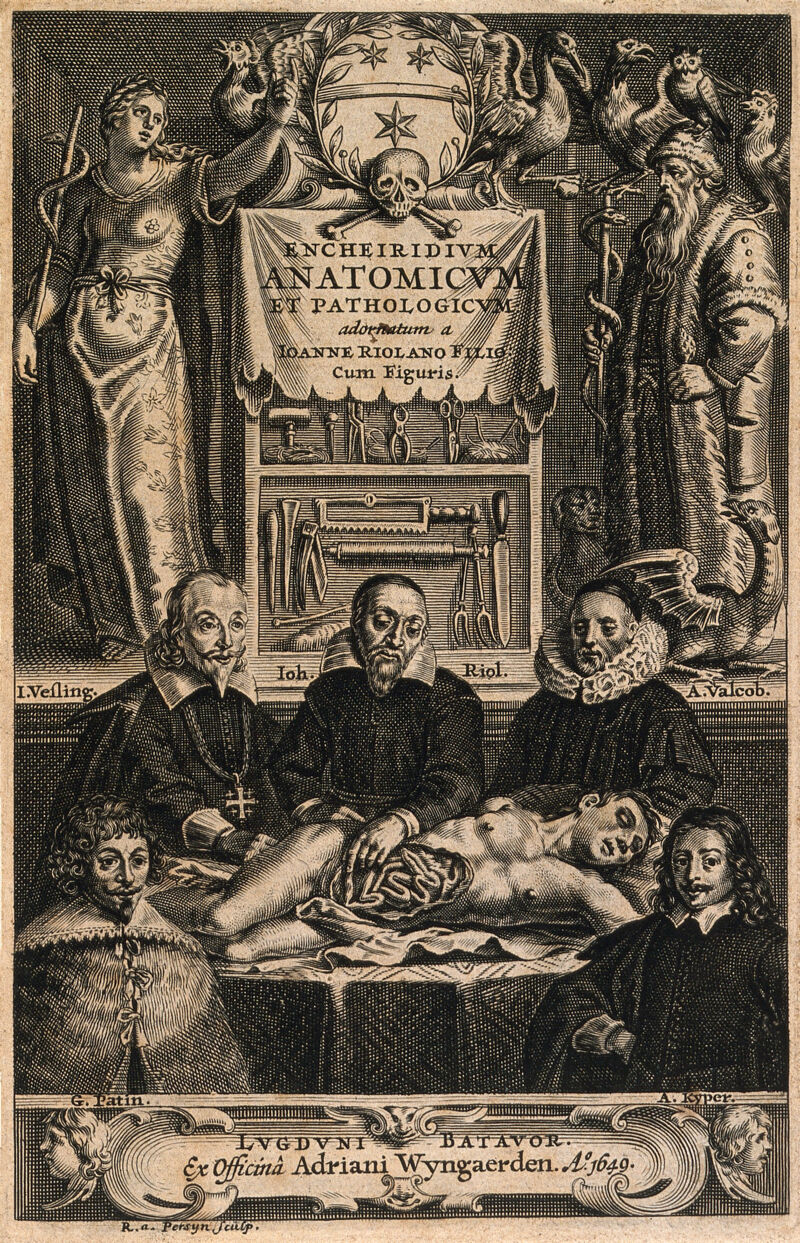
An anatomical dissection by Jean Riolan the younger (1580-1657). Engraving of 1649 by Renier van Persyn after a design of 1626 by Crispijn de Passe the second., 1649, by Crispijn van de Passe the Younger
Crispijn van de Passe the Younger · Wellcome Collection, London · Wellcome Collection
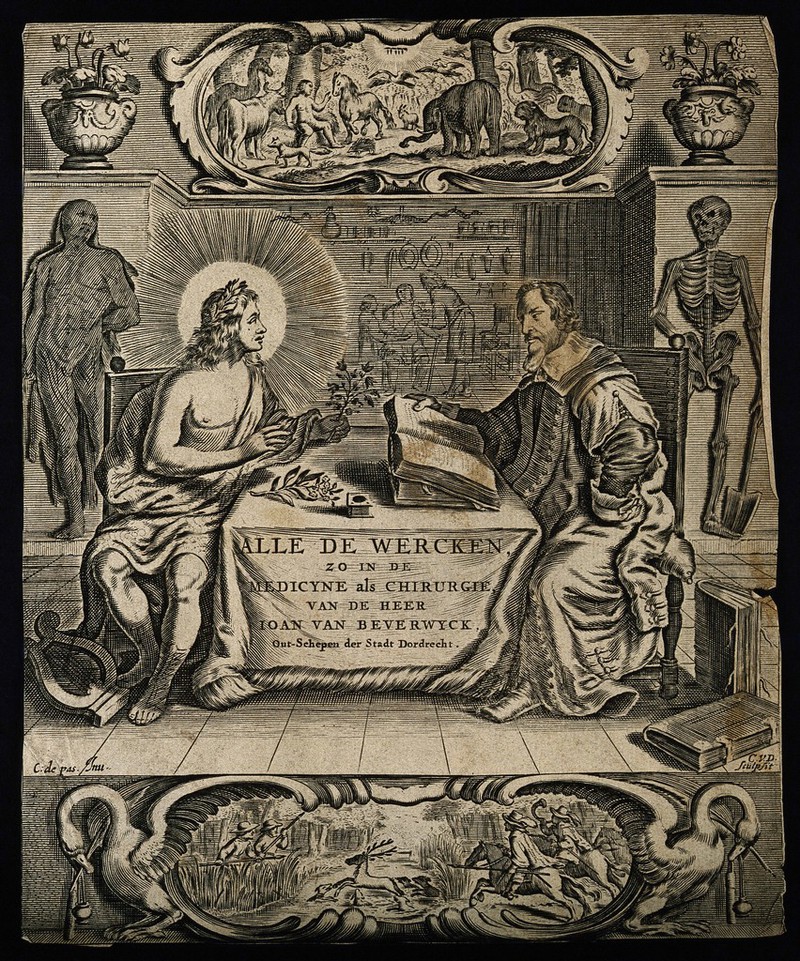
Johan van Beverwijk: he converses with Apollo about medicinal plants, while surrounded by attributes of botany, anatomy and surgery. Line engraving by C. van Dalen the younger (?) after C. de Passe the younger (?), 1656., 1656, by Crispijn van de Passe the Younger
Crispijn van de Passe the Younger · Wellcome Collection, London · Wellcome Collection
Life and career
Dated record
Life and career
The full dated record · 2 entries
1593
Crispijn van de Passe the Younger born at Cologne.
1670
Crispijn van de Passe the Younger died at Amsterdam.
Places
Named by the record
Places
Only places the record itself states, plotted where the house gazetteer settles their coordinates. Nothing is inferred from a name or a nationality.
Cologne.
Birth place
Amsterdam.
Death place
Notes from the source article
Cited by Wikipedia
Notes from the source article
These works are cited by the source article, in its own numbering. They are recorded as its citations, not as sources VALÉORINE has verified.
- 1."Crispijn de Passe (II)", RKD
- 2."(van) Crispijn de Passe", The Concise Grove Dictionary of Art, Oxford University Press, 2002 (archived)
- 3."2012 July Book of the Month", Edward Worth Library
- 4.The work was translated into Dutch under the title Ware afbeeldinghe van eenige der aldergrootste ende doorluchtigste vrouwen van heel christenrijck, vertoont in gedaente als herderinnen.
- 5.Ilja Veldman, "Passe, Magdalena de", in: Digitaal Vrouwenlexicon van Nederland (Dutch)
- 6.A facsimile edition with the introduction by J. Bolten was published in 1973 by Davaco Publishers.
- 7.Eric Jan Sluijter, Rembrandt and the Female Nude, Amsterdam University Press, 2006
- 8."Crispijn de Passe the Younger (1594-circa 1670), Printmaker", National Portrait Gallery
- 9."Crispyn de Passe II", ECARTICO, University of Amsterdam
Bibliography printed in the source article · 2
- Ilja M. Veldman, "Een riskant beroep, Crispijn de Passe de Jonge als producent van nieuwsprenten", in Jan de Jong, Mark Meadow, Bart Ramakers en Frits Scholten (ed.), Prentwerk/Print Work, 1500-1700, Zwolle, 2002, pp. 155–185 (Dutch)
- llja M. Veldman, Crispijn de Passe and his Progeny (1564-1670), Studies in prints and printmaking, vol. 3. Rotterdam: Sounds & Vision Publ., 2001
References
Citations
References
Each reference names the institution holding it, so a reader may go to the document itself.
reference work
Secondary witnessreference work
Secondary witness
Further particulars
Held on the record
Further particulars
Open the remaining particulars
Formation and teaching. Each of those relationships is stated by the authority record rather than inferred from style. Recorded as engraver, draftsperson, painter, graphic artist and art theorist.
Recognition and collections
Work by Crispijn van de Passe the Younger is
Museum Boijmans Van Beuningen, Finnish National Gallery, Museum of Fine Arts Ghent (MSK) and Victoria and Albert Museum
The Encyclopedia exists whether or not anything is for sale. Corrections are recorded rather than overwritten, and every version of this record is kept. Published 16 August 2026.
Elsewhere in Prints
4,138 published records in this field, each with its sources named.
- Cosmo ArmstrongEngraver
- Costanzo AngeliniEngraver
- Craig KauffmanEngraver
- Crescenzio OnofriEngraver
- Cristofano BerardiEngraver
- Cristoforo CoriolanoEngraver
- Cristoforo Dall'AcquaEngraver
- Cristoforo FoppaEngraver
Best supported in this field
For owners
Own a work by Crispijn van de Passe the Younger?
A specialist will read what you send and tell you what the house can establish, what it cannot, and whether the object is suited to sale. There is no charge and no obligation. The object stays with you throughout; nothing is shipped to us unless it is arranged in writing beforehand.