
Cracked Ice screen
Illustration — Maruyama Ōkyo, Cracked Ice, late 18th century, British Museum The Cracked Ice screen is a late 18th-century low two-fold Japanese screen (byōbu) intended for use at the Japanese tea ceremony. It was created in the Edo period and is signed and sealed by the artist, Maruyama Ōkyo (1733–1795), founder of the Maruyama school of realist painting. It would be used as a furosaki byōbu (風炉先屏風, literally "furnace folding screen") placed near the hearth of a room used for the Japanese tea ceremony, shielding the fire from draughts and also forming a decorative backdrop behind the tea utensils (茶道具, chadōgu).
Cracked Ice screen
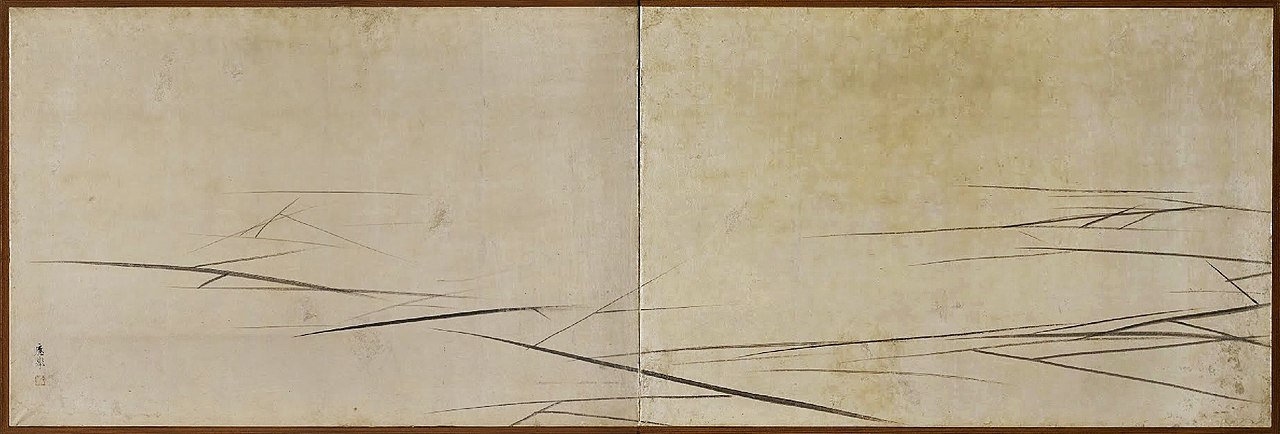
Maruyama Okyo · http: assetid=35363001 objectid=781277 · Public domain
VALÉORINE Encyclopedia
VALÉORINE documentary reading
Documentary summary
Illustration — Maruyama Ōkyo, Cracked Ice, late 18th century, British Museum The Cracked Ice screen is a late 18th-century low two-fold Japanese screen (byōbu) intended for use at the Japanese tea ceremony. It was created in the Edo period and is signed and sealed by the artist, Maruyama Ōkyo (1733–1795), founder of the Maruyama school of realist painting. It would be used as a furosaki byōbu (風炉先屏風, literally "furnace folding screen") placed near the hearth of a room used for the Japanese tea ceremony, shielding the fire from draughts and also forming a decorative backdrop behind the tea utensils (茶道具, chadōgu).
Admitted source layer · organised and presented by VALÉORINE
Reference Check
Propose documentary evidence for Cracked Ice screen. A contribution is never written directly as fact: identity, source, rights and evidence gates still decide.
Sign in to contribute
Documentary evidence
Documentary basis
Authority files
wikidata · Q103793460 · wikipedia · Cracked Ice screen
In this article
Overview
It may have been intended to be used in the summer, to evoke the cool of the winter. The low screen has a frame of unvarnished cedar wood measuring which holds two paper panels, mostly white with a few bold markings of black ink and flecks of glittering mica, indicating an expanse of ice on a lake which is cracking, receding into the distance. It is signed and sealed "應擧" (Ōkyo). The minimal composition is typical of that portion of the Edo period and is an early example of the influence of Western painting on Japanese art. Ōkyo had been commissioned to make new artworks with a Western vanishing point, learning the technique from Rangaku or "Dutch Studies", and he employed his new skill with this screen. The screen was bought by the British Museum in 1982 from Milne Henderson Fine Art. An inscription on its box indicates that it was owned at one time by the Maekawa family.
It is recorded as the work of Maruyama Ōkyo. It is recorded in the collection of British Museum.
Citations
References
Each reference names the institution holding it, so a reader may go to the document itself.
reference work
Secondary witnessreference work
Secondary witness
The Encyclopedia exists whether or not anything is for sale. Corrections are recorded rather than overwritten, and every version of this record is kept. Published 16 August 2026.
Elsewhere in Furniture
924 published records in this field, each with its sources named.
- Coronation of the VirginTerminology
- counterTerminology
- countertopTerminology
- court cupboardTerminology
- cradleTerminology
- credence tableTerminology
- credenzaTerminology
- crepe makerTerminology
Best supported in this field
For owners
Own an object connected with Cracked Ice screen?
A specialist will read what you send and tell you what the house can establish, what it cannot, and whether the object is suited to sale. There is no charge and no obligation. The object stays with you throughout; nothing is shipped to us unless it is arranged in writing beforehand.