
Chrystian Piotr Aigner
Illustration — Chrystian Piotr Aigner Chrystian Piotr Aigner (1756 in Puławy, Poland – 9 February 1841 in Florence, Italy) was a Polish architect and theoretician of architecture.
Also recorded as Christian Piotr Aigner · Chrystian Piotr Aiger
Chrystian Piotr Aigner

Grzegorz Hałaś, Ghalas · CC BY-SA 3.0
- Born
- 1756 · Puławy.
- Died
- 1841 · Florence.
- Nationality
- Polish–Lithuanian Commonwealth · Duchy of Warsaw · Congress Poland
- Occupation
- architect
- Movements
- Classicism
- Known for
- St. Anne's Church
- Honours
- Order of Saint Stanislaus and 3rd class
VALÉORINE Encyclopedia
VALÉORINE documentary reading
Documentary summary
Illustration — Chrystian Piotr Aigner Chrystian Piotr Aigner (1756 in Puławy, Poland – 9 February 1841 in Florence, Italy) was a Polish architect and theoretician of architecture.
Admitted source layer · organised and presented by VALÉORINE
Note VALÉORINE
No house-authored Note is published until its assertions and sources pass the VALÉORINE evidence contract. The documentary article remains available in full while that enrichment is being consolidated.
Documentary enrichment in progress · no unsupported statement published
Reference Check
Propose documentary evidence for Chrystian Piotr Aigner. A contribution is never written directly as fact: identity, source, rights and evidence gates still decide.
Sign in to contribute
World of VALÉORINE
Documentary connections
Only confirmed graph relationships appear here. Images are shown only when their identity and reuse rights both pass the documentary gate.
Documentary evidence
Evidence Panel
not yet certified
- Identity
- resolved
- Independent source families
- 0
- Admitted assertions
- 0
- Open conflicts
- 0
Authority files
wikidata · Q327193 · wikipedia · Chrystian Piotr Aigner
In this article
Life
Life
Chrystian Piotr Aigner acquired extensive knowledge of architecture in the course of several journeys to Italy that he made in the company of his patron and subsequent collaborator and friend Stanisław Kostka Potocki. He studied in Italy. Later, during a long association with the city of Warsaw, he created many Classicist buildings in the Polish capital. A member of Rome's Academy of St. Luke, and of the Warsaw Society of Friends of Learning, and from 1817 a professor of architecture at Warsaw University, he was active in Warsaw until 1825 and in Kraków before leaving for Italy for good in 1827. Aigner at first applied the decorative forms of early Neoclassicism (Marynka's Palace in Puławy) or made reference to the works of Andrea Palladio (the façade of St. Anne's Church in Warsaw). In a later period, he reworked patterns drawn directly from the architecture of Antiquity (the Puławy parish church; St. Alexander's Church in Warsaw), and even erected Neogothic structures (the Gothic House in Puławy). He also published a pattern book, Budowy kościołów... (Church Building...), which exerted a great influence on Polish sacral architecture in the first half of the 19th century. Aigner's work represents a mature classicism, inspired directly by Italian influences, and later enriched by Empire and Romantic influences. The Romantic influences, reflecting a growing interest in Poland's past, were expressed chiefly through the use of Neogothic forms and enriched spatial arrangements (palaces with rotunda in a corner). His theoretical writings include "Rozprawa o świątyniach u starożytnych i o słowiańskich," Roczniki Towarzystwa Warszawskiego Przyjaciół Nauk ("A Treatise on Ancient and Slavic Temples," Annals of the Warsaw Society of Friends of Learning), 1808. During the Kościuszko Uprising, Aigner wrote "Krótka nauka o kosach i pikach" ("A Brief Treatise on Scythes and Pikes"), which provided a theory for operating on the field of battle with formations of scythemen and pikemen.
Works
Works
• Classicist palace in Olesin, Puławy County (1782–1830), with Stanisław Kostka Potocki • Palace in Igołomia • Palace in Zarzecze, Przeworsk County • Remodeling of Łańcut Castle • Church in Międzyrzec Podlaski • Czartoryski residence in Puławy (Church of the Assumption, Gothic House, Temple of the Sibyl, Marynka's Palace), 1785–1810 • Church of St. Alexander in Suwałki • Church of the Holy Apostles Peter and Paul in Żyrzyn • Epitaph of Kraków Bishop Kajetan Sołtyk in Wawel Cathedral • Classicist manor house in Bachorza In Warsaw: • Krasiński Palace in Ursynów (1785–86), with Stanisław Kostka Potocki, rebuilt in 1858 by Zygmunt Rozpędowski • Remodeling of Leszno, Warsaw, palace (1785–88), probably only the interiors • St. Alexander's Church, 1818–25 • Façade of St. Anne's Church (1786–88), with Stanisław Kostka Potocki; rebuilding of bell tower, 1816 • Façade of St. Andrew's Church • Remodeling of the Warsaw Arsenal (1792) • Remodeling of main entrance hall at Wilanów Palace (1792) • Villa of Izabela Lubomirska at Krzeszowice (1792) • Library of Ignacy Potocki (1788), no longer extant, at site of Warsaw's Hotel Bristol • Remodeling of Natolin Palace (1808) • Morysin Summer Palace, near Wilanów, with Stanisław Kostka Potocki • Mint on ulica Bielańska (demolished in 1905 by Russian Imperial authorities) • Warsaw University Astronomical Observatory • Remodeling of the Presidential Palace (formerly, "Viceregal Palace"), 1818–19
Gallery
Gallery
• Illustration — Czartoryski palace, Puławy • Illustration — Marynka's Palace, Puławy • Illustration — Temple of the Sibyl, Puławy • Illustration — Church of the Assumption, Puławy • Illustration — Gothic House, Puławy • Illustration — Presidential Palace, Warsaw • Illustration — St. Alexander's Church, Warsaw • Illustration — St. Anne's Church, Warsaw • Illustration — Warsaw University Astronomical Observatory • Illustration — Łańcut Castle • Illustration — St. Nicholas' Church, in Międzyrzec Podlaski. Neoclassicist façade by Aigner.
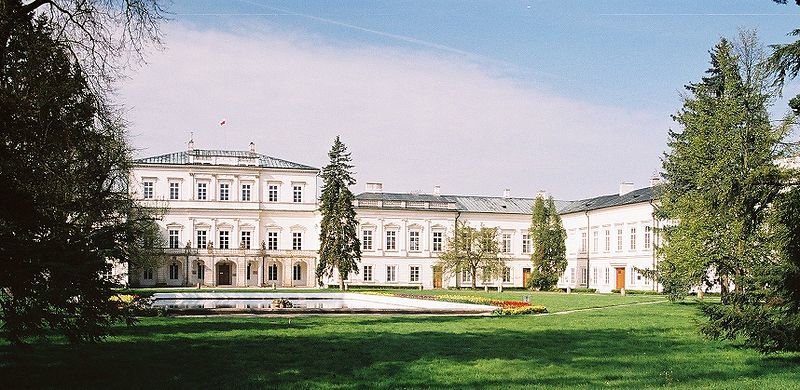
Pałac Czartoryskich in Puławy, Poland; view from courtyard at the central part of the palace
Grzegorz Hałaś, Ghalas

Rys z regulaminu Piotra Aignera Krótka nauka o pikach i kosach'
Piotr Aigner · Self-scanned
Life and career
Dated record
Life and career
Explore 1756–1841
The full dated record · 4 entries
1756
Chrystian Piotr Aigner born at Puławy.
1776
Pałac Ursynów is dated 1776.
1777
Water reservoir in Łazienki is dated 1777.
1841
Chrystian Piotr Aigner died at Florence.
Places
Named by the record
Places
Only places the record itself states, plotted where the house gazetteer settles their coordinates. Nothing is inferred from a name or a nationality.
Puławy.
Birth place
Florence.
Death place
Primary material
Documents and archives
reference work
- Wikidata, structured authority record Q327193: Chrystian Piotr Aigner
Reputable secondary · Wikimedia Foundation
- “Chrystian Piotr Aigner”, English Wikipedia, consulted as further reading
Reputable secondary · Wikipedia
scholarly publication
Citations
References
Each reference names the institution holding it, so a reader may go to the document itself.
scholarly publication
Verifiedreference work
Wikidata, structured authority record Q327193: Chrystian Piotr AignerWikimedia Foundation
Partially resolvedreference work
Partially resolved
The Encyclopedia exists whether or not anything is for sale. Corrections are recorded rather than overwritten, and every version of this record is kept. Published 14 August 2026.
Elsewhere in Design
11,558 published records in this field, each with its sources named.
- Christopher PorterDesigner
- Christopher WebbDesigner
- Christopher WernerDesigner
- Christopher WrenDesigner
- Chu Kim DucDesigner
- Chuck HobermanDesigner
- Ciarán MackelDesigner
- CicadaDesigner
Best supported in this field
For owners
Own a work by Chrystian Piotr Aigner?
A specialist will read what you send and tell you what the house can establish, what it cannot, and whether the object is suited to sale. There is no charge and no obligation. The object stays with you throughout; nothing is shipped to us unless it is arranged in writing beforehand.