
Christian Kracht
Christian Kracht (German pronunciation: [ˈkraxt]; born 29 December 1966) is a Swiss author, journalist, and screenwriter. His writing deals with key themes of popular culture and consumerism, and his novels often show disillusioned conclusions. His work has been subject to some critical controversy.
Christian Kracht

Amrei-Marie · CC BY-SA 4.0
- Nationality
- Switzerland and Germany.
- Occupation
- journalist, writer and screenwriter.
- Fields
- creative and professional writing, prose, journalism and film screenwriting.
- Education
- Sarah Lawrence College, Schule Schloss Salem and Lakefield College School.
- Known for
- I'll be here in sunshine and in shadow, Faserland, Imperium, The Dead and 1979.
- Honours
- Swiss Book Prize, Wilhelm Raabe Literature Prize, Hermann-Hesse-Preis, Axel-Springer-Preis, Phantastik-Preis der Stadt Wetzlar and Preis der deutschen Filmkritik.
- Languages
- German.
VALÉORINE Encyclopedia
VALÉORINE documentary reading
Documentary summary
Christian Kracht (German pronunciation: [ˈkraxt]; born 29 December 1966) is a Swiss author, journalist, and screenwriter. His writing deals with key themes of popular culture and consumerism, and his novels often show disillusioned conclusions. His work has been subject to some critical controversy.
Admitted source layer · organised and presented by VALÉORINE
Note VALÉORINE
Christian Kracht (born 1966) is a film screenwriter, journalist and science fiction writer, among other activities, of German and Swiss nationality. The film screenwriter was born in Saanen.
Christian Kracht was educated at Lakefield College School, Sarah Lawrence College and Schule Schloss Salem. The film screenwriter worked for Jahreszeiten Verlag and Spiegel-Verlag. Activity centred on creative and professional writing, film screenwriting and journalism.
Among the works are 1979, Faserland, I'll be here in sunshine and in shadow and Imperium, among others. The work spans fiction, pop and pop literature. Languages used include German. Honours include Axel-Springer-Preis, Hermann-Hesse-Preis and Phantastik-Preis der Stadt Wetzlar, among others.
Composed from admitted, traceable facts · 26 September 2026
VALÉORINE
Reference Check
Propose documentary evidence for Christian Kracht. A contribution is never written directly as fact: identity, source, rights and evidence gates still decide.
Sign in to contribute
World of VALÉORINE
Documentary connections
Only confirmed graph relationships appear here. Images are shown only when their identity and reuse rights both pass the documentary gate.
Documentary evidence
Evidence Panel
not yet certified
- Identity
- resolved
- Independent source families
- 0
- Admitted assertions
- 0
- Open conflicts
- 0
Authority files
gnd · 115692751X · wikidata · Q123242 · wikipedia · Christian Kracht
In this article
Early life
Early life
His books have been translated into more than 30 languages.
Christian Kracht studied at Sarah Lawrence College, Schule Schloss Salem and Lakefield College School. The recorded working language is German. The field of work recorded is creative and professional writing, prose and journalism. Subjects and genres recorded for the work are fiction and pop. Employment is recorded with Spiegel-Verlag and Jahreszeiten Verlag. Works named in the authority record are I'll be here in sunshine and in shadow, Faserland, Imperium, The Dead and 1979. Distinctions recorded are Swiss Book Prize, Wilhelm Raabe Literature Prize, Hermann-Hesse-Preis and Axel-Springer-Preis.
Kracht was born in Saanen in the Canton of Bern. Kracht's father, Christian Kracht Sr., was chief representative for the Axel Springer publishing company in the 1960s. Kracht attended Schule Schloss Salem in Baden-Württemberg, Germany and Lakefield College School in Ontario, Canada. He graduated from Sarah Lawrence College, New York, in 1989.
Journalistic career
Journalistic career
Kracht worked as a journalist for a number of magazines and newspapers in Germany, including Der Spiegel. In the mid-1990s, he lived and worked in New Delhi as Spiegel's Indian correspondent. Kracht then moved to Bangkok, from where he visited various other countries in South East Asia and authored travel vignettes which were serialised in the Welt am Sonntag newspaper, and in 2000, collated in the book Der gelbe Bleistift (The Yellow Pencil). In November 2006, Kracht was a regular columnist for the newspaper Frankfurter Allgemeine Zeitung. His fortnightly column, which originally had the title Letter from..., later changed to Letter from the Past. He also traveled to and wrote pieces on the Panjshir Valley, Mogadishu, Mount Kilimanjaro and about the Safavid architecture of Imam Ali Shrine in Iraq. In 1998, he worked with Eckhart Nickel to co-author Ferien für immer (A permanent vacation), collated musings on "the most pleasant places on earth". In 1999, Kracht took part in the performance piece Tristesse Royale with Benjamin von Stuckrad-Barre, Joachim Bessing, Eckhart Nickel, and Alexander, Count of Schönburg-Glauchau. The book is an edited transcript of a recording made by the contributors in which they discuss globalised popular culture while staying at Berlin's Hotel Adlon. For some commentators, this publication constituted the high-water mark of so-called Popliteratur – a literary marketing phenomenon for which Kracht was the supposed figurehead. The author has repeatedly distanced himself from this epithet and has, for example, refused permission for his work to be republished in an anthology of that genre. This notwithstanding, Kracht was the editor of the anthology Mesopotamia – a collection of short stories, fragments and photo montages by authors associated with the pop literature, including Rainald Goetz, Andreas Neumeister and Benjamin von Stuckrad-Barre. First published with the subtitle "Ernste Geschichten am Ende des Jahrtausends" ("Serious stories at the turn of the Millennium"), this subtitle was dropped in its 2001 republication by Deutsche Taschenbuch Verlag in favour of an "Avant-Pop-Reader." The relabeling notably coincided with the deflating currency of the term "pop literature" in the early years of the new century. Between September 2004 and June 2006, Kracht published the independent literary magazine Der Freund in collaboration with Eckhart Nickel. He initially lived in Kathmandu while working as the magazine's editor before leaving Nepal during a period of political unrest. The chiefly German-language magazine was ultimately completed in San Francisco with a total of eight editions as originally planned. The magazine featured regular contributions from Hans-Ulrich Obrist and Ingo Niermann. In February 2007, he published Metan (Methane) as the product of a climbing expedition on Kilimanjaro with Ingo Niermann. The book posits that the effects of methane gas on the Earth's atmosphere are part of a vast cosmic conspiracy. Early reviews varied from the critical to the bewildered, one describing it as "großer Quatsch" ("a load of nonsense"). Another reviewer refers to the book as a parody of "alarmism" and suggested it should be taken as a joke: "But if this book is taken as a joke, it probably is not a bad one". In 2012, Kracht published an exchange of letters with David Woodard entitled Five Years. Although this text is essentially a performance piece, certain episodes in their correspondence were deemed controversial, especially references to Nueva Germania. In February 2012, Georg Diez opined in Der Spiegel that Five Years exposed racist, right-wing sympathies supposedly present in Kracht's latest novel Imperium. This view was widely contested by established critics and authors alike during a sustained literary debate in German-language newspapers and magazines.
Personal life
Personal life
Kracht is married to German film director Frauke Finsterwalder with whom he has a daughter who was born in 2009. They live in Zurich.
Novels
Novels
The protagonists of Kracht's fiction embark on journeys that take them in search of an elusive moment of immersive, utopian experience or spiritual enlightenment often located in a different nation or culture. Their journey usually, but not always, results in disappointment, failure or even death. The theme of travel was introduced in Kracht's debut novel, Faserland (1995). While the first wave of the novel's criticism identified Faserland as a novel about the affirmation of brand names and consumer culture, a second wave of criticism suggested that the novels evinces the protagonist's dissatisfaction with his lifestyle and existential "ennui". Early criticism of the novel suggested the influence of Bret Easton Ellis on his work, with some commentators even accusing him of plagiarism. Since the critical re-evaluation of Faserland, however, critics have observed the potential influence on his work by younger German-language writers such as Leif Randt with his 2011 novel Schimmernder Dunst über Coby County (The glistening haze over Coby County). The setting of Kracht's second novel 1979 is Iran. It begins in medias res against the backdrop of the revolution of the Ayatollah Khomeini during the titular year. This novel also deals with alienation and a chiefly Western form of consumer existence, but it depicts the fragility of an apparently decadent Western-metropolitan value system and its powerlessness before the Eastern-totalitarian models of Islam and Maoism. After the supposed frivolousness of Faserland, Kracht was now seen as on the way "towards genuine seriousness" in his writing, a view held by critics that was no doubt informed by the context of the September 11 attacks with which the novel's publication coincided. Kracht is skeptical about such a reading of his work and argues that he writes literary "light entertainment" and "comedies." Thus, during a television appearance on the popular Harald Schmidt show in 2001, Kracht argued that his book was essentially kitsch. His 2008 novel Ich werde hier sein im Sonnenschein und im Schatten (I will be here in sunshine and in shadow) imagines an alternative history of the twentieth century in which Lenin never returned to Russia from Switzerland, but instead founded a Swiss Soviet Republic – a communist state engaged in the colonization of Africa and in perpetual war with other totalitarian empires, notably with a federation of British and German fascists. Channeling Philip K. Dick's The Man in the High Castle and Ford Coppola's Apocalypse Now, the plot of the novel traces a black Swiss political commissar's journey to the heart of the empire to arrest the rogue officer Brazhinsky in the Réduit. It quickly garnered acclaim in the German-speaking literary world. Broadsheet Die Welt called it a "glorious horror story." The Süddeutsche Zeitung praised the writing as not only deeply reminiscent of Ernst Jünger, but also as the "most beautiful German prose currently on offer." But the Frankfurter Rundschau reviewer discounted Ich werde hier sein as "simply moronic," and Die Tageszeitung found the text to be too diffuse and incoherent, amounting to just "drug-clouded scenery." Kracht's 2012 novel Imperium follows on from Ich werde hier sein im Sonnenschein und im Schatten both in its critical reception and as a reimagining of history. In this sense, the novel bears some similarity to Die Vermessung der Welt (Measuring the World) by Daniel Kehlmann, an author with whom Kracht corresponded while composing Imperium. The novel follows the travails of the historical figure August Engelhardt in the Bismarck Archipelago (now Papua New Guinea) at the beginning of the twentieth century. Engelhardt is an idealistic German emigrant who establishes a plantation on an island and founds a colony of "cocovoress:" radical vegetarians nourished exclusively by coconuts. Engelhardt's history is interspersed with cameo appearances by other figures from German cultural history, such as Hermann Hesse, Thomas Mann and Franz Kafka. The first of Kracht's novels not to be narrated in the first-person, the omniscient narrator informs readers of the protagonist's thoughts and contextualizes Engelhardt's life within the broader scope of twentieth-century history. Imperium created a stir in Germany even before its publication; writing in Der Spiegel, critic Georg Diez suggested that the novel "above all shows the author's proximity to extreme right-wing ideas." The accusation of racism levelled at Kracht was repudiated by other figures in the literary industry, including publisher Helge Malchow and fellow authors such as Daniel Kehlmann, Feridun Zaimoğlu, Necla Kelek and Elfriede Jelinek. Reviews of Imperium in the German-language press praised the novel's language, and it has been favourably compared to Joseph Conrad's Heart of Darkness in terms of both theme and style. Imperium has been translated into over 25 different languages, including English.
Stage adaptations and screenplays
Stage adaptations and screenplays
Since 2004, a stage version of the novel 1979 directed by Matthias Hartmann has been performed in theatres in Zurich, Bochum and Hannover. In 2009, the play was shown at the Burgtheater in Vienna, while a stage version of Ich werde hier sein im Sonnenschein und im Schatten has been performed at theatres in Basel, Stuttgart and Berlin. In 2015, a dramatized version of Imperium premiered at Thalia Theater in Hamburg, Germany. A stage version of The Dead premiered in December 2017 at Bern Theatre in Switzerland's capital. Kracht co-authored the screenplay for the 2013 film Finsterworld, which was directed by his wife Frauke Finsterwalder. The couple also co-wrote the screenplay for Finsterwalder's second feature film, Sisi & I, a biopic about Empress Elisabeth of Austria, premiered at the 73rd Berlin Film Festival on 19 February 2023. Kracht's 2021 novel Eurotrash was adapted for the stage by Jan Bosse at Schaubühne, Berlin, premiering on 18 November 2021 where it has been running continuously. Different adaptations have been brought to the stage by Israeli director Itay Tiran at Burgtheater in Vienna, and by Austrian director Stefan Pucher at Thalia Theater (Hamburg). A Swedish version is currently playing at Stockholm's Teater Galeasen. An English language version is in production at the Young Vic Theatre in London, starring Kathryn Hunter and Ben Wishaw. A film version of Eurotrash is currently in production, directed by Finsterwalder, starring Barbara Sukowa, Alexander Fehling and Luna Wedler.
Distinctions
Distinctions
1993 – Axel Springer Prize for Young Journalists 2009 – Phantastik-Preis der Stadt Wetzlar 2012 – Literaturpreis des Kantons Bern 2012 – Wilhelm Raabe Literature Prize In the words of the awarding jury, Imperium "balances on the border between humour and horror... with great confidence and so forms a significant twist in the tapestry of contemporary German-language literature". 2014 – The Extraordinary Book Award 2016 – Swiss Book Prize 2016 – Hermann-Hesse-Preis 2017 – nominated for the International Dublin Literary Award 2019 – nominated for the Prix Médicis 2021 – shortlisted for the German Book Prize 2021 – Swiss Literature Awards 2022 – Wolfgang Koeppen Prize 2025 – Eurotrash, translated by Daniel Bowles, longlisted for the International Booker Prize
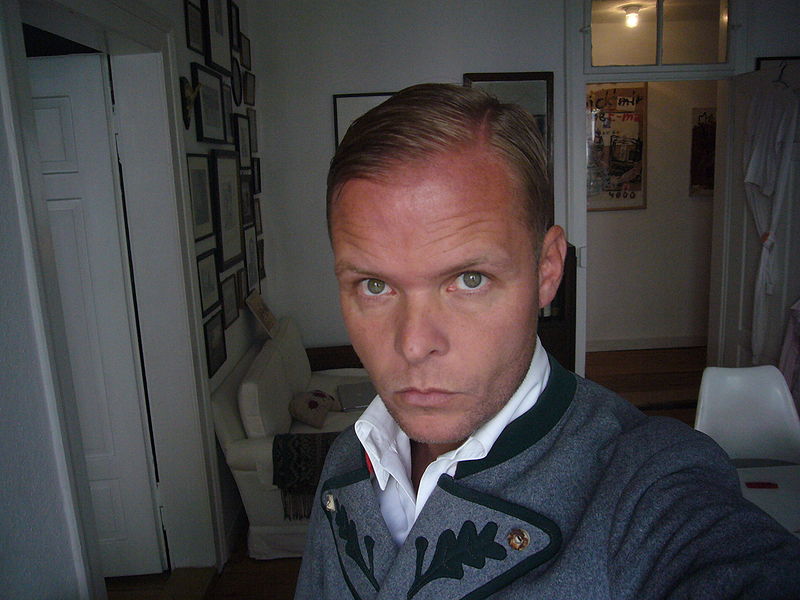
Christian Kracht
Anthony Shouan-Shwan · Anthony Shouan-Shawn

David Woodard Wikidata has entry Ma Anand Sheela with data related to this item., Ma Anand Sheela Wikidata has entry Cabaret Voltaire with data related to this item. and Christian Kracht Wikidata has entry Christian Kracht with data related to this item. reading at Cabaret Voltaire, Zürich
idem · CWells
Life and career
Dated record
Life and career
The full dated record · 1 entries
1966
Christian Kracht born at Saanen.
Books
Books
Faserland (novel), 1995 Ferien für immer (travel writing – with Eckhart Nickel), 1998 Mesopotamia. Ein Avant-Pop-Reader (as publisher, anthology), 1999 Tristesse Royale (with Joachim Bessing, Eckhart Nickel, Alexander von Schönburg and Benjamin von Stuckrad-Barre), 1999 Der gelbe Bleistift (travel writing), 2000 1979 (novel), 2001 Die totale Erinnerung. Kim Jong Ils Nordkorea, 2006. Released in English with Feral House as The Ministry of Truth. ISBN 978-1-932595-27-7 New Wave. Ein Kompendium 1999–2006, 2006 Metan (with Ingo Niermann), 2007 Ich werde hier sein im Sonnenschein und im Schatten (novel), 2008 Gebrauchsanweisung für Kathmandu und Nepal (travel writing/guide book to Nepal – with Eckhart Nickel), 2009 Five Years: Briefwechsel 2004–2009. Band 1: 2004–2007 – with David Woodard, 2011, ISBN 978-3-86525-235-7 Imperium (novel), 2012, ISBN 978-3-462-04131-6 Finsterworld (screenplay), 2013 The Dead (Die Toten) (novel), 2016 Eurotrash (novel), 2021, ISBN 978-3-462-05083-7 Air (novel), 2025, ISBN 978-3-462-00457-1
Audio books
Audio books
Liverecordings (with Benjamin von Stuckrad-Barre, Harald Schmidt and Christian Ulmen), 1999 Faserland, 2000 1979, 2002 Das Sobhraj Quartett – Asiatische Reisenotizen (with Eckhart Nickel), 2004 Das Jagdgewehr ("The Hunting Gun") by Yasushi Inoue (with Sandra Schwittau, Mavie Hörbiger and Hannelore Elsner), 2005 Frühstück bei Tiffany (Breakfast at Tiffany's) by Truman Capote, 2007 Triptychon (with Dieter Meier, Schorsch Kamerun and Dirk von Lowtzow), 2011 Imperium (with Dominik Graf), 2012 Die Toten, 2016 Eurotrash, 2021 Air (with Mavie Hörbiger), 2025
Reception
His work has appeared in The Paris Review and in Harper's Magazine. Kracht's novels contain elements of pastiche; a playful blend of influences appropriated from areas of "high" and "low" culture. Thus, Kracht's writings contain alienating references to other works, including Thomas Mann's Magic Mountain, the subtly ironic travel journals of Robert Byron, and Hergé's The Adventures of Tintin series. Furthermore, the ligne claire drawing style is used for the illustrations (by Dominik Monheim) in the first edition of Ferien für immer (1998), as well as for Der gelbe Bleistift (by Hugo Pratt) and the original cover of Imperium. Many of Hugo Pratt's characters, in turn, make their appearance in Imperium. Kracht has attested that a writer "always performs being a writer". His performance is persuasive and has successfully seduced reviewers into sometimes overlooking the distinction between the author and narrator to erroneously identify Kracht as the autobiographical protagonist of his debut novel Faserland. He has sometimes been a controversial figure in modern German-language literature. The meaning of his pronouncements in interviews is not always obvious; his description of the Taliban leader Mullah Omar (and by implication the Taliban itself) as "camp" should perhaps be taken with a pinch of salt; in this case, moral values take second place after media aesthetics. A similar principle applies to Kracht's foreword to the 2006 illustrated book Die totale Erinnerung (published with Feral House as The Ministry of Truth in the U.S.), in which Kim Jong-Il's North Korea is referred to as a gigantic simulation, whereas his apparent ignorance of actual suffering in North Korea upset some commentators.
Primary material
Documents and archives
authority file
- Gemeinsame Normdatei 115692751X, Tagung "Jenseits des Unbehagens – Christian Kracht revisited" (2016 : Bern).
Unverified · Deutsche Nationalbibliothek
authority record
- Wikidata, structured authority record Q123242: Christian Kracht
Unverified · Wikidata
reference work
- “Christian Kracht”, English Wikipedia, consulted as further reading
Reputable secondary · Wikipedia
Notes from the source article
Cited by Wikipedia
Notes from the source article
These works are cited by the source article, in its own numbering. They are recorded as its citations, not as sources VALÉORINE has verified.
- 1.Weychardt, A., Christian Kracht (Seattle: Getty Images, 1995+).
- 2.Interview with Christian Kracht in 2000. tagesspiegel.de. 30 June 2000.
- 3.Stefan Loichinger, Wenn Pop-Literaten altern in Frankfurter Rundschau, 15. October 2008.
- 4.Frank Finlay: "Dann wäre Deutschland wie das Wort Neckarauen": Surface, Superficiality and Globalisation in Christian Kracht's Faserland, in: Stuart Taberner (Hrsg.): German Literature in the Age of Globalisation. Birmingham: University of Birmingham Press, 2004, pp. 189–208
- 5.Kerstin Gleba and Eckhard Schumacher (Ed.), Pop seit 1964, Köln: Kiepenheuer & Witsch, 2007, p. 398.
- 6.Der Freund website (in English or German)
- 7.Der Freund Table of Contents. Der Freund. 2020-03-30.
- 8.See also the illustrated reportage by Kracht and Niermann, "Kilimanjaro", in Qvest, vol. 23 (6 Dec./Jan. 2007), p. 59-71.
- 9.Archived copy.
- 10.According to Harald Peters in the journal Welt am Sonntag, 4 March 2007. "Über kleine und größere Stinker"
- 11.Volker Weidermann in Frankfurter Allgemeinen Sonntagszeitung, 4 March 2007, p. 30
- 12.Christoph Bartmann, "Eine große Weltatemtheorie", Süddeutsche Zeitung, 16 April 2007, p. 16.
- 13.http://kurier.at/kultur/autoren-kritisieren-spiegel-artikel-zu-krachts-neuem-roman/771.122 Autoren kritisieren "Spiegel"-Artikel zu Krachts neuem Roman in Kurier, 15 March 2012
- 14.Blaney, Martin. Match Factory boards fresh take on Austrian Empress 'Sisi'. Screen International. 5 November 2019.
- 15.Titze, Anne-Katrin. Fur and loathing in Finsterworld, part 2. Eye For Film. 25 June 2014.
- 16.Mathéus, Pascal. Interview: Auf eine Zigarette mit Christian Kracht. Aufklappen.com. 1 July 2020.
- 17.See, for example, Ina Hartwig, "Standpunkt verschleiert" in Frankfurter Rundschau, 23 December 2003
- 18.http://www.spiegel.de/kultur/literatur/romane-des-monats-nach-middlesex-nun-also-meta-liebe-a-790606.html Christian Buß in Der Spiegel, 12 October 2011
- 19.Review of 1979 (in English)
- 20.See Stefan Zweifel, Trash Total Trash Total in FACTS, 7 April 2005
- 21.Interview with Volker Weidermann and Edo Reents, "Ich möchte ein Bilderverbot haben", Frankfurter Allgemeine Sonntagszeitung, 30 September 2001
- 22.Christian Kracht appears on Harald Schmidt Show , October 2001
- 23.Elmar Krekeler (22 September 2008). "Christian Kracht bringt Krieg in die Schweiz" (in German). Die Welt. Retrieved 25 September 2008.
- 24.Gustav Seibt (19 September 2008). "Es roch nach Menschentalg" (in German). Süddeutsche Zeitung. Retrieved 25 September 2008
- 25."Ich werde hier sein im Sonnenschein und im Schatten" . Perlentaucher.de. Retrieved 25 September 2008.
- 26.New books in German, Issue 32 Autumn 2012. Christian Kracht Imperium (A Small Empire).
- 27.Georg Diez, Die Methode Kracht , Der Spiegel, 13. February 2012
- 28.See 'Offener Brief an die Spiegel-Chefredaktion zu Kracht , 17. February 2012.
- 29.Küveler, Jan. Critic shouts Nazi murder against Christian Kracht. Die Welt. 3 February 2012.
- 30.Imperium: A Fiction of the South Seas. Publishers Weekly. 27 April 2015.
- 31."Ich schätze subversives Potenzial der Schweiz". Tages-Anzeiger. 19 September 2008.
- 32.Interview with Denis Scheck for ARD programme Druckfrisch, 25. March 2012
- 33.Interview with Volker Weidermann and Edo Reents, "Ich möchte ein Bilderverbot haben", Frankfurter Allgemeine Sonntagszeitung, 30
- 34.Burgtheater – 1979 – 25. Jänner 2010.
- 35.Ich werde hier sein im Sonnenschein und im Schatten – Agenda – Theater Basel – Spielplan, Billette & Abos – Spielplan.
- 36.Finsterworld: Montreal Review. The Hollywood Reporter. 31 August 2013.
- 37.Berlinale Programme – Sisi & Ich Sisi & I. Berlinale.de.
- 38.Eurotrash. Schaubühne Berlin.
- 39.Axel Springer Akademie: Die bisherigen Preisträger
- 40.Phantastische Bibliothek – Phantastische Bibliothek. www.phantastik.eu.
- 41.Christian Kracht, Preisträger 2012 Statement by the jury of the Wilhelm Raabe Award on braunschweig.de (in German)
- 42.Imperium – International DUBLIN Literary Award.
- 43.Creamer, Ella. All 13 writers on International Booker longlist are first-time nominees. The Guardian. 25 February 2025.
References
Citations
References
Each reference names the institution holding it, so a reader may go to the document itself.
authority file
Gemeinsame Normdatei 115692751X, Tagung "Jenseits des Unbehagens – Christian Kracht revisited" (2016 : Bern).Deutsche Nationalbibliothek
Partially resolvedauthority record
Partially resolvedreference work
Partially resolved
The Encyclopedia exists whether or not anything is for sale. Corrections are recorded rather than overwritten, and every version of this record is kept. Published 14 August 2026.
Elsewhere in Books
38,991 published records in this field, each with its sources named.
- Christian Jakob Salice-ContessaAuthor
- Christian KampmannAuthor
- Christian KeimannAuthor
- Christian Knorr von RosenrothAuthor
- Christian MatrasAuthor
- Christian MilneAuthor
- Christian MolbechAuthor
- Christian Nestell BoveeAuthor
Best supported in this field
For owners
Own a work by Christian Kracht?
A specialist will read what you send and tell you what the house can establish, what it cannot, and whether the object is suited to sale. There is no charge and no obligation. The object stays with you throughout; nothing is shipped to us unless it is arranged in writing beforehand.