
Christian Genschow
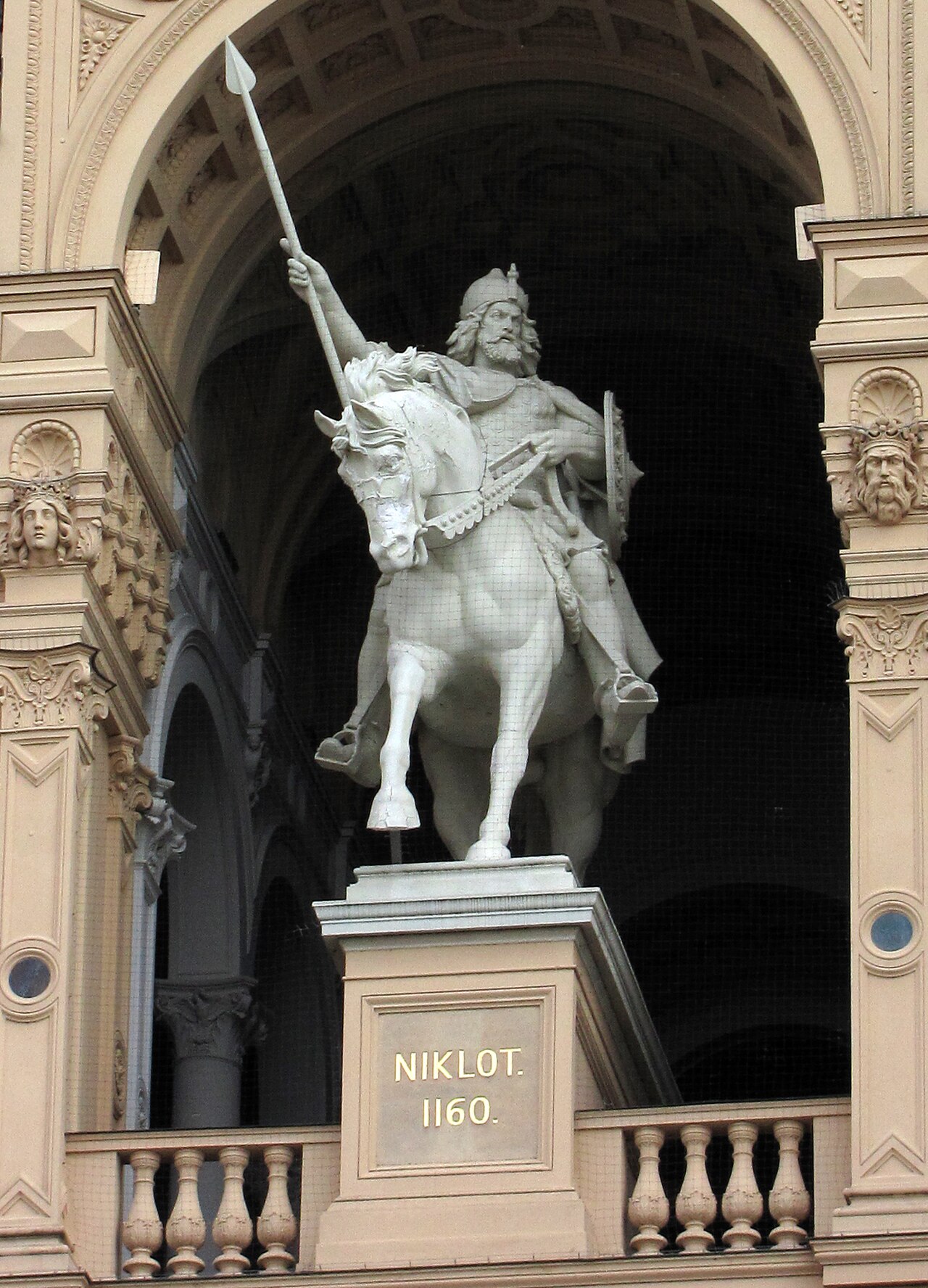
Illustration — Equestrian statue of the Obotrite leader, Niklot (Schwerin Palace) • Illustration — Portrait of Princess Augusta Reuss of Köstritz (Schwerin Palace) Christian Friedrich Genschow (18 September 1814, Rostock - 1 November 1891, Groß-Lichterfelde) was a German sculptor. Although best known for his works at the Schwerin Palace, most of his creations were in smaller formats, in the tradition of the Berliner Bildhauerschule.
Also recorded as Christian Friedrich Genschow
Christian Genschow
Håkan Henriksson (Narking) · CC BY-SA 3.0
- Born
- 1814 · Rostock.
- Died
- 1891 · Groß-Lichterfelde.
- Nationality
- German Empire
- Occupation
- sculptor
- Education
- Berlin University of the Arts
- Languages
- German
VALÉORINE Encyclopedia
VALÉORINE documentary reading
Documentary summary
Illustration — Equestrian statue of the Obotrite leader, Niklot (Schwerin Palace) • Illustration — Portrait of Princess Augusta Reuss of Köstritz (Schwerin Palace) Christian Friedrich Genschow (18 September 1814, Rostock - 1 November 1891, Groß-Lichterfelde) was a German sculptor. Although best known for his works at the Schwerin Palace, most of his creations were in smaller formats, in the tradition of the Berliner Bildhauerschule.
Admitted source layer · organised and presented by VALÉORINE
Reference Check
Propose documentary evidence for Christian Genschow. A contribution is never written directly as fact: identity, source, rights and evidence gates still decide.
Sign in to contribute
World of VALÉORINE
Documentary connections
Only confirmed graph relationships appear here. Images are shown only when their identity and reuse rights both pass the documentary gate.
Documentary evidence
Documentary basis
Authority files
wikidata · Q1079801 · wikipedia · Christian Genschow
In this article
Biography
Biography
He was the fourth of thirteen children born to the laborer, Franz Jakob Genschow and his wife. At the age of eleven, he suffered a severe, permanent injury to his left leg when he was scalded with liquid wax. An attempt at being a carpenter's apprentice had to be abandoned, as his leg could not stand the stress. In 1834, after having decided to pursue a career in art, a scholarship of 60 Thalers was approved by Frederick Francis I, Grand Duke of Mecklenburg-Schwerin, and he was able to study drawing with Johann Friedrich Hesse (1792-1853). After his scholarship award was doubled, he went to study sculpture at the Berlin University of the Arts, where he worked with Ludwig Wilhelm Wichmann (1836-1840) and Christian Daniel Rauch (1840-1842). Later he and several others worked as assistants to Rauch on his Equestrian statue of Frederick the Great. After this, he established his own studio in Berlin-Kreuzberg. From 1838 to 1881, he was a regular exhibitor at the Große Berliner Kunstausstellung. From 1852 to 1857, he worked on a major commission he received through the intercession of the Director of the Grand Ducal Collections, Georg Christian Friedrich Lisch. He created several statues for the new Schwerin Palace; notably an equestrian statue of the Medieval military leader, Niklot. From 1857 to 1866, he was employed by the Dankberg'sche Institut für architektonische Ornamentik. Until 1876, he received more orders from Grand Duke Frederick Francis II, who awarded him the Gold Cross of Merit of the House Order of the Wendish Crown in 1870, on the occasion of inaugurating the new main building at the University of Rostock, for which he had provided sculptures. In 1842, he had married Johanne Wilhelmine Ernestine Bohl (1822–1891), with whom he had four children. In 1874, continuing problems with his leg injury forced the amputation of his foot. He worked as a sculptor until 1885. After then, according to the Berlin address book, he apparently made his living as a landlord (Rentier (property owner)). His grave at the Alter Luisenstädtischer Friedhof has not been preserved.
Places
Named by the record
Places
Only places the record itself states, plotted where the house gazetteer settles their coordinates. Nothing is inferred from a name or a nationality.
Rostock.
Birth place
Groß-Lichterfelde.
Death place
Notes from the source article
Cited by Wikipedia
Notes from the source article
These works are cited by the source article, in its own numbering. They are recorded as its citations, not as sources VALÉORINE has verified.
Bibliography printed in the source article · 4
- Stüler, Willebrand, Prosch: Das Schweriner Schloss. Berlin 1869.
- Helmut Börsch-Supan: Die Kataloge der Berliner Akademieausstellungen 1786–1850. Vols. 1–3, Berlin 1971.
- Peter Bloch, Sibylle Einholz, Jutta von Simson (Eds.): Ethos & Pathos. Die Berliner Bildhauerschule 1786–1914. Beiträge zur Ausstellung. Berlin 1990,
- Bernd Schattinger: Christian Genschow (1814–1891). Recherchen zu Leben und Werk eines mecklenburgischen Bildhauers. Schwerin 2015, .
References
Citations
References
Each reference names the institution holding it, so a reader may go to the document itself.
reference work
Secondary witnessreference work
Secondary witness
People, houses and institutions
Knowledge graph
People, houses and institutions
Teachers, collaborators, publishers and institutions recorded against this person, each on a stated basis.
Citizenship
1- German EmpirePlace
Established from a fact already recorded on a verified source.
The Encyclopedia exists whether or not anything is for sale. Corrections are recorded rather than overwritten, and every version of this record is kept. Published 17 August 2026.
Elsewhere in Sculpture
6,174 published records in this field, each with its sources named.
- Christian BehrensArtist
- Christian BoltanskiArtist
- Christian Daniel RauchArtist
- Christian Friedrich TieckArtist
- Christian HessArtist
- Christian HolstadArtist
- Christian LemmerzArtist
- Christian Philipp WolffArtist
Best supported in this field
For owners
Own a work by Christian Genschow?
A specialist will read what you send and tell you what the house can establish, what it cannot, and whether the object is suited to sale. There is no charge and no obligation. The object stays with you throughout; nothing is shipped to us unless it is arranged in writing beforehand.