
Chet Baker
Chesney Henry Baker Jr. (December 23, 1929 – May 13, 1988) was an American jazz trumpeter and vocalist. He is known for major innovations in cool jazz that led him to be nicknamed the "Prince of Cool".[1] Baker earned much attention and critical praise through the 1950s, particularly for albums featuring his vocals: Chet Baker Sings (1954) and It Could Happen to You (1958).
Also recorded as Chesney Henry "Chet" Baker, Jr. · Baker Jr. · Chesney Henry Baker, Jr. · Chep
Chet Baker

Studio Harcourt. · Public domain
- Name
- Chet Baker
- Birth Name
- Chesney Henry Baker Jr.
- Born
- 23 December 1929
- Birthplace
- Yale, Oklahoma, U.S.
- Died
- 13 May 1988
- Place of death
- Amsterdam, Netherlands
- Occupation
- * Musician
- Nationality
- United States.
- Fields
- jazz.
- Education
- El Camino College.
- Teachers
- Jimmy Rowles.
- Languages
- English.
VALÉORINE Encyclopedia
VALÉORINE documentary reading
Documentary summary
Chesney Henry Baker Jr. (December 23, 1929 – May 13, 1988) was an American jazz trumpeter and vocalist. He is known for major innovations in cool jazz that led him to be nicknamed the "Prince of Cool".[1] Baker earned much attention and critical praise through the 1950s, particularly for albums featuring his vocals: Chet Baker Sings (1954) and It Could Happen to You (1958).
Admitted source layer · organised and presented by VALÉORINE
Note VALÉORINE
Chet Baker (1929–1988) was an American bandleader, composer and jazz musician, among other activities. Born in Yale, the bandleader died in Amsterdam. Chet Baker was also known as Chet.
Chet Baker studied at El Camino College and Glendale High School (California). The bandleader was a member of Chet Baker Ensemble, Chet Baker Quartet and Chet Baker Sextet, among others.
Genres include jazz. Languages used include English and Italian.
Composed from admitted, traceable facts · 26 September 2026
VALÉORINE
Reference Check
Propose documentary evidence for Chet Baker. A contribution is never written directly as fact: identity, source, rights and evidence gates still decide.
Sign in to contribute
World of VALÉORINE
Documentary connections
Only confirmed graph relationships appear here. Images are shown only when their identity and reuse rights both pass the documentary gate.
Documentary evidence
Documentary basis
Authority files
gnd · 1296481212 · wikidata · Q2274 · wikipedia · Chet Baker
In this article
Biography
Biography
Baker worked between 1929 and 1988 across singer, trumpeter, composer, jazz musician and bandleader. The registers place that work in jazz. This article rests on 103 catalogued compositions, 14 published texts, 185 issued recordings, 3 digitised documents and 16 scholarly references drawn from named institutional registers. Every statement below returns to a source shown in the evidence panel; where the record is silent or divided, the article says so instead of resolving it.
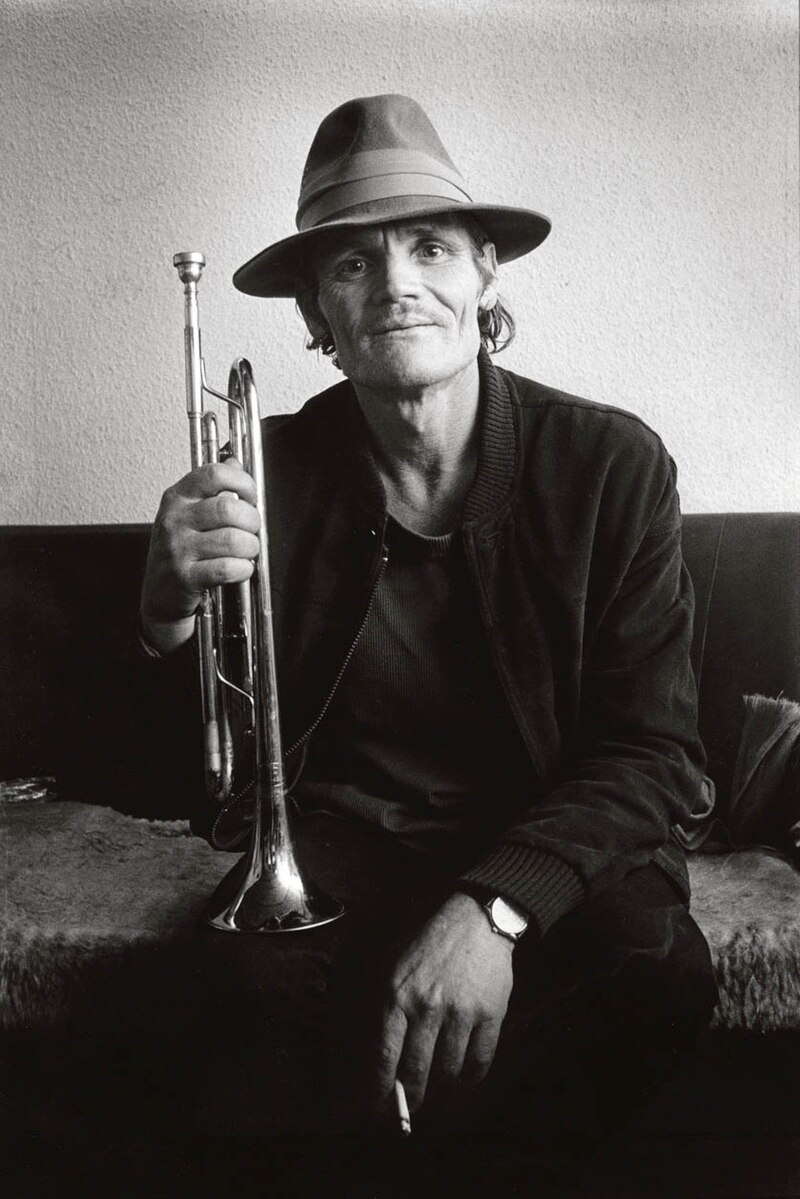
Chesney Henry "Chet" Baker, Jr. /American jazz trumpeter, flugelhorn player and singer. Here in Belgium 1983.
Michiel Hendryckx

Street of Fame Burghausen
Werner100359
Key facts
Key facts
• Name — Chet Baker • Birth Name — Chesney Henry Baker Jr. • Born — 23 December 1929 • Birthplace — Yale, Oklahoma, U.S. • Died — 13 May 1988 • Place of death — Amsterdam, Netherlands • Genre — * Bebop • cool jazz • West Coast jazz • Occupation — * Musician • composer • Instruments — * Trumpet • flugelhorn • vocals • Years Active — 1949–1988 • Label — * Pacific Jazz • RCA • Epic • Partner — * Liliane Cukier (1954–1956) • Diane Vavra (1970) • Ruth Young (1973–c. 1983)
Early years
Early years
Baker was born December 23, 1929, in Yale, Oklahoma, and raised in a musical household. His father, Chesney Baker Sr., was a professional Western swing guitarist, and his mother, Vera Moser, was a pianist who worked in a perfume factory. His maternal grandmother was Norwegian.[4] Baker said that owing to the Great Depression, his father, though talented, had to quit as a musician and take a regular job. In 1940, when Baker was 10, his family relocated to Glendale, California.[5][6] Baker began his musical career singing in a church choir. His father, a fan of Jack Teagarden, gave him a trombone, before switching to the trumpet at the age of 13 when the trombone proved to be too large for him.[7] His mother said that he had begun to memorize tunes on the radio before he was given an instrument.[8] After "falling in love" with the trumpet, he improved noticeably in two weeks. Peers called Baker a natural musician to whom playing came effortlessly. Baker received some musical education at Glendale High School, but he left school at the age of 16 in 1946 to join the United States Army. He was assigned to Berlin, Germany, where he joined the 298th Army Band. While stationed in Berlin, he became acquainted with modern jazz by listening to V-Discs of Dizzy Gillespie and Stan Kenton. After leaving the Army in 1948, he studied music theory and harmony at El Camino College in Los Angeles.[9] He dropped out during his second year to re-enlist. He became a member of the Sixth Army Band at the Presidio in San Francisco, spending time in clubs such as Bop City and the Black Hawk.[10] He was discharged from the Army in 1951 and proceeded to pursue a career in music.[11]
Career
Career
• Illustration — Baker (right) and Stan Getz in 1983. The two collaborated for over 25 years. Baker performed with Vido Musso and Stan Getz before being chosen by Charlie Parker for a series of West Coast engagements.[12] In 1952, Baker joined the Gerry Mulligan Quartet and attracted considerable attention. Rather than playing identical melody lines in unison like Parker and Gillespie, Baker and Mulligan complemented each other with counterpoint and anticipating what the other would play next. "My Funny Valentine," with a solo by Baker, became a hit and was associated with Baker for the rest of his career.[13] With the quartet, Baker was a regular performer at Los Angeles jazz clubs such as The Haig and the Tiffany Club. Baker formed a quartet with a rotation that included pianist Russ Freeman, bassists Bob Whitlock, Carson Smith, Joe Mondragon, and Jimmy Bond, and drummers Larry Bunker, Bob Neel, and Shelly Manne. Baker's quartet released popular albums between 1953 and 1956. Baker won reader's polls at Metronome and DownBeat magazines, beating trumpeters Miles Davis and Clifford Brown. In 1954, readers named Baker the top jazz vocalist. In 1954, Pacific Jazz Records released Chet Baker Sings, an album that both increased his visibility and drew criticism. Nevertheless, Baker continued to sing throughout the rest of his career. Baker, with his youthful, chiseled looks oft-photographed by William Claxton, and his cool demeanor that evoked breezy California playboy living, became somewhat of a teen idol on top of being a respected, up-and-coming jazz musician. Hollywood studios saw movie star potential in Baker, and he made his acting debut in the film Hell's Horizon in the fall of 1955. Baker declined a studio contract, preferring life on the road as a musician. Over the next few years, he led his own combos, including a 1955 quintet with Francy Boland where Baker combined trumpet-playing and singing. In September 1955, he left for Europe for the first time, completing an eight-month tour and recording for the Barclay label that October. Some of these sessions were released in the United States as Chet Baker in Europe.[14] While there, he also recorded a rare accompaniment for another vocalist: Caterina Valente playing guitar and singing "I'll Remember April" and "Ev'ry Time We Say Goodbye".[15] One month into the tour, pianist Dick Twardzik died of a heroin overdose. Despite this, Baker continued the tour, employing local pianists. Returning to Los Angeles post-tour, Baker returned to recording for Pacific Jazz. His output included three collaborations with Art Pepper, including Playboys, and the soundtrack to The James Dean Story. Baker moved to New York City, where he collaborated again with Gerry Mulligan for the 1957 release Reunion with Chet Baker. In 1958, Baker rejoined with Stan Getz for Stan Meets Chet. That same year, he also released It Could Happen to You, similar to Chet Baker Sings, notable for featuring his scat singing skills in lieu of trumpet-playing. His last significant release before returning to Europe was Chet, released by Riverside Records, featuring an all-star personnel that included pianist Bill Evans, bassist Paul Chambers, and drummer Philly Joe Jones, all associated with leading jazz trumpeter Miles Davis.
Drug addiction and decline
Drug addiction and decline
Soon after signing on with Riverside Records, Baker was arrested twice; the first arrest involved a stay at a Lexington hospital, then imprisonment at Rikers Island for four months on drug charges. Baker said he began using heroin in 1957.[16] However, author Jeroen de Valk and pianist Russ Freeman said that Baker started heroin in the early 1950s. Freeman was Baker's musical director after Baker left the Mulligan quartet. Sometimes Baker pawned his instruments to buy drugs. In late 1959, Baker returned to Europe, recording in Italy what became known as the Milano sessions with arranger and conductor Ezio Leoni (Len Mercer) and his orchestra. Baker appeared as himself in the musicarello film, Howlers in the Dock. Tabloids reviled Baker for his drug habit and reckless womanizing and infidelity. In August 1960, he was imprisoned in Lucca for importing narcotics, forging prescriptions, and drug abuse.[17] This forced Leoni to communicate through the prison warden to coordinate arrangements with Baker as they prepared for recording.[18] Baker spent nearly a year and a half in jail, and was later arrested in West Germany and expelled to Switzerland, then France, later moving to England in August 1962. He appeared as himself in the film Stolen Hours, which was released in 1963. He was deported from England to France, because of a drug offense, in March 1963. He lived in Paris and performed there and in Spain over the next year, but after being arrested again, he was deported to the U.S. from Germany.[19] He settled in Milpitas, California, performing in San Francisco and San Jose between jail terms for prescription fraud. Baker's first release in 1962, after his Italian prison sentence, was Chet Is Back! for RCA, balancing ballads with energetic bop. That same year, Baker collaborated with Ennio Morricone in Rome for a series of orchestral pop records, recording four original songs that he had composed during his prison sentence: "Chetty's Lullaby", "So che ti perderò", "Motivo su raggio di luna", and "Il mio domani". Baker returned to New York City in 1964.[20] Throughout most of the 1960s, Baker played flugelhorn, and recorded music that could be classified as West Coast jazz. In 1964, he released The Most Important Jazz Album of 1964/65 on Colpix Records, and in 1965 he released Baby Breeze on Limelight. He then released five albums with Prestige, recorded in one week.[21] Baker fell behind on jazz's latest innovations. At the end of 1965, he returned to the Pacific label, recording six themed albums whose content veered from straight jazz towards uninspired, instrumental covers of contemporary pop songs arranged by Bud Shank. Baker himself was unhappy with the records, describing them as "simply a job to pay the rent." By this time, he had a wife and three children to support. The following summer, already having reached a low point in his career, Baker was beaten up, probably while attempting to buy drugs,[22] after performing at The Trident in Sausalito. In the film Let's Get Lost, Baker said an acquaintance attempted to rob him, but backed off, only to return the next night with a group of men who chased him. He entered a car and was surrounded. Instead of rescuing him, the people inside the car pushed him back out onto the street, where the chase continued. He received cuts and several of his teeth were knocked out. This incident has been often misdated or otherwise said to be exaggerated partly because of his own unreliable testimony on the matter. Regardless, the 1966 incident did lead to his teeth eventually deteriorating. By late 1968 or early 1969, he needed dentures. This ruined his embouchure, and he struggled to relearn how to play the trumpet and flugelhorn. Baker claims that, for three years, he worked at a gas station until concluding that he had to find a way back to music and retrain his embouchure.[23] Biographer Jeroen de Valk notes that Baker was still musically active after 1966, performing and occasionally recording. In April 1968, he provided flugelhorn for Bud Shank's Magical Mystery album. In 1969, he released Albert's House, which features 11 compositions by Steve Allen, who organized the recording date to help Baker restart his career. In 1970, Baker released Blood, Chet and Tears. After these unsuccessful releases, Baker withdrew from the music business. He did not release another album for four years, and from around 1968 to 1973, stopped performing in public. Moving back with his family to his mother's house in San Jose and depending on welfare, Baker was arrested for forging heroin prescriptions. The judge released him on the condition that he remained on methadone for the next seven years.
Comeback
Comeback
In 1973, Baker attempted a comeback. Returning to the straight-ahead jazz that began his career, he drove to New York to perform again. In 1974, the India Navigation label released a live album of performances with saxophonist Lee Konitz. She Was Too Good to Me, released by CTI Records that same year, is considered a comeback album. His last release of 1974 was another live album recorded at Carnegie Hall, which was his final collaboration with Gerry Mulligan. From that time, work in both the U.S. and Europe was inconsistent. In 1977, Baker recorded Once Upon a Summertime and You Can't Go Home Again. That November, he returned to Europe to tour for the rest of that year. Being met with renewed interest in France, Italy, Germany, and Denmark, Baker decided to stay. He worked almost exclusively in Europe, only returning to the U.S. about once a year to attend some performances.[24] From that point on, Baker recorded a prolific amount of material. In 1979, Baker made 11 records; the following year, he made 10. They were released by small jazz labels such as Circle, SteepleChase, and Sandra. During the early 1980s, Baker began to associate himself with musicians with whom he meshed well, such as guitarist Philip Catherine, bassist Niels-Henning Ørsted Pedersen, and pianist Michel Graillier. Later in his career, Baker preferred to play in ensembles without drums.[25] He detested playing at loud venues to inattentive audiences. At gigs in lively French and American clubs, he would sometimes wait for over half an hour for noise to die down before beginning to perform, and he would pause his performance if he thought the audience was too noisy.[26] • Illustration — Baker in 1983 In 1983, British singer Elvis Costello, a longtime fan of Baker, hired the trumpeter to play a solo on his song "Shipbuilding" for the album Punch the Clock. The song exposed Baker's music to a new audience. Later, Baker often featured Costello's song "Almost Blue" (in turn inspired by Baker's version of "The Thrill Is Gone") in his concert sets. In 1985, five years after meeting Brazilian pianist/composer Rique Pantoja in a club in Paris, Baker was invited by Pantoja to perform at the Free Jazz Festival in Rio de Janeiro. While in Brazil, Baker recorded trumpet and vocals for their duet album Rique Pantoja & Chet Baker, as well as Lizzy Mercier Descloux's album, One for the Soul.[27] In 1986, Chet Baker: Live at Ronnie Scott's London presented Baker in an intimate stage performance filmed with Elvis Costello and Van Morrison as he performed a set of standards and classics, including "Just Friends", "My Ideal", and "Shifting Down". Augmenting the music, Baker spoke one-on-one with friend and colleague Costello about his childhood, career, and struggle with drugs. Baker recorded the live album Chet Baker in Tokyo with his quartet featuring pianist Harold Danko, bassist Hein Van de Geyn, and drummer John Engels (drummer). Released eleven months before his death, John Vinocur named it "a glorious moment in Chet Baker's twilight."[30] In the winter of 1986, at a club in New York City, Baker met fashion photographer Bruce Weber.[31] Weber convinced him to do a photo shoot for what was originally going to be only a three-minute film.[32] When Baker started opening up to Weber, Weber convinced him to work on a longer film about his life.[33] Filming began in January 1987. The finished film, Let's Get Lost, is a highly acclaimed and stylized documentary that explores Baker's talent and charm, the glamour of his youth now withered into a derelict state, and his turbulent, sensational romantic and family life. It was released in September 1988, four months after his death that May. Two accompanying soundtrack albums, one compiling highlights from the height of his fame and one featuring new material that Baker recorded during the filming of the documentary, were released in 1989. In November 2025, Swimming by Moonlight, a double album of previously unreleased songs, music, and spoken dialogue and live concert recordings from Let's Get Lost was compiled and released by Bruce Weber and John Leftwich.[34]
Death
Death
Early on May 13, 1988, Baker was found dead on the street below his room in Hotel Prins Hendrik, Amsterdam, with serious wounds to his head, apparently having fallen from the second-story window.[35] Heroin and cocaine were found in his room and in his body. No evidence of a struggle was found, and the death was ruled an accident.[36] According to another account, he inadvertently locked himself out of his room and fell while attempting to cross from the balcony of the vacant room adjacent to his own.[37] A plaque was placed outside the hotel in his memory.[38] Baker is buried at the Inglewood Park Cemetery in Inglewood, California,[39] next to his father.
Personal life
Personal life
Chet Baker's personal life was tumultuous, partly owing to a decades-long drug addiction which began in the 1950s and a nomadic lifestyle caused by touring. In 1980, he referred to his life as "1/3 in a car, 1/3 sleeping, and 1/3 playing music." His first short-lived marriage was to Charlaine Souder in 1950. In 1954, despite remaining married to Charlaine, he publicly dated French jazz club-goer Lili Cukier (later known as actress Liliane Rovère) for two years, introducing her to others as his wife.[40] A photo of the couple taken by William Claxton appears as part of a collage on the cover of Chet Baker Sings and Plays. Baker's relationship with Lili ended when he informed her of his new marriage to Halema Alli. He married the 20-year-old Halema, seven years his junior, in May 1956, one month after they met. The couple posed for a photograph by William Claxton, where Halema appears in a white dress and rests her head on Baker's knee. They had a son, Chesney Aftab Baker, to whom Baker dedicated his composition, "Chetty's Lullaby." Baker was an irresponsible and distant father.[41] In a scandal heavily scrutinized by Italian tabloids, Halema was sent to prison for smuggling jetrium from Germany to Italy for her husband, though she claimed that she was unaware that she was breaking the law. To his wife's humiliation, by the time of the trial, Baker had already started publicly dating Carol Jackson, a showgirl from Surrey. After being detained for six months, Halema returned to Inglewood, and their marriage essentially ended, though they remained legally married for several years because tracking down Baker for divorce proceedings was too difficult. In 1962, Carol Jackson gave birth to a son, Dean. Two years later in 1964, Baker returned to the United States, and Halema was able to serve Baker divorce papers. Baker married Carol Jackson in 1964, and they had two more children, Paul in 1965 and Melissa ("Missy") in 1966.[42][43] Despite his inconsistency in remaining in his family's life, and his infidelity, Carol and Chet never divorced. In 1970, Baker met jazz drummer Diane Vavra. The two started an on-again off-again relationship that lasted until the end of his life. Beginning in the 1980s, she acted as his steady companion while touring Europe. She took care of his personal needs and assisted him with his career. The Library of Congress holds the correspondence of Chet and Diane.[44] Chet dedicated his 1985 album Diane to Vavra, covering the familiar jazz standard "Diane." For a time, Vavra took refuge at a women's shelter due to Baker's behavior. In 1973, Baker began a relationship with Ruth Young, a jazz singer. She accompanied him on his 1975 tour in Europe, and he lived with her while stopping in New York. They dated, with interruptions, for about a decade.[45] Together, they recorded two duets, "Autumn Leaves" and "Whatever Possessed Me," for the 1977 album The Incredible Chet Baker Plays and Sings. Owing to his time in Italy, Baker was fluent in Italian.[46] Baker enjoyed driving and sports cars.[47] In 1971, 1972, and 1975, Baker was arrested for drunk driving. During the late 1960s and 1970s, Baker attempted to begin writing his memoirs. According to his wife Carol, he lost the draft while traveling on tour. In 1997, Carol Baker published and wrote an introduction to his "lost memoirs," taped around 1978, under the title As Though I Had Wings.[48] What writing exists is scant and idiosyncratic, and focuses mainly on his time in the army and his drug use.
Filmography
Filmography
• (1955) Hell's Horizon, by Tom Gries: actor • (1959) Audace colpo dei soliti ignoti, by Nanni Loy: music • (1960) Howlers in the Dock, by Lucio Fulci: actor • (1963) Ore rubate stolen hours, by Daniel Petrie: music • (1963) Tromba Fredda, by Enzo Nasso: actor and music • (1963) Le concerto de la peur, by José Bénazéraf: music • (1964) L'enfer dans la peau, by José Bénazéraf: music • (1964) Nudi per vivere, by Elio Petri, Giuliano Montaldo and Giulio Questi: music • (1988) Let's Get Lost, by Bruce Weber: music
Identity
Identity
Chet Baker is recorded with the occupation jazz musician. Classed in the genre jazz. Recorded as singer, trumpeter, composer, jazz musician and bandleader. Established in Bibliothèque nationale de France under 13891071k. Established in Library of Congress under n83174966. Established in Discogs under 31617. Established in FAST under 117910. Identity and origins. He also worked under the name Chet. His recorded language was English.
Life and career
Dated record
Life and career
Explore 1929–2002
The full dated record · 7 entries
1929
Chet Baker was born on 23 December 1929.
1988
Dies at Amsterdam.
1988
Chet Baker died on 13 May 1988.
1992
Chet Baker - Grey December (1992) is digitised and catalogued by Internet Archive.
1993
Chet Baker in Europe is dated 1993.
1995
Chet Baker's Scat Solos is dated 1995.
2002
The Chet Baker Collection (Artist Transcriptions) is dated 2002.
Places
Named by the record
Places
Only places the record itself states, plotted where the house gazetteer settles their coordinates. Nothing is inferred from a name or a nationality.
Chet Baker was born at Yale.
Birthplace
Chet Baker died at Amsterdam.
Deathplace
Yale.
Birth place
Amsterdam.
Death place
Compositions
Baker's notable compositions include "Chetty's Lullaby", "Freeway", "Early Morning Mood", "Two a Day", "So che ti perderò" ("I Know I Will Lose You"), "Il mio domani" ("My Tomorrow"), "Motivo su raggio di luna" ("Contemplate on a Moonbeam"), "The Route", "Skidaddlin'", "New Morning Blues" (with Duke Jordan), "Blue Gilles", "Dessert", "Anticipated Blues", "Blues for a Reason",[49] "We Know It's Love", and "Looking Good Tonight".
Legacy
• Illustration — Plaque at the Hotel Prins Hendrik, in Amsterdam[51] Baker was photographed by William Claxton for his book Young Chet: The Young Chet Baker. An Academy Award-nominated 1988 documentary about Baker, Let's Get Lost, portrays him as a cultural icon of the 1950s while juxtaposing this with his later image as a drug addict. The film, directed by fashion photographer Bruce Weber, was shot in black-and-white, and includes a series of interviews with friends, family (including his three children by third wife Carol Baker), musical associates, and female friends, interspersed with footage from Baker's earlier life, and interviews with Baker in his last years. In Chet Baker, His Life and Music, author Jeroen de Valk and others criticize the film for presenting Baker as a "washed-up" musician in his later years. The film was shot during the first half of 1987, the year before Baker's death, ending in Cannes in May 1987, just prior to Baker's June 14, 1987, Tokyo concert, released on Chet Baker in Tokyo. It premiered four months after Baker's death. Time after Time: The Chet Baker Project, written by playwright James O'Reilly, toured Canada in 2001.[52] Jeroen de Valk has written a biography of Baker; Chet Baker: His Life and Music is the English translation.[53] Other biographies of him include James Gavin's Deep in a Dream—The Long Night of Chet Baker, and Matthew Ruddick's Funny Valentine. Baker's "lost memoirs" are available in the book As Though I Had Wings, which includes an introduction by Carol Baker. The 1960 film All the Fine Young Cannibals, starring Robert Wagner as a jazz trumpeter named Chad Bixby, was loosely inspired by Baker. The 1999 film version of The Talented Mr. Ripley, Matt Damon plays a master of mimicry who imitates Baker's recording of "My Funny Valentine" from Chet Baker Sings. Chet Baker is portrayed by Ethan Hawke in the 2015 film Born to Be Blue. It is a reimagining of Baker's career in the late 1960s, when he is famous for both his music and his addiction, and he takes part in a movie about his life to boost his career.[54] Steve Wall plays Baker in the 2018 film My Foolish Heart. American singer/songwriter David Wilcox included the tender biographical portrait Chet Baker's Unsung Swan Song on his 1991 album Home Again.[55] Vocalist Luciana Souza recorded The Book of Chet in 2012 as a tribute. Brazilian jazz pianist Eliane Elias dedicated her 2013 album I Thought About You to Chet Baker.[56][57] Australian musician Nick Murphy chose "Chet Faker" as his stage name as a tribute to Baker. Murphy said, "I listened to a lot of jazz and I was a big fan of... the way he sang, when he moved into mainstream singing. He had this really fragile vocal style—this really, broken, close-up, and intimate style. The name is kind of just an ode to Chet Baker and the mood of music he used to play—something I would like to at least pay homage to in my own music."[58] In 2023, Rolling Stone ranked Baker at number 116 on its list of the 200 Greatest Singers of All Time.[59]
Primary material
Documents and archives
scholarly publication
- Baker, Chet (1929-1988), jazz trumpet player and singer, American National Biography Online, 2000
Scholarly · Crossref registry · 2000
- Baker, Chet (jazz), Oxford Music Online, 2003
Scholarly · Crossref registry · 2003
- Chet Baker, The Parisian Jazz Chronicles, 2005
Scholarly · Crossref registry · 2005
institutional register
- MusicBrainz artist record for Chet Baker
General reference · MusicBrainz
- Wikidata, structured authority record Q2274: Chet Baker
General reference · Wikimedia Foundation
reference work
- “Chet Baker”, English Wikipedia, consulted as further reading
Reputable secondary · Wikipedia
Awards and honours
• Big Band and Jazz Hall of Fame induction, 1987 • DownBeat magazine Jazz Hall of Fame, 1989 • Oklahoma Jazz Hall of Fame, 1991 • Grammy Hall of Fame Award for Chet Baker Sings (1956), inducted 2001[60] • Chet Baker Day proclaimed by Oklahoma Governor Brad Henry and the Oklahoma House of Representatives, 2005 • Chet Baker Jazz Festival in his honor in Yale, Oklahoma, October 10, 2015 • Forlì Jazz Festival in honor of Chet Baker (30 years after his death), in Forlì, Italy, May 2–19, 2018
Notes from the source article
Cited by Wikipedia
Notes from the source article
These works are cited by the source article, in its own numbering. They are recorded as its citations, not as sources VALÉORINE has verified.
- 1.Carr, Roy. A century of jazz. London : Hamlyn. December 2, 2004.
- 2.Gelly, Dave. Icons of Jazz: A History in Photographs, 1900–2000. Thunder Bay Press. 2000. 1-57145-268-0.
- 3.Leland, John. Hip: The History. HarperCollins. 265–. 5 October 2004. 978-0-06-052817-1.
- 4.Gavin, James. Deep in a Dream: The Long Night of Chet Baker. Chicago Review Press. 2011. 9781569767573.
- 5.Chet Baker Biography & History. AllMusic.
- 6.Peary, Gerald. Finding the Legendary Chet Baker. Los Angeles Times. 1988-12-18.
- 7.Valk, Jeroen de. Chet Baker: His Life and Music. Berkeley Hills Books. 2000. 9789463381987.
- 8.Zeitgeist Films. Let's Get Lost. 1988-09-15.
- 9.Chet Baker. AllMusic.
- 10.McKeever, Stuart A. Becoming Joey Fizz. Author House. 17–. 19 June 2014. 9781496915214.
- 11.Cahill, Greg. Chet Baker. North Bay Bohemian.
- 12.Gordon, Robert. Jazz West Coast : the Los Angeles jazz scene of the 1950s. Quartet Books. 72. 1986. 9780704326033.
- 13.Davis Inman. Chet Baker, 'My Funny Valentine'. American Songwriter. January 16, 2012.
- 14.Review spotlight on. Jazz Albums. Billboard. 86. 10 November 1956.
- 15.Myers, Mark. Chet Baker + Caterina Valente. JazzWax. 2020-02-04.
- 16.Gioia, Ted. West Coast Jazz: Modern Jazz in California, 1945-1960. University of California Press. 1998. 9780520217294.
- 17.Myers, Mark. Chet Baker: La Voce. JazzWax. 2017-07-21.
- 18.Chet Baker - 1959 Milano Sessions - Promo Sound, CD 4312 ADD
- 19.Ruhlmann, William. Chet Baker. AllMusic.
- 20.Myers, Mark. Chet Baker: New York, 1964. JazzWax. 2012-04-16.
- 21.Yanow, Scott. A Taste of Tequila Review. AllMusic.
- 22.Selvin, Joel. 'Cool' jazz's tortured king / Drugs, abuse marked trumpeter's career. San Francisco Chronicle. June 12, 2002.
- 23.Chet Baker interview about drug and jazz1980. 1980.
- 24.Chet Baker resided and played almost exclusively in Europe. Jazzbluesnews.com. 2017-12-22.
- 25.Enos, Morgan. Chet Baker Trio: Live in Paris: The Radio France Recordings 1983-1985 (Elemental). JazzTimes. 2022-04-22.
- 26.Wulff, Ingo. Chet Baker in Europe: 1975-1988. Nieswand Verlag. 1993. 9783926048578.
- 27.Jones, Janice L. Jazz Artists Are Going in New Directions : Composer: Internationally known Rique Pantoja, who plays in San Juan Capistrano tonight, works toward wider fame in the U.S. Los Angeles Times. 1992-05-30.
- 28.Arbor Way (Live).
- 29.Deming, Mark. Lizzy Mercier Descloux: Biography. AllMusic.
- 30.Vinocur, John. A glorious moment in Chet Baker's twilight. The New York Times. 2008-02-22. 0362-4331.
- 31.Adams, James. Through a Legend, Darkly. The Globe and Mail. September 9, 2006.
- 32.Kreigmann, Jame. Requiem for a Horn Player. Esquire. 231. December 1988.
- 33.James, Nick. Return Of The Cool. Sight & Sound. June 2008.
- 34.Amorosi, A. D. Beauty and the Beat(ific): Chet Baker and Bruce Weber Get Lost, Again, with Swimming by Moonlight. JazzTimes. 2025-11-07.
- 35.Pareles, Jon. Chet Baker, Jazz Trumpeter, Dies at 59 in a Fall. The New York Times. May 14, 1988.
- 36.Chet Baker: het roerige leven van een jazzlegende. USA365. May 18, 2015.
- 37.Tom Schnabel. How Chet Baker Really Died. Kcrw.com. January 17, 2012.
- 38.Chet Baker - Amsterdam - May 13, 1988. Thelastgps.altevista.org. 2012-08-21.
- 39.Notable Lives Inglewood Park Cemetery. Inglewoodparkcemetery.com. 2019-01-23.
- 40.Merle, Sylvain. Liliane Rovère, actrice dans "Dix Pour Cent" : "Je suis une rescapée". Le Parisien. 2019-04-11.
- 41.St. Clair, Jeffrey. Scenes From the Life of Chet Baker. CounterPunch. 2011-11-25.
- 42.Bruce Guthrie: Remembering Chet Baker article @ All About Jazz. All About Jazz. April 23, 2020.
- 43.Murray, Ruby. Chet Baker historical profile Dumbo Feather Magazine. Dumbo Feather. 1 January 2012.
- 44.Miller, Cait. Chet Baker, Heart and Soul. Library of Congress Blogs. 2020-05-26.
- 45.Gladstone, Michael P. Ruth Young: This Is Always review. AllAboutJazz. 2005-07-14.
- 46.Chet in italiano.mov. May 2011.
- 47.Carol Baker, Chet Baker's widow. Jerry Jazz Musician. 1998-06-22.
- 48.Bouchard, Fred. As Though I Had Wings: The Lost Memoir by Chet Baker. JazzTimes. 2019-04-19.
- 49.Chet Baker Quintet* Featuring Warne Marsh - Blues For A Reason. Discogs. November 13, 1985.
- 50.15 best jazz trumpet players ever. Classical Music. March 19, 2024.
- 51.Zhuk, Roman. News - Chet Baker (memorial plaque). Roman-Zhuk.com.
- 52.Crew, Robert. Time After Time: The Chet Baker Project. Variety. April 6, 2001.
- 53.Jeroen de Valk: tekst & muziek. Jeroendevalk.nl.
- 54.Barraclough, Leo. Berlin: Ethan Hawke Brings Jazz Pic 'Born to Be Blue' to Fest. Variety. February 4, 2015.
- 55.Iyengar, Vik. David Wilcox -- Home Again. AllMusic.
- 56.Collar, Matt. Eliane Elias -- I Thought About You. AllMusic.
- 57.Bailey, C. Michael. Eliane Elias: I Thought About You: A Tribute to Chet Baker. All About Jazz. May 23, 2013.
- 58.Discovery: Chet Faker. Interview Magazine. 2012-03-16.
- 59.The 200 Greatest Singers of All Time. Rolling Stone. 1 January 2023.
- 60.GRAMMY Hall Of Fame. Grammy.com. October 18, 2010.
Bibliography printed in the source article · 5
- Baker, Chet; Carol Baker. As Though I Had Wings: The Lost Memoir. St Martins Press, 1997.
- De Valk, Jeroen. Chet Baker: His Life and Music. Berkeley Hills Books, 2000. . Updated and expanded edition: Chet Baker: His Life and Music. Uitgeverij Aspekt, 2017. .
- Frank, Artt. Chet Baker: The Missing Years: A Memoir. BooksEndependent, 2013. .
- Gavin, James. Deep in a Dream: The Long Night of Chet Baker. New York: Alfred A. Knopf, 2002.
- Ruddick, Matthew. Funny Valentine: The Story of Chet Baker. Melrose Books, 2012.
References
Citations
References
Each reference names the institution holding it, so a reader may go to the document itself.
scholarly publication
Baker, Chet (1929-1988), jazz trumpet player and singer, American National Biography Online, 2000Crossref registry
Institutional witnessscholarly publication
Baker, Chet (jazz), Oxford Music Online, 2003Crossref registry
Institutional witnessscholarly publication
Chet Baker, The Parisian Jazz Chronicles, 2005Crossref registry
Institutional witnessinstitutional register
MusicBrainz artist record for Chet BakerMusicBrainz
Secondary witnessinstitutional register
Wikidata, structured authority record Q2274: Chet BakerWikimedia Foundation
Secondary witnessreference work
Secondary witness
The Encyclopedia exists whether or not anything is for sale. Corrections are recorded rather than overwritten, and every version of this record is kept. Published 17 August 2026.
Elsewhere in Music memorabilia
42,375 published records in this field, each with its sources named.
- Chester KamenPerson
- Chester ThompsonPerson
- Chestplate RecordsOrganisation
- Chet AtkinsPerson
- Chet DoxasPerson
- Chet FakerPerson
- Chevalier d’HerbainPerson
- Chevalier de Saint-GeorgesPerson
Best supported in this field
For owners
Own a work by Chet Baker?
A specialist will read what you send and tell you what the house can establish, what it cannot, and whether the object is suited to sale. There is no charge and no obligation. The object stays with you throughout; nothing is shipped to us unless it is arranged in writing beforehand.