
Charles Nicolle
Charles Jules Henri Nicolle (21 September 1866 – 28 February 1936) was a French bacteriologist who received the Nobel Prize in Medicine for his identification of lice as the transmitter of epidemic typhus.
Charles Nicolle
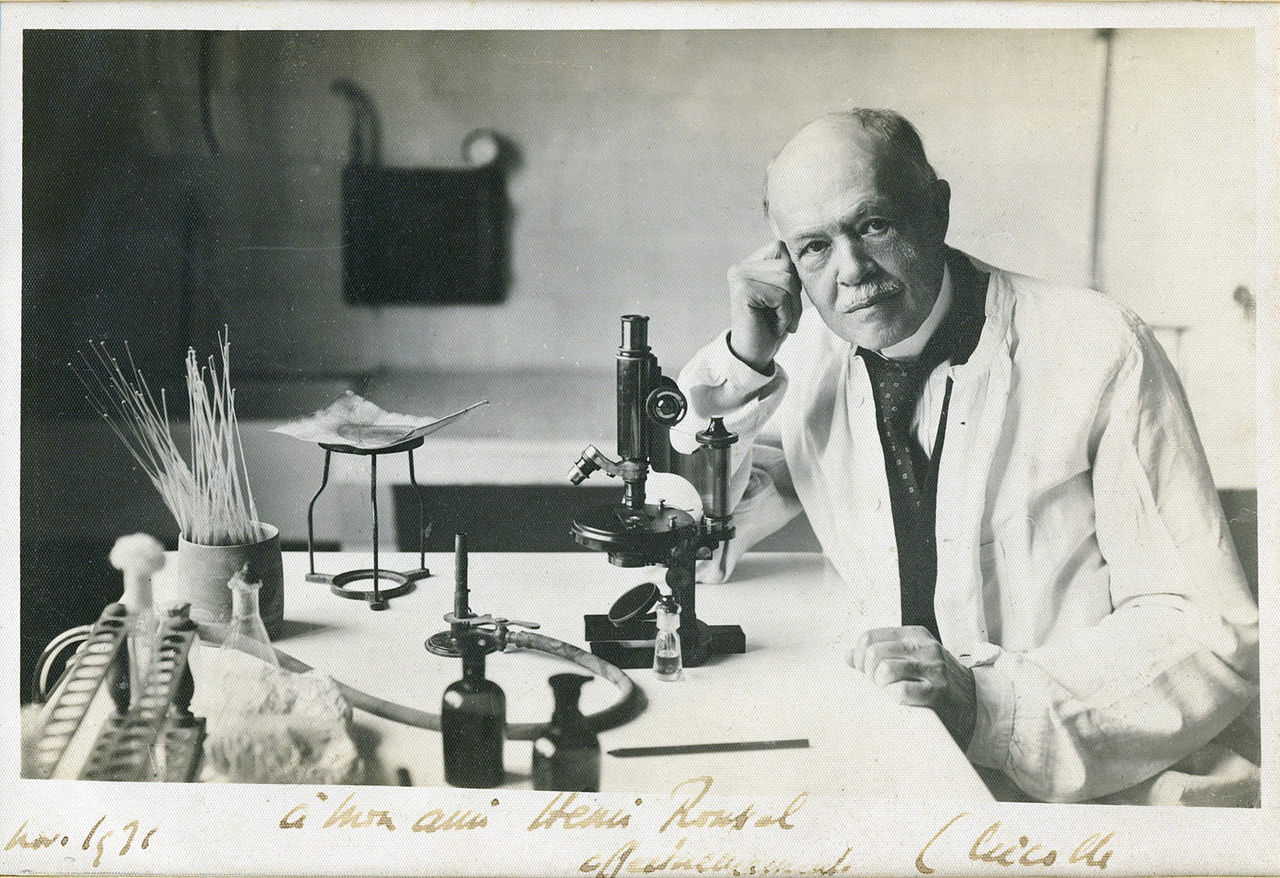
Roland Huet · Personal collection · Public domain
- Name
- Charles Nicolle
- Birth Name
- Charles Jules Henri Nicolle
- Born
- 21 September 1866
- Birthplace
- Rouen, French Empire
- Died
- 28 February 1936
- Place of death
- Tunis, French Tunisia
- Field
- Bacteriology
- Education
- University of Paris
- Known for
- Epidemic typhus
- Awards
- Nobel Prize in Physiology or Medicine (1928)
- Full name
- Charles Jules Henri Nicolle.
- Nationality
- France
VALÉORINE Encyclopedia
VALÉORINE documentary reading
Documentary summary
Charles Jules Henri Nicolle (21 September 1866 – 28 February 1936) was a French bacteriologist who received the Nobel Prize in Medicine for his identification of lice as the transmitter of epidemic typhus.
Admitted source layer · organised and presented by VALÉORINE
Note VALÉORINE
No house-authored Note is published until its assertions and sources pass the VALÉORINE evidence contract. The documentary article remains available in full while that enrichment is being consolidated.
Documentary enrichment in progress · no unsupported statement published
Reference Check
Propose documentary evidence for Charles Nicolle. A contribution is never written directly as fact: identity, source, rights and evidence gates still decide.
Sign in to contribute
World of VALÉORINE
Documentary connections
Only confirmed graph relationships appear here. Images are shown only when their identity and reuse rights both pass the documentary gate.
Documentary evidence
Evidence Panel
not yet certified
- Identity
- resolved
- Independent source families
- 0
- Admitted assertions
- 0
- Open conflicts
- 0
Authority files
wikidata · Q233965 · wikipedia · Charles Nicolle
In this article
Biography
Biography
Charles Nicolle studied at Pasteur Institute, Lycée Pierre-Corneille and Paris Medical Faculty. The recorded working language is French. The field of work recorded is bacteriology. Employment is recorded with Collège de France and Pasteur Institute. Positions recorded include professor. Distinctions recorded are Commander of the Legion of Honour, Nobel Prize in Physiology or Medicine and Montyon Science Award.

Charles Jules Henri Nicolle. Photograph. Iconographic Collections
https: Gallery: https: Wellcome Collection gallery (2018-03-27)
Key facts
Key facts
• Name — Charles Nicolle • Native Name — Charles Nicolle (French) • Birth Name — Charles Jules Henri Nicolle • Born — 21 September 1866 • Birthplace — Rouen, French Empire • Died — 28 February 1936 • Place of death — Tunis, French Tunisia • Field — Bacteriology • Workplaces — Pasteur Institute of Tunis • Education — University of Paris • Known for — Epidemic typhus • Awards — Nobel Prize in Physiology or Medicine (1928) • Father — Eugène Nicolle
Family
Family
Nicolle was born to Aline Louvrier and Eugène Nicolle in Rouen, France and was raised as part of a middle-class family that valued education. He had two other siblings – his older brother, Maurice Nicolle (a medical microbiologist, professor at the Pasteur Institute in Paris, and Director of the Bacteriological Institute of Constantinople), and his younger brother, Marcel Nicolle (an art critic). Nicole later married Alice Avice in 1895 and had two children, Marcelle (b. 1896) and Pierre (b. 1898), both of whom also went on to enter the medical field.
Studies and career
Studies and career
The earliest educational influences on Nicolle were from his father, a doctor at a Rouen hospital. Nicolle later received his education from the Lycée Pierre Corneille in Rouen, followed by his medical degree from the Pasteur Institute of Paris in 1893. At this point he returned to Rouen, as a member of the Medical Faculty until 1896 and then as Director of the Bacteriological Laboratory from 1896 to 1902. Around this time, Nicolle also became deaf. He did just that in 1903, when he became Director of the Pasteur Institute in Tunis and conducted his Nobel Prize-winning work on typhus, bringing Hélène Sparrow with him as laboratory chief. He was still director of the Institute when he died in 1936.
Directing the Pasteur Institute in Tunis
Directing the Pasteur Institute in Tunis
Before Nicolle took on the position of leading the Pasteur Institute in Tunis, the Pasteur Institute in Paris remained the predominant centre for research in France as it aimed to combine medical research, teaching, and public service (treatment of diseases) under Pasteurian missionary principles. However, under Nicolle’s guidance over the next 33 years, the 'sister' Institute in Tunis quickly became an international centre of its own for the production of vaccines used against infectious diseases and for medical research. Nicolle’s success in expanding the Pasteur Institute in Tunis lies primarily in his deviation from the traditional Pasteurian ideology that mandated that medical aid and research be done in a nonprofit manner. Nicolle instead actively sought to build relations with the local Tunisian and French healthcare officials and organized the Institute such that other medical functions (such as caring for sick patients) would monetarily support the Institute's ongoing laboratory research. Doing so gave him autonomy to run the Institute without relying on public or governmental funds. As the Institute grew more financially stable, Nicolle tackled the diseases and public health concerns that were prevalent in the local region, shared research findings and resources with the Paris Institute, and expanded his scientific writings into a journal called the Archives de l’Institut de Tunis. He also became a key point of contact for the French government when new epidemics arose that required his intervention – such as in the malaria epidemic of 1906 and the cholera outbreak of 1907. During this time, Nicolle also undertook two major projects that would come to define his role in the scientific communitythe discovery of the mode of transmission of typhus (an infectious disease prevalent throughout North Africa and the Mediterranean Basin at that time) and the production of vaccines.
Discovery of the vector transmitting typhus
Discovery of the vector transmitting typhus
Nicolle's discovery came about first from his observation that, while epidemic typhus patients were able to infect other patients inside and outside the hospital, and their very clothes seemed to spread the disease, they were no longer infectious when they had had a hot bath and a change of clothes. Once he realized this, he reasoned that it was most likely that lice were the vector for epidemic typhus. Because studying the transmission of typhus required that the parasite be alive (needed a human host), scientists were only able to study it during epidemic times. However, Nicolle found that the chimpanzee served as a suitable alternate host for this study since it was genetically similar to humans, and in June 1909, Nicolle tested his theory by infecting a chimpanzee with typhus, retrieving the lice from it, and placing it on a healthy chimpanzee. Within 10 days, the second chimpanzee had typhus as well. After repeating his experiment, he was sure of it: lice were the carriers. As Nicolle continued his ongoing research on the disease, he later switched to using guinea pigs as his model organism instead of chimpanzees as they were just as susceptible to infection and were also smaller and cheaper. An important finding from further research showed that the major transmission method was not louse bites but excrement: lice infected with typhus turn red and die after a couple of weeks, but in the meantime, they excrete a large number of microbes. When a small quantity of this is rubbed on the skin or eye, an infection occurs. Nicolle’s work was not only influential in containing the typhus epidemics that occurred in the region but also helped scientists distinguish the typhus fever caused by lice from murine typhus, which is transmitted by fleas.
Attempt at a vaccine
Attempt at a vaccine
Nicolle surmised that he could make a simple vaccine by crushing up the lice and mixing it with blood serum from recovered patients. He first tried this vaccine on himself, and when he stayed healthy he tried it on a few children (because of their better immune systems), who developed typhus but recovered. He did not succeed in his effort to develop a practical vaccine. The next step would be taken by Rudolf Weigl in 1930. Despite being unable to develop a vaccination against typhus, Nicolle did make several other key discoveries in the field of vaccination. He was the first to determine that sodium fluoride was a good reagent to sterilize parasites (so that they are no longer infectious) while also preserving their structure (to use in vaccines). Using this method, he developed vaccines for gonorrhea, some staphylococcal infections, and cholera. These vaccines were not only used throughout France but were also sent worldwide.
Accomplishments
Accomplishments
Nicolle's major accomplishments in bacteriology and parasitology were: • The discovery of the transmission method of typhus fever • The introduction of a vaccination for Malta fever • The discovery of the transmission method of tick fever • His studies of cancer, scarlet fever, rinderpest, measles, influenza, tuberculosis and trachoma. • Identification of the parasitic organism Toxoplasma gondii within the tissues of the gundi (Ctenodactylus gundi), which is commonly found in AIDS patients • His study of the parasitic microorganism Leishmania tropica that caused the Oriental sore (a type of skin boil)
Major works
Major works
During his life Nicolle wrote a number of non-fiction and bacteriology books, including: • Le Destin des Maladies infectieuses (1933) • La Nature, conception et morale biologiques (1934) • Responsabilités de la Médecine (1935) • La Destinée humaine (1936) He also wrote fiction and philosophy throughout his life, including: • Le Pâtissier de Bellone (1913) • Les deux Larrons (1929) • Les Contes de Marmouse (1930)
Religious views
Religious views
Baptized a Catholic, Nicolle left the faith when he was twelve. Starting in 1934, he felt spiritual anxiety, and he was reconciled with the Church in August 1935 after communicating with a Jesuit priest.
Career and activity
Career and activity
Charles Nicolle worked in bacteriology. He was employed by Collège de France and Pasteur Institute. Recorded position is professor. He belonged to French Academy of Sciences, Royal Swedish Academy of Sciences, Académie Nationale de Médecine, Société des écrivains normands and Académie des sciences d'outre-mer.
Identity
Identity
Charles Nicolle is recorded as having received Commander of the Legion of Honour, Nobel Prize in Physiology or Medicine and Montyon Science Award. Recorded at birth as Charles Jules Henri Nicolle. Recognition and collections. Nicolle received Commander of the Legion of Honour, Nobel Prize in Physiology or Medicine and Montyon Science Award.
Life and career
Dated record
Life and career
The full dated record · 2 entries
1866
Charles Nicolle born at Rouen.
1936
Charles Nicolle died at Tunis.
Places
Named by the record
Places
Only places the record itself states, plotted where the house gazetteer settles their coordinates. Nothing is inferred from a name or a nationality.
Rouen.
Birth place
Tunis.
Death place
Primary material
Documents and archives
reference work
- Wikidata, structured authority record Q233965: Charles Nicolle
Reputable secondary · Wikidata
- “Charles Nicolle”, English Wikipedia, consulted as further reading
Reputable secondary · Wikipedia
scholarly publication
- Staring at the Sea: Nicolle and the Pasteur Institute of Tunis, Charles Nicolle, Pasteur's Imperial Missionary, 2006
Scholarly · Crossref registry · 2006
Citations
References
Each reference names the institution holding it, so a reader may go to the document itself.
scholarly publication
Staring at the Sea: Nicolle and the Pasteur Institute of Tunis, Charles Nicolle, Pasteur's Imperial Missionary, 2006Crossref registry
Verifiedreference work
Partially resolvedreference work
Partially resolved
The Encyclopedia exists whether or not anything is for sale. Corrections are recorded rather than overwritten, and every version of this record is kept. Published 14 August 2026.
Elsewhere in Books
39,285 published records in this field, each with its sources named.
- Charles NapierAuthor
- Charles NeavesAuthor
- Charles Newton RobinsonAuthor
- Charles NichollAuthor
- Charles NodierAuthor
- Charles NorthAuthor
- Charles of ValoisAuthor
- Charles OlsonAuthor
Best supported in this field
For owners
Own a work by Charles Nicolle?
A specialist will read what you send and tell you what the house can establish, what it cannot, and whether the object is suited to sale. There is no charge and no obligation. The object stays with you throughout; nothing is shipped to us unless it is arranged in writing beforehand.