
Charles Kinnear
Illustration — Scotsman Office 1860 by Peddie and Kinnear • Illustration — 1–2 Rothesay Terrace, Edinburgh by Peddie and Kinnear Charles George Hood Kinnear FRIBA ARSA FRSE (30 May 1830 – 5 November 1894) was one half of Peddie & Kinnear partnership, one of Scotland’s most renowned and prodigious architectural firms. They were noted for their development of the Scots Baronial style, typified by Cockburn Street in Edinburgh, which evokes a highly medieval atmosphere. Kinnear was also a pioneer photographer credited with inventing the bellows attachment on early cameras.
Also recorded as C. G. H. Kinnear · Charles George Hood Kinnear
Charles Kinnear
Stephencdickson · CC BY-SA 4.0
- Born
- 1830 · Collessie.
- Died
- 1894 · Edinburgh.
- Nationality
- United Kingdom of Great Britain and Ireland
- Occupation
- architect · photographer
- Education
- University of Edinburgh
VALÉORINE Encyclopedia
VALÉORINE documentary reading
Documentary summary
Illustration — Scotsman Office 1860 by Peddie and Kinnear • Illustration — 1–2 Rothesay Terrace, Edinburgh by Peddie and Kinnear Charles George Hood Kinnear FRIBA ARSA FRSE (30 May 1830 – 5 November 1894) was one half of Peddie & Kinnear partnership, one of Scotland’s most renowned and prodigious architectural firms. They were noted for their development of the Scots Baronial style, typified by Cockburn Street in Edinburgh, which evokes a highly medieval atmosphere. Kinnear was also a pioneer photographer credited with inventing the bellows attachment on early cameras.
Admitted source layer · organised and presented by VALÉORINE
Reference Check
Propose documentary evidence for Charles Kinnear. A contribution is never written directly as fact: identity, source, rights and evidence gates still decide.
Sign in to contribute
World of VALÉORINE
Documentary connections
Only confirmed graph relationships appear here. Images are shown only when their identity and reuse rights both pass the documentary gate.

Documentary evidence
Documentary basis
Authority files
wikidata · Q18619351 · wikipedia · Charles Kinnear
In this article
Life
Life
He was born in Kinloch House, near Collessie in Fife, the son of Christian Jane Greenshields, a rich heiress, and Charles Kinnear a banker in the family firm of Thomas Kinnear & Co. Kinnear can be presumed to have had a privileged life. For most of his early life he lived at 125 Princes Street in Edinburgh. His elder brother, John Boyd Kinnear, was a politician. After private schooling and a degree at the University of Edinburgh he trained as an architect under first William Burn then David Bryce, both based in Edinburgh. In 1852, he inherited a large number of properties, reducing any immediate need to be employed. In 1853/4, he appears to have toured Sicily and Italy, and is known to have sketched in both Palermo and Pisa. He was asked to join the rising John Dick Peddie as a partner in 1855, bringing an always-welcome large cash injection to the firm as a result. At the same time, he set up his own home at 12 Alva Street where he lived until death. Despite a second huge inheritance in 1856, he continued to work, clearly having a degree of love for it, rather than a financial need. On the retiral of John Dick Peddie Kinnear went into partnership with Peddie’s son, John More Dick Peddie, placing his name to the front to create the lesser known firm of Kinnear & Peddie. They also employed Peddie’s fifth son, Walter Lockhart Dick Peddie (b.1865). In 1893, he was elected a Fellow of the Royal Society of Edinburgh. His proposers were Sir Andrew Douglas Maclagan, Sir Arthur Mitchell, Alexander Crum Brown and A Gillies Smith. Kinnear lived in a large Victorian townhouse at 12 Grosvenor Crescent in Edinburgh's West End. The street was designed by Kinnear's rival, John Chesser. John Menzies, the newsagent magnate was his neighbour.
Military career
Military career
In 1859, he joined the First Midlothian County (Midlothian Coast) Artillery Volunteer Brigade (at that time an equivalent to today’s Territorial Army) as a junior officer. He was commissioned as a lieutenant in July 1860 and in 1861 became Captain of the Portobello battalion. After rising to become Major Kinnear, he was one of the three majors who personally financed the Regimental Headquarters on Grindlay Street in 1866.
Works
Works
• Illustration — Pitreavie Castle by Kinnear & Peddie As part of Peddie & Kinnear, Charles’ output was huge. He is known to have contributed the historical aspect of the designs. They did many banks and churches but are best remembered in Edinburgh for Cockburn Street: a specific town planning exercise, creating a serpentine link down from the Royal Mile to improve access to Waverley Station.
As Kinnear & Peddie
As Kinnear & Peddie
See. • Monteath Mausoleum (1864) • Terrace, 1-37 Drumsheugh Gardens, Edinburgh (1879) • 30-34 Palmerston Place, Edinburgh (1879) • Callander Hydropathic (1879) (funded by John Dick Peddie) • Completion of Chalmers Street in Edinburgh (1879) • Longmore Hospital for Incurables (asylum) (1879) now Longmore House, home to Historic Scotland (extended by Kinnear in 1891) • 94 George Street, Edinburgh (1880) • Kirkintilloch Church and manse (1881) • Sunbury Mews, Edinburgh (1881) built as stables • Extra floors and ornamentation, 2-8 Cockburn Street Edinburgh (1882) • Kirkcudbright Railway Station (1882) • Lodge house, Newington Cemetery (1883) • Rebuilding of Cortachy Castle following a major fire (1883) • Mosswater Cottages, Fife (1884) • Remodelling of Pitreavie Castle plus new stables and gate lodge (1884-6) • Sandgate Street and Foul Ford in Berwick-upon-Tweed (1884) • Royal Bank and tenement over, Campbeltown (1885) • Villa at 6 Ravelston Park, Edinburgh (1885) • Slogarie House and attached Cottages, Kirkcudbrightshire (1886) • British Linen Bank, Dunfermline (1887) • Feuing of streets for housing, Craiglockhart, Edinburgh (1887) • Four villas on Morningside Drive, Edinburgh (1887) • Reconstruction of Kinglassie Parish Church (1887) • Lochmaddy Combination Poorhouse, North Uist (1887) • British Linen Bank, Clydebank (1888) • Southwick Parish Church, Kirkcudbrightshire (1889-90) • Reredos, St John’s Episcopal Church, Princes Street, Edinburgh (1890) • Caledonian Railway Station, Lothian Road Edinburgh (1890-3) demolished • Caputh Fountain, Caputh, Perthshire (1890) • Pitlochry Public Library (alterations), Perthshire (1890) • Mission Hall, Ellon, Aberdeenshire (1890) • North Berwick Golf Clubhouse (1890) • Niddrie Mains School, Edinburgh (1890) • British Linen Bank, Greenock (1891) • British Linen Bank, Coldstream, Berwickshire (1891) • British Linen Bank, Alexandria, West Dunbartonshire (1893) • Dalton Parish Church (1893)
Sole works
Sole works
• Mosswater Farmhouse and Steading, Fife (1852) • Kinnear Farmhouse and Steading, Fife (1853) • Valley Cemetery, Old Town, Stirling (1857) • Stoneykirk Parish Church (1859) • Tenement, 64-70 Great Junction Street, Leith (1859) • Remodelling of his family seat, Kinloch House near Collessie (1880) • Office at 94 George Street, Edinburgh (1880)
Life and career
Dated record
Life and career
The full dated record · 2 entries
1830
Charles Kinnear was born on 30 May 1830.
1894
Charles Kinnear died on 5 November 1894.
Places
Named by the record
Places
Only places the record itself states, plotted where the house gazetteer settles their coordinates. Nothing is inferred from a name or a nationality.
Collessie.
Birth place
Edinburgh.
Death place
Photography
• Illustration — The west side of Drumsheugh Gardens, Edinburgh In 1856, together with David Bryce, David MacGibbon and Sir David Brewster, Kinnear was a founding member of the Photographic Society of Scotland, acting as Secretary during Brewster’s Presidency. He made a photographic study of Milan in the same year. In 1857, he contracted a Mr Bell of Potterow, Edinburgh to create a new camera, which is said to be the first use of a customised bellows, allowing complete darkness whilst comfortably adjusting the focal plane. He used this new camera on a study tour of Germany and northern France.
Death and legacy
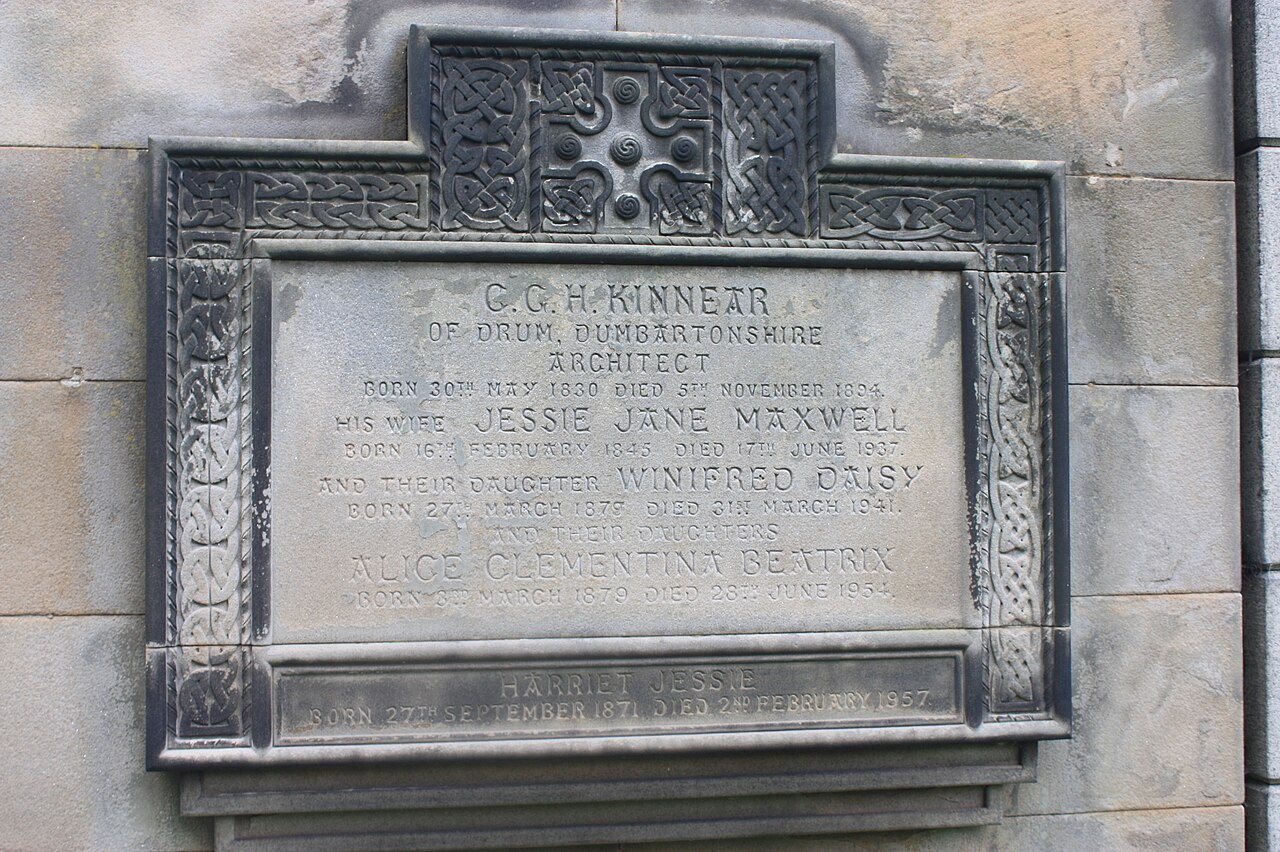
• Illustration — The grave of Charles Kinnear, Dean Cemetery, Edinburgh He died suddenly of a heart attack after a normal day at the office in November 1894 and was buried against the north wall in the northern extension to the original Dean Cemetery. Unusually for an architect, he was given a full military funeral. He is buried with his wife, Jessie Jane Maxwell (1845-1931) and three daughters. The grave lies against the northern outer wall, towards the north-west. It lies not far from his business partner, John More Dick Peddie, who lies on the southern wall of the same section. Although his estate was large, a high proportion went to pay off the debts of his brother John. His son Charles Maxwell Kinnear became a tobacco manufacturer and the younger son, Norman Boyd Kinnear, a keen ornithologist, went on to become Director of the British Museum in 1947.
Primary material
Documents and archives
reference work
- “Charles Kinnear”, English Wikipedia, consulted as further reading
Reputable secondary · Wikipedia
authority record
- Wikidata, structured authority record Q18619351: Charles Kinnear
General reference · Wikidata
References
Citations
References
Each reference names the institution holding it, so a reader may go to the document itself.
reference work
Secondary witnessauthority record
General reference
Further particulars
Held on the record
Further particulars
Open the remaining particulars
Charles Kinnear is recorded as a citizen of United Kingdom of Great Britain and Ireland. Recorded with the occupation photographer.
The Encyclopedia exists whether or not anything is for sale. Corrections are recorded rather than overwritten, and every version of this record is kept. Published 18 August 2026.
Elsewhere in Photography
11,392 published records in this field, each with its sources named.
- Charles James HankinsonPhotographer
- Charles JonesPhotographer
- Charles KerryPhotographer
- Charles KinkeadPhotographer
- Charles L. ReasonPhotographer
- Charles LathamPhotographer
- Charles Leander WeedPhotographer
- Charles LeirensPhotographer
Best supported in this field
For owners
Own a work by Charles Kinnear?
A specialist will read what you send and tell you what the house can establish, what it cannot, and whether the object is suited to sale. There is no charge and no obligation. The object stays with you throughout; nothing is shipped to us unless it is arranged in writing beforehand.