
Charles Henry Page
Charles Page • Illustration — Hays County Courthouse Charles Henry Page (1876–1957) was an American architect. He and his brother Louis Charles Page (1883–1934) founded the Texas firm of Page Brothers, Architects (also known as C. Page & Bro.). The firm achieved great recognition when they were commissioned to design the Texas State Building for the 1904 Louisiana Purchase Exposition (informally known as the St.
Also recorded as Page, Charles Henry Jr. · Charles H. Page · C. H. Page
Charles Henry Page

Z28scrambler · CC BY-SA 3.0
- Died
- 1957 · Austin.
- Nationality
- United States
- Occupation
- architect
- Languages
- English
VALÉORINE Encyclopedia
VALÉORINE documentary reading
Documentary summary
Charles Page • Illustration — Hays County Courthouse Charles Henry Page (1876–1957) was an American architect. He and his brother Louis Charles Page (1883–1934) founded the Texas firm of Page Brothers, Architects (also known as C. Page & Bro.). The firm achieved great recognition when they were commissioned to design the Texas State Building for the 1904 Louisiana Purchase Exposition (informally known as the St.
Admitted source layer · organised and presented by VALÉORINE
Reference Check
Propose documentary evidence for Charles Henry Page. A contribution is never written directly as fact: identity, source, rights and evidence gates still decide.
Sign in to contribute
World of VALÉORINE
Documentary connections
Only confirmed graph relationships appear here. Images are shown only when their identity and reuse rights both pass the documentary gate.
Documentary evidence
Documentary basis
Authority files
wikidata · Q15999012 · wikipedia · Charles Henry Page
In this article
Early life and career
Early life and career
Louis World's Fair). The Pages also designed many courthouses and other buildings across Texas.
Page was the son of an English immigrant stonemason. Page was born in St. Louis, Missouri. His family moved to Texas when he was ten years old so his father could work on the Texas State Capitol. He attended public school and worked with his father in the construction industry. Page apprenticed with several architects and then began his own practice at the age of 19 with the firm Makin and Page. Page left that firm and began an independent practice as C. H. Page Jr. His brother Louis soon joined him, and they formed Page Brothers, Architects in 1898. The firm became one of the leading firms specializing in public projects such as public schools and courthouses. Page's son Charles Henry Page Jr. was born in 1910 in Austin. He received his bachelor's degree in architecture in 1932 from the University of Texas at Austin. After Louis's death in 1934, Page Jr. joined the practice. In 1936, he became a partner and the firm name was changed to C.H. Page & Son. After the death of Page Sr. (the father, though sometimes also referred to as C. H. Page Jr.) in 1957, Page Jr. continued to practice for several years. Louis Charles Page also had a son, Louis Charles Page Jr. (1909–1981), who became an architect. He and college roommate Louis Southerland (1906–1994) formed Page and Southerland in 1935 in Austin. Page and Southerland designed many of the monuments placed around the state to commemorate the Texas Centennial. They were joined by Louis's brother George in 1939 and the name was expanded to Page Southerland Page. The company changed its name to just Page in 2013.
Texas courthouses
Texas courthouses
The brothers designed numerous public buildings in Texas, including the Anderson, Chambers, Fort Bend, Hays, Hunt, Orange, and Williamson county courthouses.
Other designs
Other designs
Page also designed the 1936 Austin federal courthouse. and the station at Crowley, Louisiana, built in 1907 for the Colorado Southern, New Orleans and Pacific Railroad as well as the city hall buildings in Brownsville, Mexia and Eagle Lake. Many of Page's buildings have been added to the National Register of Historic Places.
Personal
Personal
Page lived in the Pemberton Heights district of Austin. He died in 1957 and is buried at Oakwood Cemetery in Austin, the same cemetery he had designed a small chapel for in 1914.
Gallery
Gallery
• Illustration — Fort Bend County Courthouse, Texas • Illustration — Williamson County Courthouse, Texas • Illustration — Anderson County Courthouse, Texas • Illustration — Hunt County Courthouse, Texas • Illustration — Orange County Courthouse, Texas • Illustration — United States Courthouse, Austin, Texas • Illustration — Railroad Depot, Crowley, Louisiana
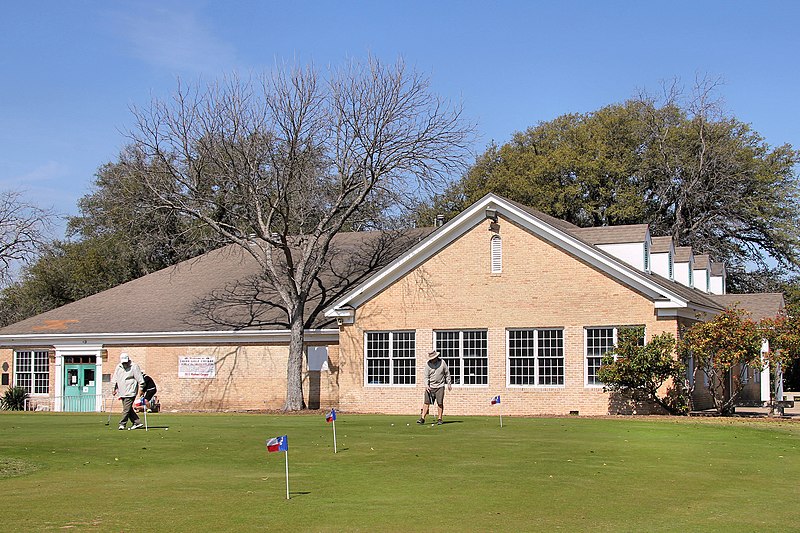
The Lions Municipal Golf Course clubhouse and putting green in Austin, Texas, United States.
Larry D. Moore

The Hancock Recreation Center in Austin, Texas, United States. Charles Henry Page designed the 1934 clubhouse.
Larry D. Moore
Life and career
Dated record
Life and career
The full dated record · 2 entries
1876
Charles Henry Page born at St. Louis.
1957
Charles Henry Page died at Austin.
Places
Named by the record
Places
Only places the record itself states, plotted where the house gazetteer settles their coordinates. Nothing is inferred from a name or a nationality.
St. Louis.
Birth place
Austin.
Death place
Citations
References
Each reference names the institution holding it, so a reader may go to the document itself.
reference work
Secondary witnessreference work
Secondary witness
The Encyclopedia exists whether or not anything is for sale. Corrections are recorded rather than overwritten, and every version of this record is kept. Published 17 August 2026.
Elsewhere in Design
11,558 published records in this field, each with its sources named.
- Charles Heathcote TathamDesigner
- Charles Henry AthertonDesigner
- Charles Henry DriverDesigner
- Charles Henry HowellDesigner
- Charles Herbert AslinDesigner
- Charles Herbert ReillyDesigner
- Charles Hercules RutanDesigner
- Charles Hodgson FowlerDesigner
Best supported in this field
For owners
Own a work by Charles Henry Page?
A specialist will read what you send and tell you what the house can establish, what it cannot, and whether the object is suited to sale. There is no charge and no obligation. The object stays with you throughout; nothing is shipped to us unless it is arranged in writing beforehand.