
Charles-François Daubigny
Charles-François Daubigny (15 February 181719 February 1878) was a French painter, one of the members of the Barbizon school, and is considered an important precursor of impressionism. He was also a prolific printmaker, mostly in etching, and one of the main artists who used the cliché verre technique.
Also recorded as Daubigny, Charles-François · Добиньи, Ш.-Ф. 1817-1878 Шарль-Франсуа · D'Aubigny, 1817-1878 · Daubigny, Charles François (French landscapist, 1817-1878)
Charles-François Daubigny
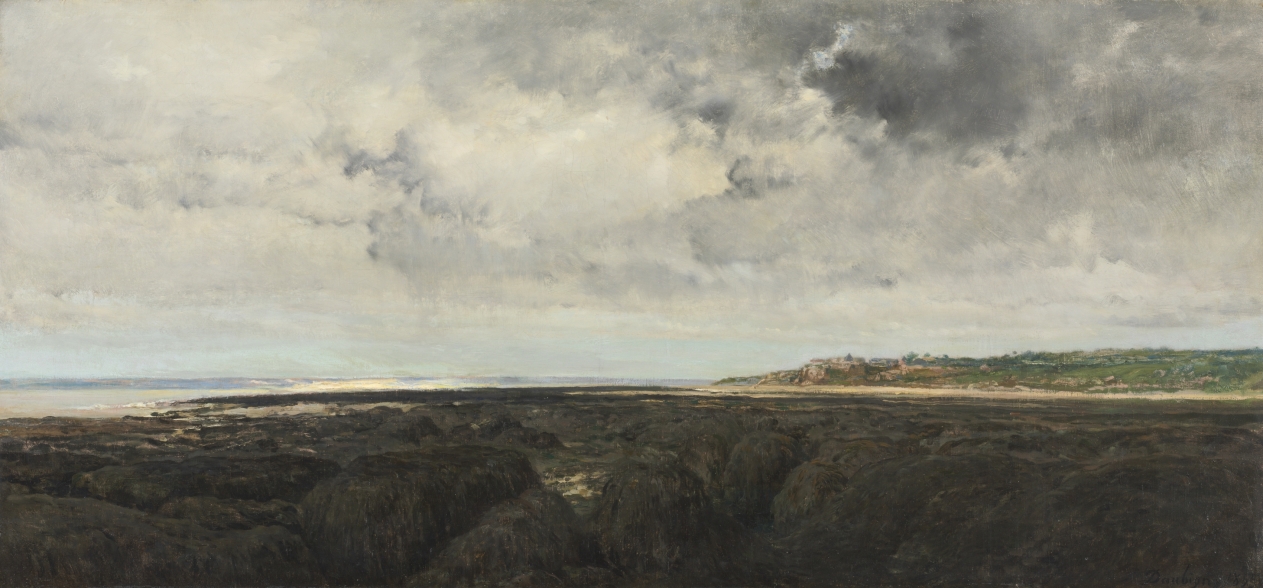
Charles François Daubigny · The Cleveland Museum of Art · Bequest of William G. Mather · CC0
- Name
- Charles-François Daubigny
- Born
- 15 February 1817
- Birthplace
- Paris, France
- Died
- 19 February 1878
- Known for
- Painting
- Movement
- Barbizon school
VALÉORINE Encyclopedia
VALÉORINE documentary reading
Documentary summary
Charles-François Daubigny (15 February 181719 February 1878) was a French painter, one of the members of the Barbizon school, and is considered an important precursor of impressionism. He was also a prolific printmaker, mostly in etching, and one of the main artists who used the cliché verre technique.
Admitted source layer · organised and presented by VALÉORINE
Note VALÉORINE
No house-authored Note is published until its assertions and sources pass the VALÉORINE evidence contract. The documentary article remains available in full while that enrichment is being consolidated.
Documentary enrichment in progress · no unsupported statement published
Reference Check
Propose documentary evidence for Charles-François Daubigny. A contribution is never written directly as fact: identity, source, rights and evidence gates still decide.
Sign in to contribute
World of VALÉORINE
Documentary connections
Only confirmed graph relationships appear here. Images are shown only when their identity and reuse rights both pass the documentary gate.

Documentary evidence
Evidence Panel
not yet certified
- Identity
- resolved
- Independent source families
- 0
- Admitted assertions
- 0
- Open conflicts
- 0
Authority files
gnd · 3017776-5 · gnd · 3017776-5 · museum · 71399615 · museum · 67 · museum · 724809 · museum · 128363 · museum · 436085
In this article
Key facts
Key facts
• Name — Charles-François Daubigny • Born — 15 February 1817 • Birthplace — Paris, France • Died — 19 February 1878 • Place of death — Paris, France • Known for — Painting • Movement — Barbizon school
Biography
Biography
Daubigny was born in Paris, into a family of painters; taught art by his father, Edmé-François Daubigny, and his uncle, miniaturist Pierre Daubigny (1793–1858). He was also a pupil of Jean-Victor Bertin, Jacques Raymond Brascassat and Paul Delaroche, from whom he would quickly emancipate himself. Though best known for his painted landscapes, Daubigny survived for many years as a graphic artist, illustrating books, magazines and travel guides for publication. In 1838, he set up, at the Rue des Amandiers-Popincourt, a community of artists, a phalanstery, with Adolphe-Victor Geoffroy-Dechaume, Hippolyte Lavoignat, Ernest Meissonnier, Auguste Steinheil, Louis Joseph Trimolet, with whom he already had expressed his interest in subjects drawn directly from daily life and nature. These artists will work, among others, for the publisher Léon Curmer, who was specialized in books illustrated with vignettes. From this period date the first confirmed engravings by Daubigny. Initially Daubigny painted in a more traditional style, but this changed after 1843 when he settled in Barbizon to work outside in nature. Even more important was his meeting with Camille Corot in 1852 in Optevoz (Isère). From 1852 onward, he was influenced by Gustave Courbet. The two artists were from the same generation and were driven by the realist movement: during a joint stay, each composed a series of views of Optevoz. In 1848, Daubigny worked on behalf of the Chalcographie du Louvre, performing facsimiles, which testifies to his great expertise in this art, and revisiting the technique of aquatint in a less cumbersome process. His famous series of Rolling Carts dates from this period. • Illustration — Self-portrait of Daubigny painting in his floating studio, from Voyage en Bateau. In 1857, Daubigny bought a boat and outfitted it as a floating studio, taking his first excursion in November of that year. As "captain" of the Botin, he painted along the Seine and Oise, often in the region around Auvers. In 1862, Daubigny published Voyage en Bateau, a series of 19 etchings (including the title page) depicting the artist's life on and along the water in his floating atelier, accompanied by a "cabin boy," his son Karl. "This was a practice that greatly inspired Claude Monet, who followed Daubigny and made his own studio boat." In 1862, with Corot, he experimented with the cliché-verre technique, a process halfway between photography and printmaking. In 1866, he joined the jury of the Paris Salon for the first time, alongside his friend Corot. The same year, Daubigny visited England, eventually returning because of the Franco-Prussian War, in 1870. In London he met Claude Monet, and they left for the Netherlands together. Back in Auvers, he was visited by an admiring Paul Cézanne. Daubigny died in Paris in 1878. His remains are interred at cimetière du Père-Lachaise (division 24).
In popular culture
In popular culture
The life of Daubigny was adapted into a graphic novel by Belgian comics writer Bruno de Roover and artist Luc Cromheecke. It appeared under the title De Tuin van Daubigny in 2016, and in an ebook English translation by James Vandermeersch, as Daubigny's Garden, in 2017.
Gallery
Gallery
• Illustration — Pool Beneath Trees (1850), Museum of Modern Art André Malraux, Le Havre • Illustration — The Harvest (1851), Musée d'Orsay, Paris • Illustration — The Ponds of Gylieu (1853), Cincinnati Art Museum • Illustration — The River Seine at Mantes (1856), Brooklyn Museum • Illustration — Banks of the Oise (1863), Saint Louis Art Museum • Illustration — The Creek (1863), Clark Art Institute, Williamstown, Massachusetts • Illustration — Twilight (1866), Walters Art Museum, Baltimore • Illustration — The Bridge between Persan and Beaumont-sur-Oise (1867), Clark Art Institute, Williamstown, Massachusetts • Illustration — La Confluence de la Seine et de l'Oise (1868), Museum of Fine Arts, Budapest • Illustration — Les Blanchisseuses (1870–1874), The Frick Collection, New York • Illustration — Les Sables-d'Olonne, Artizon Museum, Tokyo • Illustration — Boats on the Seacoast at Étaples (1871), Metropolitan Museum of Art, New York • Illustration — Les Laveuses (1873), Aberdeen Art Gallery • Illustration — Lever de lune à Auvers, or Le Retour du troupeau (1878), Montreal Museum of Fine Arts • Illustration — Farm at Kerity, Kunstmuseum Den Haag, The Hague • Illustration — The Painter’s Barge at the Ile de Vaux on the Oise River (1877), Dallas Museum of Art
Identity and origins
Identity and origins
The authorities additionally record the headings Daubigny, Charles-François, Добиньи, Ш.-Ф. 1817-1878 Шарль-Франсуа, D'Aubigny, 1817-1878, Charles-François Daubigny and Daubigny, Charles François (French landscapist, 1817-1878). His recorded language was French. He was the child of Edmé-François Daubigny. One child is recorded: Karl Daubigny. Other recorded relations include Pierre Daubigny.
Career and activity
Career and activity
Charles-François Daubigny worked in painting and visual arts. His work is associated with Barbizon school. He belonged to Barbizon school. He worked at Paris and London.
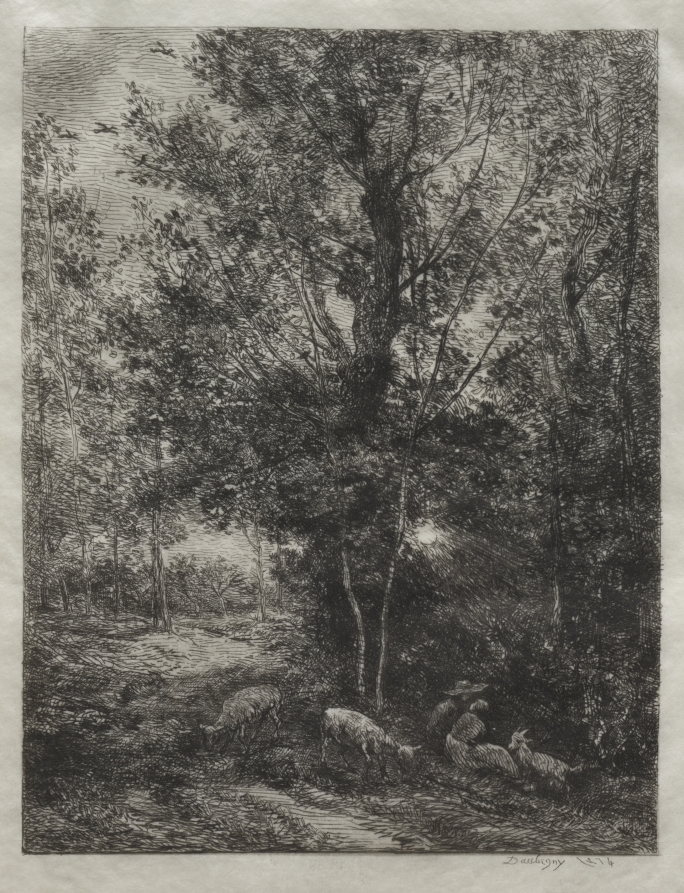
The Shepherd and the Shepherdess, 1874, by Charles-François Daubigny
Charles François Daubigny · The Cleveland Museum of Art · Mr. and Mrs. Charles G. Prasse Collection
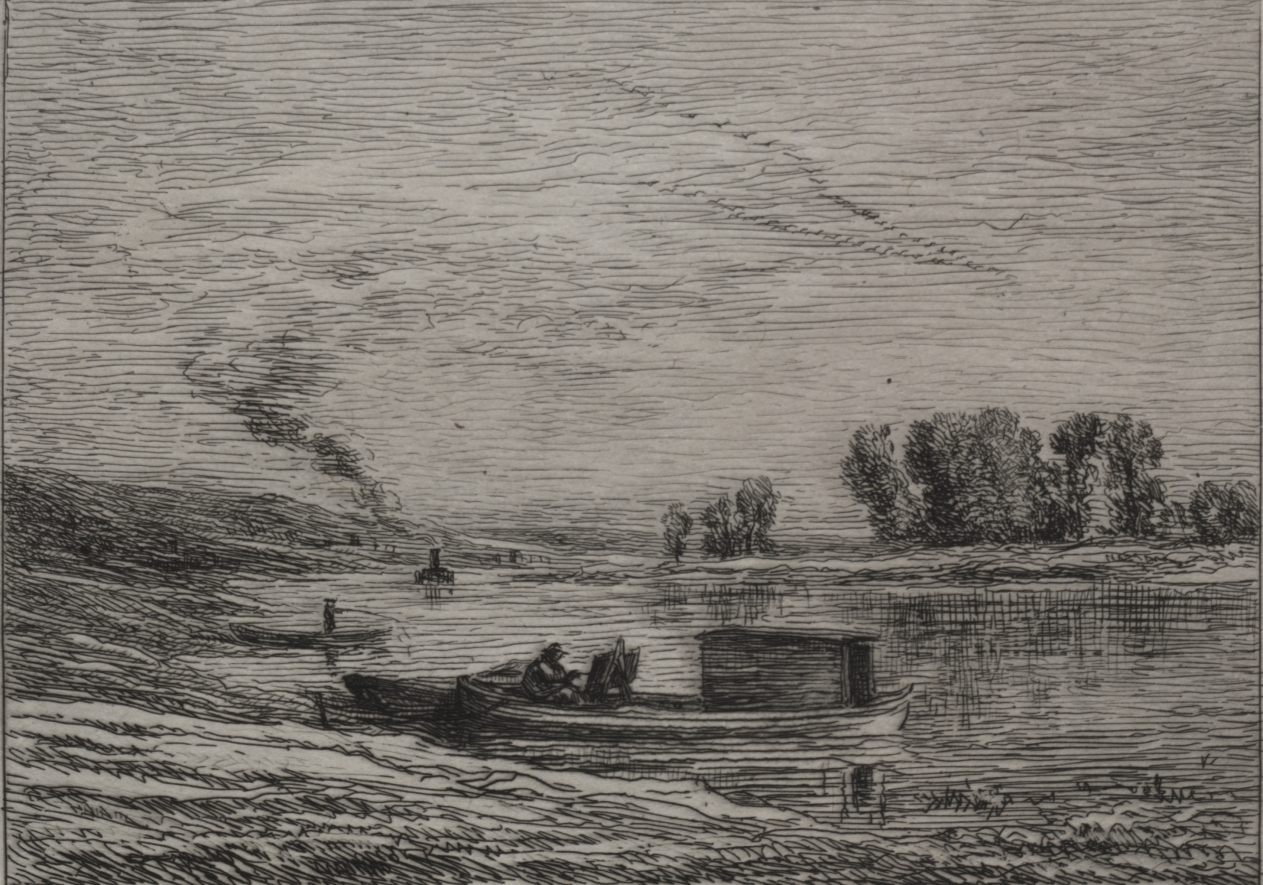
The Boat in Conflans, 1866, by Charles-François Daubigny
Charles François Daubigny · The Cleveland Museum of Art · Gift of Ralph King, the Frederick Keppel Memorial
Life and career
Dated record
Life and career
The full dated record · 2 entries
1817
Charles-François Daubigny born at Paris.
1878
Charles-François Daubigny died at Paris.
Paintings
• Illustration — Charles-François Daubigny, Spring (1862) The most striking paintings by Daubigny were those produced between 1864 and 1874, which depict mostly forest landscapes and lakes. Disappointed because he felt that he did not meet with the same level of success and admiration as his contemporaries, by the end of his career he was nonetheless an extremely sought-after and appreciated artist. The motifs of his paintings, sometimes tending towards repetitiveness and often playing on the horizontality of the landscape underlined by a backlight effect, would be taken up and accentuated by Hippolyte Camille Delpy, his most influenced student. His most ambitious canvases include Springtime (1857), in the Louvre; Borde de la Cure, Morvan (1864); Villerville sur Mer (1864); Moonlight (1865); Auvers-sur-Oise (1868); and Return of the Flock (1878). He was named by the French government as an Officer of the Legion of Honor.
Legacy
• Illustration — Daubigny's Garden, painted by Vincent van Gogh in 1890. His followers and pupils included his son Karl Pierre Daubigny, Achille Oudinot, Hippolyte Camille Delpy, Albert Charpin and Pierre Emmanuel Damoye. The two painters who introduced the Barbizon School in Portugal in 1879, António da Silva Porto and João Marques de Oliveira, were also his disciples. Upon learning of Daubigny's death, Vincent van Gogh wrote in a letter: It must be truly good, when one dies, to be conscious of having done a thing or two in truth, knowing that as a result one will continue to live in the memory of at least a few, and having left a good example to those who follow. If others appear later, they can do no better than to follow in the footsteps of such predecessors and to do it the same way. Daubigny’s house and studio at Auvers-sur-Oise became a kind of pilgrimage site for many artists, including Cézanne and also van Gogh, who (with permission of the artist's widow) painted Daubigny's garden three times. In 2016, the Van Gogh Museum in Amsterdam presented Daubigny, Monet, Van Gogh: Impressions of Landscape, an exhibition of 63 paintings and 16 works on paper by Daubigny and the Impressionist and Post-Impressionist painters he influenced.
Public collections
Public collections
Among the public collections holding works by Charles-François Daubigny are:
Recognition and collections
Where the work is held
Recognition and collections
Charles-François Daubigny received Knight of the Legion of Honour and Officer of the Legion of Honour.
Documents and archives
Primary material
Documents and archives
Museum record
- Charles-François Daubigny
Institutional or primary · Art Institute of Chicago
- Charles-François Daubigny
Institutional or primary · Cleveland Museum of Art
- Charles-François Daubigny
Institutional or primary · The Metropolitan Museum of Art
- The Metropolitan Museum of Art, Open Access collection record 724809, consulted for Charles-François Daubigny
Institutional or primary · The Metropolitan Museum of Art
Library record
- Exposition Charles-François Daubigny (1990 : Aulnay-sous-Bois)
Institutional or primary · Deutsche Nationalbibliothek
Institutional database
- Charles-François Daubigny, 1817-1878
Scholarly · OCLC VIAF
Literature
Scholarly footprint
A count of publications is evidence of attention, not of standing, and is given here only as a measure.
Notes from the source article
Cited by Wikipedia
Notes from the source article
These works are cited by the source article, in its own numbering. They are recorded as its citations, not as sources VALÉORINE has verified.
- 1.Oxford University Press dead link. Daubigny, Charles François. September 2022.
- 2.HarperCollins. Daubigny. Collins English Dictionary.
- 3.Cite Merriam-Webster Daubigny access-date=17 September 2019
- 4.Newhouse, Jill. Charles F. Daubigny: Drawings for Le Voyage en Bateau. Jill Newhouse Gallery. January 2015.
- 5.Voyage en bateau : [estampe] : Croquis à l'eau forte par Daubigny 1862. gallica.bnf.fr.
- 6.Siegal, Nina. Exploring Daubigny, Through His Influence on van Gogh. The New York Times. October 20, 2016.
- 7.José-Augusto França, A Arte em Portugal no Século XIX, Lisbon, Bertrand Editora, 3rd edition, 1990, volume 2 (Portuguese)
- 8.The Iconographic Encyclopaedia of the Arts and Scien: Sculpture and painting, 1887, page 138
- 9.Bruno de Roover.
- 10.Luc Cromheecke.
- 11.Cromheecke voelt sympathie voelt voor pretentieloosheid van Daubigny. 10 December 2016.
- 12.Daubigny's Garden. books.apple.com.
- 13.The Art Institute of Chicago
- 14.Cincinnati Art Museum
- 15.The Frick Collection
- 16.The Hermitage
- 17.Mesdag Collection
- 18.The Israel Museum
- 19.Kunstmuseum Den Haag
- 20.Metropolitan Museum of Art
- 21.Nathalie Bondil, The Montreal Museum of Fine Arts. 150th anniversary guide, Montréal, Musée des beaux-arts de Montréal, 2013, p. 168
- 22.Musée du Louvre
- 23.Musée d'Orsay
- 24.Museum of Fine Arts, Boston
- 25.National Gallery of Canada
- 26.National Galleries of Scotland
- 27.National Gallery, London
- 28.National Gallery of Art
- 29.Neue Pinakothek
- 30.Rijksmuseum
- 31.Smithsonian American Art Museum
Bibliography printed in the source article · 6
- Fidell-Beaufort, Madeleine and Bailly-Herzberg, Janine; parallel text, French/English, with English translation by Judith Schub (1975). Daubigny. Series: La Vie et l'œuvre. Paris: Geoffroy-Dechaume.
- Hellebranth, Robert. Charles François Daubigny, 1817-1878. Vol. I, Catalogue Raisonné, 1016 paintings (1976); Vol. 2, Supplement, 224 paintings (1996). Morges: Matute.
- Henriet, Frédéric (1897). C. Daubigny et son œuvre gravé. Paris: A. Lévy.
- Ives, Colba, with Barker, Elizabeth E. (2000). Romanticism & the school of nature: nineteenth-century drawings and paintings from the Karen B. Cohen collection, pp. 186-193. New York: The Metropolitan Museum of Art.
- Mollett, John W. (1890). "Charles-François Daubigny" (pp. 34-58) in The Painters of Barbizon, Volume 2, London: Sampson Low, Marston, Searle & Rivington.
- Wickenden, Robert J. (1914). Charles-François Daubigny, painter and etcher. Boston: Museum of Fine Arts Boston, Houghton Mifflin Company.
References
Citations
References
Each reference names the institution holding it, so a reader may go to the document itself.
Museum record
Charles-François DaubignyArt Institute of Chicago
VerifiedMuseum record
Charles-François DaubignyCleveland Museum of Art
VerifiedLibrary record
Exposition Charles-François Daubigny (1990 : Aulnay-sous-Bois)Deutsche Nationalbibliothek
VerifiedMuseum record
Charles-François DaubignyThe Metropolitan Museum of Art
VerifiedMuseum record
The Metropolitan Museum of Art, Open Access collection record 724809, consulted for Charles-François DaubignyThe Metropolitan Museum of Art
VerifiedInstitutional database
Charles-François Daubigny, 1817-1878OCLC VIAF
Verifiedauthority file
Gemeinsame Normdatei 3017776-5, Exposition Charles-François Daubigny (1990 : Aulnay-sous-Bois).Deutsche Nationalbibliothek
Partially resolved
People, houses and institutions
Knowledge graph
People, houses and institutions
Teachers, collaborators, publishers and institutions recorded against this person, each on a stated basis.
Place
1- ParisPlace
Established from a fact already recorded on a verified source.
Further particulars
Held on the record
Further particulars
Open the remaining particulars
He trained under Edmé-François Daubigny, Pierre Daubigny, Jean-Victor Bertin and Jacques Raymond Brascassat. His recorded influences include Gustave Courbet. Each of those relationships is stated by the authority record rather than inferred from style.
The Encyclopedia exists whether or not anything is for sale. Corrections are recorded rather than overwritten, and every version of this record is kept. Published 13 August 2026.
Elsewhere in General
22,758 published records in this field, each with its sources named.
- CharlemagnePlace
- CharleroiPlace
- Charles Edward ChambersPerson
- Charles P. Daly MedalTerminology
- CharlesbourgPlace
- Charleston AcademyOrganisation
- CharlestownPlace
- Charleville-MézièresPlace
Best supported in this field
For owners
Own a work by Charles-François Daubigny?
A specialist will read what you send and tell you what the house can establish, what it cannot, and whether the object is suited to sale. There is no charge and no obligation. The object stays with you throughout; nothing is shipped to us unless it is arranged in writing beforehand.