
CBU-100 Cluster Bomb
The Mk 20 Rockeye II, CBU-99 Rockeye II, and CBU-100 Rockeye II comprise an American cluster bomb family which are employed primarily in an anti-tank mode against armored vehicles. They are an air-launched, conventional free-fall, explosively opened, submunition dispensing, cluster bomb. They deploy 247 Mk 118 Rockeye submunitions, a HEAT bomblet, and weigh 489 lb (222 kg) as an assembled unit.
Also recorded as Mk.20 Rockeye II · Mk 20 Rockeye II · Rockeye II · CBU-99/100
CBU-100 Cluster Bomb

USN · U.S. Navy Naval Aviation News September-October 1991 [1] · Public domain
- Field
- cluster munition and aerial bomb.
- Region
- United States.
VALÉORINE Encyclopedia
VALÉORINE documentary reading
Documentary summary
The Mk 20 Rockeye II, CBU-99 Rockeye II, and CBU-100 Rockeye II comprise an American cluster bomb family which are employed primarily in an anti-tank mode against armored vehicles. They are an air-launched, conventional free-fall, explosively opened, submunition dispensing, cluster bomb. They deploy 247 Mk 118 Rockeye submunitions, a HEAT bomblet, and weigh 489 lb (222 kg) as an assembled unit.
Admitted source layer · organised and presented by VALÉORINE
Note VALÉORINE
No house-authored Note is published until its assertions and sources pass the VALÉORINE evidence contract. The documentary article remains available in full while that enrichment is being consolidated.
Documentary enrichment in progress · no unsupported statement published
Reference Check
Propose documentary evidence for CBU-100 Cluster Bomb. A contribution is never written directly as fact: identity, source, rights and evidence gates still decide.
Sign in to contribute
World of VALÉORINE
Documentary connections
Only confirmed graph relationships appear here. Images are shown only when their identity and reuse rights both pass the documentary gate.


Documentary evidence
Evidence Panel
original value insufficient · checked 25 September 2026
- Identity
- resolved
- Independent source families
- 0
- Admitted assertions
- 0
- Open conflicts
- 0
Authority files
wikidata · Q5009301 · wikipedia · CBU-100 Cluster Bomb
In this article
Design
Design
The CBUs are delivered to the fleet as completely assembled all-up-rounds. The cargo section of the Rockeye's Mk 7 bomb dispenser is the main structure of the weapon and contains the bombs/bomblets. A nose fairing is attached to the forward end of the cargo section for aerodynamics and fuze installation. It has an observation window for viewing the safe/arm indicator on the installed fuze. The dispenser has two linear-shaped charges secured longitudinally inside the walls. When initiated, these shaped charges cut the dispenser in half, from front to rear, and the bombs/bomblets spread in free-fall trajectories. When the Mk 20 bomb cluster is released from the aircraft, the arming wires (primary and/or optional arming) are pulled sufficiently to arm the Mk 339 fuze (and recently the FMU-140 fuze) and release the fins. The positive armed fin release arming wire frees the fin release band, and the movable fins snap open by spring-force. Functioning of the fuze initiates the linear shaped charges in the dispenser which cut the dispenser case in half and disperse the bombs/bomblets. When the Mk 339 Mod 1 primary fuse arming wire is pulled, the fuze will function 1.2 seconds after the arming wire has been extracted. If the pilot selects the option time (4.0 seconds), both the primary and option arming wires must be pulled. If the pilot selects the option time and the primary arming wire is not pulled, the fuze will fail to function and be a dud. To stabilize the weapon after release from the aircraft, a tail cone assembly is attached to the aft end of the cargo section. The tail cone assembly houses four, spring-actuated folding fins. The fins are spring-loaded to the open position and secured in the closed position during ground handling by a fin release-band assembly. The fin release band is secured in the closed position by a safety cotter pin and by the fin release wire. A yellow band around the forward end of the cargo section indicates the explosive content of the weapon. The Mk 7 Mods 3, 4, and 6 bomb dispensers have the Mk 339 Mod 1 fuze, which provides the pilot with in-flight selection of the fuze function time. The Mk 7 Mod 4 bomb dispenser differs from the Mk 7 Mod 3 by modifying the dispenser and giving interface capabilities with a wider range of military aircraft. The Mk 7 Mod 6 bomb dispenser is the same as the Mk 7 Mod 3 except that the outside of the Mod 6 cargo section is coated with a thermal protective coating and has an additional yellow band around the forward end of the cargo section. The addition of the thermal coating increases the overall weight of the Mod 6 to 505 pounds (229 kg). Each bomblet weighs 1.32 pounds (600 g) and has a 0.4-pound (180 g) shaped-charge warhead of high explosives, which produces up to 250,000 psi (1.7 GPa) at the point of impact, allowing penetration of approximately 7.5 inches (190 mm) of armor. Rockeye is most efficiently used against area targets requiring penetration to kill. The Mk 118 Mod 0 bomblet and Mk 118 Mod 1 bomblet only differ in the latter having faster arming after separation from the dispenser.
Operational history
Operational history
Fielded in 1968, the Rockeye dispenser is also used in the Gator air-delivered mine system. During Desert Storm US Marines used the weapon extensively, dropping 15,828 of the 27,987 total Rockeyes against armor, artillery, and personnel targets. The remainder were dropped by Air Force (5,346) and Navy (6,813) aircraft. According to a test report conducted by the United States Navy's Weapon System Explosives Safety Review Board established in the wake of the 1967 USS Forrestal fire, the cooking off time for a Rockeye CBU is approximately 1 minute and 13 seconds.
Variants
Variants
Mk 20 Rockeye II, consists of 247 Mk 118 Mod 1 or Mod 2 anti-tank bomblets in an Mk 7 dispenser, with the dispenser ranging from Mk 7 Mod 2 to Mod 12 CBU-99 Rockeye II, consists of 247 Mk 118 Mod 1 or Mod 2 anti-tank bomblets in an SUU-75 dispenser CBU-100 Rockeye II, consists of 247 Mk 118 Mod 1 or Mod 2 anti-tank bomblets in an SUU-76 dispenser Mk 7 dispenser as training version of the Mk 20, indicated by a single blue band
Potential future users
Potential future users
In March 2023 Ukraine requested Mk 20 Rockeye II cluster bombs from the US to use the Mk 118 Rockeye bomblets as drone dropped munitions.
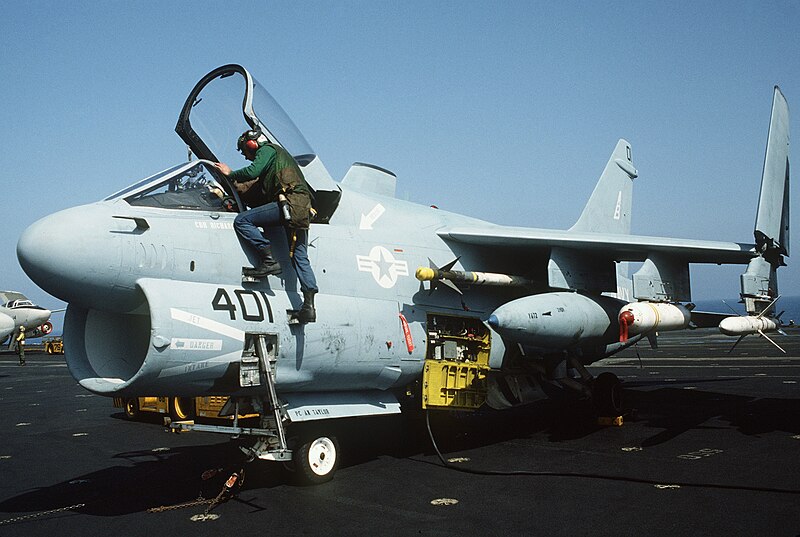
A U.S. Navy flight deck crewman checks an LTV A-7E Corsair II aircraft from attack squadron VA-72 Blue Hawks aboard the aircraft carrier USS America (CV-66) during flight operations off the coast of Libya on 17 April 1986. The aircraft is armed with an AIM-9L Sidewinder missile on the fuselage station, a Mark 20 Rockeye II bomb on the middle wing pylon and an AGM-45 Shrike missile on the outside w
PHAN David Casper, USN · U.S. DefenseImagery [1] photo VIRIN: DN-ST-86-10022 [2]

A U.S. Navy Ling-Temco-Vought A-7E Corsair II (BuNo 160873) of an Attack Squadron 72 (VA-72) enroute to its target during the 1991 Gulf War. The aircraft is carrying Mark 20 Rockeye II anti-tank cluster bombs on its outboard wing pylon and an AIM-9L Sidewinder missile on it fuselage pylon. VA-72 was assigned to Carrier Air Wing 3 (CVW-3) aboard the aircraft carrier USS John F. Kennedy (CV-67) for
Cdr. John Leenhouts, USN · U.S. DefenseImagery photo VIRIN: DN-ST-91-05575
Notes from the source article
Cited by Wikipedia
Notes from the source article
These works are cited by the source article, in its own numbering. They are recorded as its citations, not as sources VALÉORINE has verified.
- 1.CAT-UXO - Cbu 100mk 20 aircraft cluster bomb. cat-uxo.com.
- 2.CAT-UXO - Mk 118 rockeye submunition. cat-uxo.com.
- 3."Military-Systems-Munitions-Mk.20" Globalsecurity.org
- 4.Texas Instruments Paveway I. www.designation-systems.net.
- 5.CAT-UXO - Cbu 100mk 20 aircraft cluster bomb. cat-uxo.com.
- 6.CAU to CXU - Equipment Listing. www.designation-systems.net.
- 7.CAU to CXU - Equipment Listing. www.designation-systems.net.
- 8.CAT-UXO - Cbu 100mk 20 aircraft cluster bomb. cat-uxo.com.
- 9.Helfrich, Emma. Ukraine Wants U.S. Cluster Bombs But Not For What You Think. The Drive. 2023-03-08.
References
Citations
References
Each reference names the institution holding it, so a reader may go to the document itself.
reference work
Partially resolvedreference work
Partially resolved
The Encyclopedia exists whether or not anything is for sale. Corrections are recorded rather than overwritten, and every version of this record is kept. Published 14 August 2026.
Elsewhere in Militaria
6,095 published records in this field, each with its sources named.
- caseless ammunitionTerminology
- cast bulletTerminology
- catapultTerminology
- catapultaTerminology
- CBU-107 Passive Attack WeaponTerminology
- CBU-24Terminology
- CBU-55Terminology
- CBU-87 Combined Effects MunitionTerminology
Best supported in this field
For owners
Own an object connected with CBU-100 Cluster Bomb?
A specialist will read what you send and tell you what the house can establish, what it cannot, and whether the object is suited to sale. There is no charge and no obligation. The object stays with you throughout; nothing is shipped to us unless it is arranged in writing beforehand.