
Carl Bloch
Carl Heinrich Bloch (Danish pronunciation: [ˈkʰɑːˀl ˈplɒk]; 23 May 1834 – 22 February 1890) was a Danish painter.
Also recorded as Carl Heinrich Bloch · Carl H. Bloch
Carl Bloch

Israel Berendt Melchior. · bruun-rasmussen.dk. · Public domain
- Born
- 1834.
- Died
- 1890.
- Nationality
- Kingdom of Denmark.
- Occupation
- painter and printmaker.
- Fields
- history painting.
- Known for
- In a Roman Osteria, Samson and the Philistines, Christian II i fængslet på Sønderborg Slot, Transfiguration of Jesus, The Sermon On the Mount and Prometheus' Liberation.
VALÉORINE Encyclopedia
VALÉORINE documentary reading
Documentary summary
Carl Heinrich Bloch (Danish pronunciation: [ˈkʰɑːˀl ˈplɒk]; 23 May 1834 – 22 February 1890) was a Danish painter.
Admitted source layer · organised and presented by VALÉORINE
Note VALÉORINE
Carl Bloch (1834–1890) was a Danish painter and printmaker. The painter was born and died in Copenhagen.
Carl Bloch studied at Mariboes school and Royal Danish Academy of Fine Arts. The painter worked for Royal Danish Academy of Fine Arts and was a member of Accademia delle Arti del Disegno. Carl Bloch worked in Copenhagen.
Works include Christian II i fængslet på Sønderborg Slot, In a Roman Osteria, Prometheus' Liberation and Samson and the Philistines, among others. Genres include history painting. Languages used include Danish. The painter received Knight of the Order of the Dannebrog.
Composed from admitted, traceable facts · 27 September 2026
VALÉORINE
Reference Check
Propose documentary evidence for Carl Bloch. A contribution is never written directly as fact: identity, source, rights and evidence gates still decide.
Sign in to contribute
Documentary evidence
Documentary basis
Authority files
wikidata · Q547055 · wikipedia · Carl Bloch
In this article
Early life and education
Early life and education
Bloch was born in Copenhagen, Denmark, and studied there at the Royal Danish Academy of Art (Det Kongelige Danske Kunstakademi) under Wilhelm Marstrand. His parents wanted their son to enter what they considered to be a respectable profession – an officer in the Navy. This, however, was not what he wanted. His only interest was drawing and painting, and he was consumed by the idea of becoming an artist. Bloch went to Italy to study art, passing through the Netherlands, where he became acquainted with the work of Rembrandt, which became a major influence on him.
Career
Career
Bloch's early work featured rural scenes from everyday life. From 1859 to 1866, Bloch lived in Italy, and this period was important for the development of his historical style. His first great success was the exhibition of his 1864 painting Prometheus Unbound in Copenhagen in 1865. After the death of Marstrand, Bloch finished the decoration of the ceremonial hall at the University of Copenhagen. In a New Year's letter from 1866 to Bloch, H. C. Andersen wrote: "What God has arched on solid rock will not be swept away!" Another letter from Andersen declared "Through your art you add a new step to your Jacob-ladder into immortality." In a final ode, from a famous writer to a famous artist, Andersen said "Write on the canvas; write your seal on immortality. Then you will become noble here on earth." Bloch was then commissioned to produce twenty-three paintings for the King's Chapel at Frederiksborg Castle, located in Hillerød. These were all scenes from the life of Christ which have become very popular as illustrations. The originals, painted between 1865 and 1879, are still at Frederiksborg Castle. The altarpieces can be found at Holbæk, Odense, Ugerløse and Copenhagen in Denmark, as well as Löderup, Hörup, and Landskrona in Sweden and Hvalvík in the Faroe Islands.
Personal life
Personal life
Bloch met his future wife, Alma Trepka, in Rome, where he married her on 31 May 1868. They were happily married until her early death in 1886. The sorrow over losing his wife weighed heavily on Bloch, and being left alone with their eight children after her death was very difficult for him.
Death and eulogies
Death and eulogies
Bloch died of cancer on 22 February 1890. His death came as "an abrupt blow for Nordic art", according to an article by Sophus Michaelis. Michaelis stated that "Denmark has lost the artist that indisputably was the greatest among the living." Kyhn stated in his eulogy at Bloch's funeral that "Bloch stays and lives." Danish art critic, Karl Madsen, stated that Bloch reached higher toward the great heaven of art than all other Danish art up to that date. Madsen also said "If there is an Elysium, where the giant, rich, warm and noble artist souls meet, there Carl Bloch will sit among the noblest of them all!".
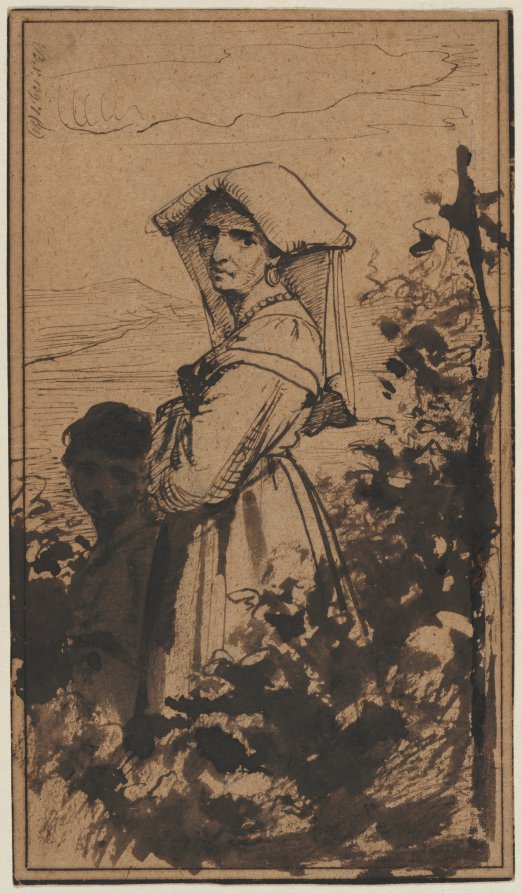
Standing Woman and Child, 1850–90, by Carl Bloch
Carl Bloch · The Cleveland Museum of Art · James Parmelee Fund
Life and career
Dated record
Life and career
The full dated record · 2 entries
1834
Carl Bloch born at Copenhagen.
1890
Carl Bloch died at Copenhagen.
Influence on art of The Church of Jesus Christ of Latter-day Saints
For over forty years, The Church of Jesus Christ of Latter-day Saints has made heavy use of Bloch's paintings, mostly from the Frederiksborg Castle collection, in its church buildings and printed media. The church has produced films depicting scriptural accounts of Christ's public ministry, using Bloch's paintings as models for the colour, light and overall set design, as well as the movement of the actors in many of the films' scenes. The most notable example of this is its 2000 film The Testaments of One Fold and One Shepherd. The church's interest in Bloch's work was generally popularized by Latter-day Saint missionary and writer Doyle L. Green, who valued the classically trained realism of his artwork, as opposed to the trend towards abstraction in contemporary art of the time. It has been further argued that the Protestant lack of iconographic features in his works, as well as the lack of "Catholic" motifs such as halos and wings, also helped to make his artworks comfortable for Latter-day Saint audiences. Through the assistance of Danish-born artist Soren Edsberg (born 1945), the acquisition of Christ Healing at the Pool of Bethesda (formerly owned by Indre Mission, Copenhagen, Denmark) was made possible for Brigham Young University Museum of Art, located in Provo, Utah. A second work by Bloch, an 1880 grisaille version of The Mocking of Christ, was purchased by BYU in June 2015.
Primary material
Documents and archives
scholarly publication
- 49335, 1890-09-29, BLOCH (Carl), artiste-peintre, Art Sales Catalogues Online
Scholarly · Crossref registry
- 49336, 1890-09-29, BLOCH (Carl), Art Sales Catalogues Online
Scholarly · Crossref registry
reference work
- Wikidata, structured authority record Q547055: Carl Bloch
Reputable secondary · Wikimedia Foundation
- “Carl Bloch”, English Wikipedia, consulted as further reading
Reputable secondary · Wikipedia
Notes from the source article
Cited by Wikipedia
Notes from the source article
These works are cited by the source article, in its own numbering. They are recorded as its citations, not as sources VALÉORINE has verified.
- 1.BYU Magazine, Winter 2011.
- 2.Smith, Helena. Carl Bloch's Lost Masterpiece Prometheus Unbound Finds Fame Again in Athens. The Guardian. 25 January 2025.
- 3.Carmack, Noel A. Images of Christ in Latter-day Saint Visual Culture, 1900–1999. Brigham Young University Studies. 39. 3. 18–76. 2000. 0007-0106.
- 4.Oman, Richard G. "What Think Ye of Christ?" An Art Historian's Perspective. Brigham Young University Studies. 39. 3. 77–90. 2000. 0007-0106.
- 5.McDonald, Amy. Mormon-Owned BYU Acquires Long-Lost 'Mysterious' Bloch Painting of Jesus. The Salt Lake Tribune. June 4, 2015.
- 6.carlbloch.org. Carl Heinrich Bloch Biography with All Details.
References
Citations
References
Each reference names the institution holding it, so a reader may go to the document itself.
scholarly publication
Institutional witnessscholarly publication
49336, 1890-09-29, BLOCH (Carl), Art Sales Catalogues OnlineCrossref registry
Institutional witnessreference work
Wikidata, structured authority record Q547055: Carl BlochWikimedia Foundation
Secondary witnessreference work
Secondary witness
The Encyclopedia exists whether or not anything is for sale. Corrections are recorded rather than overwritten, and every version of this record is kept. Published 14 August 2026.
Elsewhere in Prints
4,138 published records in this field, each with its sources named.
- Carel DakeEngraver
- Carel Nicolaas Storm van 's-GravesandeEngraver
- Carl Abraham ArfwedsonEngraver
- Carl August LebschéeEngraver
- Carl Borromäus Andreas RuthartEngraver
- Carl Edvard SonneEngraver
- Carl HummelEngraver
- Carl KuntzEngraver
Best supported in this field
For owners
Own a work by Carl Bloch?
A specialist will read what you send and tell you what the house can establish, what it cannot, and whether the object is suited to sale. There is no charge and no obligation. The object stays with you throughout; nothing is shipped to us unless it is arranged in writing beforehand.