
Canon de 305 modèle 1893/96 à berceau
The Canon de 305 modèle 1893/96 à berceau was a French railroad gun that saw action during the First and Second World Wars.
Canon de 305 modèle 1893/96 à berceau
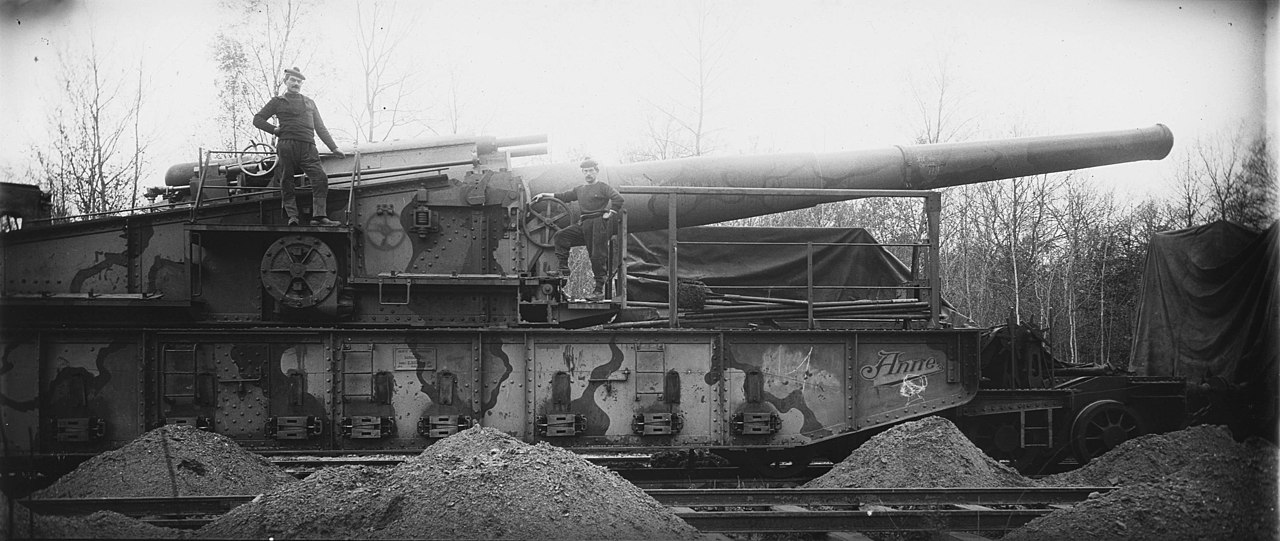
Raoul Berthelé · This photograph is part of the Fonds Raoul Berthelé, preserved by the city archives of Toulouse. It was provided to Wikimedia Commons as part of a cooperation project with Wikimédia France. In 1978 · Public domain
- Name
- Canon de 305 modèle 1893/96 à berceau
- Field
- railway gun
- Region
- France
VALÉORINE Encyclopedia
VALÉORINE documentary reading
Documentary summary
The Canon de 305 modèle 1893/96 à berceau was a French railroad gun that saw action during the First and Second World Wars.
Admitted source layer · organised and presented by VALÉORINE
Reference Check
Propose documentary evidence for Canon de 305 modèle 1893/96 à berceau. A contribution is never written directly as fact: identity, source, rights and evidence gates still decide.
Sign in to contribute
World of VALÉORINE
Documentary connections
Only confirmed graph relationships appear here. Images are shown only when their identity and reuse rights both pass the documentary gate.

Documentary evidence
Documentary basis
Authority files
wikidata · Q65058460 · wikipedia · Canon de 305 modèle 1893/96 à berceau
In this article
Key facts
Key facts
• Name — Canon de 305 modèle 1893/96 à berceau • Origin — France • Type — Railway gun • Is Artillery — yes • Is Ranged — yes • Is Explosive — yes • Service — 1916–1945 • Used By — Nazi Germany • Wars — World War I World War II • Designer — Batignolles • Design Date — 1915 • Manufacturer — Batignolles • Production Date — 1916 • Number — 8 • Variants — Canon de 320 modèle 1917 à berceau • Weight — 140 t • Part Length — 12.2 m L/40 • Cartridge — Separate loading bagged charges and projectiles • Caliber — 305 mm • Rate — 1 round every 6 minutes • Velocity — 795 m/s • Range — 27 km • Breech — Welin breech block • Recoil — Hydro-pneumatic cradle recoil • Carriage — 2 railroad bogies, 4 axles each • Elevation — -6° to +38° • Traverse — 10°
History
History
Although the majority of combatants had heavy field artillery prior to the outbreak of the First World War, none had adequate numbers of heavy guns in service, nor had they foreseen the growing importance of heavy artillery once the Western Front stagnated and trench warfare set in. Since aircraft of the period were not yet capable of carrying large diameter bombs the burden of delivering heavy firepower fell on the artillery. Two sources of heavy artillery suitable for conversion to field use were surplus coastal defense guns and naval guns. However, a paradox faced artillery designers of the time, while large caliber naval guns were common, large caliber land weapons were less common due to their weight, complexity, and lack of mobility. Large caliber field guns often required extensive site preparation because the guns had to be broken down into multiple loads light enough to be towed by a horse team or the few traction engines of the time and then reassembled before use. Building a new gun could address the problem of disassembling, transporting and reassembling a large gun, but it didn't necessarily address how to convert existing heavy weapons to make them more mobile. Rail transport proved to be the most practical solution because the problems of heavy weight, lack of mobility and reduced setup time were addressed.
Design
Design
The Canon de 305 modèle 1893/96 à berceau started life as eight Canon de 305 mm Modèle 1893/96 naval guns salvaged from two pre-dreadnought battleships the Iéna and Liberté that sank after suffering internal explosions while in port. The guns were typical built-up guns of the period which consisted of a rifled liner reinforced by layers of hoops. The guns used a Welin interrupted screw breech and fired separate loading bagged charges and projectiles. To load the gun the barrel was lowered to -6° and there was a collapsible shell handling trolley at the rear. Each gun sat on a rectangular steel base which was suspended from two railroad bogies with four axles each. The number of axles was determined by the weight limit for European railways of 17 tonnes per axle. The howitzers had a hydro-pneumatic cradle recoil system with two recoil cylinders below the barrel and one recuperator on top. When the gun fired the cradle recoiled up a slightly inclined rear deck which helped return the howitzer to battery after firing. The guns were mounted on Berceau style rail mounts produced by Batignolles which consisted of five steel cross ties with integral spades which were driven between the railroad ties. On top of these steel ties, two heavy girders were laid parallel to the tracks which bolted to the ties. The girders were equipped with 12 sets of flanges that matched the same number on the carriage. When the carriage was over the flanges the carriage was fastened to the girders and the ties. Once the platform was ready, the piece could be anchored in minutes and ready to fire. The ties and girders supported the weight of the carriage and absorbed the gun's recoil, the track did not have to be reinforced. A pit was also dug under the gun's breech and lined with a steel box to allow the gun to recoil at high angles of elevation, which took about 3 hours. The Batignolles mounts also employed car-traverse which allowed for limited traverse by shifting the carriage on its bogies. When the United States entered the First World War a license to produce Berceau style rail mounts was negotiated with Batignolles and the carriage used by the 12-inch M1895 railway gun was similar.
World War I
World War I
After the barrels became worn out they were bored out to fire 320 mm (13 in) ammunition during 1918–1919 and were designated Canon de 320 modèle 1917 à berceau. These were placed in reserve between the wars.
World War II
World War II
Eight Canon de 320 modèle 1917 à berceau were mobilized by the French Army during the Second World War. The Germans gave them the designation 32 cm Kanone (Eisenbahn) 652 (f).
Ammunition
Ammunition
• APC (Armor Piercing Capped) - 340 kg • CI (Common Incendiary) - 292 kg • SAPC (Semi-Armor Piercing Capped) - 340 kg
Gallery
Gallery
• Illustration — A diagram showing the anchoring system of the Batignolles railway mount. • Illustration — Details of the anchoring for the Batignolles mount. • Illustration — The breech of a 1893/96 gun. • Illustration — A gun being moved into position during the Battle of the Somme. • Illustration — A US Army 12-inch M1895 railway gun which used a similar Batignolles style rail chassis.
Definition
Definition
The following is established of the heading itself. Associated with France.
Places
Named by the record
Places
Only places the record itself states, plotted where the house gazetteer settles their coordinates. Nothing is inferred from a name or a nationality.
- France
Primary material
Documents and archives
reference work
- “Canon de 305 modèle 1893/96 à berceau”, English Wikipedia, consulted as further reading
Reputable secondary · Wikipedia
authority record
- Wikidata, structured authority record Q65058460: Canon de 305 modèle 1893/96 à berceau
General reference · Wikidata
Notes from the source article
Cited by Wikipedia
Notes from the source article
These works are cited by the source article, in its own numbering. They are recorded as its citations, not as sources VALÉORINE has verified.
- 1.Miller, H. W., LTC, USA. Railway Artillery, vols. I and II. Government Printing Office. 80–83. 1921.
- 2.Hogg, Ian. Allied Artillery of World War One. Crowood. 129–134. 2004. 1861267126.
- 3.REGARDER SANS TOUCHER. thebebert1er.free.fr.
- 4.Zaloga, Steve. Railway Guns of World War II. Osprey. 5. 2016. 978-1472810687.
- 5.Gander, Terry. Weapons of the Third Reich: An Encyclopedic Survey of all Small Arms, Artillery, and Special Weapons of the German Land Forces, 1939-1945. Doubleday. 245. 1978. 0385150903.
References
Citations
References
Each reference names the institution holding it, so a reader may go to the document itself.
reference work
Secondary witnessauthority record
General reference
The Encyclopedia exists whether or not anything is for sale. Corrections are recorded rather than overwritten, and every version of this record is kept. Published 17 August 2026.
Elsewhere in Militaria
6,095 published records in this field, each with its sources named.
- Canon de 274 modèle 87/93 GlissementTerminology
- Canon de 274 modèle 93/96 BerceauTerminology
- Canon de 305 mm Modèle 1887Terminology
- Canon de 305 mm Modèle 1893/96 gunTerminology
- Canon de 305 modèle 1893/96 à glissementTerminology
- Canon de 305 modèle 1906/10 à glissementTerminology
- Canon de 305 modèle 93/96 TAZTerminology
- Canon de 32 modèle 1870/81 à glissementTerminology
Best supported in this field
For owners
Own an object connected with Canon de 305 modèle 1893/96 à berceau?
A specialist will read what you send and tell you what the house can establish, what it cannot, and whether the object is suited to sale. There is no charge and no obligation. The object stays with you throughout; nothing is shipped to us unless it is arranged in writing beforehand.