
Budai
Budai is a nickname given to the historical Chinese monk Qieci in the Later Liang Dynasty, who is often identified with and venerated as the future Buddha Maitreya in Chan Buddhism and Buddhist scripture. The name "Budai" literally means "cloth sack", and refers to the bag he is often depicted carrying as he wanders. His jolly nature and eccentric lifestyle distinguish him from most Buddhist masters or figures.
Also recorded as Hotei · Laughing Buddha · Shi Qici · Budai heshang
Budai

Photograph by Mike Peel ( · CC BY-SA 4.0
- Died
- 28 March 917
- Born
- 850
- Nationality
- Tang dynasty
- Occupation
- philosopher · poet · buddhist monk
VALÉORINE Encyclopedia
VALÉORINE documentary reading
Documentary summary
Budai is a nickname given to the historical Chinese monk Qieci in the Later Liang Dynasty, who is often identified with and venerated as the future Buddha Maitreya in Chan Buddhism and Buddhist scripture. The name "Budai" literally means "cloth sack", and refers to the bag he is often depicted carrying as he wanders. His jolly nature and eccentric lifestyle distinguish him from most Buddhist masters or figures.
Admitted source layer · organised and presented by VALÉORINE
Note VALÉORINE
Budai (850–916) was a buddhist monk, philosopher and poet, a national of Tang dynasty. The buddhist monk died in Yuelin Temple.
Composed from admitted, traceable facts · 01 October 2026
VALÉORINE
Reference Check
Propose documentary evidence for Budai. A contribution is never written directly as fact: identity, source, rights and evidence gates still decide.
Sign in to contribute
World of VALÉORINE
Documentary connections
Only confirmed graph relationships appear here. Images are shown only when their identity and reuse rights both pass the documentary gate.
Documentary evidence
Documentary basis
Authority files
wikidata · Q599838 · wikipedia · Budai
In this article
Biography
Biography
He is almost always shown smiling or laughing, hence his nickname in Chinese, the "Laughing Buddha". Traditionally depicted as having a huge stomach (possibly a symbol of abundance or forgiveness) and many stories surrounding Budai involve his love of food and drink. Because of this, he is also referred to as the "Fat Buddha", especially in the Western world, where he is often mistaken for Gautama Buddha. The main textual record of Budai's life resides in a collection of Chan Buddhist biographies known as The Transmission of the Lamp.
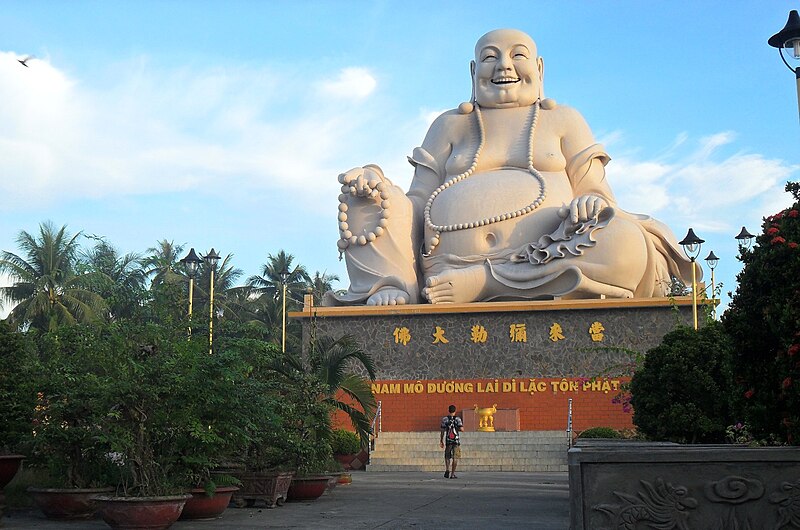
Budai (Bố Đại) statue, god of happiness at Ving Trang (Vĩnh Tràng) Pagoda, Mỹ Tho, Vietnam
Milei.vencel, Hungary
Key facts
Key facts
• Died — 28 March 917
Hagiography
Hagiography
The origins of Budai are centred on cult worship and local legend. He is traditionally depicted as a fat, bald monk wearing a simple robe. He carries his few possessions in a cloth sack, being poor but content. His figure appears throughout Chinese culture as a representation of both contentment and abundance. Budai was able to predict people's fortunes and even weather patterns. He slept wherever he arrived, even outside, for he could ward off the bitter cold. A note dated 28 March 917 claims that he was an incarnation of Maitreya, the Buddha of the Future. A body allegedly belonging to Budai was displayed at the eastern section of the Great Hall at Yuelin Temple in Fenghua District, Zhejiang.
In art
In art
Budai is almost always depicted with his cloth sack that looks like a large bag. The bag serves as a prominent motif within the context of Chan Buddhism as it represents abundance, prosperity, and contentment. Ink paintings such as these attributed to Budai often had an inscription and seal that signaled to high-ranking officials. For example, Budai and Jiang Mohe was inscribed by Chusi Fanqi, who was closely related to Song Lian (1310–1381) and Wei Su (1295–1372). After Chan Buddhism was transmitted to Japan around the 13th century as Zen Buddhism, the devout monastics and laymen of the area utilized figure painting to portray the characters central to this "awakening" period of Zen art. Many of the eccentric personalities that were inducted into the Zen tradition like Budai were previously wrapped up in the established culture and folklore of Japan. The assimilation and reapplication of these wondrous charismas to the Zen pantheon assisted in the expansion of the Zen tradition. As the images demonstrate, Budai is most jubilant when in the presence of others, especially children. When depicted with other gods in the Seven Lucky Gods, Budai maintains a solemn or even depressed countenance. Budai's round figure comes into practical use through the sculpting of the incense box (18th century) that splits the monk's body into two halves. The newer images such as Hotei and Children Carrying Lanterns (19th century) employs much more color, dramatization of physical features, and detail than the older pieces such as Hotei from Mokuan Reien (1336) that employs much more wispy and heavily contrasting outlines of his figure with no color or assumed setting. Japanese iconography, like that of Zen master Hakuin Ekaku, shows Budai in a multiplicity of representative actions, like entertaining passersby, sheltering children under an umbrella and meditating using his sack as a cushion. In an especially known motif, Budai appears smoking in a kiseru and exhaling Otafuku, an ugly but charming prostitute that embodies Zen happiness, in a humorous reflection of the tradition according to which Shandao exhaled Amida, Kannon and Seishi with a prayer. The smooth lumpfish is known in Japan as hotei-uo ("Budai fish") due to its rotund appearance.
Crafts
Crafts
• Illustration — Ivory netsuke depicting Hotei. Japan, 17th century. • Illustration — Chinese porcelain figure of Budai with European ormolu stand. Qing dynasty, 1720–1730. • Illustration — Scent container featuring a Chinese porcelain figure of Budai with French ormolu gilding and added porcelain flowers, an example of chinoiserie art. France, 1745–1749. • Illustration — Hotei dreaming on his bag of treasures. Ceramic with gold and lacquer. Japan, mid-19th century.
Angida
Angida
Angida was one of the original Eighteen Arhats. According to legend, Angida was a talented Indian snake catcher whose aim was to catch venomous snakes to prevent them from biting passers-by. Angida would also remove the snake's venomous fangs and release them. Due to his kindness, he was able to attain bodhi. In Chinese art, Angida is sometimes portrayed as Budai, being rotund, laughing, and carrying a bag.
Kangxi Emperor
Kangxi Emperor
In Mongolia, Budai is called Enkh Amaglan Khan, which is identical to the Mongolian name for the Kangxi Emperor. Because of this, Budai is often mistaken for the Kangxi Emperor.
Phra Sangkajai
Phra Sangkajai
In Thailand, Budai is sometimes confused with the arhat Kaccāyana, known in Thailand as Phra Sangkajai or Phra Sangkachai. Buddha praised Phra Sangkajai for his excellence in explaining sophisticated concepts of the dhamma in an easily and correctly understandable manner. Phra Sangkajai is also known for composing the Madhupindika Sutta. One story from Thai folklore relates that Phra Sangkajai was so handsome that even a man once wanted him for a wife. To avoid a similar situation, Phra Sangkajai decided to transform himself into a fat monk. Another tale says he was so attractive that angels and men often compared him with the Buddha. He considered this inappropriate, so disguised himself in a fat body. Although both Budai and Phra Sangkajai may be found in both Thai and Chinese temples, Phra Sangkajai is found more often in Thai temples, and Budai in Chinese temples. Two points to distinguish them from one another are: • Phra Sangkajai has a trace of hair on his head (looking similar to the Buddha's) while Budai is clearly bald. • Phra Sangkajai wears the robes in Theravada fashion, with the robes folded across one shoulder, leaving the other uncovered. Budai wears the robes in Chinese style, covering both arms but leaving the front part of the upper body uncovered.
Life and career
Dated record
Life and career
The full dated record · 2 entries
850
Budai born.
916
Budai died at Yuelin Temple.
In Chan Buddhism
In Chan Buddhism
Budai was one of several "uncommitted saints" that became incorporated into the Chan pantheon. Similar figures from the lamp histories were not inducted into the Chan patriarchal line. Instead, these obscure figures represented the "special transmission" that occurred during the early to mid 12th century. This transmission did not rely on patriarchal lineage legitimacy but instead used the peculiar personalities and qualities of various folkloric figures to illustrate the Chan tradition's new commitment to the idea of "awakening" and the propagation of Chan to a larger congregation. The Chan Masters Dahui Zonggao (1089—1163) and Hongzhi Zhengjue (1091—1157) were both leaders in the initial merging of local legend and Buddhist tradition. They hoped the induction of likable and odd figures would attract all types of people to the Chan tradition, no matter their gender, social background, or complete understanding of the dharma and patriarchal lineage. Bernard Faure summarizes this merging of local legend and Chan tradition by explaining, "One strategy in Chan for domesticating the occult was to transform thaumaturges into tricksters by playing down their occult powers and stressing their this-world aspect..." The movement allocated the figures as religious props and channeled their extraordinary charismas into the lens of the Chan pantheon in order to appeal to a larger population. Ultimately, Budai was revered from both a folkloric standpoint as a strange, wandering vagabond of the people as well as from his newfound personage within the context of the Chan tradition as a 'mendicant priest' who brought abundance, fortune, and joy to all he encountered with the help of his mystical "cloth sack" bag.
Gautama Buddha
Gautama Buddha
• Illustration — Budai under a pine tree, by Wang Zhen. 1921 In the Western world, Budai is often mistaken for Gautama Buddha himself, and thus is nicknamed the "Fat Buddha". In Chan and Zen tradition he is an incarnation of Maitreya, not Gautama Buddha.
Sculpture
Sculpture
• Illustration — Sculpture of Budai at the Feilai Feng grottoes in Zhejiang, China. Northern Song dynasty, 11th century. • Illustration — Budai as Maitreya at the Feilai Feng grottoes, depicted with disciples • Illustration — Statue of Budai at Hushan Temple in Taiwan • Illustration — Statue of Budai as Maitreya at Haedong Yonggungsa temple in South Korea • Illustration — Statue of Budai at Miroku-ji in Himeji city, Hyōgo Prefecture, Japan. It is the largest Budai sculpture in Japan. • Illustration — Statue of Budai at Vĩnh Tràng Temple in Vietnam • Illustration — Statue of Budai at Ko Samui island, Thailand • Illustration — Statue of Budai in the Chinese style at Chalakudy, Kerala, India • Illustration — Small statue at a cafe in Birmingham, United Kingdom • Illustration — Figure of Budai, "Laughing Buddha", c. 1920–1960. Leon Abdalian Collection, Boston Public Library
Paintings
Paintings
• Illustration — Budai and Jiang Mohe Discussing Buddhism, by Yintuoluo and inscribed by Chushi Fanqi. Circa 1350. • Illustration — Hanging scroll showing Hotei, by Mokuan Reien and inscribed by Liao'an Qingyu. 14th century. • Illustration — Painting of Podae, by Kim Myong-kuk, Joseon dynasty, 1600–1650 • Illustration — Painting of Hotei watching two cocks fighting, by the famous swordsman Miyamoto Musashi (1584–1645) • Illustration — Painting of Hotei, by Kanō Kōi of the Kanō school. Early 17th century. • Illustration — Hotei lifting his belly, a stereotypical depiction based on earlier Chinese copies. Painting by Odano Naotake (1750–1780), Edo period. • Illustration — Minimalist painting of Hotei and his bag, by Itō Jakuchū (1716–1800), Edo period • Illustration — Hotei With Summer and Winter Landscapes. Triptych by Igarashi Shunmei (1768), Edo period. • Illustration — The Moon of Enlightenment, depicting Hotei pointing at the Moon. From the print series One Hundred Aspects of the Moon by Tsukioka Yoshitoshi. 1885–1891, Meiji Era. • Illustration — Hotei and Children Carrying Lanterns, by Utagawa Kuniyoshi. 19th century.
Notes from the source article
Cited by Wikipedia
Notes from the source article
These works are cited by the source article, in its own numbering. They are recorded as its citations, not as sources VALÉORINE has verified.
- 1.《明州岳林寺志‧卷二‧古蹟‧彌勒涅槃石》.
- 2.Leighton, Taigen Dan. Bodhisattva Archetypes: Classic Buddhist Guides to Awakening and Their Modern Expression. Penguin Arkana. 260–261. 1998. 0140195564.
- 3.Cook, Francis Dojun. How to Raise an Ox. Wisdom Publications. 166 note 76. 2002. 9780861713172.
- 4.Chapin, H.B. The Chan Master Pu-tai. Journal of the American Oriental Society. 53. 1. 47–52. 1933. 10.2307/593188.
- 5.Levine, Gregory. Awakenings: Zen Figure Painting in Medieval Japan. Japan Society. 2007.
- 6.Seow. Legend of the Laughing Buddha. Asiapac Books. 2002.
- 7.Stevens, Keith. Chinese Preserved Monks. Journal of the Hong Kong Branch of the Royal Asiatic Society. Royal Asiatic Society Hong Kong Branch. 16. 293–294. 1976. 23886762.
- 8.Faure, Bernard. The Rhetoric of Immediacy: A Cultural Critique of Chan/Zen Buddhism. Princeton University Press. 115. 1991. 978-0-691-07374-3.
- 9.Katsuhiro Yoshizawa, Norman Waddell. The Religious Art of Zen Master Hakuin. Catapult. 2009. 9781582439860.
- 10.Audrey Yoshiko Seo, Stephen Addiss. The Sound of One Hand: Paintings and Calligraphy by Zen Master Hakuin. Shambhala. 2010. 9781590305782.
- 11.ゴッコ. Sapporo Market.
- 12.Seo, Audrey Yoshiko. The Sound of One Hand: Paintings and Calligraphy by Zen Master Hakuin. Shambhala Publications. 205. 2010. 9781590305782.
- 13.National Heritage Board. Sangkachai Buddha. Roots.gov.sg.
Bibliography printed in the source article · 3
- Buswell, Robert E. The Princeton Dictionary of Buddhism. Princeton University Press. 2013. 978-0-691-15786-3.
- Chapin, H.B. The Chan Master Pu-tai. Journal of the American Oriental Society. 53. 1. 47–52. 1933. 10.2307/593188.
- Cambridge University Press. Maitreya, the Future Buddha. 1988. 978-0-521-34344-2.
References
Citations
References
Each reference names the institution holding it, so a reader may go to the document itself.
reference work
Secondary witnessreference work
Secondary witness
Further particulars
Held on the record
Further particulars
Open the remaining particulars
The authorities additionally record the headings Hotei, Laughing Buddha, Shi Qici, Budai heshang and Changtingzi. His recorded confession was Buddhism.
Identity and origins
The Encyclopedia exists whether or not anything is for sale. Corrections are recorded rather than overwritten, and every version of this record is kept. Published 17 August 2026.
Elsewhere in Books
38,988 published records in this field, each with its sources named.
- Buchi EmechetaAuthor
- Bucura DumbravăAuthor
- Bud CollinsAuthor
- Bud OsbornAuthor
- Budd SchulbergAuthor
- Buddha SayamiAuthor
- Buddhadeb BhattacharjeeAuthor
- Buddhadeb BoseAuthor
Best supported in this field
For owners
Own a work by Budai?
A specialist will read what you send and tell you what the house can establish, what it cannot, and whether the object is suited to sale. There is no charge and no obligation. The object stays with you throughout; nothing is shipped to us unless it is arranged in writing beforehand.