
Boomwhacker
A Boomwhacker is a percussion instrument in the plosive aerophone and idiophone family. They are lightweight, hollow, color-coded, plastic tubes, tuned to a musical pitch by length. They were first produced by Craig Ramsell through his company Whacky Music in 1995.
Boomwhacker
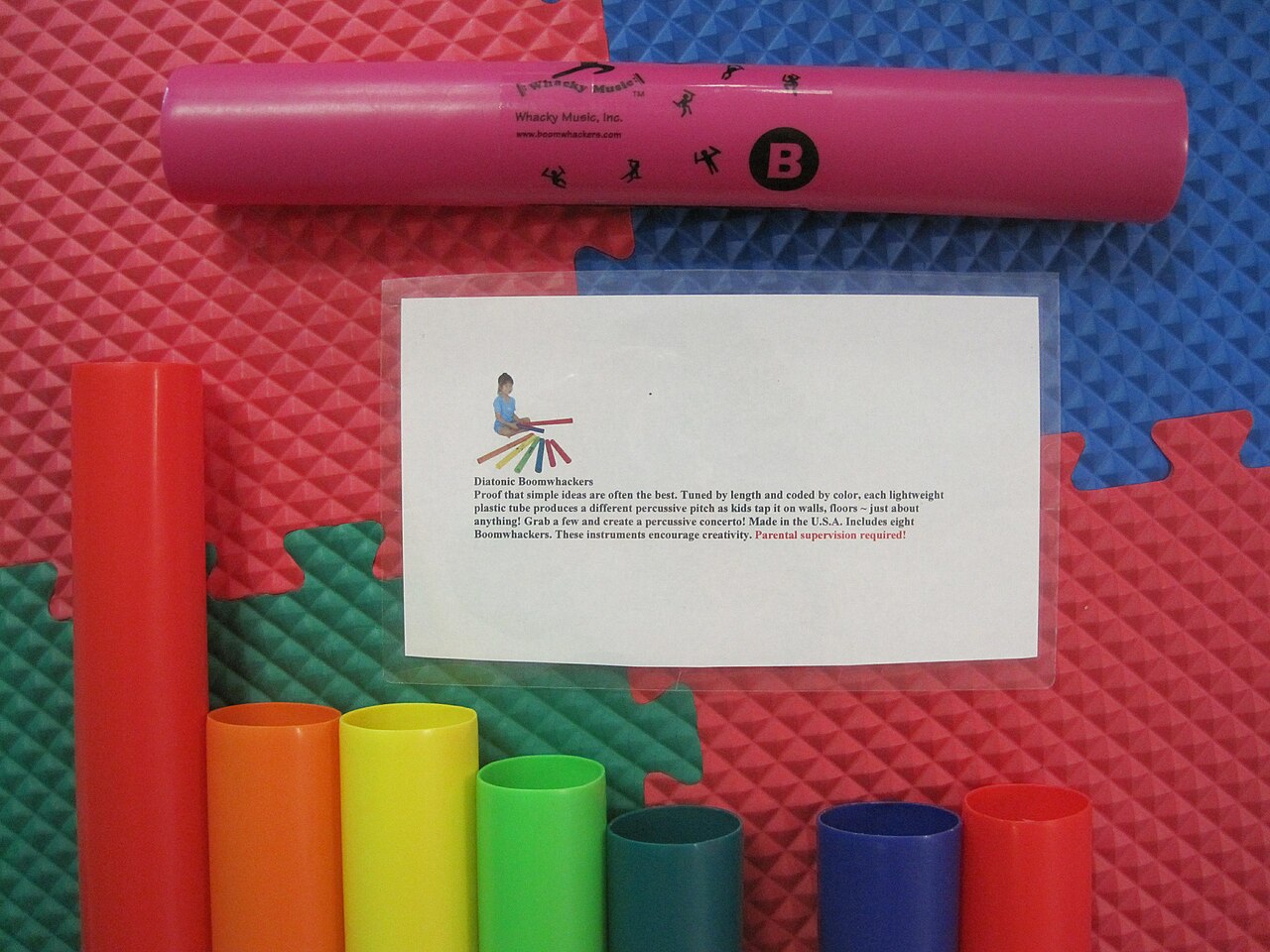
Andrew Watson from Silver Spring, MD, USA · Diatonic Boomwhackers Uploaded by Quedel · CC BY-SA 2.0
- Field
- idiophone and plosive aerophone.
VALÉORINE Encyclopedia
VALÉORINE documentary reading
Documentary summary
A Boomwhacker is a percussion instrument in the plosive aerophone and idiophone family. They are lightweight, hollow, color-coded, plastic tubes, tuned to a musical pitch by length. They were first produced by Craig Ramsell through his company Whacky Music in 1995.
Admitted source layer · organised and presented by VALÉORINE
Note VALÉORINE
No house-authored Note is published until its assertions and sources pass the VALÉORINE evidence contract. The documentary article remains available in full while that enrichment is being consolidated.
Documentary enrichment in progress · no unsupported statement published
Reference Check
Propose documentary evidence for Boomwhacker. A contribution is never written directly as fact: identity, source, rights and evidence gates still decide.
Sign in to contribute
World of VALÉORINE
Documentary connections
Only confirmed graph relationships appear here. Images are shown only when their identity and reuse rights both pass the documentary gate.

Documentary evidence
Evidence Panel
original value insufficient · checked 25 September 2026
- Identity
- resolved
- Independent source families
- 0
- Admitted assertions
- 0
- Open conflicts
- 0
Authority files
wikidata · Q893045 · wikipedia · Boomwhacker
In this article
History
History
The term is now a registered trademark by Rhythm Band Instruments.
Boomwhackers evolved at a time when junk bands and performers using instruments made from recycled materials were popular. Bands often used gas pipes or various cast-offs from plumbers that were cut to length to produce different pitches when struck on an open end. Schools, meanwhile, created their own junk bands as a cheap way to simultaneously promote creativity and encourage recycling. However, creating a custom kit was labor-intensive, leaving a niche for Boomwhackers, which are premade and mass-produced. American Craig Ramsell reportedly came up with the idea for his Boomwhackers in 1994 while at home recovering from radiation therapy. While cutting cardboard tubes into shorter lengths for recycling, he noticed the different pitches resulting from the different lengths and decided to investigate their creative potential. He experimented with various plastics before settling on plastic mailing tubes. He and his wife, Monnie Ramsell, formed DrumSpirit as a sole proprietorship to market the tubes. The original plastic Boomwhackers were first produced in 1995. The current, more durable version was released in 1997. Craig Ramsell then started Whacky Music, Inc. in 1998, marketing a wider variety of Boomwhacker sets and materials. Boomwhackers are now available to span 3½ chromatic octaves. (The addition of the Octavator Tube Caps in 1999 allowed for the third lower octave.) In July 2009, the Sedona, Arizona-based Whacky Music, Inc., sold its interests to Rhythm Band Instruments LLC of Fort Worth, Texas, through an asset purchase agreement. Rhythm Band now distributes and owns the trademark to Boomwhackers.
Sound production
Sound production
Boomwhackers produce musical tones through vibrations in the instrument when struck. The pitch of the instrument is determined by the length of the tube. The longer a tube is, the lower its pitch; the shorter a tube is, the higher the pitch. When one end of a Boomwhackers tube is covered with what the manufacturer calls an "Octavator Cap", the pitch it produces is lowered by an octave. They are most commonly hit with a hand, against the floor, or on other parts of the human body. They can also be grouped together and struck with mallets in different configurations using specialized holders (either homemade or available from the manufacturer), similar to a horizontally-aligned xylophone.
Usage
Usage
Boomwhackers are most commonly used in elementary music classrooms as an inexpensive alternative or supplement to traditional pitched instruments such as xylophones and metallophones. Students are usually given a distinctly pitched tube, such as F♯ or A. Educators then instruct players of certain pitches to strike the Boomwhacker at a precise time, forming a melody. Boomwhackers are often used by performance artists and other musical performance groups to add an element of spectacle. They can also be used by people with intellectual and developmental impairment to develop sensorimotor skills, social skills, and creativity.
Primary material
Documents and archives
authority record
- Wikidata, structured authority record Q893045: Boomwhacker
Unverified · Wikidata
reference work
- “Boomwhacker”, English Wikipedia, consulted as further reading
Reputable secondary · Wikipedia
Notes from the source article
Cited by Wikipedia
Notes from the source article
These works are cited by the source article, in its own numbering. They are recorded as its citations, not as sources VALÉORINE has verified.
- 1.Libin, Laurence. The Grove Dictionary of Musical Instruments. Oxford University Press. 2015. 978-0-19-974339-1.
- 2.X8 Drumes. Boomwhackers!. 28 October 2014.
- 3.Greenberg, Steve. Gadget Nation: A Journey Through the Eccentric World of Invention. Sterling. 56–59. 2008. 9781402736865.
- 4.Anderson, William M. Integrating Music Into the Elementary Classroom. Cengage. 137. 2007. 978-0495064275.
- 5.Boomwhackers in Music Class. Teachers.net Gazette. January 2013.
- 6.Boomwhackers Colorful Music Tubes Instruments.West Music. January 2020.
- 7.Ramey, Maria. Group Music Activities for Adults with Intellectual and Developmental Disabilities. Jessica Kingsley Publishers. 98. 2011.
References
Citations
References
Each reference names the institution holding it, so a reader may go to the document itself.
authority record
Partially resolvedreference work
Partially resolved
Connections
Knowledge graph
Connections
Each connection was recorded deliberately, with the basis for it kept on the internal record.
Broader subject
1- idiophoneTerminology
Established from a fact already recorded on a verified source.
The Encyclopedia exists whether or not anything is for sale. Corrections are recorded rather than overwritten, and every version of this record is kept. Published 14 August 2026.
Elsewhere in Collectables
20,755 published records in this field, each with its sources named.
- Boom Blox Bash PartyWork
- Boom Boom RocketWork
- boom-baTerminology
- Boomerang FuWork
- Boost BeastWork
- Boot HillWork
- Bop ItTerminology
- Boppin'Work
Best supported in this field
For owners
Own an object connected with Boomwhacker?
A specialist will read what you send and tell you what the house can establish, what it cannot, and whether the object is suited to sale. There is no charge and no obligation. The object stays with you throughout; nothing is shipped to us unless it is arranged in writing beforehand.