
Bofors 37 mm Gun Model 1934
The Bofors 37 mm anti-tank gun was an anti-tank gun designed by Swedish manufacturer Bofors in the early 1930s originally for Swedish use. It was exported to several countries during the 1930s of which several bought licences to produce it themselves. The gun was used in several conflicts but most of its fame comes from its use in the Spanish Civil War and the Winter War where it was used very successfully against light tanks and armored cars among other targets.
Also recorded as 37 mm anti-tank gun M1934 · Model 1934 anti-tank gun · M1934 · 37L45 Bofors M1934
Bofors 37 mm Gun Model 1934
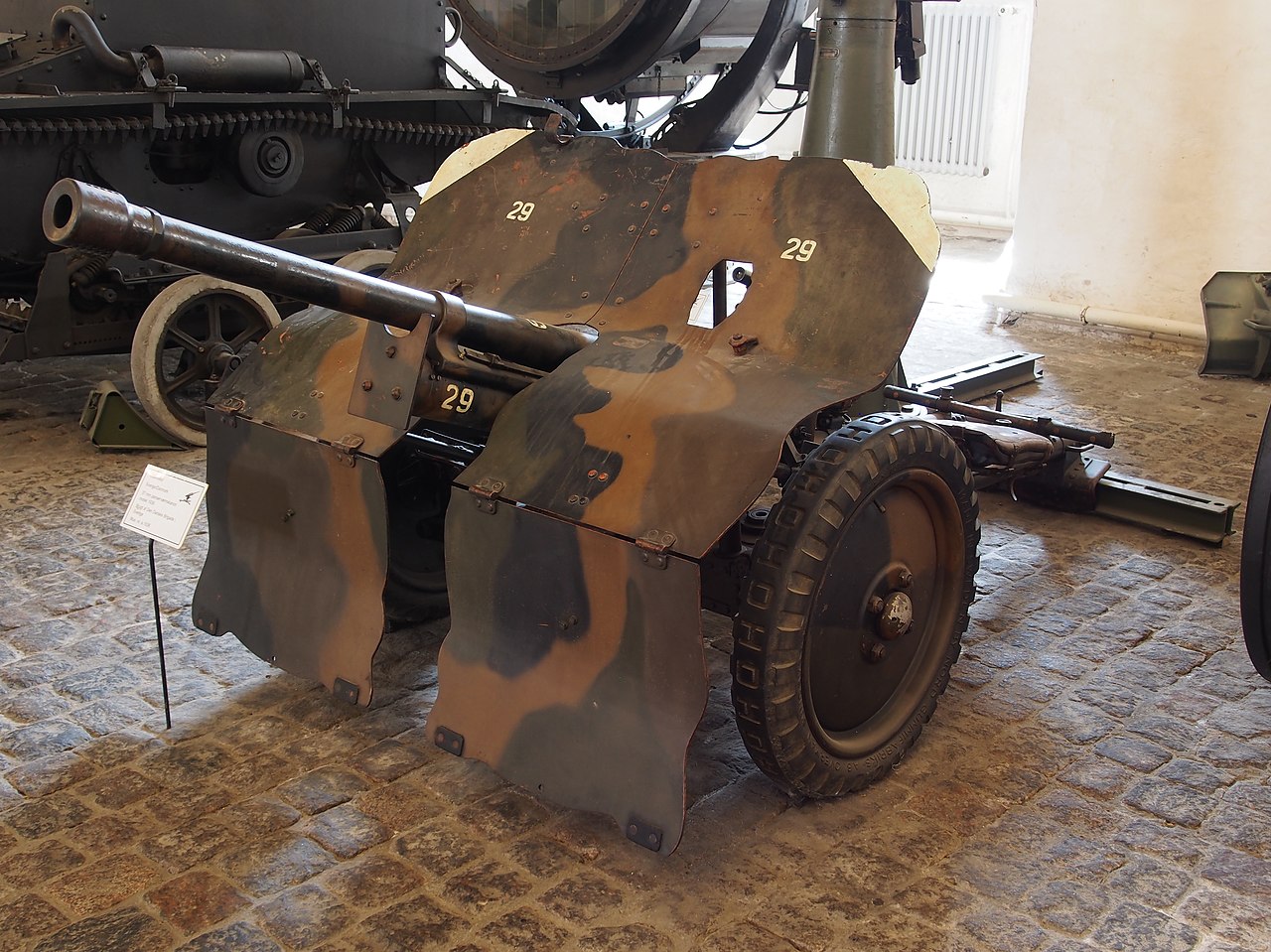
Alf van Beem · CC0
- Field
- anti-tank cannon.
- Region
- Sweden.
VALÉORINE Encyclopedia
VALÉORINE documentary reading
Documentary summary
The Bofors 37 mm anti-tank gun was an anti-tank gun designed by Swedish manufacturer Bofors in the early 1930s originally for Swedish use. It was exported to several countries during the 1930s of which several bought licences to produce it themselves. The gun was used in several conflicts but most of its fame comes from its use in the Spanish Civil War and the Winter War where it was used very successfully against light tanks and armored cars among other targets.
Admitted source layer · organised and presented by VALÉORINE
Note VALÉORINE
No house-authored Note is published until its assertions and sources pass the VALÉORINE evidence contract. The documentary article remains available in full while that enrichment is being consolidated.
Documentary enrichment in progress · no unsupported statement published
Reference Check
Propose documentary evidence for Bofors 37 mm Gun Model 1934. A contribution is never written directly as fact: identity, source, rights and evidence gates still decide.
Sign in to contribute
World of VALÉORINE
Documentary connections
Only confirmed graph relationships appear here. Images are shown only when their identity and reuse rights both pass the documentary gate.

Documentary evidence
Evidence Panel
original value insufficient · checked 25 September 2026
- Identity
- resolved
- Independent source families
- 0
- Admitted assertions
- 0
- Open conflicts
- 0
Authority files
wikidata · Q890350 · wikipedia · Bofors 37 mm anti-tank gun
In this article
Development history
Development history
Beyond its use as an infantry gun it was also used as the main armament in several armored cars and tanks such as the Dutch M39 Pantserwagen and the Polish 7TP to name a few. This was due to its high fire rate, great mobility and effective high explosive shells.
The gun was initially designed by Swedish manufacturer Bofors, mainly for export purposes. It was likely derived from Rheinmetall's 3,7-cm Tak, the predecessor of 3.7 cm Pak 36. The first prototype was built in 1932; the development process continued until 1934. The Netherlands were the first to purchase the gun (order for 12 pieces was placed in 1935) and were followed by many other countries. Licensed copies were produced in Denmark, Finland, the Netherlands and Poland. The barrel was of monobloc type, with semi-automatic vertical sliding breech block and small muzzle brake. It was mounted on a split trail carriage which had suspension and metal wheels with rubber tires. To give the crew some protection from firearms and shell fragments, the gun was equipped with a 5 mm thick shield, with a folding lower plate.
Operational history
Operational history
The Bofors gun saw combat for the first time in Spanish Civil War, where it could easily pierce the armor of contemporary light tanks. The Polish guns were actively used during the German and Soviet invasion of Poland in 1939. Volhynian Cavalry Brigade equipped with the Bofors 37 mm antitank gun beat the German Panzer Divisions in one of the first battles of the invasion; the Battle of Mokra. At that time, the armored forces of the Wehrmacht consisted mainly of light Panzer I and Panzer II tanks, which were vulnerable to the Bofors gun. Early models of the Panzer III and Panzer IV could also be penetrated at ranges up to 500 m. After Poland was occupied, most of the guns fell into the hands of the German and Soviet armies. The weapon was proven obsolete by 1941 during Operation Barbarossa. Even though only one Bofors AT-gun was in action in the invasion of Denmark, it damaged two tanks, and shot the tracks off another tank, before its crew were either wounded or killed by a German tank destroyer which drove over the gun. The gun is now at the Tøjhusmuseet in Copenhagen. During the Winter War, the Finnish guns were successfully used against Soviet tanks such as T-26, T-28 and BT. However, in the Continuation War the gun was found to be ineffective against the T-34 and KV and was relegated to an infantry support role. The gun was used to equip the British forces in North Africa, where it made up for the lack of the QF 2-pounder anti-tank guns after the Fall of France. It was often carried portee on the back of a vehicle. Bofors guns were also employed in World War II by Germany, the Netherlands, Romania, Yugoslavia and USSR, but there are no detailed reports of their use.
Summary
Summary
When it was introduced, the Bofors 37 mm anti-tank gun was an effective weapon and an international success, able to deal with contemporary tanks. Its performance, light weight and high rate of fire made it a popular anti-tank weapon in the pre-war Europe. Introduction of better armored tanks early in World War II, however, made the gun obsolete (as with other similarly performing weapons such as the German 3.7 cm Pak 36 and the United States 37 mm Gun M3).
Ammunition
Ammunition
There were many different ammunition types available for the Bofors 37 mm at gun. It could fire all common types of ammunition and some rare types such as APDS and white phosphorus incendiary.
Operators
Operators
Denmark A version with slightly more powerful cartridge was manufactured by the Danish state arsenal Hærens Vaabenarsenal in 1936-37 as 37 mm fodfolkskanon M. 1934. In 1945 Danish units returning to their homeland brought with them a few Swedish model 1938 guns. Finland As 37 PstK/36. 114 pieces were bought from Bofors in 1938–39 (some of them were returned to Sweden in 1940), 42 Polish-made guns were received from Germans in 1940–41 and 355 were produced by local manufacturers Tampella and VTT (Valtion Tykkitehdas – State Artillery Factory) in 1939–41. When the Winter War began in November 1939, the Finnish Army had 98 guns of the type. A tank version was also used to equip Finnish 6-tonne tanks. The gun remained in the Finnish Army inventory listings until 1986. Germany Used Polish guns captured in 1939 as 3,7 cm PaK 36(p) and Danish guns captured in 1940 as 3,7 cm PaK 157(d). Netherlands 12 pieces were ordered from Bofors in 1934. Later another 24 (or more) were procured. All these were used for Dutch armoured cars: 24 Landsverk types L180 and L181 as well as 12 DAF Pantrado cars. Poland As 37 mm armata przeciwpancerna wz. 36. 300 guns were bought in Sweden and hundreds more were produced by SMPzA (Stowarzyszenie Mechaników Polskich z Ameryki) in Pruszków, some of them exported. When World War II began, the Polish Army had 1,200 pieces. A tank variant, designated wz. 37, was mounted in 7TP (single-turret version), 9TP (prototypes) and 10TP tanks. 111 of them were produced before the war. Romania 669 pieces (former Polish ones) were bought from Germany. Spanish Republic Some guns bought by the Republicans were used during the Spanish Civil War. Sweden Adopted in 1937 as 37 mm infanterikanon m/34 (infantry gun model 1934). Modernized version was adopted in 1938 as 37 mm pansarvärnskanon m/38 (anti-tank gun model 1938) and 37 mm pansarvärnskanon m/38 F. The latter was also produced in a tank gun variant – 37 mm Kanon m/38 stridsvagn; it was fitted to Landsverk Strv m/38, Strv m/39, Strv m/40 light tanks and to the Strv m/41, a Swedish version of the Czech TNH light tank. Turkey United Kingdom A number of Swedish m/34 ordered by Anglo-Egyptian Sudan were adopted as "Ordnance QF 37 mm Mk I". Soviet Union Several dozen Polish guns fell into Soviet hands. Late in 1941 these pieces were issued to Red Army units to make up for the lack of anti-tank guns. Yugoslavia
Notes from the source article
Cited by Wikipedia
Notes from the source article
These works are cited by the source article, in its own numbering. They are recorded as its citations, not as sources VALÉORINE has verified.
- 1.Chamberlain, Peter. Anti-tank weapons. Arco Pub. Co. 36. 1974. 0668036079.
- 2.Swedo-Polish Tank Killer. 26 January 2022.
- 3.Swedish army. 37 mm kan m/38 värntorn skjuttabeller.
- 4.Pansarkommittén 1944.
- 5.Arméhögkvarteret försvarets materielverk 1942.
- 6.Pansartruppskolan, försöksgruppen hemlig 1960, försök mot strv 74 torn.
- 7.Mark Axworthy, London: Arms and Armour, 1995, Third Axis, Fourth Ally: Romanian Armed Forces in the European War, 1941–1945, p. 30
References
Citations
References
Each reference names the institution holding it, so a reader may go to the document itself.
reference work
Partially resolvedreference work
Partially resolved
The Encyclopedia exists whether or not anything is for sale. Corrections are recorded rather than overwritten, and every version of this record is kept. Published 14 August 2026.
Elsewhere in Militaria
6,095 published records in this field, each with its sources named.
- Bofors 152 mm m/42 gunTerminology
- Bofors 155 BonusTerminology
- Bofors 25 mm gun m/32Terminology
- Bofors 283 mm m/12 gunTerminology
- Bofors 375 mm Rocket LauncherTerminology
- Bofors 40 Mk4Terminology
- Bofors 40 mmTerminology
- Bofors 40 mm L/60 gunTerminology
Best supported in this field
For owners
Own an object connected with Bofors 37 mm Gun Model 1934?
A specialist will read what you send and tell you what the house can establish, what it cannot, and whether the object is suited to sale. There is no charge and no obligation. The object stays with you throughout; nothing is shipped to us unless it is arranged in writing beforehand.