
Blue Qur'an
The Blue Quran (romanized: al-Muṣḥaf al-′Azraq) is an early Quranic manuscript written in Kufic script. The dating, location of origin, and patron of the Blue Quran are unknown and have been the subject of academic debate. Scholars have proposed that the manuscript was created under the Abbasid, Fatimid, or Umayyad Caliphates, or the Aghlabid or Kalbid dynasties; this would mean it was produced between the 8th and 10th centuries, likely in either the Islamic West (Maghreb or Al-Andalus) or the central Islamic lands of the Middle East.
Blue Qur'an
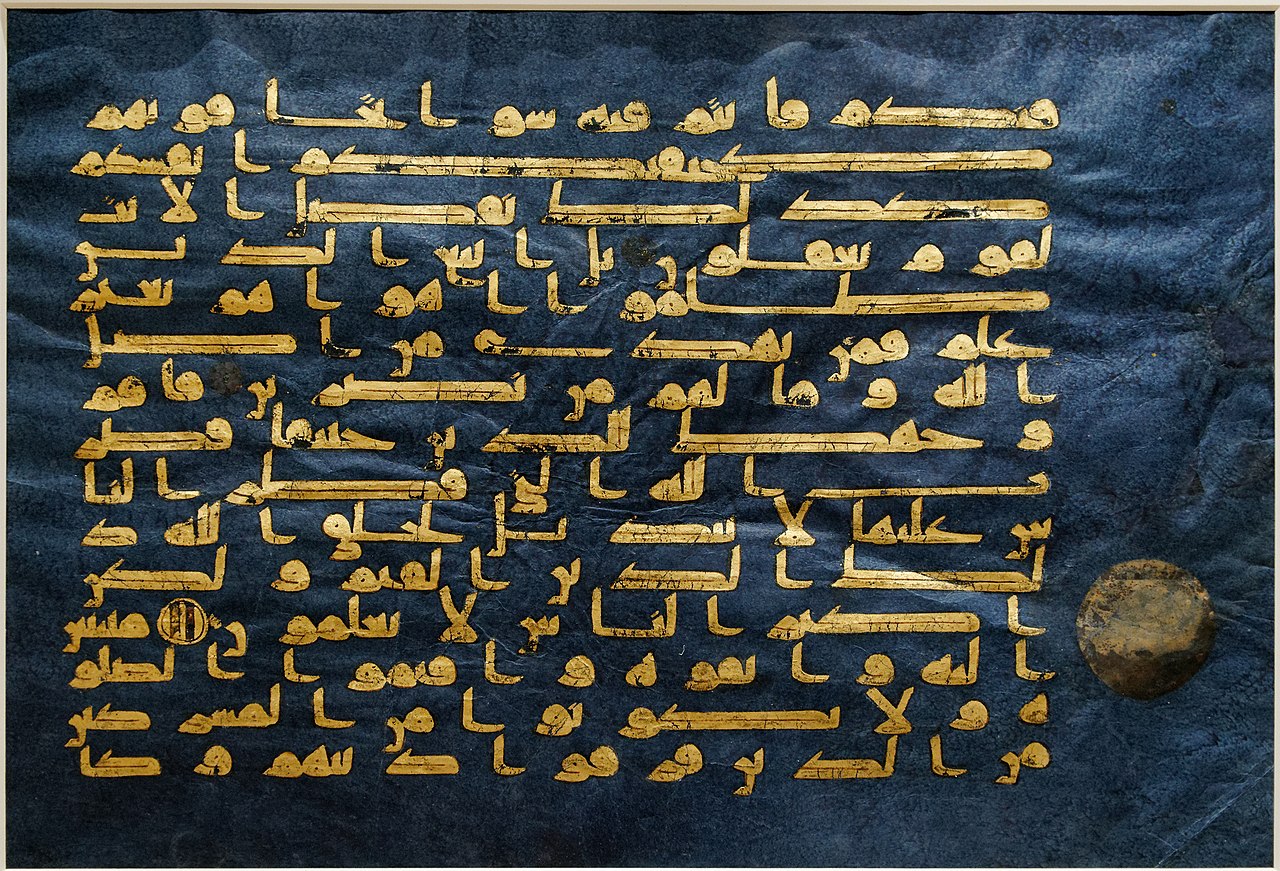
Marie-Lan Nguyen (2011) · CC BY 2.5
- Date
- 1000
- Material
- vellum · indigo
Reference Check
Propose documentary evidence for Blue Qur'an. A contribution is never written directly as fact: identity, source, rights and evidence gates still decide.
Sign in to contribute
World of VALÉORINE
Documentary connections
Only confirmed graph relationships appear here. Images are shown only when their identity and reuse rights both pass the documentary gate.
Documentary evidence
Documentary basis
Authority files
wikidata · Q2997010
In this article
Form
Form
The manuscript is among the most famous works of Islamic calligraphy, notable for its gold lettering on a rare indigo-colored parchment. • Illustration — Leaf from the Blue Quran showing Sura 30: 28–32, Metropolitan Museum of Art, New York
The Blue Quran is a large manuscript, with height 11 15/16 inches (30.4 cm) and width 15 13/16 inches (40.2 cm). The codex is arranged with horizontal pages, rather than the vertical format traditionally used for Qurans. Each page contains 15 lines, which is unusual for the period: it was more common for Qurans to have thick margins, few lines, and large spaces between words e.g. the Amajur Quran has three lines per horizontal page. The manuscript is thought to have initially contained 600 folios. Each is made from sheepskin parchment, which provides a thin page. Given the size and construction of the manuscript, its production required at least 150 sheep. The parchment has a distinctive blue color produced using indigo dye, derived from an indigotin-bearing plant material, either Indian indigo or woad. Due to the similar chemical compositions of all indigo dyes, art historians are unable to determine the source of the blue dye. The dye was likely applied to the parchment using a brush, before it was stretched and dried. The text is written in right-to-left Kufic script, which is characterized by sharp angles and the absence of vowel markings. There is a perceptible column of letters on the right side of each folio and unconnected letters are split between lines, which are more common features of quranic manuscripts from this period. The gilded lettering was produced by the application of gold leaf over an unidentified adhesive, which could be gum, egg white, fig sap, fish collagen, or a glue byproduct of parchment making. The text was outlined in black or brown, using an iron-tannate ink that was commonly available at the estimated time and place of creation. The ink was used to "tidy up" the feathery edges of the gold leaf. Each sura of text was arranged into groups of twenty verses, with boundaries demarcated using rosettes made from either silver leaf or silver ink. Detailing was added to the verse markers using red paint, derived from either lac or safflower. Several pages have been completely or partly stripped of their golden letters. These erasures seem to go beyond correcting scribal mistakes, as encountered regularly in other quranic manuscripts.
History
History
• Illustration — Map of the Umayyad Caliphate in 750 CE. Mashhad is in Khurasan, west of and equidistant from Merv and Herat.
Origin
Origin
The exact origin of the Blue Quran is unknown. Scholars have proposed that the manuscript was created under the Abbasid, Fatimid, or Umayyad Caliphates, or the Aghlabid or Kalbid dynasties. Consequently, theories regarding its geographic origin generally assign it to either the Islamic West (Maghreb or Al-Andalus) or the Middle East. The precise dating, location of origin, and patronage of the Blue Quran remain unknown. One theory is that the Blue Quran was produced in Persia during the Abbasid Caliphate. This was first proposed by Frederik R. Martin, a Swedish diplomat and dealer, who introduced the Blue Quran to the academic community. He claimed that he obtained some of the manuscript's pages in Constantinople and that it originated in Mashhad, Persia, where they were commissioned for the tomb of the 9th-century Abbasid caliph Harun al-Rashid. This is supported by the Persian customs stamp on one of its pages. Additionally, the horizontal layout of the Blue Quran resembles the Qurans created in the early Abbasid period, which would place the manuscript in or around modern day Iraq. These pieces of evidence support the idea that the Blue Quran was created in the Eastern Islamic world. On the other hand, the Blue Quran was included in the inventory of the Great Mosque of Kairouan, which places the manuscript in Tunisia around 1300 CE. While this does not confirm that the manuscript was created in Tunisia, scholars argue that transporting the Blue Quran in its entirety over a long distance would be unlikely. This supports the idea that the Blue Quran was created in the Western Islamic world. Additionally, the Blue Quran shares many characteristics, including its deep blue color, with the Bible of Cava, a manuscript created in 812 CE in Umayyad Spain. The physical similarities between the two supports the idea that the Blue Quran originated in Spain around the 9th-century. One theory is that an Umayyad patron commissioned the Blue Quran and that the manuscript was created by Christians, who have a greater tradition of writing their sacred texts on dyed parchment than Muslims. Since the distance between Spain and Tunisia is closer than that of Persia and Tunisia, transporting the Blue Quran would be easier and therefore more likely. Many museums cannot agree on how to categorize the manuscript, with some, like the Denver Art Museum, categorizing it as Asian Art while acknowledging it may have origins in North Africa.
Current status of the manuscript
Current status of the manuscript
• Illustration — Folio in the Khalili Collection of Islamic Art The manuscript's approximately 600 folios were separated and dispersed during the Ottoman Empire, though most remained in Kairouan, Tunisia, until the 1950s. It is estimated that about 100 folios remain in museums and private collections. The Raqqada National Museum of Islamic Art near Kairouan has 67 folios. A single folio and a rare bifolium are in the Aga Khan Museum collection. The Museum of Islamic Art, Doha in Qatar has two folios. Two folios are also included in the Khalili Collection of Islamic Art. Other collections include the National Library of Tunisia, the Museum of Fine Arts, the Harvard University Art Museums, and the Metropolitan Museum of Art. Several folios were sold at major British auction houses Christie's and Sotheby's in the 2010s, carrying a price of hundreds of thousands of dollars apiece. In 2018, Christie's auctioned one folio for a reported £512,750, over double the low estimate for the lot.
Significance
Significance
The Blue Quran is among the most famous Qur'an manuscripts and one of the most famous works of Islamic calligraphy. This work emulated the purple parchment that was used in the Byzantine illuminated manuscripts and was an effort to surpass their rivals in the Byzantine Empire. The Blue Quran was also a display of wealth and power among the Fatimid Dynasty. Art historian Yasser Tabbaa wrote that the "evanescent effect" of the gold lettering on the blue parchment "appears to affirm the Mu'tazili belief in the created and mysterious nature of the Word of God."
History of the document
Dated record
History of the document
The full dated record · 2 entries
1000
Blue Qur'an created.
1000
Blue Qur'an is recorded from 1000.
Places
Named by the record
Places
Only places the record itself states, plotted where the house gazetteer settles their coordinates. Nothing is inferred from a name or a nationality.
Fatimid Caliphate
Country
Blue Qur'an is associated with Fatimid Caliphate.
Country
Text attribution
Licensing
Text attribution
Part of the biographical narrative on this page reuses licensed material. Its origin, revision and licence are recorded here.
The biographical narrative on this page is based on the Wikipedia article Blue Quran, revision 1371012451 (EN edition), by its contributors. VALÉORINE has edited that text and built its own documentary record around it. The reused material is available under CC BY-SA 4.0, and this page's reuse of it is offered under the same licence. Everything else on this page — the chronology, the holdings, the evidence, the plates and the connections — is VALÉORINE's own record. Sources and licences.
Notes from the source article
Cited by Wikipedia
Notes from the source article
These works are cited by the source article, in its own numbering. They are recorded as its citations, not as sources VALÉORINE has verified.
- 1.Folio from the "Blue Qur'an". www.metmuseum.org.
- 2.George, Alain. A Companion to Islamic Art and Architecture. John Wiley & Sons, Ltd. 109–129. 2017. 978-1-119-06921-8.
- 3.George, Alain. Calligraphy, Colour and Light in the Blue Qur'an. Journal of Qur'anic Studies. 11. 1. 75–125. April 2009. 1465-3591.
- 4.Porter, Cheryl. The Materiality of the Blue Quran: A Physical and Technological Study. The Aghlabids and Their Neighbors. 573–586. 2018-12-12. 9789004356047.
- 5.Whitfield, Susan. Silk, Slaves, and Stupas: Material Culture of the Silk Road. University of California Press. 2018. 978-0-520-28177-6.
- 6.Bifolium from the "Blue Qur'an".
- 7.Blair, Sheila S. Ivories and Inscriptions from Islamic Spain. Oriente Moderno. 84. 2. 375–386. 2004-08-12. 2213-8617.
- 8.Fraser, Marcus. Doha, Qatar National Library: HC.MS.03223. Corpus Coranicum. Berlin Brandenburgische Akademie der Wissenschaften.
- 9.Bloom, Jonathan. The Blue Koran Revisited. Journal of Islamic Manuscripts. 6. 2–3. 196–218. 2015-01-01. 10.1163/1878464X-00602005.
- 10.Neumeier, Emily. Early Koranic Manuscripts: The Blue Koran Debate. Elements. 2. 1. 2006-04-15. 2380-6087.
- 11.D’Ottone Rambach, Arianna. The Blue Koran. A Contribution to the Debate on Its Possible Origin and Date. Journal of Islamic Manuscripts. 8. 2. 127–143. 2017-01-01. 1878-4631.
- 12.Qur'an leaf in Kufic script Denver Art Museum. www.denverartmuseum.org.
- 13.Soucek, Priscilla P. The Abbasid Tradition: Qur'ans of the 8th to the 10th Centuries A.D., The Nasser D. Khalili Collection of Islamic Art, vol. 1. François Déroche. Studies in the Decorative Arts. 6. 2. 129–131. 1999-04-01. 1069-8825.
- 14.Rammah, Mourad. Two pages from the Blue Qur'an. Discover Islamic Art. 2023.
- 15.Folio, from a manuscript known as the "Blue Qur'an", AKM248, The Aga Khan Museum. Aga Khan Museum.
- 16.Two folios, from a manuscript known as the "Blue Qur'an", AKM477, The Aga Khan Museum. Aga Khan Museum.
- 17.Thames & Hudson. Museum of Islamic art: the collection. 30–31. 2022. 978-0-500-48084-7.
- 18.Two Folios from the 'Blue Qur'an'. Khalili Collections.
- 19.A Large Qur'an Leaf in Gold Kufic Script on Blue Vellum, Near East, North Africa or Southern Spain, 9th-10th Century AD. Sotheby's.
- 20.A KUFIC QUR'AN FOLIO ON BLUE VELLUM. www.christies.com.
- 21.Blair, Sheila S. The Art and Architecture of Islam 1250-1800. Yale University Press. 1995. 9780300064650.
- 22.Brill. The Aghlabids and Their Neighbors: Art and Material Culture in Ninth-Century North Africa. 29. 2018. 978-90-04-35566-8.
- 23.Keene, Bryan C. Toward a Global Middle Ages: Encountering the World through Illuminated Manuscripts. Getty Publications. 14. 2019. 978-1-60606-598-3.
- 24.Blue Qur'an (MET). Joy of Museums Virtual Tours.
- 25.Tabbaa, Yasser. The Transformation of Arabic Writing: Part I, Qur'ānic Calligraphy. Ars Orientalis. 21. 119–148. 1991. 0571-1371.
Bibliography printed in the source article · 1
- Déroche, François. The Qurʾan and Its Handwritten Transmission: Current Researches. BRILL. 132–189. 9 December 2024. 978-90-04-70693-4.
References
Citations
References
Each reference names the institution holding it, so a reader may go to the document itself.
reference work
Secondary witness
The Encyclopedia exists whether or not anything is for sale. Corrections are recorded rather than overwritten, and every version of this record is kept. Published 14 August 2026.
Elsewhere in Manuscripts
376 published records in this field, each with its sources named.
- Bibbia di Federico da Montefeltro - BAV Urb.Lat.1&2Manuscript
- Bible of Borso d'EsteManuscript
- Birds' Head HaggadahManuscript
- Black Hours, Morgan LibraryManuscript
- Bobbio MissalManuscript
- Bobbio OrosiusManuscript
- Bodleian Library, MS Rawlinson B 512Manuscript
- Book of ArmaghManuscript
Best supported in this field
For owners
Own a copy of Blue Qur'an?
A specialist will read what you send and tell you what the house can establish, what it cannot, and whether the object is suited to sale. There is no charge and no obligation. The object stays with you throughout; nothing is shipped to us unless it is arranged in writing beforehand.