
Blue Grotto
The Blue Grotto (Grotta Azzurra) is a sea cave on the coast of the island of Capri, southern Italy. Sunlight shining through an underwater cavity is reflected back upward through the seawater below the cavern, giving the water a blue glow that illuminates the cavern. The cave extends some 50 m into the cliff at the surface, and is approximately 150 m deep, with a sandy bottom.
Also recorded as Grotta Azzurra
Blue Grotto
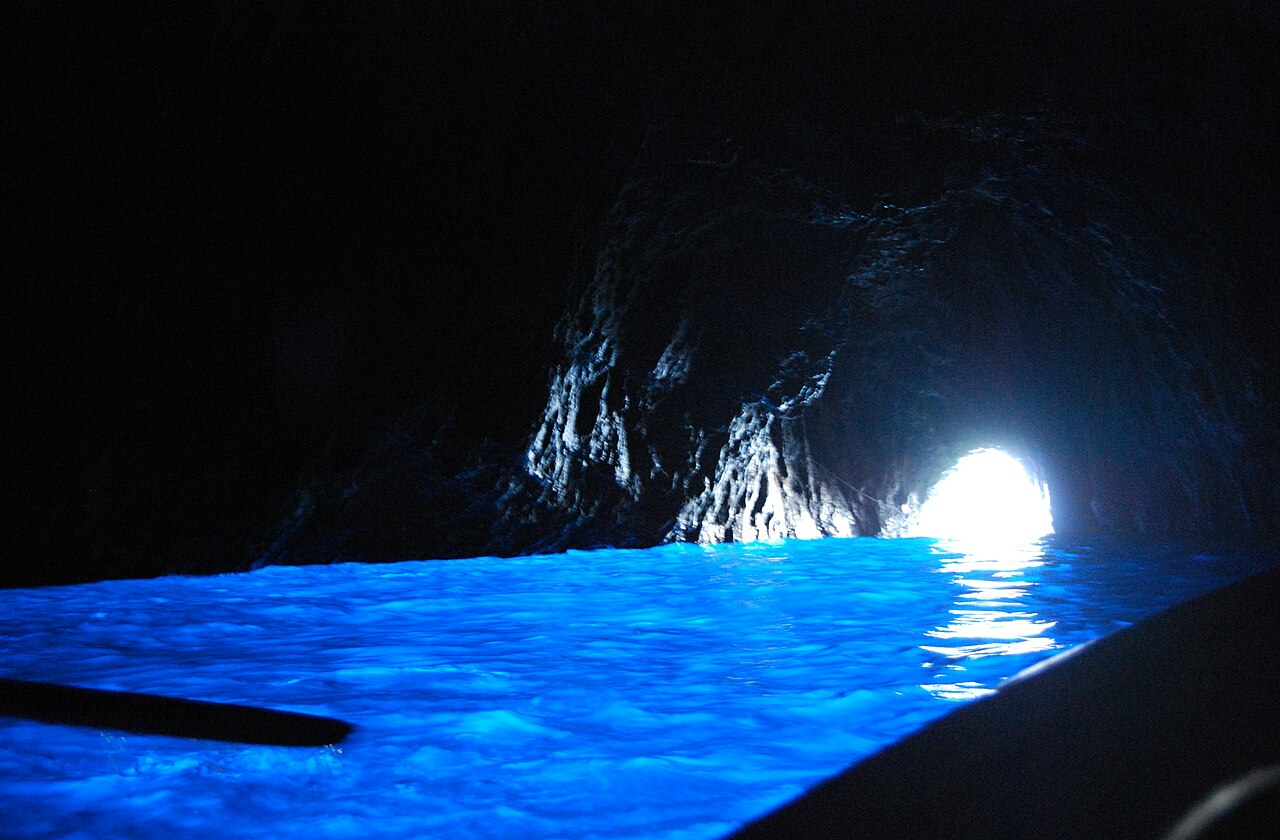
Elenagm · CC BY-SA 4.0
- Name
- Grotta Azzurra
- Headquarters
- Italy
VALÉORINE Encyclopedia
VALÉORINE documentary reading
Documentary summary
The Blue Grotto (Grotta Azzurra) is a sea cave on the coast of the island of Capri, southern Italy. Sunlight shining through an underwater cavity is reflected back upward through the seawater below the cavern, giving the water a blue glow that illuminates the cavern. The cave extends some 50 m into the cliff at the surface, and is approximately 150 m deep, with a sandy bottom.
Admitted source layer · organised and presented by VALÉORINE
Reference Check
Propose documentary evidence for Blue Grotto. A contribution is never written directly as fact: identity, source, rights and evidence gates still decide.
Sign in to contribute
Documentary evidence
Documentary basis
Authority files
wikidata · Q605185
In this article
Key facts
Key facts
• Name — Grotta Azzurra • Location — Anacapri (NA, Campania, Italy) • Length — 54 m • Geology — Sea cave • Entrances — 1 • Illustration — Painting by Jakob Alt, 1835–36
Access
Access
The cave is 60 m long and 25 m wide. The entry is 2 m wide and roughly 1 m high at low tides, making safe access possible only when tides are low and the sea is calm. To enter the grotto, visitors must lie flat on the bottom of a small four-person rowboat. The oarsman then uses a metal chain attached to the cave walls to guide the boat inside the grotto. In 2011, a visitor suffered a life-altering injury when his neck was broken while entering the cave. The Cooperativa Battellieri Grotta Azzurra initially denied liability, but settled a damages claim. It was concluded that the boatmen had continued entering the cave when the sea conditions were too dangerous. Swimming in the grotto is forbidden.
Colour
Colour
• Illustration — A diagram of how daylight illuminates the cave through the underwater opening. The Blue Grotto is one of several sea caves worldwide that is flooded with a brilliant blue or emerald light. The quality and nature of the colour in each is determined by its unique combination of depth, breadth, water clarity, and light source. In the case of the Blue Grotto, the light comes from two sources: the narrow arched entranceway, and a large hole somewhere below the above water entrance, separated by a band of rock between one and two meters tall. Since it is farther from the surface, much less light passes through the lower opening, but its depth and size allow it to be the grotto water's primary source of illumination. As light passes through the water into the cave, red reflections are filtered out and only blue light enters the cave. Objects placed in the water of the grotto famously appear silver. This is caused by tiny bubbles, which cover the outside of the object when they are placed underwater. The bubbles cause the light to refract differently than it does from the surrounding water and gives off the silver effect. In part because of the dazzling effect of the light from the above-water opening, it is impossible for a visitor who is in one of the rowboats to identify the shape of the larger hole, the outline of the bar that separates the two holes, or the nature of the light source. Visitors only have a general awareness of the light coming up from underneath as well as the water in the cave being more light-filled than the air. A visitor who places a hand in the water can see it "glow" eerily in this light. The island of Capri gives its name to the colour Capri because of the colour's resemblance to the bright blue colour of the waters of the Blue Grotto.
History
History
During Roman times, the grotto was used as the personal swimming hole of Emperor Tiberius as well as a marine temple. Tiberius moved from the Roman capital to the island of Capri in 27 AD. During Tiberius' reign, the grotto was decorated with several statues as well as resting areas around the edge of the cave. Three statues of the Roman sea gods Neptune and Triton were recovered from the floor of the grotto in 1964 and are now on display at a museum in Anacapri. Seven bases of statues were also recovered from the grotto floor in 2009. This suggests that there are at least four more statues lying on the cave's bottom. The cave was described by the Roman historian Pliny the Elder as being populated with Triton "playing on a shell". The now-missing arms on the recovered Triton statue—usually depicted with a conch shell—suggest that the statues recovered in 1964 are the same statues Pliny the Elder saw in the 1st century AD. According to a reconstruction of how the Blue Grotto might have looked in Roman times, a swarm of Triton statues headed by a Neptune statue may have stood in the walls of the cave. The Marevivo association aims to construct this by placing statues in the grotto. This project is being carried out in collaboration with the archaeological superintendence of Pompeii. At the back of the main cave of the Blue Grotto, three connecting passageways lead to the Sala dei Nomi, or "Room of Names", named for the graffiti signatures left by visitors over the centuries. Two more passages lead deeper into the cliffs on the side of island. It was thought that these passages were ancient stairways which led to Emperor Tiberius' palace. However, the passages are natural ones that narrow and then end further along. During the 18th century, the grotto was known to the locals as Gradola, after the nearby landing place of Gradola. It was avoided by sailors and islanders because it was said to be inhabited by witches and monsters. The grotto was then "rediscovered" by the public in 1826, with the visit of German writer August Kopisch and his friend Ernst Fries, who were taken to the grotto by local fisherman Angelo Ferraro.
The legend of the Blue Grotto
The legend of the Blue Grotto
The cave as in every medieval history was said to be a refuge for devils and monsters. Two priests determined to drive them away entered the cave swimming, and after a few minutes spent inside it, they ran away in panic as if they had seen the face of the devil. From that moment on, the two began to rant. Named the cursed cave, it has numerous legends.
Identity and overview
Identity and overview
The following is established of the heading itself. It is also recorded that blue Grotto is associated with Italy.
Places
Named by the record
Places
Only places the record itself states, plotted where the house gazetteer settles their coordinates. Nothing is inferred from a name or a nationality.
- Italy
Named but not plotted · 1
Blue Grotto is associated with Italy.
Country
Cultural influence
In 1826, German writer August Kopisch and his friend Ernst Fries, a German painter, visited the cave and recorded their visit in the Kopisch's Entdeckung der blauen Grotte auf der Insel Capri in 1838. A Neapolitan song dating from the 18th century, "la grotta azzurra" refers to this cave and also proves that it was already well known before its rediscovery in 1826. In 1842, Danish choreographer August Bournonville set the second act of his ballet Napoli in the Blue Grotto. In this fantastic tale, Golfo, the demon who rules the Blue Grotto, transforms the ballet's heroine, Teresina, into a Naiad. Mark Twain visited the Blue Grotto in 1867 and recorded his thoughts in his book The Innocents Abroad. King Ludwig II of Bavaria had a "Venus Grotto" installed from 1875 to 1877 in the park of his Linderhof Palace. On the one hand, this should be an illustration of the First Act of Richard Wagner's opera Tannhäuser in the cave of Venusberg. On the other hand, the backdrop inside an artificial mountain cave should be able to be transformed into the Blue Grotto of Capri, an effect which was achieved using arc lamps and a power plant consisting of electric generators as well as specially developed blue lamp glass. Uranian poet Edwin Emmanuel Bradford recorded his impression of a bathing boy in the Blue Grotto in the poem "In Quest of Love", included in In Quest of Love and Other Poems (1914), and again in "The Bather in the Blue Grotto at Capri", included in The New Chivalry and Other Poems (1918) and reprinted in To Boys Unknown (1988). Both poems were anthologised in Lad's Love: An anthology of Uranian poetry and prose (2010). The grotto is highlighted in the 1953 Newbery Honor book Red Sails to Capri by Ann Weil. In Alberto Moravia's 1954 novel Il disprezzo (Contempt), a vision appears to the protagonist when, under heavy mental stress, he visits the cave alone.
Collections and holdings
Where the work is held
Collections and holdings
It is also recorded that zLONK!
Documents and archives
Primary material
Documents and archives
institutional register
- Internet Archive holdings naming Blue Grotto
General reference · Internet Archive
authority record
- Wikidata, structured authority record Q605185: Blue Grotto
General reference · Wikidata
Notes from the source article
Cited by Wikipedia
Notes from the source article
These works are cited by the source article, in its own numbering. They are recorded as its citations, not as sources VALÉORINE has verified.
- 1.Lorenzi, Rossella. Roman Statues Found in Blue Grotto Cave. NBC News. 28 September 2009.
- 2.Black, Annetta. Blue Grotto (Grotta Azzurra). Atlas Obscura. 29 March 2010.
- 3.The Blue Grotto Capri, italy - Grotta Azzurra. capri.com.
- 4.Balzano, Francesco. Grotta Azzurra, Capri. Quovadi. 19 April 2022.
- 5.La Grotto Azzurra. Napoligrafia.
- 6.Kegan Paul. In Quest of Love and Other Poems. 1914.
- 7.Valancourt Books. Lad's Love: An anthology of Uranian poetry and prose. Volume I: John Leslie Barford to Edward Cracroft Lefroy. 2010. 978-1934555958.
- 8.Gay Men's Press. To Boys Unknown. 1988. 978-0854490929.
References
Citations
References
Each reference names the institution holding it, so a reader may go to the document itself.
institutional register
Internet Archive holdings naming Blue GrottoInternet Archive
Secondary witnessauthority record
General reference
The Encyclopedia exists whether or not anything is for sale. Corrections are recorded rather than overwritten, and every version of this record is kept. Published 16 August 2026.
Elsewhere in Institutions
3,152 published records in this field, each with its sources named.
- BlaafarveværketOrganisation
- Blackitude MuseumOrganisation
- Blaffer Art MuseumOrganisation
- Blanton Museum of ArtOrganisation
- Bob Jones University Museum and GalleryOrganisation
- Bode MuseumOrganisation
- Bogotá Museum of Modern ArtOrganisation
- Bologna Gallery of Modern ArtOrganisation
Best supported in this field
For owners
Own an object connected with Blue Grotto?
A specialist will read what you send and tell you what the house can establish, what it cannot, and whether the object is suited to sale. There is no charge and no obligation. The object stays with you throughout; nothing is shipped to us unless it is arranged in writing beforehand.