
bitasen
Bitasen refers to a privately minted mon type coin that circulated in Japan from the middle of the Muromachi period to the early Edo period. These low quality imitation Chinese cash coins were made to aid the supply of cash coins (authentic) that flowed into Japan from China. The Japanese populance widely despised them, giving these coins the name Bitasen or "bad metal" ("Bita").
bitasen
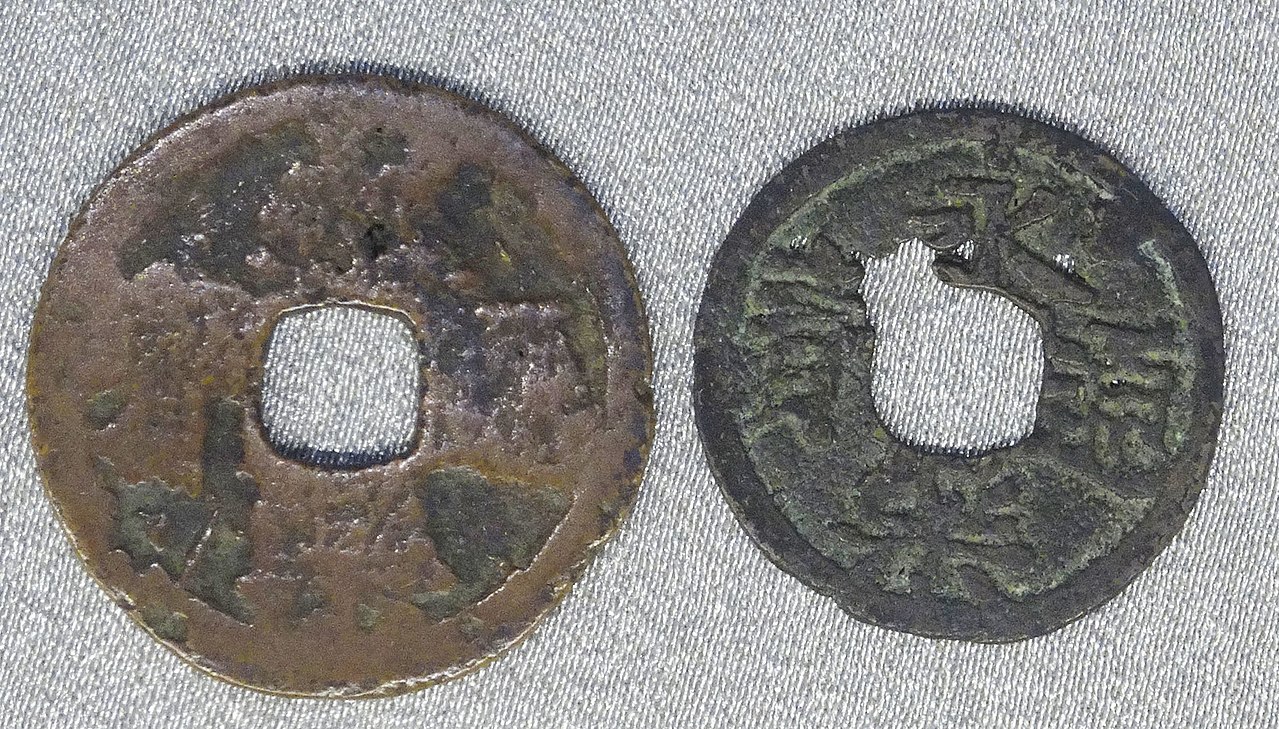
うぃき野郎 · CC BY-SA 4.0
- Field
- shichūsen
- Region
- bitasen is situated in Japan.
Reference Check
Propose documentary evidence for bitasen. A contribution is never written directly as fact: identity, source, rights and evidence gates still decide.
Sign in to contribute
Documentary evidence
Documentary basis
Authority files
wikidata · Q11651342
In this article
Key facts
Key facts
• Country — Japan • Denomination — Bitasen • Unit — 1 Mon • Edge — Smooth • Shape — Circular • Years Of Minting — 1404–c.1625 • Obverse Design — Chinese characters • Reverse Design — Usually blank
History
History
• Illustration — "Bitasen" from the late Muromachi period In the mid-12th century, large amounts of Chinese coins called "toraisen" were introduced to Japan. By the 13th century these coins had replaced commodity money as currency after the Kamakura shogunate's initial reluctance gave way to approval. As the "mere import of coins" could not meet the needs of a growing economy, Japanese clans and wealthy merchants began to issue their own coins which are referred to as Shichūsen privately minted Japanese coins. While sources agree on the Muromachi period as a starting point for "bitasen"/"toraisen" co-circulation there are differing opinions on an exact date. Mentions include the year 1404 by the Japan Mint, while others give a later period in the 16th century. By definition, the word Bitasen translates to "bad metal" ("Bita") or poor-quality coins with worn surfaces. These coins were essentially imitation money which was struck in copper with "significant" amounts of lead to match the "toraisen" cash coins already in circulation. Bitasen had a fluctuating value that depended on their worth relative to the "toraisen". Regional markets initially made their own decisions on the bitasen's value until the shogunate established a uniform valuation that was used in every Japanese region. As per their namesake, Bitasen were coins "of inferior quality" that remained in circulation for a "long time" due to an overall lack of currency available at the time. This in turn took its course on Japanese consumers throughout the 15th century who were irritated by the increasing number of damaged and worn-out coins. Bitasen were frequently no longer accepted at their face value due to a practice called "erizeni", in which they were sorted out in favor of "toraisen". Though Chinese coins would continue to circulate in Eastern Japan, the confusion and chaos caused by the Bitasen coinage caused rice to replace copper coinage in Western Japan. Although Bitasen were officially prohibited in 1608 by the Tokugawa shogunate, these coins continued to illegally circulate. The shogunate responded to this by opening more mines for the production of copper, silver, and gold coinages. The end for the Bitasen instead came in the form of Kan'ei Tsūhō, which was first issued in 1626. Due to the isolationist policies of the Tokugawa shogunate, the outflow of currency halted and Kan'ei Tsūhō coins would continue to stay the main coin circulating in Japan. In 1670, the Eiraku Tsūhō was completely prohibited from circulation and depreciated in favor of the government produced Kan'ei Tsūhō cash coins.
Types
Types
• Obverse — Reverse — Japanese name — Chinese name — Minted — Origin • — — Eiraku Tsūhō — Yongle Tongbao (永樂通寶) — Japan • — — Xiang Fu Tong Bao (祥符通寶) — Japan • — — Hongwu Tongbao (洪武通寶) — Kajiki, Kagoshima • — — Heian Tsūhō — None — Kyushu • — — Genyū Tsūhō — Yuan You Tong Bao (元祐通寶) — Japan • — — Katou bitasen — Various — China
Places
Named by the record
Places
Only places the record itself states, plotted where the house gazetteer settles their coordinates. Nothing is inferred from a name or a nationality.
bitasen is situated in Japan.
Country
bitasen is associated with Japan.
Country
Literature
Scholarly footprint
A count of publications is evidence of attention, not of standing, and is given here only as a measure.
Text attribution
Licensing
Text attribution
Part of the biographical narrative on this page reuses licensed material. Its origin, revision and licence are recorded here.
The biographical narrative on this page is based on the Wikipedia article Bitasen, revision 1369667458 (EN edition), by its contributors. VALÉORINE has edited that text and built its own documentary record around it. The reused material is available under CC BY-SA 4.0, and this page's reuse of it is offered under the same licence. Everything else on this page — the chronology, the holdings, the evidence, the plates and the connections — is VALÉORINE's own record. Sources and licences.
References
Citations
References
Each reference names the institution holding it, so a reader may go to the document itself.
authority record
Secondary witness
The Encyclopedia exists whether or not anything is for sale. Corrections are recorded rather than overwritten, and every version of this record is kept. Published 16 August 2026.
Elsewhere in Coins
642 published records in this field, each with its sources named.
- bezantTerminology
- bi-metallic coinTerminology
- Big Maple LeafTerminology
- bigatusTerminology
- Black Revolutionary War Patriots silver dollarTerminology
- BlaffertTerminology
- Booker T. Washington Memorial half dollarTerminology
- Botanic Garden silver dollarTerminology
Best supported in this field
For owners
Own an object connected with bitasen?
A specialist will read what you send and tell you what the house can establish, what it cannot, and whether the object is suited to sale. There is no charge and no obligation. The object stays with you throughout; nothing is shipped to us unless it is arranged in writing beforehand.