
Bill Bradley
After playing in the National Basketball Association (NBA) for 10 seasons with the New York Knicks, he served as a United States senator from New Jersey from 1979 to 1997. A member of the Democratic Party, he was a candidate for the party's nomination for president in the 2000 election, losing to Vice President Al Gore. Bradley was born and raised in Crystal City, Missouri, a small town 45 mi south of St.
Also recorded as William Warren Bradley
Bill Bradley

Jay Godwin · Public domain
- Name
- Bill Bradley
- Birth Name
- William Warren Bradley
- Born
- 28 July 1943
- Birthplace
- Crystal City, Missouri, U.S.
- Education
- Princeton University (BA) Worcester College, Oxford (BA)
- Nationality
- United States.
- Occupation
- politician, basketball player, writer, businessperson and senior advisor.
- Honours
- New Jersey Hall of Fame, Rhodes Scholarship, Distinguished Eagle Scout Award and Golden Plate Award.
- Languages
- English.
VALÉORINE Encyclopedia
VALÉORINE documentary reading
Documentary summary
After playing in the National Basketball Association (NBA) for 10 seasons with the New York Knicks, he served as a United States senator from New Jersey from 1979 to 1997. A member of the Democratic Party, he was a candidate for the party's nomination for president in the 2000 election, losing to Vice President Al Gore. Bradley was born and raised in Crystal City, Missouri, a small town 45 mi south of St.
Admitted source layer · organised and presented by VALÉORINE
Note VALÉORINE
Bill Bradley (born 1943) is an American basketball player, businessperson and politician, among other activities. The basketball player was born in Crystal City.
Bill Bradley studied at Crystal City High School, Princeton University and University of Oxford, among others. The basketball player is a member of American Academy of Arts and Sciences and held the position of United States senator.
Languages used include English. Bill Bradley received Distinguished Eagle Scout Award, Golden Plate Award and New Jersey Hall of Fame, among others.
Composed from admitted, traceable facts · 27 September 2026
VALÉORINE
Reference Check
Propose documentary evidence for Bill Bradley. A contribution is never written directly as fact: identity, source, rights and evidence gates still decide.
Sign in to contribute
World of VALÉORINE
Documentary connections
Only confirmed graph relationships appear here. Images are shown only when their identity and reuse rights both pass the documentary gate.
Documentary evidence
Evidence Panel
not yet certified
- Identity
- resolved
- Independent source families
- 0
- Admitted assertions
- 0
- Open conflicts
- 0
Authority files
wikidata · Q504025 · wikipedia · Bill Bradley
In this article
Biography
Biography
He excelled at basketball from an early age. He did well academically and was an all-county and all-state basketball player in high school. He was offered 75 college scholarships, but declined them all to attend Princeton University. He won a gold medal as a member of the 1964 Olympic basketball team and was the Most Outstanding Player of the 1965 NCAA Tournament, when Princeton finished third. After graduating in 1965, he attended Oxford on a Rhodes Scholarship where he was a member of Worcester College, delaying a decision for two years on whether or not to play in the National Basketball Association (NBA). While at Oxford, Bradley played one season of professional basketball in Europe and eventually decided to join the New York Knicks in the 1967–68 season, after serving six months in the Air Force Reserve. He spent his entire ten-year professional basketball career playing for the Knicks, winning NBA titles in 1970 and 1973. Retiring in 1977, he ran for a seat in the United States Senate the following year, from his adopted home state of New Jersey. He was re-elected in 1984 and 1990, before deciding against seeking a fourth term in 1996. He was an unsuccessful candidate for the 2000 Democratic presidential nomination. Bradley is the author of seven non-fiction books, most recently We Can All Do Better, and hosts a weekly radio show, American Voices, on Sirius Satellite Radio. He is a corporate director of Starbucks and a partner at investment bank Allen & Company in New York City. Bradley is a member of the ReFormers Caucus of Issue One. He also serves on that group's advisory board. Bradley is a member of both the American Academy of Arts and Sciences and the American Philosophical Society. In 2008 Bradley was inducted into the New Jersey Hall of Fame.
Bill Bradley studied at Princeton University, University of Oxford and Worcester College. The recorded working language is English. Places of work recorded in the authority are Washington, D.C. Positions recorded include United States senator. Distinctions recorded are New Jersey Hall of Fame, Rhodes Scholarship, Distinguished Eagle Scout Award and Golden Plate Award.

Bill Bradley playing basketball
John Bottega, World Telegram staff photographer · Library of Congress. New York World-Telegram Sun Collection.
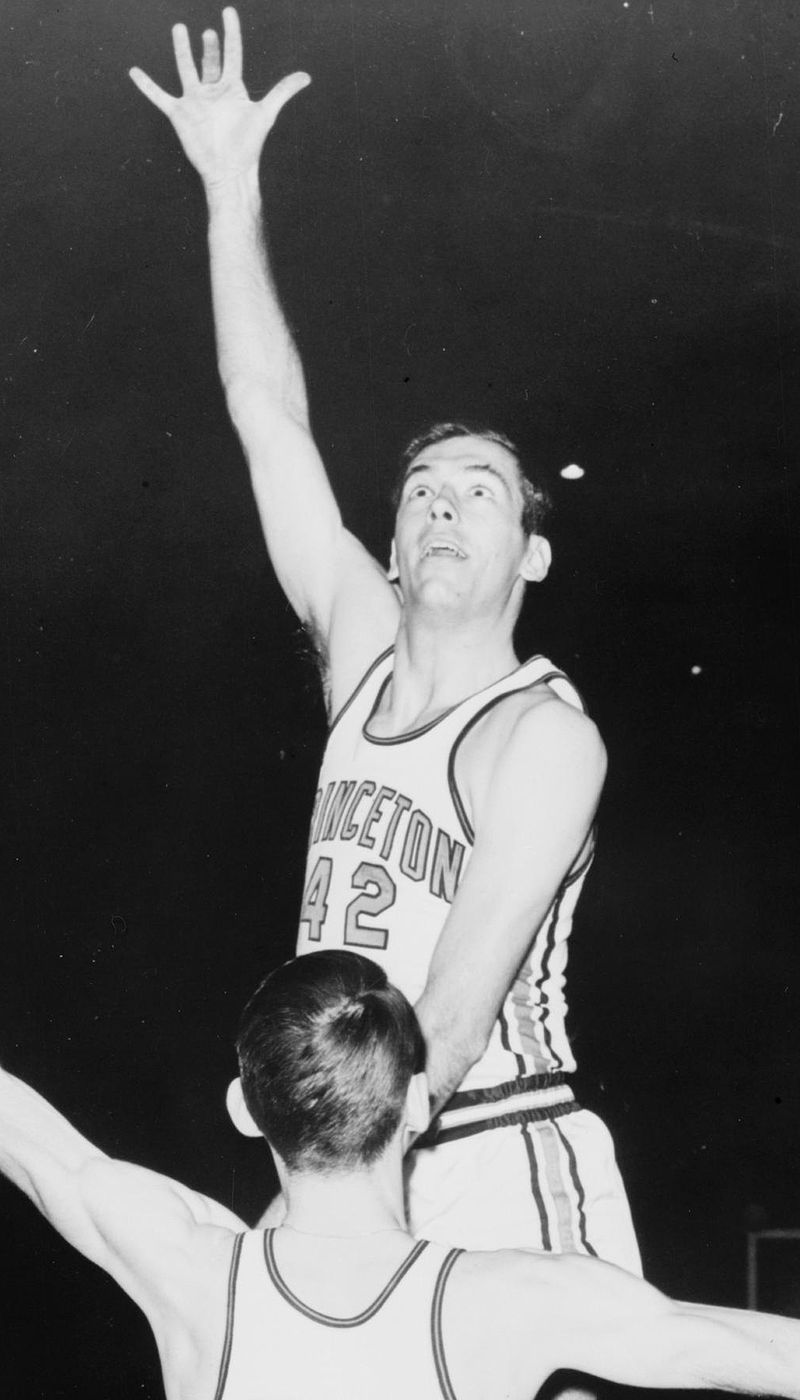
Bill Bradley playing basketball
John Bottega, World Telegram staff photographer · File:Bill_Bradley_NYWTS.jpg
Key facts
Key facts
• Name — Bill Bradley • Jr Sr — United States Senator • State — New Jersey • Term Start — January 3, 1979 • Term End — January 3, 1997 • Predecessor — Clifford P. Case • Successor — Robert Torricelli • Birth Name — William Warren Bradley • Born — 28 July 1943 • Birthplace — Crystal City, Missouri, U.S. • Party — Democratic • Partner — Betty Sue Flowers (2009–present) • Children — 1 • Education — Princeton University (BA) Worcester College, Oxford (BA) • Allegiance — United States • Branch — United States Air Force • Unit — Air Force Reserve Command
Early life
Early life
Bradley was born on July 28, 1943, in Crystal City, Missouri, the only child of Warren (June 22, 1901October 1, 1994), who despite leaving high school after a year had become a bank president, and Susan "Susie" Crowe (June 12, 1909November 30, 1995), a teacher and former high school basketball player. Politicians and politics were standard dinner-table topics in Bradley's childhood, and he described his father as a "solid Republican" who was an elector for Thomas E. Dewey in the 1948 presidential election. An active Boy Scout, he became an Eagle Scout and member of the Order of the Arrow. Bradley began playing basketball at the age of nine. He was a star at Crystal City High School, where he scored 3,068 points in his scholastic career, was twice named All-American, and was elected to the Missouri Association of Student Councils. He received 75 college scholarship offers, although he applied to only five schools and only scored a 485 out of 800 on the Verbal portion of the SAT, which—despite being likely in the top third of all test takers that year—normally would have caused selective schools like Princeton University to reject him. Bradley's basketball ability benefited from his height—5 ft in the seventh grade, 6 ft in the eighth grade, and his adult size of 6 ft by the age of 15—and unusually wide peripheral vision, which he worked to improve by focusing on faraway objects while walking. During his high school years, Bradley maintained a rigorous practice schedule, a habit he carried through college. He would work on the court for "three and a half hours every day after school, nine to five on Saturday, one-thirty to five on Sunday, and, in the summer, about three hours a day. He put ten pounds of lead slivers in his sneakers, set up chairs as opponents and dribbled in a slalom fashion around them, and wore eyeglass frames that had a piece of cardboard taped to them so that he could not see the floor, for "a good dribbler never looks at the ball."
College career
College career
Bradley was considered to be the top high school basketball player in the country. He initially chose to attend Duke in the fall of 1961. However, after breaking his foot in the summer of 1961 during a baseball game and thinking about his college decision outside of basketball, Bradley decided to enroll at Princeton due to its record in preparing students for government or United States Foreign Service work. He had been awarded a scholarship at Duke, but not at Princeton; the Ivy League does not allow its members to award athletic scholarships, and he was disqualified from receiving financial aid because of his family's wealth. • Illustration — Bradley practicing at Princeton in 1964 Bradley wore #42 in honor of childhood hero Dick Kazmaier, who had won the Heisman Trophy at Princeton. He was so superior to the rest of the freshman team that coach Eddie Donovan chose lineups by saying "You, you, you, you, and Bradley". Bradley averaged more than 30 points per game for the freshman team, at one point making 57 consecutive free throws, breaking a record set by a member of the NBA's Syracuse Nationals. The following year, as a sophomore, he was a varsity starter in Butch van Breda Kolff's first year as coach of the Tigers. In his sophomore year Bradley scored 40 points in an 82–81 loss to St. Joseph's and was named to The Sporting News All-American first team in early 1963. The coach of the St. Louis Hawks believed he was ready to play professional basketball. The AP and United Press International polls both put Bradley on the second team, establishing him as the top sophomore player in the country; Bradley also hit.316 as a first baseman for the baseball team. The following year The Sporting News again named him to its All-American team as its only junior, and as its player of the year. At the Olympic basketball trials in April 1964, Bradley played guard instead of his usual forward position but was still a top performer. He was one of three chosen unanimously for the Olympic team, the youngest chosen, and the only undergraduate. The Olympic team won its sixth consecutive gold medal. • Illustration — Bradley in the Princeton University yearbook, 1965 As a senior and team captain in the 1964–1965 season, Bradley became a household name. Only the third tallest on his team, but called "easily the No. 1 player in college basketball today", "the best amateur basketball player in the United States", and "The White Oscar Robertson", he scored 41 points before fouling out of the game in an 80–78 loss to Michigan and their star player Cazzie Russell in the 1964 ECAC Holiday Basketball semi-final at Madison Square Garden, then led Princeton to the NCAA Final Four after defeating heavy favorite Providence and Jimmy Walker by 40 points. The team then lost to Michigan in the semifinals, but Bradley scored a record 58 points in the consolation game to lead the team to victory against Wichita State and earn himself the Final Four MVP. In total, Bradley scored 2,503 points at Princeton, averaging 30.2 points per game. He was awarded the 1965 James E. Sullivan Award, presented annually to the United States' top amateur athlete, the first basketball player to win the honor, and the second Princeton student to win the award, after runner Bill Bonthron in 1934. Bradley holds a number of Ivy League career records, including total and average points (1,253/29.83, respectively), and free throws made and attempted (409/468, 87.4%). Ivy League season records he holds similarly include total and average points (464/33.14, 1964) and most free throws made (153 in 170 attempts, 90.0%, 1962–1963). Bradley also holds the career point record at Princeton and many other school records, including the top ten slots in the category of total points scored in a game, but likely could have scored many more points if he had not insisted so often on passing the ball, in what his coaches called "Bradley's hope passes", to inferior teammates closer to the basket; he only emphasized his own scoring when Princeton was behind or, as during the Wichita State game, his teammates forced Bradley to shoot by returning passes to him. Van Breda Kolff often encouraged Bradley to be more of a "one on one" player, stating that "Bill is not hungry. At least ninety percent of the time, when he gets the ball, he is looking for a pass." The coach described Bradley as "not the most physical player. Others can run faster and jump higher. The difference... is self-discipline." Afraid that he was not qualified for Princeton, Bradley recalled that after almost failing freshman French and biology, he "just lived in the library". Bradley had three to four hours of classes and four hours of basketball practice daily, studied an average of seven hours each weekday, and up to 24 more hours each weekend, frequently spoke for the Fellowship of Christian Athletes around the country, and taught Sunday school at the local Presbyterian Church. When practicing he did not move from a location on the court unless he made at least ten of 13 shots, and could detect whether a basket was an inch too low from the regulation ten feet. Bradley took losses personally, outraged when other freshman players laughed and joked after a loss. His only criticism of childhood hero Wilt Chamberlain was that Chamberlain lacked a "killer instinct." Others noted that Bradley seemed to lack enemies despite great athletic, academic, and social success. Classmate Larry Lucchino described Bradley as having an "aura... of near-idolatry". All 15 Princeton University eating clubs asked him to join; Bradley chose Cottage Club. Fans shouted "Don't touch God!" when opposing players' bodies hit his on court. Roommates helped answer dozens of letters each week asking for autographs, mementos, and public appearances. Each year improving from mediocre freshman grades, Bradley graduated magna cum laude after writing his senior thesis about Harry S. Truman's 1940 United States Senate campaign, titled "On That Record I Stand", and received a Rhodes Scholarship at Worcester College, Oxford. At Princeton, Bradley was taught by John William Ward. His years at Princeton were the subject of Pulitzer Prize-winning author John McPhee's January 23, 1965, article "A Sense of Where You Are" in The New Yorker, which McPhee expanded into a book of the same name. The title came from Bradley's explanation for his ability to repeatedly throw a basketball over his shoulder and into the basket while looking away from it. In 1965, Bradley received the Golden Plate Award of the American Academy of Achievement.
Professional career
Professional career
• Illustration — Bradley playing for Olimpia Milano in the 1965–66 season Bradley's graduation year, 1965, was the last year that the NBA's territorial rule was in effect, which gave professional teams first rights to draft players who attended college within 50 miles of the team. The New York Knicks—one mile closer to Princeton than the Philadelphia 76ers—drafted Bradley as a territorial pick in the 1965 draft, but he did not sign a contract with the team immediately. While studying Politics, Philosophy, and Economics (PPE) at Oxford, he commuted to Italy to play professional basketball for Olimpia Milano, then called Simmenthal, during the 1965–66 season, where the team won a European Champions Cup (predecessor to the modern EuroLeague). Bradley was also a member of the Oxford University Basketball Club and helped lead the men's basketball team to back-to-back British University Sports Federation (B.U.S.F.) championships in 1965 and 1966 and the Amateur Basketball Association (A.B.B.A.) National Championship in 1966. Bradley dropped out of Oxford in April 1967, two months before graduation, to enter the Air Force Reserves. (The following year, Oxford allowed Bradley to take "special exams", enabling him to graduate.) He served six months on active duty as an officer, though the requirement was four years' service. (On March 6, 1967, President Lyndon B. Johnson declared that he would issue an executive order that Selective Service deferments for post-graduate study would henceforth be limited to the medical and dental fields.) Bradley joined the New York Knicks in December 1967, having missed the preseason and several weeks of the 1967–1968 season. He was placed in the backcourt, although he had spent his high school and college careers as a forward. Neither he nor the team did well, and in the following season, he was returned to the forward slot. Then, in his third season, the Knicks won their first NBA championship, followed by the second in the 1972–73 season, when he made the only All-Star Game appearance of his career. Over 742 NBA games – all with the Knicks – Bradley scored a total of 9,217 points, an average of 12.4 points per game, and averaged 3.4 assists per game. His best season scoring average was 16.1 points per game in the 1972–73 season, during which he also averaged a career-best 4.5 assists per game. As in college Bradley was an aggressive player, pushing and shoving to intimidate and distract opponents. Bradley had an intense rivalry with Jack Marin, who played chiefly with the Baltimore Bullets, to the point of Bradley's "shrieking incoherently" at Marin on one occasion, and their exchanging slaps on others. Hall of Fame Knick's coach Red Holzman did not consider the physical aspect too serious, describing their rivalry as "two intense players in a matchup of skills and the will to win." During his NBA career, Bradley used his fame on the court to explore social as well as political issues, meeting with journalists, government officials, academics, businesspeople, and social activists. He also worked as an assistant to the director of the Office of Economic Opportunity in Washington, D.C., and as a teacher in the street academies of Harlem. In 1976, he also became an author by publishing Life on the Run. Using a 20-day stretch of time during one season as the main focus of the book, he chronicled his experiences in the NBA and the people he met along the way. Bradley wrote that he was uncomfortable using his celebrity status to earn extra money endorsing products as other players did. Retiring from basketball in 1977, he was elected to the Naismith Memorial Basketball Hall of Fame in 1983, along with teammate Dave DeBusschere. In 1984, the Knicks retired his number 24 jersey; he was the fourth player so honored by the Knicks, after Willis Reed, Walt Frazier, and DeBusschere. He is one of only two players, along with Manu Ginóbili, to have won a EuroLeague title, an NBA championship, and an Olympic gold medal.
Politics
Politics
Politics was a frequent subject of discussion in the Bradley household, and some of his relatives held local and county political offices. He majored in history at Princeton and was present in the Senate chamber when the Civil Rights Act of 1964 was passed. Van Breda Kolff and many others who knew him predicted that Bradley would be Governor of Missouri, or president, by 40. His Rhodes application stated "I can best serve mankind as a politician". Bradley spent his time at Oxford focusing on European political and economic history. During his third year with the Knicks, Bradley told Robert Lipsyte that he regretted only focusing on school and basketball at Princeton; "perhaps considered a smart athlete" by society, "or an athlete with character, but still a particular kind of object instead of a particular human being". In Life on the Run, Bradley wrote that he had intended to only play in the NBA for four years before signing a second contract for four more. The New York Timess review of the book stated that "it does not seem... that there was much in the way of intellectual contact" with teammates, and speculated that after basketball "Perhaps he will turn to politics at last". In 1978 Bradley said that congressman Mo Udall, himself a former professional basketball player, had told him ten years earlier that professional sports could help prepare him for politics, depending on what he did with his non-playing time. A year after the Lipsyte conversation, Bradley gave a speech to 113 top Missouri scholar-athletes. Instead of just congratulations as they expected, the NBA starter quoted Bob Dylan and Joni Mitchell in giving advice he wished he had heard in high school: Thousands of people who do not know me use my participation on a Sunday afternoon as an excuse for non-action, as a fix to help them escape their own everyday problems, and society's problems. The toll of providing that experience is beginning to register on me "Are you being subtly programmed into being a certain kind of person with a narrow range of traditional career alternatives?" Bradley asked the audience. "If so, rebel".
U.S. Senate
U.S. Senate
• Illustration — Drawer of Bradley's former Senate Chamber desk (Bradley's signature is visible in the upper left corner) After four years of political campaigning for Democratic candidates around New Jersey, Bradley decided in the summer of 1977 to retire from the Knicks and run in the 1978 United States Senate election in New Jersey. He felt his time had been well-spent in "paying his dues". The seat was held by liberal Republican and four-term incumbent Clifford P. Case. Case lost the Republican primary to anti-tax conservative Jeffrey Bell, who, like Bradley, was 34 years old as the campaign season began. Bradley won the election with about 56% of the vote. During the campaign, Yale football player John Spagnola was Bradley's bodyguard and driver. In the Senate, Bradley acquired a reputation for being somewhat aloof and was thought of as a "policy wonk", specializing in complex reform initiatives. Among these was the 1986 overhaul of the federal tax code, co-sponsored with Dick Gephardt, which reduced the tax rate schedule to just two brackets, 15 percent and 28 percent, and eliminated many kinds of deductions. Domestic policy initiatives that Bradley led or was associated with included reform of child support enforcement; legislation concerning lead-related children's health problems; the Earned Income Tax Credit; campaign finance reform; a re-apportioning of California water rights; and federal budget reform to reduce the deficit, which included, in 1981, supporting Reagan's spending cuts but opposing his parallel tax cut package, one of only three senators to take this position. He sponsored the Freedom Support Act, an exchange program between the republics of the former Soviet Union and the United States. • Illustration — Bradley at his Senate office in 1987 Bradley was re-elected in 1984 with 65% of the vote against Montclair mayor Mary V. Mochary. In 1987, Bradley re-introduced legislation that would return 1.3 million acres of land in the Black Hills of South Dakota to the Sioux tribe that had been illegally seized by President Ulysses S. Grant under the threat of starvation of the tribe in 1877. The legislation proposed to keep Mount Rushmore within the US Park Service and 1.3 million acres of the Black Hills to return to jurisdiction under a Sioux National Council. The legislation died in committee. In 1988, he was encouraged to seek the Democratic nomination for president, but he declined to enter the race, saying that he would know when he was ready. In 1990, a controversy over a state income tax increase—on which he refused to take a position—and his proposal on merit pay for teachers, which led the NJEA to support his opponent, turned his once-obscure rival for the Senate, future governor Christine Todd Whitman, into a viable candidate, and Bradley won by only a slim margin. In 1995, he announced he would not run for re-election, publicly declaring American politics "broken". While he was a senator, Bradley walked the beaches from Cape May to Sandy Hook, a four-day, 127-mile trip each Labor Day weekend, to assess beach and ocean conditions and talk with constituents. Bradley was criticized for neglecting constituent services while in office.
Presidential campaign
Presidential campaign
Bradley ran in the 2000 presidential primaries, challenging incumbent Vice President Al Gore for his party's nomination. Bradley campaigned as the liberal alternative to Gore, taking positions to the left of Gore on a number of issues, including universal health care, gun control, and campaign finance reform. On the issue of taxes, Bradley trumpeted his sponsorship of the Tax Reform Act of 1986, which had significantly cut tax rates while abolishing dozens of loopholes. He voiced his belief that the best possible tax code would be one with low rates and no loopholes, but he refused to rule out the idea of raising taxes to pay for his health care program, calling the idea of such a pledge "dishonest". • Illustration — Bill Bradley for President campaign logo used in various materials in 1999 and 2000 On public education, Bradley proposed to make over $2 billion in block grants available to each state every year. He further promised to bring 60,000 new teachers into the education system in hard-to-staff areas over ten years by offering college scholarships to anyone who agreed to become a teacher after graduating; Gore offered a similar proposal. Bradley also made child poverty a significant issue in his campaign. He promised to address the minimum wage, expand the Earned Income Tax Credit, allow single parents on welfare to keep their child support payments, make the Dependent Care Tax Credit refundable, build support homes for pregnant teenagers, enroll 400,000 more children in Head Start, and increase the availability of food stamps. Although Gore was considered the party favorite, Bradley received a number of high-profile endorsements, including senators Paul Wellstone, Bob Kerrey, and Daniel Patrick Moynihan; former Secretary of Labor Robert Reich; former New York City mayor Ed Koch; former Federal Reserve chairman Paul Volcker; and basketball stars Michael Jordan and Phil Jackson. Bradley and Jackson have been close friends since they were teammates playing for the New York Knicks. Jackson was a vocal supporter of Bradley's run for the presidency and often wore his campaign button in public. Jackson announced his acceptance of the position of head coach of the Los Angeles Lakers while Bradley was campaigning in California in 1999, and he was a "regular draw on the Bradley money trail" during the campaign. Bradley later called it a "great honor" to be the presenter when Jackson was inducted into the Naismith Memorial Basketball Hall of Fame in 2007. Bradley's campaign initially had strong prospects from high-profile endorsements and his fundraising efforts gave him a deep war chest. However, the campaign floundered due to Gore's strong Democratic establishment support. Bradley was embarrassed by his two-to-one defeat in the Iowa caucus, despite spending heavily there, after the unions pledged their support for Gore. Bradley then lost the New Hampshire primary 53–47%, which had been viewed as a must-win state for his campaign to remain competitive. It also did not help that Bradley was overshadowed by Senator John McCain's far more attention-gaining insurgent campaign for the Republican nomination. McCain was also ultimately unsuccessful, but he resonated better with independent voters and stole Bradley's "thunder" on several occasions, including an upset win in New Hampshire over eventual GOP nominee George W. Bush. Bradley finished a distant second during each of the primaries on Super Tuesday. On March 9, 2000, after failing to win any of the first 20 primaries and caucuses in the election process, Bradley withdrew his campaign and endorsed Gore; he ruled out the possibility of being Gore's running mate and did not answer questions about possible future runs for the presidency. He said that he would continue to speak out regarding his brand of politics, calling for campaign finance reform, gun control, and increased health care insurance.
After politics
After politics
• Illustration — Bradley at the LBJ Presidential Library in 2020 In 1999 Bradley was awarded the Honorary degree of Doctor of Laws (LL.D) by the University of North Carolina at Chapel Hill. Later in 2000, Bradley was offered the chairmanship of the United States Olympic Committee, which he turned down. In September 2002, Bradley turned down a request from New Jersey Democrats to replace Robert Torricelli on the ballot for his old Senate seat, which another former senator, Frank Lautenberg, accepted. Oxford University awarded Bradley an honorary Doctor of Civil Law (DCL) in 2003, with a citation that described him in part as "an outstandingly distinguished athlete, a weighty pillar of the Senate, and still a powerful advocate of the weak". In 2007 Bradley was awarded the Distinguished Eagle Scout Award. This award is given in recognition of community service more than 25 years after a scout first earns the Eagle badge. In January 2004, Bradley and Gore both endorsed Howard Dean for president in the 2004 Democratic primaries. In January 2008, Bradley announced that he was supporting Barack Obama in the 2008 Democratic primary. He campaigned for Obama and appeared on political news shows as a surrogate. Bradley's name was mentioned as a possible replacement for Tom Daschle as nominee for Secretary of Health and Human Services in the Obama administration after Daschle withdrew from consideration; the position went to Kansas governor Kathleen Sebelius. He has occasionally been involved in political matters, most recently consulting the Senate Finance Committee on tax reform along with former colleague Bob Packwood. He has worked as a corporate consultant and investment banker. He has been a managing director of Allen & Company LLC, since 2001, was chief outside advisor to McKinsey & Company's nonprofit division, the McKinsey Global Institute, from 2001 to 2004, and is a member of the board of directors of QuinStreet and the private company Raydiance. Bradley is a senior advisor to the private equity firm Catterton Partners. Bradley is also a board member of DonorsChoose.org, an online charity that connects individuals to classrooms in need. He is also the Chair of the Advisory Council for Acumen Fund, a non-profit global venture fund that uses entrepreneurial approaches to solve the problems of global poverty. Bradley is a co-chair for the advisory board of Issue One, a non-profit whose goal is to reduce the influence of money in American politics. Bradley is a member of the board of directors of the American Committee on East-West Accord. And he has been member of the advisory board of the Peter G. Peterson Foundation. Bradley created an autobiographical one-man show, Rolling Along, which was filmed before a live audience in a New York theater in 2022. The film debuted at the 2023 Tribeca Film Festival and launched on streaming service Max in February 2024.
Personal life
Personal life
As a young man Bradley avoided women who wanted to date a celebrity. He wrote in Life on the Run that being famous had taught him what beautiful women experienced, “the unnaturalness of being a sex object.” Future TV journalist Diane Sawyer was a serious girlfriend in college. Bradley married Ernestine (née Misslbeck) Schlant, a German-born professor of comparative literature, in 1974. She has a daughter, Stephanie, from a previous marriage, and they have one daughter, Theresa Anne. Bradley and Schlant divorced in 2007. His partner since 2009 has been former LBJ Library director Betty Sue Flowers. In January 2025, President Joe Biden named Bradley as a recipient of the Presidential Citizens Medal.
NBA
NBA
Source
Life and work
Life and work
Bill Bradley was born on 28 July 1943 in Crystal City. Bradley held the nationality of United States. Bradley was educated at Princeton University, which Bradley left in 1965, University of Oxford, which Bradley left in 1968, Worcester College and Crystal City High School. Bradley worked as politician, basketball player, writer and businessperson, and the authority record catalogues a further 1 occupations under the same name, among them senior advisor. Bradley was active from 1965 to 1977. Bradley worked in Washington, D.C. Bradley worked in English.
Life and career
Dated record
Life and career
Explore 1943–2008
The full dated record · 14 entries
1943
Bill Bradley born at Crystal City.
1965
Receives Rhodes Scholarship.
1965
Receives Golden Plate Award.
1979
Recorded as position held: United States senator.
1981
Recorded as position held: United States senator.
1983
Recorded as position held: United States senator.
1985
Recorded as position held: United States senator.
1987
Recorded as position held: United States senator.
1987
Life on the Run (Bill Bradley) digitised by Internet Archive.
1989
Recorded as position held: United States senator.
1991
Recorded as position held: United States senator.
1993
Recorded as position held: United States senator.
1995
Recorded as position held: United States senator.
2008
Receives New Jersey Hall of Fame.
Published works
Published works
• Bradley, Bill Life on the Run (Bantam Books, 1977) • Bradley, Bill Time Present, Time Past: A Memoir (Alfred A. Knopf, 1996) • Bradley, Bill Values of the Game (Artisan, 1998) • Bradley, Bill The Journey from Here (Artisan, 2000) • Bradley, Bill The New American Story (Random House, 2007) • Bradley, Bill We Can All Do Better (Vanguard Press, May 8, 2012)
Books and published writings
Catalogued output
Books and published writings
These are catalogued publications carrying the name — editions and printings, distinct from the works they contain and from writing about the subject. The run opens with Life on the run and closes with Coach Lib/E. The 1980s are the densest part of the run, with 5 titles, and that concentration is a fact about what the registers have catalogued rather than a judgement on the work itself.
15 editions carry dates between 1976 and 2014
The entries follow Open Library
Life on the run
1976
Energy security--can we cope with a crisis?
1981
The Fair Tax
1984
Less taxing alternatives
1984
Trade policies for a better future
1985
Implications of Soviet New Thinking (Special Report / Institute for East-West Security Studies)
1987
The new world challenges America faces
1991
Time present, time past
1996
Double exposure
1996
Values of the game
1998
Primary material
Documents and archives
scholarly publication
- S. 705: In the Senate of the United States: The Bradley Bill, Wicazo Sa Review, 1988
Scholarly · Crossref registry · 1988
reference work
- “Bill Bradley”, English Wikipedia, consulted as further reading
Reputable secondary · Wikipedia
authority record
- Wikidata, structured authority record Q504025: Bill Bradley
Unverified · Wikidata
Where the work is held
Honours and awards
They run from 1965 to 2008.
4 honours stand against the name
Distinguished Eagle Scout Award
Rhodes Scholarship
1965
Golden Plate Award
1965
New Jersey Hall of Fame
2008
Primary sources
Primary sources
• Bradley, Bill. Time Present, Time Past: A Memoir (Vintage, 1997). • Bradley, Bill. The New American Story (Random House, 2008).
Notes from the source article
Cited by Wikipedia
Notes from the source article
These works are cited by the source article, in its own numbering. They are recorded as its citations, not as sources VALÉORINE has verified.
- 1.Issue One – ReFormers Caucus. www.issueone.org. August 30, 2023.
- 2.Bill Bradley. American Academy of Arts & Sciences.
- 3.APS Member History. search.amphilsoc.org.
- 4.Bill Bradley. April 11, 2014.
- 5.Gellman, Barton. Meandering Toward A Destination Certain. The Washington Post. A1. December 17, 1999.
- 6.Berkow, Ira. Bill Bradley Uses Old Lessons in a New Arena. The New York Times. S1. May 1, 1983.
- 7.Phillips, John L. Bill Bradley for U.S. Senator. The New York Times. SM5. June 18, 1978.
- 8.Gellman, Barton. A Mother's Ardent 'Project' – Disciplined Young Bradley Was Coached to Achieve. The Washington Post. A1. December 12, 1999.
- 9.Levy, Clifford J. Bradley Says He Won't Seek 4th Term. The New York Times. A1. August 17, 1995.
- 10.Gelman, Steve. The Unusual All-American. Boys' Life. 19–21. January 1965.
- 11.Numbers: Feb. 7, 2000. Time. February 7, 2000.
- 12.Kabaservice, Geoff. Bill Bradley's SAT Scores. Slate. January 27, 2000.
- 13.Samuel, Ebenezer. Daily News Sports Hall of Fame Candidates. And Introducing the Candidates . Bill Bradley. New York Daily News. 10. June 18, 2006.
- 14.Kornheiser, Tony. Bill Bradley's Shooting Star; The Freshman Senator From New Jersey Winning Points With His Party and on the Senate Floor. The Washington Post. G1. April 18, 1982.
- 15.At Princeton, Practice Makes Bradley a Near-Perfect Player. The New York Times. S6. February 23, 1964.
- 16.Sumner, Jim. Tales from the Duke Blue Devils Hardwood. Sports Publishing, LLC. 54. 2005. 1-59670-164-1.
- 17.Bradley, Bill. Values of the Game. Workman Publishing. 136. 1998. 978-1-57965-116-9.
- 18.At that time, freshmen were prohibited from playing varsity sports for NCAA member schools. That rule would not be repealed for basketball until the 1972–73 academic year.
- 19.Chicago Daily Defender. Pick 3 On All-American Five. 24. February 19, 1963.
- 20.Princeton Quintet's New Coach To Stress a 'New Look' Offense. The New York Times. 232. November 25, 1962.
- 21.Heyman of Duke Tops All-Star Fives. The New York Times. 16. March 1, 1963.
- 22.UPI. Bradley of Princeton Tops All-America Basketball List. The New York Times. S6. February 23, 1964.
- 23.White, Gordon S. Bradley of Princeton (at Guard) Sets Pace in Olympic Tryouts. The New York Times. 21. April 4, 1964.
- 24.Princeton's Five Elects Bradley. The New York Times. 47. April 10, 1964.
- 25.No. 1: Bill Bradley '65. The Daily Princetonian.
- 26.Web Page Under Construction.
- 27.McGowen, Deane. Sullivan Award Is Voted to Bill Bradley. The New York Times. S1. January 30, 1966.
- 28.Princetonbasketball.com. Princeton Player Records. October 11, 2008.
- 29.About the Cottage Club. University Cottage Club.
- 30.Bradley, William Warren Jr. "On That Record I Stand" – Harry S. Truman's Fight for the Senatorship in 1940. Princeton University. 1965.
- 31.Amdur, Neil. Athletes Prospering in Political Arena. The New York Times. B9. November 9, 1978.
- 32.McPhee, John. A Sense of Where You Are. Farrar, Straus and Giroux. 1965. 978-0-374-26099-6.
- 33.American Academy of Achievement. Golden Plate Awardees of the American Academy of Achievement. www.achievement.org.
- 34.Daley, Arthur. Sports of The Times: Lost in a Draft. The New York Times. 57. May 19, 1965.
- 35.Elderkin, Phil. New Hope for the Knickerbockers. The Christian Science Monitor. 16. November 25, 1964.
- 36.Mann, Jack. Just A Guy At Oxford. Sports Illustrated. February 7, 1966.
- 37.An Oxford scholar turned European champion. Euroleague.net.
- 38.Bradley, Bill Life on the Run (Bantam Books, 1977)
- 39.Daley, Arthur. Sports of The Times: It Still Was a Good Year. The New York Times. 54. April 3, 1968.
- 40.Koppett, Leonard. Bradley Gives Knicks a Forward Look. The New York Times. 56. November 30, 1968.
- 41.Sports Reference LLC. Bill Bradley NBA Statistics. Basketball Reference.
- 42.Novak, Ralph. Politics? Business? TV? Pro Basketball Star Bill Bradley Goes One On One With His Future. People. 6. 23. December 6, 1976.
- 43.Holzman, Red. My Unforgettable Season 1970. Tor Books. 91. 1993.
- 44.Broyard, Anatole. Books of The Times: Moving Without The Ball. The New York Times. 57. April 20, 1976.
- 45.Dupont, Kevin. Bradley, DeBusschere Join Hall of Fame. The New York Times. S3. February 20, 1983.
- 46.Goldaper, Sam. Knicks Beat Nets As King Scores 32. The New York Times. S1. February 19, 1984.
- 47.Gancedo, Javier. An Oxford scholar turned European champion. EuroLeague.net. April 23, 2013.
- 48.Jersey Democrats Contend Bradley Will Mean 'Big Plus' for the State. The New York Times. B8. November 9, 1978.
- 49.York, Anthony. Who's the Real Underdog?. Salon.com. October 2, 1999.
- 50.Grover, Ronald. Does Bill Bradley Have Enough Fire in the Belly?. BusinessWeek. 80. March 31, 1986.
- 51.Reisner, Mark. Cadillac Desert, New York Penguin 1987.
- 52.Cox, Ed. New faces from abroad: Exchange students bring different cultural perspectives to gorge. Dallas Chronicle. September 7, 2007.
- 53.Tuesday's Election Results in the States and Makeup of 99th Congress; The Senate Contest. The New York Times. Associated Press. A28. November 8, 1984.
- 54.King, Wayne. Bradley Offers Bill to Return Land to Sioux. The New York Times. March 11, 1987. 0362-4331.
- 55.Kastengren, Stetson. Perspective Trump's Mount Rushmore speech showed why our battle over history is so fraught. The Washington Post. July 5, 2020.
- 56.Jacobson, Joel R. The Ball's in Bradley's Court. The New York Times. NJ16. December 27, 1987.
- 57.Bradley, Bill. Beach Assets. The New York Times. 38. November 17, 1996.
- 58.O'Neill, James M. Question for Bradley at the Beach / The Retiring Senator Took His Last Annual Shore Walk. But Everyone Wanted to Know if he Would Run. The Philadelphia Inquirer. August 28, 1995.
- 59.Marelius, John. Bradley makes candidacy official. The San Diego Union-Tribune. A1. September 9, 1999.
- 60.Rusher, William A. 2000 Race Could Get Interesting. Contra Costa Times. A17. September 22, 1999.
- 61.Dao, James. Bradley Says Ruling Out A Tax Hike Is Dishonest. The New York Times. A20. December 7, 1999.
- 62.Mezzacappa, Dale. Candidates Tackling Education Dilemmas They Know Voters Care About School Issues. The Philadelphia Inquirer. A01. January 31, 2000.
- 63.Jones, Charisse. Bradley plans to lift kids from poverty Proposal would tap surplus from federal budget. USA Today. 6A. October 22, 1999.
- 64.National News Briefs; Minnesota Senator Endorses Bradley. The New York Times. A20. April 24, 1999.
- 65.Wellstone, Paul. Why I Support Bradley. The Nation. January 20, 2000.
- 66.Dao, James. Moynihan to Endorse Bradley, Favoring Friend Over the Vice President. The New York Times. B4. September 22, 1999.
- 67.Reich, Robert. The Case For Bill Bradley. The New Republic. February 24, 2000.
- 68.Dao, James. Bradley Finally Ready to Rub Tall Shoulders. The New York Times. 1. October 3, 1999.
- 69.Powell, Michael. USA ISO Strong, Macho Type .; The Dizzying Effect on Election 2000 Of New York's Political Circles. The Washington Post. C01. March 4, 2000.
- 70.Seelye, Katharine Q. Gore Unites Most New York Democrats and Pulls Even With Bradley in Poll. The New York Times. 36. December 19, 1999.
- 71.Kawakami, Tim. Lakers Report; Timberwolves Leave Fisher All Alone, and They Pay for It. Los Angeles Times. D8. January 16, 2000.
- 72.Arnold, Elizabeth. Bill Bradley Campaigning in California. Morning Edition. National Public Radio. June 22, 1999.
- 73.Allen, Mike. At Bradley's Fund-Raising Events, the Stars Come Out; With Sports Luminaries as Headliners, Former NBA Player Nets Big Bucks. The Washington Post. A08. November 13, 1999.
- 74.Fee, Kevin. Phil Enshrined – former UND All-American Joins the Hall of Fame. Grand Forks Herald. C1. September 8, 2007.
- 75.Bradley and McCain quit presidential contest. The Guardian. 2000-03-09. 0261-3077.
- 76.Kalb, Deborah. Bradley withdraws, endorses Gore. USA Today. ARC. March 10, 2000.
- 77.Underdogs Exit Campaign – Bradley Drops Democratic Presidential Bid. Chicago Tribune. Associated Press. 1. March 9, 2000.
- 78.Bill Bradley's UNC Honorary Degree Citation. The University of North Carolina at Chapel Hill. 19 November 2023.
- 79.Bradley says no to USOC post. Star-Ledger. 52. September 1, 2000.
- 80.Torricelli Substitute Named – Lautenberg Vows Tough Campaign. The Washington Post. A1. October 2, 2002.
- 81.Chancellor's Honorary Degree Ceremony, 21 November 2003. Oxford University Gazette. November 26, 2003.
- 82.Eagle Scout News. Scouting. 41. October 2007.
- 83.Batterson, Paulina Ann. Columbia College: 150 years of courage, commitment, and change. University of Missouri Press. 311. 2001.
- 84.Southern Illinoisan. Former Sen. Bill Bradley endorses Howard Dean. B6. January 7, 2007.
- 85.Jennifer Parker. Political Radar: Bill Bradley Backs Barack Obama. Blogs.abcnews.com. January 5, 2008.
- 86.Kraske, Steve. Sebelius a leading candidate for HHS Cabinet post. The Kansas City Star. A1. February 5, 2009.
- 87.Senate holds 'interesting' tax reform hearing. Everyone shocked. The Christian Science Monitor. February 11, 2015.
- 88."Catterton Partners – Management". N.p., n.d. Web. April 27, 2014.
- 89.Jacksonville Patriot. Bill Bradley to speak at ECS commencement. May 15, 2009.
- 90.Tedeschi, Bruno. Bradley Stirrings. The Record. O6. June 3, 2001.
- 91.Price, Jay. NCSU Job is Hard to Pin Down. News & Observer. A1. June 8, 2009.
- 92."Issue One – Advisory Board" Issue One – Advisory Board. N.p., n.d. Web. November 5, 2014.
- 93.Bloom, David. Bill Bradley Rolling Along Onto Max With One-Man Plea For Better Politics. Forbes. January 31, 2024.
- 94.Marks, Peter. Bill Bradley was an NBA star and a senator. Now he's a one-man show. The Washington Post. June 23, 2023.
- 95.Gellman, Barton. At Princeton, Bradley Met Impossible Demands. The Washington Post. A1. December 13, 1999.
- 96.Macintyre, Ben. Would-be first lady confronts the horrors of her past. The Ottawa Citizen. A10. February 3, 2000.
- 97.Lawrence, Jill. The girl from Germany, the professor from N.J. USA Today. 8A. September 9, 1999.
- 98.Lawrence, Jill. Unconventional Ernestine on the road. USA Today. January 19, 2000.
- 99.Buchholz, Brad. Betty Sue Flowers leaving behind 45 years in Austin to follow her bliss. Austin American-Statesman. May 31, 2009.
- 100.The White House. President Biden Announces Recipients of the Presidential Citizens Medal. 2 January 2025.
Bibliography printed in the source article · 1
- McPhee, John. A Sense of Where You Are: Bill Bradley at Princeton (Farrar, Straus and Giroux, 1965). .
References
Citations
References
Each reference names the institution holding it, so a reader may go to the document itself.
scholarly publication
S. 705: In the Senate of the United States: The Bradley Bill, Wicazo Sa Review, 1988Crossref registry
Verifiedreference work
Partially resolvedauthority record
Unverified
Further particulars
Held on the record
Further particulars
Open the remaining particulars
Bill Bradley studied at Princeton University, University of Oxford, Worcester College and Crystal City High School.
The Encyclopedia exists whether or not anything is for sale. Corrections are recorded rather than overwritten, and every version of this record is kept. Published 15 August 2026.
Elsewhere in Books
38,960 published records in this field, each with its sources named.
- BilhanaAuthor
- Bilkisu FuntuwaAuthor
- Bill BauerAuthor
- Bill BerksonAuthor
- Bill BrightAuthor
- Bill BrysonAuthor
- Bill BufordAuthor
- Bill ClintonAuthor
Best supported in this field
For owners
Own a work by Bill Bradley?
A specialist will read what you send and tell you what the house can establish, what it cannot, and whether the object is suited to sale. There is no charge and no obligation. The object stays with you throughout; nothing is shipped to us unless it is arranged in writing beforehand.