
Benedetto Briosco
Illustration — Arca of Saints Marcellinus and Peter, Cremona Cathedral. Benedetto Briosco (c.1460–c.1517) was an Italian Renaissance sculptor and architect, active in Lombardy. Briosco was born in Pavia, and is thought to have apprenticed in Milan.
Also recorded as Benedetto Brioschi
Benedetto Briosco
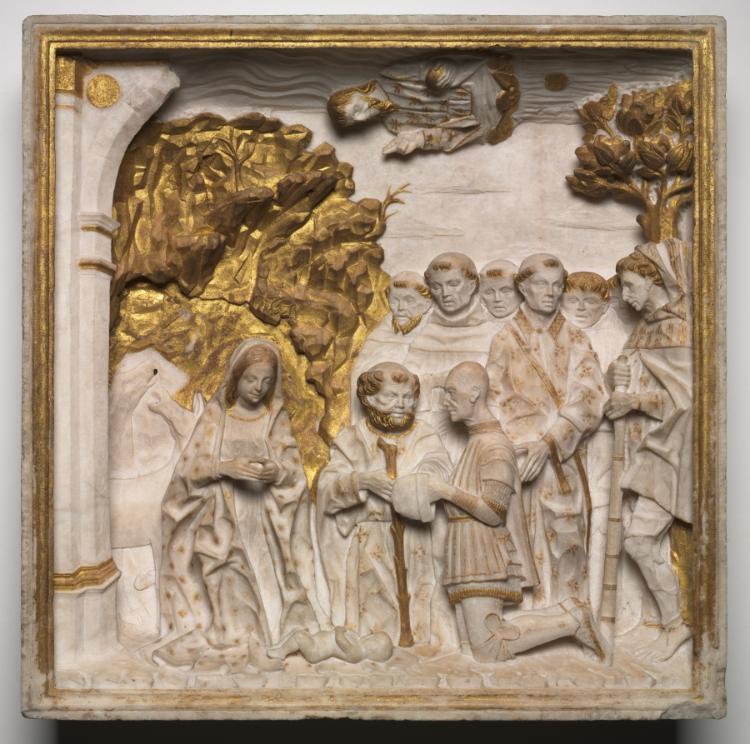
Benedetto Briosco · The Cleveland Museum of Art · Gift of the John Huntington Art and Polytechnic Trust · CC0
- Born
- 1460 · Pavia.
- Died
- 1517 · Pavia.
- Occupation
- sculptor · architect
- Languages
- Italian
VALÉORINE Encyclopedia
VALÉORINE documentary reading
Documentary summary
Illustration — Arca of Saints Marcellinus and Peter, Cremona Cathedral. Benedetto Briosco (c.1460–c.1517) was an Italian Renaissance sculptor and architect, active in Lombardy. Briosco was born in Pavia, and is thought to have apprenticed in Milan.
Admitted source layer · organised and presented by VALÉORINE
Reference Check
Propose documentary evidence for Benedetto Briosco. A contribution is never written directly as fact: identity, source, rights and evidence gates still decide.
Sign in to contribute
Documentary evidence
Documentary basis
Authority files
wikidata · Q2519517 · wikipedia · Benedetto Briosco
In this article
Biography
Biography
His sepulchre monument of Ambrogio Grifi (1489) in the church of San Pietro in Gessate in Milan is his first documented work. The statue is characterized by a crude realism. Also from his early years in Milan, in which he collaborated with Francesco Cazzaniga, are the Brivio Monument in the Basilica of Sant'Eustorgio (1489) and the Della Torre Monument in Santa Maria delle Grazie (1483–1484). From around 1492 he was involved in the sculptural program of the Certosa di Pavia. He collaborated on the decoration of the façade with Giovanni Antonio Amadeo, and after the death of Amadeo he took over as sole director of the design and sculpting of the main portal (1501–1507). He also worked on the tomb of Gian Galeazzo Visconti (under Giovanni Cristoforo Romano). In 1508-13 he worked in the Cathedral of Cremona (sculpting the Urn of Saints Peter and Marcellinus). Traveling from Lombardy to Piedmont, in the church of San Giovanni in Saluzzo he built the tomb of Ludovico II of Saluzzo. He sculpted the noteworthy statue of "St. Anne" for the Duomo of Milan (1492), now in the cathedral's museum. From 1495 is the Longhignana monument once in the church of San Pietro in Gessate, and now in the Palazzo Borromeo on the Isola Bella in Lake Maggiore.
Life and career
Dated record
Life and career
The full dated record · 2 entries
1460
Benedetto Briosco was born on 1 January 1460.
1517
Benedetto Briosco died on 1 January 1517.
Context
Primary material
Context
The circumstances in which Benedetto Briosco stands. Works and catalogued output.
Documents and archives
Primary material
Documents and archives
reference work
- “Benedetto Briosco”, English Wikipedia, consulted as further reading
Reputable secondary · Wikipedia
authority record
- Wikidata, structured authority record Q2519517: Benedetto Briosco
General reference · Wikidata
Citations
References
Each reference names the institution holding it, so a reader may go to the document itself.
reference work
Secondary witnessauthority record
General reference
The Encyclopedia exists whether or not anything is for sale. Corrections are recorded rather than overwritten, and every version of this record is kept. Published 17 August 2026.
Elsewhere in Design
11,558 published records in this field, each with its sources named.
- Ben-Ami ShulmanDesigner
- Benedetta TagliabueDesigner
- Benedetto AlfieriDesigner
- Benedetto AntelamiDesigner
- Benedetto da MaianoDesigner
- Benedetto da RavennaDesigner
- Benedict WilliamsonDesigner
- Benedikt RejtDesigner
Best supported in this field
For owners
Own a work by Benedetto Briosco?
A specialist will read what you send and tell you what the house can establish, what it cannot, and whether the object is suited to sale. There is no charge and no obligation. The object stays with you throughout; nothing is shipped to us unless it is arranged in writing beforehand.