
ballistic missile
Illustration — Minuteman-III MIRV launch sequence: • 1. The missile launches out of its silo by firing its first-stage boost motor (A). • 2. About 60 seconds after launch, the first-stage drops off and the second-stage motor (B) ignites.
Also recorded as MRBM · IRBM
ballistic missile
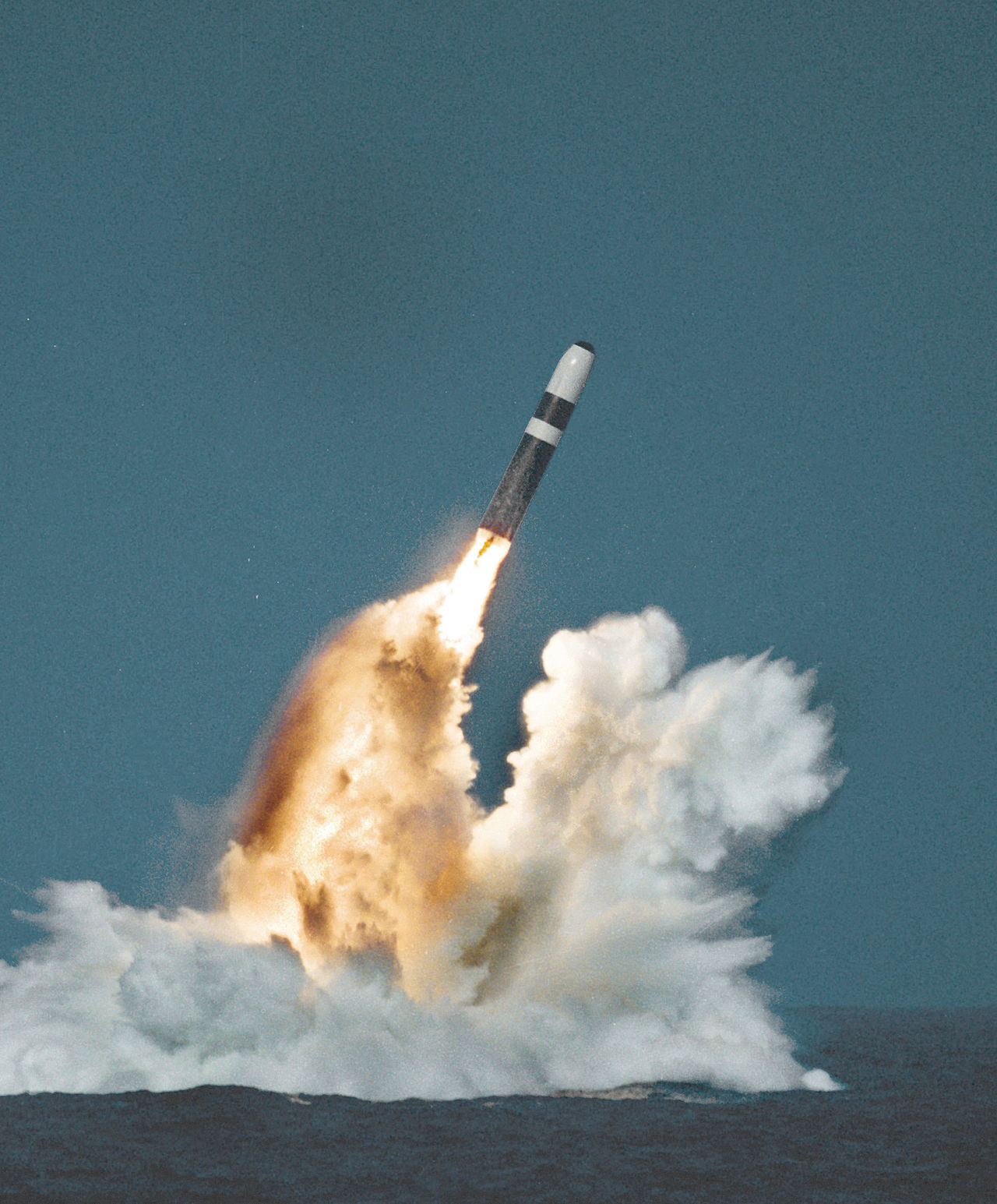
High Res image from Lockheed Martin NOTE: According to NTI, this image is a U.S. Department of Defense photo, therefore is in the public domain. Also here, on US Navy web site · Public domain
- Field
- missile
VALÉORINE Encyclopedia
VALÉORINE documentary reading
Documentary summary
Illustration — Minuteman-III MIRV launch sequence: • 1. The missile launches out of its silo by firing its first-stage boost motor (A). • 2. About 60 seconds after launch, the first-stage drops off and the second-stage motor (B) ignites.
Admitted source layer · organised and presented by VALÉORINE
Reference Check
Propose documentary evidence for ballistic missile. A contribution is never written directly as fact: identity, source, rights and evidence gates still decide.
Sign in to contribute
World of VALÉORINE
Documentary connections
Only confirmed graph relationships appear here. Images are shown only when their identity and reuse rights both pass the documentary gate.
Broader Term · incoming
Abdali-I
Term

Broader Term · incoming
Aggregate
Term
Own work
Broader Term · incoming
air-launched ballistic missile
Term

Broader Term · incoming
Al Hussein
Term
VIRIN: DD-ST-89-11778

Broader Term · incoming
Al-Samoud 2
Term
Task Force Tarawa, US Marine Corps
Broader Term · incoming
Alpha Draco
Term
Broader Term · incoming
anti-ship ballistic missile
Term

Broader Term · incoming
Black Knight
Term
Own work

Broader Term · incoming
DF-61
Term
YouTube : https://www.youtube.com/watch?v=NT4O0teEYXU – View/save archived versions on archive.org

Broader Term · incoming
Dongfeng
Term
https://apps.dtic.mil/sti/citations/ADA528060 "Military Power of the People’s Republic of China 2007" P.19 add text.

Broader Term · incoming
Fateh-313
Term
mehrnews.com

Broader Term · incoming
Fattah-1
Term
tasnimnews.ir (Direct URL: https://newsmedia.tasnimnews.ir/Tasnim/Uploaded/Image/1402/03/16/1402031612024860227723844.jpg )

Broader Term · incoming
Fattah-2
Term
https://www.tasnimnews.com/

Broader Term · incoming
GAM-87 Skybolt
Term
Own work

Broader Term · incoming
Global Rocket 1
Term
собственный снимок

Broader Term · incoming
Hrim missile system
Term
Военный парад в честь Дня Независимости Украины / Military parade in honor of the Independence Day of Ukraine
Documentary evidence
Documentary basis
Authority files
wikidata · Q179348 · wikipedia · Ballistic missile
In this article
History
History
The missile shroud (E) is ejected. • 3. About 120 seconds after launch, the third-stage motor (C) ignites and separates from the second stage. • 4. About 180 seconds after launch, third-stage thrust terminates and the post-boost vehicle (D) separates from the rocket. • 5. The post-boost vehicle maneuvers itself and prepares for re-entry vehicle (RV) deployment. • 6. The RVs, as well as decoys and chaff, are deployed. • 7. The RVs (now armed) and chaff re-enter the atmosphere at high speeds. • 8. The nuclear warheads detonate. A ballistic missile is a type of missile that follows a ballistic trajectory and is powered only during a relatively brief initial period—most of the flight is unpowered. Short-range ballistic missiles (SRBM) typically stay within the Earth's atmosphere, while most larger missiles travel outside the atmosphere. The type of ballistic missile with the greatest range is an intercontinental ballistic missile (ICBM). The largest ICBMs are capable of full orbital flight. These missiles are in a distinct category from cruise missiles, which are aerodynamically guided in powered flight and thus restricted to the atmosphere.
• Illustration — Replica V-2 Ballistic missiles developed from earlier rocket artillery and from the study of ballistics. Rockets had been used as weapons for centuries, including in China, the Kingdom of Mysore, and nineteenth-century European armies, but these weapons were unguided and short-ranged compared with later ballistic missiles. Modern ballistic missiles emerged from twentieth-century liquid-fuel rocketry and from attempts to deliver explosive payloads over long distances without using crewed aircraft.
V-2 and the Second World War
V-2 and the Second World War
One of the first operational ballistic missiles was the German Aggregat 4 (A-4), better known as the V-2. It was developed by Nazi Germany during the 1930s and 1940s under a program associated with Wernher von Braun and Walter Dornberger. The first successful A-4 launch took place on 3 October 1942. The V-2 entered combat use in September 1944. The first V-2 used in combat was fired against Paris on 6 September 1944, and attacks against London began two days later. Because it followed a high, fast ballistic trajectory and travelled faster than sound, the V-2 could not be intercepted by wartime air defenses. A vertically launched V-2, MW 18014, became the first human-made object to reach outer space on 20 June 1944. After the war, the United States, the Soviet Union, and other states examined captured German missiles, documents, and personnel. This postwar transfer of V-2 technology influenced both military missile programs and early spaceflight programs.
Cold War strategic missiles
Cold War strategic missiles
During the Cold War, ballistic missile development became central to the nuclear competition between the United States and the Soviet Union. Early postwar missiles were limited by range, accuracy, reliability, and launch preparation time, but rapid advances in propulsion, guidance, and warhead design led to increasingly capable medium-range ballistic missiles, intermediate-range ballistic missiles, and intercontinental ballistic missiles (ICBMs). The Soviet R-7 Semyorka was the first ICBM to complete a successful flight, on 21 August 1957. A modified R-7 launched Sputnik 1, the first artificial satellite, on 4 October 1957, linking early ICBM development with the beginning of the Space Age. The United States developed its own early ICBMs, including Atlas and Titan, followed by the solid-fuel Minuteman family. Solid-fuel missiles improved readiness because they could be stored for longer periods and launched more quickly than many earlier liquid-fuel missiles. The Minuteman III became operational in 1970 and was the first missile to carry multiple independently targetable reentry vehicles (MIRVs). MIRVs allowed a single missile to deliver several warheads against separate targets and became an important factor in strategic nuclear planning and missile defense debates.
Submarine-launched missiles
Submarine-launched missiles
The development of submarine-launched ballistic missiles (SLBMs) added a sea-based component to nuclear deterrence. The United States Navy developed the solid-fuel Polaris missile for launch from submerged ballistic missile submarines. USS George Washington conducted the first submerged Polaris launch on 20 July 1960 and departed on the first U.S. ballistic missile submarine deterrent patrol on 15 November 1960. SLBMs increased the survivability of nuclear forces by placing missiles on mobile and concealed platforms at sea. Later SLBM systems, including Poseidon and Trident, increased range, accuracy, and payload compared with Polaris. The Soviet Union and other nuclear-armed states also developed submarine-launched ballistic missile forces during the Cold War.
Arms control and proliferation
Arms control and proliferation
Ballistic missiles became a major subject of arms control agreements. The Intermediate-Range Nuclear Forces Treaty (INF Treaty), signed by the United States and the Soviet Union in 1987, required the elimination of their ground-launched ballistic and cruise missiles with ranges between 500 and 5,500 kilometers. Strategic ballistic missiles were also covered by later strategic arms agreements, including the Strategic Arms Reduction Treaty process and New START. Outside the U.S.–Soviet and U.S.–Russian strategic competition, shorter-range ballistic missiles proliferated widely. The Soviet Scud and its derivatives became especially common. Scud-type missiles were used during the Iran–Iraq War, including attacks on cities, and Iraq used modified Scud variants during the Gulf War.
Twenty-first century use
Twenty-first century use
In the twenty-first century, ballistic missiles have remained part of both strategic arsenals and regional conflicts. They have been used or tested by states including Russia, Ukraine, Iran, North Korea, India, Pakistan, and others. During the Russian invasion of Ukraine, both ballistic and cruise missiles were used in long-range strikes, while Iran used ballistic missiles in direct attacks on Israel in 2024 and 2025. The continued spread and use of ballistic missiles has kept missile defense, early warning, and arms control central to international security debates.
Flight
Flight
In order to cover large distances, ballistic missiles are usually launched into a high sub-orbital spaceflight; for intercontinental missiles, the highest altitude (apogee) reached during free-flight is about 4500 km. A ballistic missile's trajectory consists of three parts or phases: the boost phase, the mid-course phase and the terminal phase. Special systems and capabilities are required to facilitate the successful passage from one phase to the other. The boost phase is the powered flight portion, beginning with the ignition of the engines and concluding with the end of powered flight. The powered flight portion can last from a few tenths of seconds to several minutes and can consist of multiple rocket stages. Internal computers keep the missile aligned on a preprogrammed trajectory. On multi-stage missiles, stage separation (excluding any post-boost vehicles or MIRV bus) occurs primarily during the boost phase. The mid-course phase is the longest in the missile's trajectory, beginning with the conclusion of powered flight. When the fuel is exhausted, no more thrust is provided and the missile enters free flight. During this phase the missile, now largely consisting of a warhead or payload and possibly defensive countermeasures and small propulsion systems for further alignment toward its target, will reach its highest altitude and may travel in space for thousands of kilometers (or even indefinitely, in the case of some fractional-orbital capable systems) at speeds of up to 7.5 to. The last phase in the missile's trajectory is the terminal or re-entry phase, beginning with the re-entry of the missile into the Earth's atmosphere (if exoatmospheric) where atmospheric drag plays a significant part in missile trajectory, and lasts until missile impact. Re-entry vehicles re-enter the Earth's atmosphere at very high velocities, on the order of 6-8 km/s at intercontinental ballistic missile ranges. During the beginning of this phase, the missile's trajectory is still relatively well defined, though as the missile reaches the heavier layers of atmosphere it is increasingly influenced by gravity and aerodynamic drag, which can affect its landing.
Types
Types
• Illustration — Trident II SLBM launched by ballistic missile submarine Ballistic missiles can be launched from fixed sites or mobile launchers, including vehicles (e.g., transporter erector launchers), aircraft, ships, and submarines. Ballistic missiles vary widely in range and use, and are often divided into categories based on range. Various schemes are used by different countries to categorize the ranges of ballistic missiles: • Tactical ballistic missile (TBM): Range less than 300 km • Short-range ballistic missile (SRBM): Range from 300 to • Medium-range ballistic missile (MRBM): Range from 1000 to • Intermediate-range ballistic missile (IRBM): Range from 3500 to • Intercontinental ballistic missile (ICBM): Range greater than 5500 km Long- and medium-range ballistic missiles are generally designed to deliver nuclear weapons because their payload is too limited for conventional explosives to be cost-effective in comparison to conventional bomber aircraft.
Quasi-ballistic missiles
Quasi-ballistic missiles
A quasi-ballistic missile is a type of ballistic missile that follows a shallow, largely ballistic trajectory while remaining guided during flight and capable of sustained maneuvering within the atmosphere. These maneuvers can alter the missile's altitude, direction, or range, improving accuracy and complicating interception. Some large guided MLRS rockets, particularly those with ranges comparable to short-range ballistic missiles, blur the traditional distinction between rocket artillery and ballistic missiles and are categorized as quasi-ballistic missiles.
Examples
Examples
• India • Pralay (active) • Long Range – Anti-Ship Missile (under development) • Israel • LORA (active) • North Korea • Hwasong-11A (active) • United States • MGM-140 ATACMS (active) • Precision Strike Missile (active) • RIM-174 Standard ERAM (SM-6) when used for surface-attack (active)
Hypersonic ballistic missile
Hypersonic ballistic missile
Many ballistic missiles reach hypersonic speeds (i.e. Mach 5 and above) when they re-enter the atmosphere from space. However, in common military terminology, the term "hypersonic ballistic missile" is generally only given to those that can sustain hypersonic speeds throughout the majority of duration of flight, often with maneuvering capability that allows them to avoid following a simple ballistic trajectory.
Throw-weight
Throw-weight
Throw-weight is a measure of the effective weight of ballistic missile payloads. It is measured in kilograms or tonnes. Throw-weight equals the total weight of a missile's warheads, reentry vehicles, self-contained dispensing mechanisms, penetration aids, and any other components that are part of the delivered payload, and not of the rocket itself (such as the launch rocket booster and launch fuel). Throw-weight may refer to any type of warhead, but in normal modern usage, it refers almost exclusively to nuclear or thermonuclear payloads. It was once also a consideration in the design of naval ships and the number and size of their guns. Throw-weight was used as a criterion in classifying different types of missiles during Strategic Arms Limitation Talks between the Soviet Union and the United States. The term became politically controversial during debates over the arms control accord, as critics of the treaty alleged that Soviet missiles were able to carry larger payloads and so enabled the Soviets to maintain higher throw-weight than an American force with a roughly comparable number of lower-payload missiles. The missiles with the world's heaviest payloads are the Russian SS-18 and Chinese CSS-4 and As of 2017, Russia was developing a new heavy-lift, liquid-propellant ICBM called the Sarmat.
Depressed trajectory
Depressed trajectory
• Illustration — Example of depressed trajectory: Fractional Orbital Bombardment System Throw-weight is normally calculated using an optimal ballistic trajectory from one point on the surface of the Earth to another. A "minimum-energy trajectory" maximizes the total payload (throw-weight) using the available impulse of the missile. By reducing the payload weight, different trajectories can be selected, which can either increase the nominal range or decrease the total time in flight. A depressed trajectory is non-optimal, as a lower and flatter trajectory takes less time between launch and impact but has a lower throw-weight. The primary reasons to choose a depressed trajectory are to evade anti-ballistic missile systems by reducing the time available to shoot down the attacking vehicle (especially during the vulnerable burn-phase against space-based ABM systems) or a nuclear first-strike scenario. An alternate, non-military purpose for a depressed trajectory is in conjunction with the spaceplane concept with use of airbreathing jet engines, which requires the ballistic missile to remain low enough inside the atmosphere for air-breathing engines to function. In contrast, a "lofted" trajectory is frequently used for testing purposes, as it reduces the range of the missile (allowing for a controlled and observed impact), as well as signals a lack of hostile intention with the test.
Combat use
Combat use
The following ballistic missiles have been used in combat: • Ghadr-110 • LORA • MGM-140 ATACMS • OTR-21 Tochka • Qaher-1/2M • Scud • V-2 • Zolfaghar • Kh-47M2 Kinzhal • Oreshnik • Hwasong-11A
Notes from the source article
Cited by Wikipedia
Notes from the source article
These works are cited by the source article, in its own numbering. They are recorded as its citations, not as sources VALÉORINE has verified.
- 1.NASA Glenn Research Center. Brief History of Rockets.
- 2.Zaloga, Steven. V-2 Ballistic Missile 1942–52. Osprey Publishing. 3. 2003. 978-1-84176-541-9.
- 3.Rocket and missile system - Strategic missiles. Encyclopaedia Britannica.
- 4.Wade, Mark. Peenemuende. Astronautix.com.
- 5.Reichhardt, Tony. 60 Years Since Sputnik. Air & Space/Smithsonian. 3 October 2017.
- 6.Reichhardt, Tony. 60 Years Since Sputnik. Air & Space/Smithsonian. 3 October 2017.
- 7.National Museum of the United States Air Force. Boeing LGM-30G Minuteman III.
- 8.United States Navy. Navy Commemorates 50th Anniversary Of First SSBN Deterrent Patrol. 17 November 2010.
- 9.United States Navy Strategic Systems Programs. Our History.
- 10.National Museum of American History. Ballistic Missiles.
- 11.Rocket and missile system - Strategic missiles. Encyclopaedia Britannica.
- 12.Arms Control Association. The Intermediate-Range Nuclear Forces Treaty at a Glance.
- 13.Center for Strategic and International Studies Missile Threat. Shahab-1 (Scud B-Variant).
- 14.Nuclear Threat Initiative. Iraq Missile Overview. 1 June 2012.
- 15.Doyle, Gerry. Israel's strikes on Iran spark interest in air-launched ballistic missiles. Reuters. 4 November 2024.
- 16.Iran strikes back at Israel with missiles over Jerusalem, Tel Aviv. Reuters. 13 June 2025.
- 17.North Korea launches 'highest ever' ballistic missile. BBC. 28 November 2017.
- 18.Chun, Clayton K. S. Thunder over the horizon: from V-2 rockets to ballistic missiles. Praeger Security International. 2. 2006. 978-0-275-98577-6.
- 19.Chun, Clayton K. S. Thunder over the horizon: from V-2 rockets to ballistic missiles. Praeger Security International. 4. 2006. 978-0-275-98577-6.
- 20.McFadden, Christopher. What is an intercontinental ballistic missile and how does it work?. 4 December 2017.
- 21.Defense Intelligence Ballistic Missile Analysis Committee. Ballistic and Cruise Missile Threat. June 2017.
- 22.Delory, Stéphane. Ballistic missiles and conventional strike weapons: Adapting the HCoC to address the dissemination of conventional ballistic missiles. Nonproliferation.eu. Fondation pour la Recherche Stratégique. January 2020.
- 23.MLRS For Army and Indigenous Capability. SPS Land Forces.
- 24.Press Information Bureau. DRDO successfully conducts salvo launch of two Pralay missiles in quick succession. 2026-05-28.
- 25.Defence Ministry clears proposal to buy 'Pralay' ballistic missiles for Indian Army. The Economic Times. 2023-09-17. 0013-0389.
- 26.Missile marvels: India makes a mark with its growing capabilities. The Financial Express. 2022-12-27.
- 27.Menon, Adithya Krishna. India showcases first Hypersonic Anti-Ship Missile System in national parade. Naval News. 2026-01-29.
- 28.IAI conducts dual LORA firing demonstration. Janes. 2020-06-03.
- 29.NK News. Hwasong-11A (Hwasong-11Ka, KN-23). NK Pro. 2026-08-17.
- 30.MGM-140 ATACMS Short-Range Ballistic Missile. www.militarytoday.com.
- 31.Precision Strike Missile (PrSM). Lockheed Martin.
- 32.Leveraging sovereign-guided weapons for the RAN The Australian Naval Institute. 2025-11-01.
- 33.Kass, Harrison. America’s “PrSM” Missile Just Made Its Debut in Iran. The National Interest. 2026-03-08.
- 34.Newdick, Thomas. Confusion Surrounds Future Of U.S. Long-Range Missiles In Germany Amid Rift With White House. The War Zone. 2026-05-04.
- 35.'National pride is at stake.' Russia, China, United States race to build hypersonic weapons. www.science.org.
- 36.Gale, Alastair. What Are Hypersonic Missiles and Who's Developing Them?. WSJ.com. February 2022.
- 37.Trevithick, Joseph. Blackbeard 'Cheap' Hypersonic Strike Missile Being Developed For U.S. Army (Updated). The War Zone. 2025-06-30.
- 38.What is throw weight?. The New York Times. 10, Sec. A. 15 July 1991.
- 39.James John Tritten, Throw-Weight and Arms Control , Air University Review, Nov-Dec 1982.
- 40.What Is Throw-Weight? , New York Times, July 15, 1991.
- 41.Druckmann, Erez. Optimal In-flight Trajectory Modifications for Ballistic Missiles and Rockets. Journal of Guidance, Control, and Dynamics. 35. 2. 462. 28 Aug 2012. 10.2514/1.54538.
- 42.Science & Global Security, 1992, Vol. 3, pp.101–159 Depressed Trajectory SLBMs: A Technical Evaluation and Arms Control Possibilities http://www.princeton.edu/sgs/publications/sgs/pdf/3_1-2gronlund.pdf
- 43.Why North Korea's missile tests are going higher and further. Reuters. 2022-12-16.
- 44.Little and large missile surprises in Sanaa and Tehran.
- 45.Video Points to Azerbaijan's First Use of Israeli-Made Ballistic Missile Against Armenia. 2 October 2020.
- 46.In a first, Israel shoots down a ballistic missile in space. 5 November 2023.
- 47.Key Russian air defence system hit in Ukraine Atacms strike. www.bbc.com. 2024-11-26.
- 48.A peek inside Houthi Rebel's recent missile strikes in Saudi Arabia. FDD's Long War Journal. 28 March 2018.
- 49.Weapons - Ss-1 Scud The Gulf War FRONTLINE. www.pbs.org.
- 50.V-2 Missile National Air and Space Museum. airandspace.si.edu. 2023-11-06.
- 51.Iran Hits Syria With Ballistic Missiles Arms Control Association. www.armscontrol.org.
- 52.Goldstein, Lyle. China Evaluates Russia's Use of Hypersonic 'Daggers' in the Ukraine War. 2024-01-12.
- 53.Russia has used its hypersonic Oreshnik missile for the first time. What are its capabilities?. AP News. 2024-12-09.
- 54.Van Diepen, Vann H. The KN-23 Goes to War: Has It Improved North Korea’s Missiles?. 38 North. The Henry L. Stimson Center. 2026-08-14.
Bibliography printed in the source article · 4
- Bath, David W. Assured Destruction: Building the Ballistic Missile Culture of the U.S. Air Force (Naval Institute Press, 2020) online book review
- Futter, Andrew. Ballistic Missile Defence and US National Security Policy: Normalisation and Acceptance after the Cold War. Routledge. 2013. 978-0-415-81732-5.
- Neufeld, Jacob. The Development of Ballistic Missiles in the United States Air Force, 1945–1960. Office of Air Force History, U.S. Air Force. 1990. 0-912799-62-5.
- Swaine, Michael D. Japan and Ballistic Missile Defense. Rand. 2001. 0-8330-3020-5.
References
Citations
References
Each reference names the institution holding it, so a reader may go to the document itself.
reference work
Secondary witnessreference work
Secondary witness
Connections
Knowledge graph
Connections
Each connection was recorded deliberately, with the basis for it kept on the internal record.
Broader subject
12- air-launched ballistic missileTerminology
Established from a fact already recorded on a verified source.
- anti-ship ballistic missileTerminology
Established from a fact already recorded on a verified source.
- Black KnightTerminology
Established from a fact already recorded on a verified source.
- DongfengTerminology
Established from a fact already recorded on a verified source.
- Fattah-1Terminology
Established from a fact already recorded on a verified source.
- GAM-87 SkyboltTerminology
Established from a fact already recorded on a verified source.
Further particulars
Held on the record
Further particulars
Open the remaining particulars
Ballistic missile is connected to 41 other published records in the VALÉORINE Encyclopedia.
The Encyclopedia exists whether or not anything is for sale. Corrections are recorded rather than overwritten, and every version of this record is kept. Published 16 August 2026.
Elsewhere in Militaria
6,095 published records in this field, each with its sources named.
- Ball turretTerminology
- Ballard RifleTerminology
- Ballester-MolinaTerminology
- ballistaTerminology
- ballistic shieldTerminology
- bamboo cannonTerminology
- bamboo spearTerminology
- BAP 100Terminology
Best supported in this field
For owners
Own an object connected with ballistic missile?
A specialist will read what you send and tell you what the house can establish, what it cannot, and whether the object is suited to sale. There is no charge and no obligation. The object stays with you throughout; nothing is shipped to us unless it is arranged in writing beforehand.