
Baccio Bandinelli
Baccio Bandinelli (also called Bartolomeo Brandini; 12 November 1493 – shortly before 7 February 1560) was an Italian Renaissance sculptor, draughtsman, and painter. • Illustration — Self-portrait of Bartolommeo Bandinelli, 16th century • Illustration — Hercules and Cacus, 1530–1534 • Illustration — Drawing of the monument for Pope Leo X and Clement VII
Also recorded as Bartollomeo Bandinelli · Bartolomeo Brandini · Bartolomeo Bandinelli · Baccio Bandinelle
Baccio Bandinelli
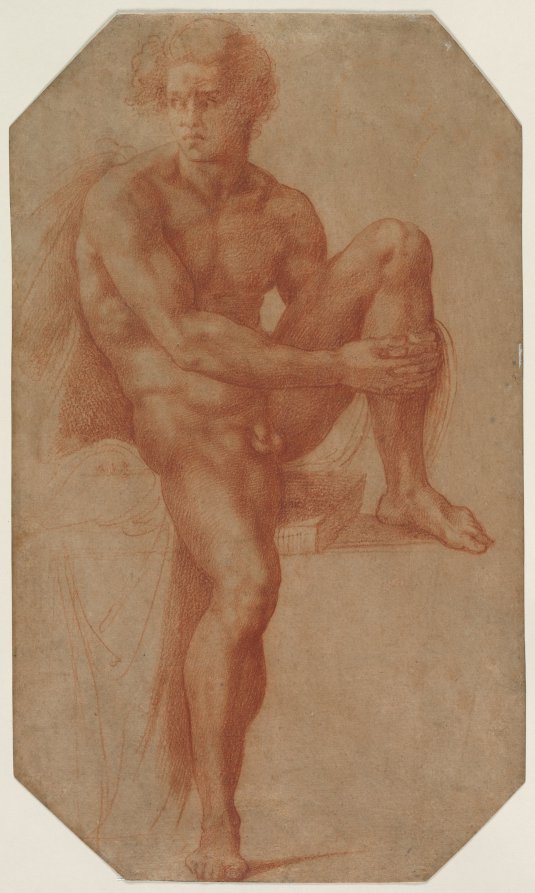
Baccio Bandinelli · The Cleveland Museum of Art · John L. Severance Fund · CC0
- Born
- 1493
- Died
- 1560
- Nationality
- Republic of Florence · Duchy of Florence
- Occupation
- sculptor · painter · draftsperson · art historian · designer
- Known for
- Portrait of Michelangelo · Hercules and Cacus · Adam and Eve · Bacchus · Bust of Cosimo I de' Medici and Bargello · Bust of Cosimo I de' Medici
VALÉORINE Encyclopedia
VALÉORINE documentary reading
Documentary summary
Baccio Bandinelli (also called Bartolomeo Brandini; 12 November 1493 – shortly before 7 February 1560) was an Italian Renaissance sculptor, draughtsman, and painter. • Illustration — Self-portrait of Bartolommeo Bandinelli, 16th century • Illustration — Hercules and Cacus, 1530–1534 • Illustration — Drawing of the monument for Pope Leo X and Clement VII
Admitted source layer · organised and presented by VALÉORINE
Reference Check
Propose documentary evidence for Baccio Bandinelli. A contribution is never written directly as fact: identity, source, rights and evidence gates still decide.
Sign in to contribute
Documentary evidence
Documentary basis
Authority files
wikidata · Q358348 · wikipedia · Baccio Bandinelli
In this article
Biography
Biography
Bandinelli was the son of a prominent Florentine goldsmith, and first apprenticed in his shop. As a boy, he was apprenticed under Giovanni Francesco Rustici, a sculptor friend of Leonardo da Vinci. Among his earliest works was a Saint Jerome in wax, made for Giuliano de' Medici, identified as Bandinelli's by John Pope-Hennessy. Giorgio Vasari, a former pupil in Bandinelli's workshop, claimed Bandinelli was driven by jealousy of Benvenuto Cellini and Michelangelo; and recounts that: Bandinelli's lifelong obsession with Michelangelo is a recurring theme in assessments of his career. Bandinelli was a leader in the group of Florentine Mannerists who were inspired by the revived interest in Donatello attendant on the installation of Donatello's bas-relief panels for the pulpit in San Lorenzo, 1515. The artist presented his relief of the Deposition to Charles V at Genoa in 1529; though the relief has been lost, a bronze from it by Antonio Susini in 1600 (Musée du Louvre) shows the decisive inspiration of Donatello's emotional pitch and intensity; Bandinelli made several drawings of the Donatello reliefs, though later in life he disparaged them in a letter to Cosimo I de' Medici. His sculptures have never inspired the admiration given those of Michelangelo, especially the colossal (5.05 m) marble group of Hercules and Cacus (completed in 1534) in the Piazza della Signoria, Florence, and Adam and Eve in the Museo Nazionale del Bargello, which both stand within sight of some of Michelangelo's masterworks. Vasari said of him "He did nothing but make bozzetti and finished little", and modern commentators have remarked on the vitality of Bandinelli's terracotta models contrasted with the finished marbles: "all the freshness of his first approach to a subject was lost in the laborious execution in marble... A brilliant draughtsman and excellent small-scale sculptor, he had a morbid fascination for colossi which he was ill-equipped to execute. His failure as a sculptor on a grand scale was accentuated by his desire to imitate Michelangelo." Hercules and Cacus was commissioned by the Medici pope Clement VII, who had been shown a wax model. The supplied block of Carrara marble was not big enough to execute Bandinelli's original design. He had to make new wax models, one of which was chosen by the pope as the final draft. Bandinelli had already carved the sculpture as far as the abdomen of Hercules, when during the 1527 Sack of Rome, the pope was taken prisoner. Meanwhile, in Florence, republican enemies of the Medici took advantage of the chaos to exile Ippolito de' Medici. Bandinelli, a supporter of the Medici, was also exiled. In 1530 Emperor Charles V retook Florence after a long siege. Pope Clement VII subsequently installed his illegitimate son Alessandro de' Medici as duke of Tuscany. Bandinelli then returned to Florence and continued work on the statue, which was completed in 1534 and transported from the cathedral's workshop to its present marble pedestal. But from the moment it was unveiled, it faced ridicule; Cellini compared the ponderous group to 'a sack full of melons'. Afterwards, Bandinelli tried to sabotage Cellini's career. The statue was restored between February and April 1994. Bandinelli's drawings, which have in the past masqueraded as Michelangelo's in connoisseurs' collections, came into their own in the later twentieth century. Among Bandinelli's pupils were Vasari and Francesco de' Rossi (Il Salviati). His sons Clemente, a collaborator in his studio, and Michelangelo Bandinelli were also sculptors. • Illustration — The cartoon of the Battle of Cascina by Michelangelo • Illustration — Bandinelli's copy of the Laocoön Group • Illustration — Pietà, Basilica della Santissima Annunziata, Florence • Illustration — Baccio Bandinelli and collaborators, 5 of 24 reliefs from the choir of Santa Maria del Fiore, 1547–72, Museo dell'Opera del Duomo, Florence
Selected works
Selected works
Baccio Bandinelli's works include: • copy of the Laocoön group, at the time in the Cortile del Belvedere, commissioned by Pope Leo X as a gift to François I. Bandinelli boasted that he would exceed the original, and when he was finished, after a hiatus during the pontificate of Adrian VI, the Medici Pope Clement VII could not bear to part with it, sent some antiquities to the King of France in its stead, and sent Baccio's Laocoön to Florence. It remains at the Uffizi. • Tombs of the Medici popes Leo X and Clement VII in Santa Maria sopra Minerva (1536–41). • Bust of Cosimo I de' Medici (c. 1539–40) (Metropolitan Museum of Art, acc. no. 1987.280) This had been locked away in a vault in a Swiss bank until a dealer's tip led the curator Olga Raggio to its rediscovery. • Monument to Giovanni delle Bande Nere (1540–54), a seated figure on a magnificent pedestal, in piazza San Lorenzo, Florence • Pietà in the Basilica della Santissima Annunziata, Florence, where Bandinelli portrayed himself in the figure of Joseph of Arimathea. Bandinelli is buried in the chapel, with his wife Giacoma Doni. • Ceres and Apollo (1552–1556) for niches in the façade of Buontalenti's grotto in the Boboli Gardens • Illustration — Orpheus, now in the courtyard of the Palazzo Medici-Riccardi, Florence • Orpheus for Palazzo Vecchio, now in the courtyard of the Palazzo Medici-Riccardi. One of Bandinelli's few signed works. • Works for the Duomo, Florence, including the high altar and its Adam and Eve (1551), now in the Bargello and Pietà now in the crypt of Santa Croce; much-praised bas-reliefs made for the enclosure of the choir, designed by the architect Giuliano di Baccio d'Angnolo (1555), now in the Museo dell'Opera del Duomo; Saint Peter, one of eight apostles by various sculptors in the piers of the crossing. • Works in Palazzo Vecchio, including, in the Audience Hall, a statue of Grand Duke Cosimo I de' Medici and one of Pope Leo X blessing (finished after Bandinelli's death by Vincenzo de' Rossi) • God the Father (1549) in Santa Croce cloister • Andrea Doria as Neptune, outside Carrara Cathedral. When Carrara was lost for a short while to the Genoese Republic, Bandinelli was commissioned to sculpt Andrea Doria. Afterwards the Florentine Republic recaptured the city and such a symbol of Genoese dominion was rendered inappropriate, so the statue was renamed Neptune. This rechristening as the Roman sea divinity was suggested by the fountain sea creatures at the statue's base. • In the Bargello are also a number of lesser works: Noah (bas-relief), portrait busts of Eleonora di Toledo and Cosimo I de' Medici, Venus, Leda, Hercules, Bacchus, Cleopatra, and a portrait bust of an unknown man. • A youthful portrait by Andrea del Sarto c. 1517 is conserved at the Uffizi.
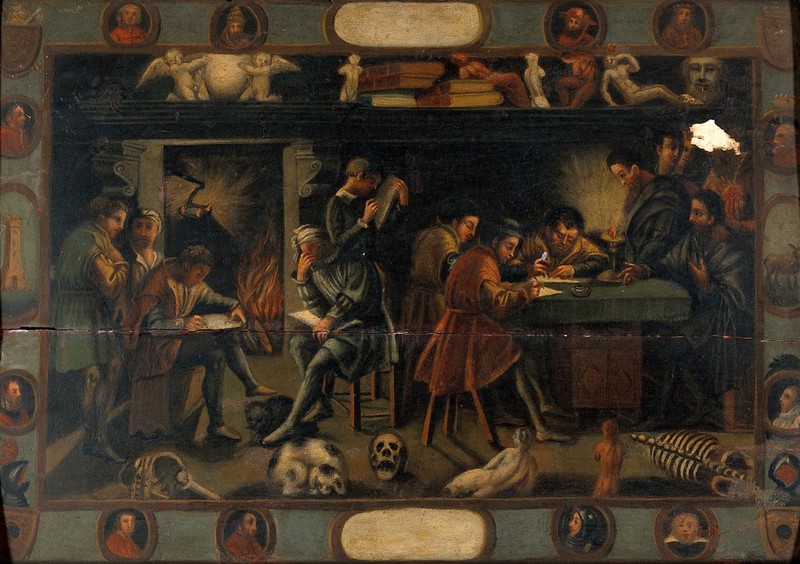
The drawing academy of Baccio Bandinelli. Oil painting after Baccio Bandinelli., by Baccio Bandinelli
Baccio Bandinelli · Wellcome Collection, London · Wellcome Collection
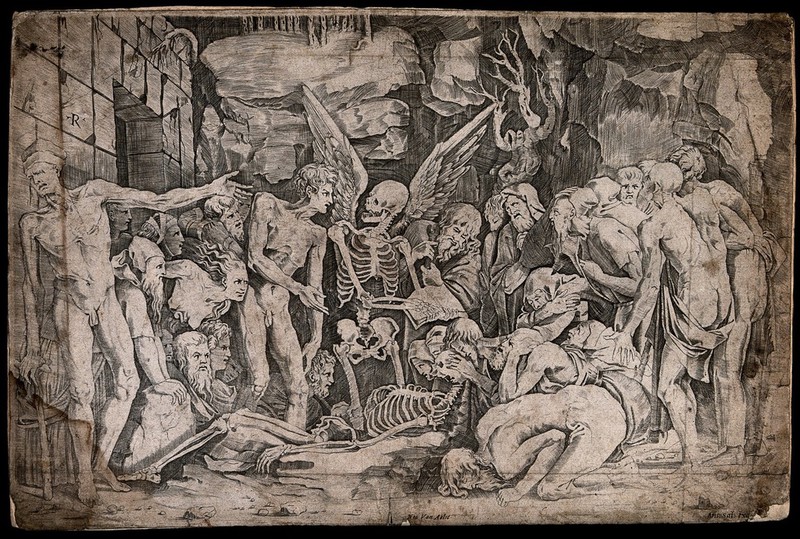
A winged figure of Death stands in front of a prostrate skeleton and tears out the pages of a book while a crowd of people watch him. Etching by Marco Dente (Marco da Ravenna) after Baccio Bandinelli., by Baccio Bandinelli
Baccio Bandinelli · Wellcome Collection, London · Wellcome Collection
Life and career
Dated record
Life and career
Explore 1493–1560
The full dated record · 9 entries
1493
Baccio Bandinelli born at Florence.
1519
Orpheus is dated 1519.
1530
Hercules and Cacus is dated 1530.
1540
Statue of Giovanni delle Bande Nere is dated 1540.
1548
Portrait of Baccio Bandinelli with Lion (1548) is digitised and catalogued by Internet Archive.
1550
Head of a young woman wearing a ghirlanda is dated 1550.
1551
Adam and Eve is dated 1551.
1560
Baccio Bandinelli died at Florence.
1560
Fountain of Neptune is dated 1560.
Citations
References
Each reference names the institution holding it, so a reader may go to the document itself.
reference work
Wikidata, structured authority record Q358348: Baccio BandinelliWikimedia Foundation
Secondary witnessreference work
Secondary witness
The Encyclopedia exists whether or not anything is for sale. Corrections are recorded rather than overwritten, and every version of this record is kept. Published 14 August 2026.
Elsewhere in Modern design
3,254 published records in this field, each with its sources named.
- Axel SchandorffDesigner
- Axel WelinDesigner
- Ayah BdeirDesigner
- Ayşe BirselDesigner
- Badura AfganliDesigner
- Bahia ShehabDesigner
- Bahram TavakoliDesigner
- Baillie ScottDesigner
Best supported in this field
For owners
Own a work by Baccio Bandinelli?
A specialist will read what you send and tell you what the house can establish, what it cannot, and whether the object is suited to sale. There is no charge and no obligation. The object stays with you throughout; nothing is shipped to us unless it is arranged in writing beforehand.