
Augustine of Hippo
Augustine of Hippo (USalso; Aurelius Augustinus Hipponensis; 13 November 354 – 28 August 430), also well-known as Saint Augustine, was a Christian theologian and philosopher from Thagaste, Numidia Cirtensis and the Bishop of Hippo Regius. He is generally regarded as one of the most influential philosophers in the history of the Western world, and he is viewed as one of the most important Church Fathers of the Latin Church in the Patristic Period. In his youth he was drawn to the Manichaean faith, and later to the Hellenistic philosophy of Neoplatonism.
Also recorded as Saint Augustine · Saint Austin · Augustine · St. Augoustinos
Augustine of Hippo
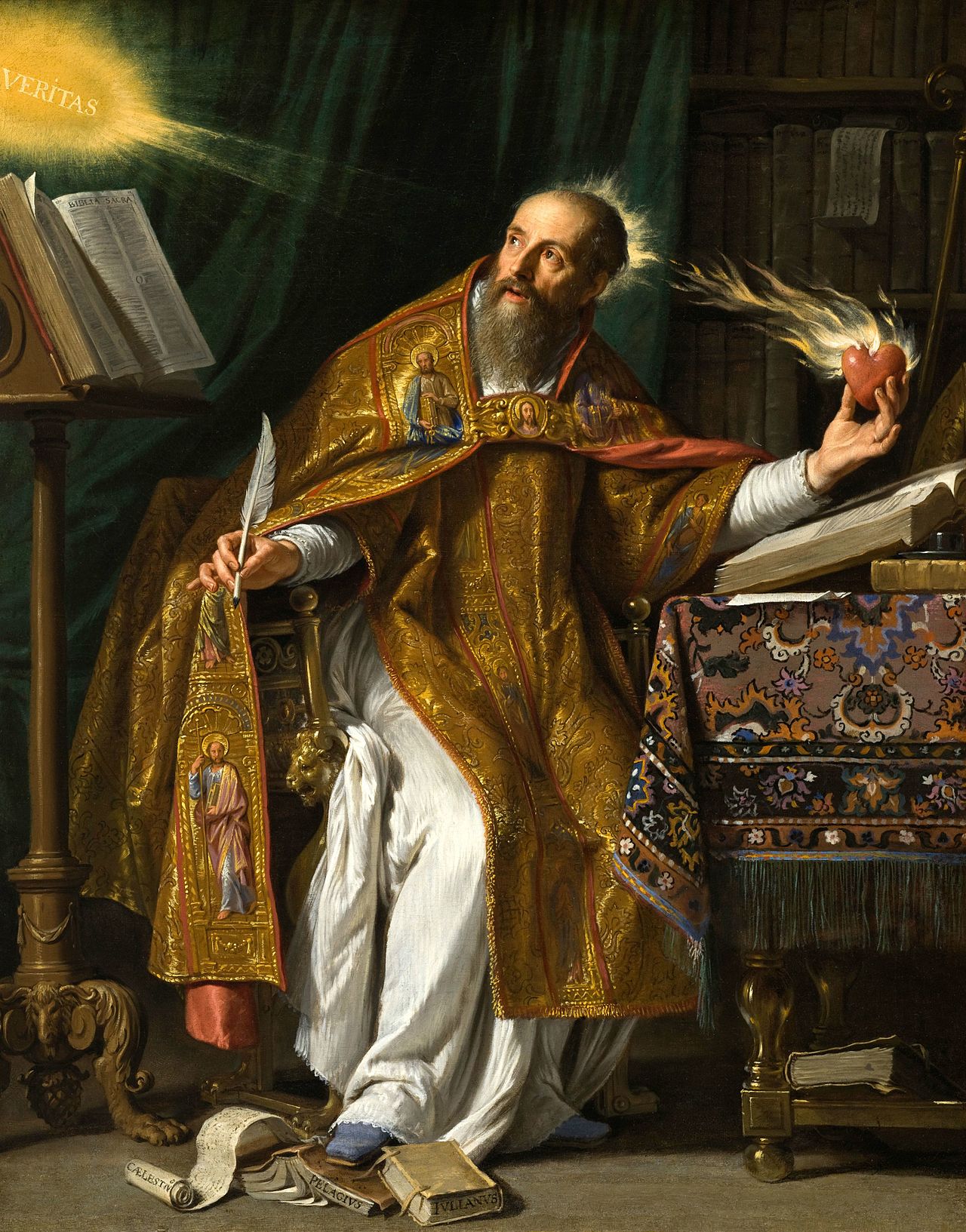
Philippe de Champaigne · Los Angeles County Museum of Art: online database: entry 171584 · Public domain
- Name
- Augustine of Hippo
- Birth Name
- Aurelius Augustinus
- Born
- 13 November 354
- Birthplace
- Thagaste, Numidia Cirtensis, Roman Empire (present-day Souk Ahras, Algeria)
- Died
- 28 August 430 (aged 75)
- Place of death
- Hippo Regius, Numidia Cirtensis, Western Roman Empire (present-day Annaba, Algeria)
- Nationality
- Ancient Rome.
- Occupation
- philosopher, theologian, autobiographer, music theorist, preacher, historian, poet, writer and Catholic priest.
- Known for
- Confessions, The City of God and On the Trinity.
VALÉORINE Encyclopedia
VALÉORINE documentary reading
Documentary summary
Augustine of Hippo (USalso; Aurelius Augustinus Hipponensis; 13 November 354 – 28 August 430), also well-known as Saint Augustine, was a Christian theologian and philosopher from Thagaste, Numidia Cirtensis and the Bishop of Hippo Regius. He is generally regarded as one of the most influential philosophers in the history of the Western world, and he is viewed as one of the most important Church Fathers of the Latin Church in the Patristic Period. In his youth he was drawn to the Manichaean faith, and later to the Hellenistic philosophy of Neoplatonism.
Admitted source layer · organised and presented by VALÉORINE
Note VALÉORINE
No house-authored Note is published until its assertions and sources pass the VALÉORINE evidence contract. The documentary article remains available in full while that enrichment is being consolidated.
Documentary enrichment in progress · no unsupported statement published
Reference Check
Propose documentary evidence for Augustine of Hippo. A contribution is never written directly as fact: identity, source, rights and evidence gates still decide.
Sign in to contribute
World of VALÉORINE
Documentary connections
Only confirmed graph relationships appear here. Images are shown only when their identity and reuse rights both pass the documentary gate.
Documentary evidence
Evidence Panel
not yet certified
- Identity
- resolved
- Independent source families
- 0
- Admitted assertions
- 0
- Open conflicts
- 0
Authority files
gnd · 1091816891 · wikidata · Q8018 · wikipedia · Augustine of Hippo
In this article
Biography
Biography
Hippo worked between 354 and 430 across philosopher, theologian, autobiographer, music theorist and preacher and 9 further recorded occupations. Every statement below returns to a source shown in the evidence panel; where the record is silent or divided, the article says so instead of resolving it.
Key facts
Key facts
• Honorific Prefix — Saint • Name — Augustine of Hippo • Titles — Bishop of Hippo Regius Church Father Doctor of the Church Blessed • Birth Name — Aurelius Augustinus • Born — 13 November 354 • Birthplace — Thagaste, Numidia Cirtensis, Roman Empire (present-day Souk Ahras, Algeria) • Died — 28 August 430 (aged 75) • Place of death — Hippo Regius, Numidia Cirtensis, Western Roman Empire (present-day Annaba, Algeria) • Resting Place — Pavia, Italy • Feast Day — * 28 August (Western Christianity) • 15 June (Eastern Christianity) • 4 November (Assyrian) • Venerated In — All Christian denominations which venerate saints • Canonized Date — Pre-Congregation • Major Shrine — San Pietro in Ciel d'Oro, Pavia, Italy • Attributes — Crozier, mitre, young child, book, small church, flaming or pierced heart • Patronage — * Brewers • Printers • Theologians • Philosophers • Sore eyes • Bridgeport, Connecticut • Cagayan de Oro • San Agustin, Isabela • Mendez, Cavite • Tanza, Cavite • Baliwag, Bulacan • Lubao, Pampanga • Iba, Zambales
Name
Name
Augustine of Hippo, also known as Saint Augustine or Saint Austin, is known by various cognomens throughout the many denominations of the Christian world, including Blessed Augustine and the Doctor of Grace (Doctor gratiae).
Childhood and education
Childhood and education
• Illustration — Saint Augustine Taken to School by Saint Monica, by Niccolò di Pietro, 1413–15 Augustine was born in 354 in the municipium of Thagaste (now Souk Ahras, Algeria) in the Roman province of Numidia. His mother, Monica or Monnica, was a devout Christian; his father Patricius was a pagan who converted to Christianity on his deathbed. He had a brother named Navigius and a sister whose name is lost but is conventionally remembered as Perpetua. Scholars generally agree that Augustine and his family were Berbers, an ethnic group indigenous to North Africa, but were heavily Romanized, speaking only Latin at home as a matter of pride and dignity. In his writings, Augustine mentions in passing his identity as a Roman African. For example, he refers to Ponticianus as "a country man of ours, insofar as being African," and to Faustus of Mileve as "an African Gentleman". He writes that Apuleius "as an African is better known to us Africans". Augustine's family name, Aurelius, suggests his father's ancestors were freedmen of the gens Aurelia given full Roman citizenship by the Edict of Caracalla in 212. Augustine's family had been Roman, from a legal standpoint, for at least a century when he was born. It is assumed that his mother, Monica, was of Berber origin, on the basis of her name, but as his family were honestiores, an upper class of citizens known as honorable men, Augustine's first language was likely Latin. At the age of 11, Augustine was sent to school at Madaurus (now M'Daourouch), a small Numidian city about 19 mi south of Thagaste. There he became familiar with Latin literature, as well as pagan beliefs and practices. His first insight into the nature of sin occurred when he and a number of friends stole pears from a neighbourhood garden. He tells this story in his autobiography, Confessions. He realises that the pears were "tempting neither for its colour nor its flavour" – he was neither hungry nor poor, and he had enough of fruit which were "much better". Over the next few chapters, Augustine agonises over this past sin of his, recognising that one does not desire evil for evil's sake. Rather, "through an inordinate preference for these goods of a lower kind, the better and higher are neglected". In other words, man is drawn to sin when grossly choosing the lesser good over a greater good. Eventually, Augustine concludes that it was the good of the "companionship" between him and his accomplices that allowed him to delight in this theft. At the age of 17, through the generosity of his fellow citizen Romanianus, Augustine went to Carthage to continue his education in rhetoric, though it was above the financial means of his family. Despite the good warnings of his mother, as a youth Augustine lived a hedonistic lifestyle for a time, associating with young men who boasted of their sexual exploits. The need to gain their acceptance encouraged inexperienced boys like Augustine to seek or make up stories about sexual experiences. It was while he was a student in Carthage that he read Cicero's dialogue Hortensius (now lost), which he described as leaving a lasting impression, enkindling in his heart the love of wisdom and a great thirst for truth. It started his interest in philosophy. Although raised Christian, Augustine became a Manichaean, much to his mother's chagrin. At about the age of 17, Augustine began a relationship with a young woman in Carthage. Though his mother wanted him to marry a person of his class, the woman remained his lover. He was warned by his mother to avoid fornication (sex outside marriage), but Augustine persisted in the relationship for over fifteen years, and the woman gave birth to his son Adeodatus (372–388), which means "Gift from God", who was viewed as extremely intelligent by his contemporaries. In 385, Augustine ended his relationship with his lover in order to prepare to marry a teenage heiress. By the time he was able to marry her, however, he had already converted to Christianity and decided to become a Christian priest and the marriage did not happen. Augustine was, from the beginning, a brilliant student, with an eager intellectual curiosity, but he never mastered Greek – his first Greek teacher was a brutal man who constantly beat his students, and Augustine rebelled and refused to study. By the time he realized he needed to know Greek, it was too late; and although he acquired a smattering of the language, he was never eloquent with it. He did, however, become a master of Latin.
Move to Carthage, Rome, and Milan
Move to Carthage, Rome, and Milan
Augustine taught grammar at Thagaste between 373 and 374. The following year he moved to Carthage to conduct a school of rhetoric and remained there for the next nine years. Disturbed by unruly students in Carthage, he moved to establish a school in Rome, where he believed the best and brightest rhetoricians practised, in 383. However, Augustine was disappointed with the apathetic reception. It was the custom for students to pay their fees to the professor on the last day of the term, and many students attended faithfully all term, and then did not pay. Manichaean friends introduced him to the prefect of the City of Rome, Symmachus, who had been asked by the imperial court at Milan to provide a rhetoric professor. Augustine won the job and headed north to take his position in Milan in late 384. At thirty years old, he had won the most visible academic position in the Latin world at a time when such posts gave ready access to political careers. Although Augustine spent ten years as a Manichaean, he was never an initiate or "elect", but an "auditor", the lowest level in this religion's hierarchy. While still at Carthage a disappointing meeting with the Manichaean bishop, Faustus of Mileve, a key exponent of Manichaean theology, started Augustine's scepticism of Manichaeanism. In Rome, he reportedly turned away from Manichaeanism, embracing the scepticism of the New Academy movement. Because of his education, Augustine had great rhetorical prowess and was very knowledgeable of the philosophies behind many faiths. At Milan, his mother's religiosity, Augustine's own studies in Neoplatonism, and his friend Simplicianus all urged him towards Christianity. This was shortly after the Roman emperor Theodosius I declared Christianity to be the only legitimate religion for the Roman Empire on 27 February 380 by the Edict of Thessalonica and then issued a decree of death for all Manichaean monks in 382. Initially, Augustine was not strongly influenced by Christianity and its ideologies, but after coming in contact with Ambrose of Milan, Augustine reevaluated himself and was forever changed. • Illustration — Saint Augustine and his mother, Saint Monica (1846) by Ary Scheffer Augustine arrived in Milan and visited Ambrose, having heard of his reputation as an orator. Like Augustine, Ambrose was a master of rhetoric, but older and more experienced. Soon, their relationship grew, as Augustine wrote, "And I began to love him, of course, not at the first as a teacher of the truth, for I had entirely despaired of finding that in thy Churchbut as a friendly man." Augustine was very much influenced by Ambrose, even more than by his own mother and others he admired. In his Confessions, Augustine states, "That man of God received me as a father would, and welcomed my coming as a good bishop should." Ambrose adopted Augustine as a spiritual son after the death of Augustine's father. Augustine's mother had followed him to Milan and arranged a respectable marriage for him. Although Augustine acquiesced, he had to dismiss his concubine and grieved for having forsaken his lover. He wrote, "My mistress being torn from my side as an impediment to my marriage, my heart, which clave to her, was racked, and wounded, and bleeding." Augustine confessed he had not been a lover of wedlock so much as a slave of lust, so he procured another concubine since he had to wait two years until his fiancée came of age. However, his emotional wound was not healed. It was during this period that he uttered his famously insincere prayer, "Grant me chastity and continence, but not yet." There is evidence Augustine may have considered this former relationship to be equivalent to marriage. In his Confessions, he admitted the experience eventually produced a decreased sensitivity to pain. Augustine eventually broke off his engagement to his eleven-year-old fiancée, but never renewed his relationship with either of his concubines. Alypius of Thagaste steered Augustine away from marriage, saying they could not live a life together in the love of wisdom if he married. Augustine looked back years later on the life at Cassiciacum, a villa outside of Milan where he gathered with his followers, and described it as Christianae vitae otium – the leisure of Christian life.
Conversion to Christianity and priesthood
Conversion to Christianity and priesthood
• Illustration — The Conversion of St. Augustine by Fra Angelico In late August of 386, at the age of 31, having heard of Ponticianus's and his friends' first reading of the life of Anthony of the Desert, Augustine converted to Christianity. As Augustine later told it, his conversion was prompted by hearing a child's voice say "take up and read" (tolle, lege). Resorting to the sortes biblicae, he opened a book of St. Paul's writings (Confessiones 8.12.29) at random and read Romans 13:13–14: "Not in rioting and drunkenness, not in chambering and wantonness, not in strife and envying, but put on the Lord Jesus Christ, and make no provision for the flesh to fulfil the lusts thereof." He later wrote an account of his conversion in his Confessions (Confessiones), which has since become a classic of Christian theology and a key text in the history of autobiography. This work is an outpouring of thanksgiving and penitence. Although it is written as an account of his life, the Confessions also talks about the nature of time, causality, free will, and other important philosophical topics. The following is taken from that work: • Illustration — The vision of St. Augustine by Ascanio Luciano Ambrose baptized Augustine and his son Adeodatus, in Milan on Easter Vigil, 24–25 April 387. A year later, in 388, Augustine completed his apology On the Holiness of the Catholic Church. That year, also, Adeodatus and Augustine returned home to Africa. Augustine's mother Monica died at Ostia, Italy, as they prepared to embark for Africa. Upon their arrival, they began a life of aristocratic leisure at Augustine's family's property. Soon after, Adeodatus, too, died. Augustine then sold his patrimony and gave the money to the poor. He only kept the family house, which he converted into a monastic foundation for himself and a group of friends. Furthermore, while he was known for his major contributions to Christian rhetoric, another major contribution was his preaching style. After converting to Christianity, Augustine turned against his profession as a rhetoric professor in order to devote more time to preaching. In 391 Augustine was ordained a priest in Hippo Regius (now Annaba), in Algeria. He was especially interested in discovering how his previous rhetorical training in Italian schools would help the Christian Church achieve its objective of discovering and teaching the different scriptures in the Bible. He became a famous preacher (more than 350 preserved sermons are believed to be authentic), and was noted for combating the Manichaean religion, to which he had formerly adhered. He preached around 6,000 to 10,000 sermons when he was alive; however, there are only around 500 sermons that are accessible today. When Augustine preached his sermons, they were recorded by stenographers. Some of his sermons would last over one hour and he would preach multiple times throughout a given week. When talking to his audience, he would stand on an elevated platform; however, he would walk towards the audience during his sermons. When he was preaching, he used a variety of rhetorical devices that included analogies, word pictures, similes, metaphors, repetition, and antithesis when trying to explain more about the Bible. In addition, he used questions and rhymes when talking about the differences between people's life on Earth and Heaven as seen in one of his sermons that was preached in 412 AD. Augustine believed that the preachers' ultimate goal is to ensure the salvation of their audience. In 395, he was made coadjutor Bishop of Hippo and became full Bishop shortly thereafter, hence the name "Augustine of Hippo"; and he gave his property to the church of Thagaste. He remained in that position until his death in 430. Bishops were the only individuals allowed to preach when he was alive and he scheduled time to preach after being ordained despite a busy schedule made up of preparing sermons and preaching at other churches besides his own. When serving as the Bishop of Hippo, his goal was to minister to individuals in his congregation and he would choose the passages that the church planned to read every week. As bishop, he believed that it was his job to interpret the work of the Bible. He wrote his autobiographical Confessions in 397–398. His work The City of God was written to console his fellow Christians shortly after the Visigoths had sacked Rome in 410. Augustine worked tirelessly to convince the people of Hippo to convert to Christianity. Though he had left his monastery, he continued to lead a monastic life in the episcopal residence. Much of Augustine's later life was recorded by his friend Possidius, bishop of Calama (present-day Guelma, Algeria), in his Sancti Augustini Vita. During this latter part of Augustine's life, he helped lead a large community of Christians against different political and religious factors which had a major influence on his writings. Possidius admired Augustine as a man of powerful intellect and a stirring orator who took every opportunity to defend Christianity against its detractors. Possidius also described Augustine's personal traits in detail, drawing a portrait of a man who ate sparingly, worked tirelessly, despised gossip, shunned the temptations of the flesh, and exercised prudence in the financial stewardship of his see.
Death and sainthood
Death and sainthood
• Illustration — Baroque Painting of Augustine triumphantly ascending into Heaven on a cloud c. 1664 Shortly before Augustine's death, the Vandals, a Germanic tribe that had converted to Arianism, invaded Roman Africa. The Vandals besieged Hippo in the spring of 430 when Augustine entered his final illness. According to Possidius, one of the few miracles attributed to Augustine, the healing of an ill man, took place during the siege. Spending his final days in prayer and repentance, he requested the penitential Psalms of David be hung on his walls so he could read them, which led him to "[weep] freely and constantly" according to Possidius's biography. He directed the library of the church in Hippo and all the books therein should be carefully preserved. He died on 28 August 430. Shortly after his death, the Vandals lifted the siege of Hippo, but they returned soon after and burned the city. They destroyed all but Augustine's cathedral and library, which they left untouched. Augustine was canonized by popular acclaim, and recognized as a Doctor of the Church in 1298 by Pope Boniface VIII. His feast day is 28 August. He is considered the patron saint of brewers, printers, theologians, and a number of cities and dioceses. He is invoked against sore eyes. Augustine is remembered in the Church of England's calendar of saints with a lesser festival on 28 August.
Relics
Relics
• Illustration — Augustine's arm bones, Saint Augustin Basilica, Annaba, Algeria According to Bede's True Martyrology, Augustine's body was later translated to Cagliari, Sardinia, by the Catholic bishops expelled from North Africa by Huneric. Around 720, his remains were transported again by Peter, bishop of Pavia and uncle of the Lombard king Liutprand, to the church of San Pietro in Ciel d'Oro in Pavia, to save them from frequent coastal raids by Saracens. In January 1327, Pope John XXII issued the papal bull Veneranda Santorum Patrum, appointing the Augustinians guardians of the tomb of Augustine, called the Arca. It was remade in 1362 and elaborately carved with bas-reliefs of scenes from Augustine's life, created by Giovanni di Balduccio. • Illustration — Giovanni di Balduccio, Tomb of St Augustine, 1362–1365, San Pietro in Ciel d'Oro, Pavia In October 1695, some workmen in the Church of San Pietro in Ciel d'Oro in Pavia discovered a marble box containing human bones (including part of a skull). A dispute arose between the Augustinian hermits (Order of Saint Augustine) and the regular canons (Canons Regular of Saint Augustine) as to whether these were the bones of Augustine. The hermits did not believe so; the canons affirmed they were. Pope Benedict XIII (1724–1730) directed the Bishop of Pavia, Monsignor Pertusati, to make a determination. The bishop declared that, in his opinion, the bones were those of Augustine. The Augustinians were expelled from Pavia in 1785, Augustine's ark and relics were brought to Pavia Cathedral in 1799. San Pietro fell into disrepair but was restored in the 1870s at the urging of Agostino Gaetano Riboldi. It was reconsecrated in 1896 when the relics of Augustine and the shrine were once again reinstalled. In 1842, a portion of Augustine's right arm (cubitus) was secured from Pavia and returned to Annaba. It now rests in the Saint Augustin Basilica within a glass tube inserted into the arm of a life-size marble statue of Augustine.
Theology
Theology
Augustine's large contribution of writings covered diverse fields including theology, philosophy and sociology. Along with John Chrysostom, Augustine was among the most prolific scholars of the early church by quantity.
Christian anthropology
Christian anthropology
Augustine was one of the first Christian ancient Latin authors with a very clear vision of theological anthropology. He saw the human being as a perfect unity of soul and body. In his late treatise On Care to Be Had for the Dead, section 5 (420) he exhorted respect for the body on the grounds it belonged to the very nature of the human person. Augustine's favourite figure to describe body–soul unity is marriage: caro tua, coniunx tua – your body is your wife. Augustine believed that though initially the two elements of body and soul were in perfect harmony, after the fall of humanity they came into dramatic combat with one another. He wrote of them as two categorically different things: the body as a three-dimensional object composed of the four elements, and the soul as spatially dimensionless. He further defined the soul as a kind of substance, participating in reason, fit for ruling the body. Augustine was not preoccupied, as Plato and Descartes were, in detailed efforts to explain the metaphysics of the soul-body union. It sufficed for him to admit they are metaphysically distinct: to be a human is to be a composite of soul and body, with the soul superior to the body. The latter statement is grounded in his hierarchical classification of things into those that merely exist, those that exist and live, and those that exist, live, and have intelligence or reason. Sermons directed at Manichaeism focused on their error of teaching the soul was part of God instead of admission that the soul is 'full of illusions'. Like other Church Fathers such as Athenagoras, Tertullian, Clement of Alexandria and Basil of Caesarea, Augustine "vigorously condemned the practice of induced abortion", and although he disapproved of abortion during any stage of pregnancy, he made a distinction between early and later abortions. He acknowledged the distinction between "formed" and "unformed" fetuses mentioned in the Septuagint translation of Exodus 21:22–23, which incorrectly translates the word "harm" (from the original Hebrew text) as "form" in the Koine Greek of the Septuagint. His view was based on the Aristotelian distinction "between the fetus before and after its supposed 'vivification. Therefore, he did not classify the abortion of an "unformed" fetus as murder since he thought it could not be known with certainty the fetus had received a soul. Augustine held that "the timing of the infusion of the soul was a mystery known to God alone". However, he considered procreation as "one of the goods of marriage; abortion figured as a means, along with drugs which cause sterility, of frustrating this good. It lay along a continuum which included infanticide as an instance of 'lustful cruelty' or 'cruel lust.' Augustine called the use of means to avoid the birth of a child an 'evil work:' a reference to either abortion or contraception or both."
Creation
Creation
• Illustration — Mosaic of Augustine from the Cappella Palatina in Palermo, Italy (1140) In City of God, Augustine rejected both the contemporary ideas of ages (such as those of certain Greeks and Egyptians) that differed from the Church's sacred writings. In The Literal Interpretation of Genesis, Augustine argued that God had created everything in the universe simultaneously and not over a period of six days. He argued the six-day structure of creation presented in the Book of Genesis represents a logical framework, rather than the passage of time in a physical way – it would bear a spiritual, rather than physical, meaning, which is no less literal. One reason for this interpretation is the passage in Sirach 18:1, creavit omnia simul ("He created all things at once"), which Augustine took as proof that the days of Genesis 1 had to be taken non-literalistically. As additional support for describing the six days of creation as a heuristic device, Augustine thought the actual event of creation would be incomprehensible by humans and therefore needed to be translated. Augustine also does not envision original sin as causing structural changes in the universe, and even suggests that the bodies of Adam and Eve were already created mortal before the Fall. Apart from his specific views, Augustine recognized that interpreting the creation story was difficult, and remarked that interpretations could change should new information come up.
Ecclesiology
Ecclesiology
• Illustration — St. Augustine by Carlo Crivelli Augustine developed his doctrine of the Church principally in reaction to the Donatist sect. He taught there is one Church, but within this Church there are two realities, namely, the visible aspect (the institutional hierarchy, the Catholic sacraments, and the laity) and the invisible (the souls of those in the Church, who are either dead, sinful members or elect predestined for Heaven). The former is the institutional body established by Christ on earth which proclaims salvation and administers the sacraments, while the latter is the invisible body of the elect, made up of genuine believers from all ages, who are known only to God. The Church, which is visible and societal, will be made up of "wheat" and "tares", that is, good and wicked people (as per Mat. 13:30), until the end of time. This concept countered the Donatist claim that only those in a state of grace were the "true" or "pure" church on earth, and that priests and bishops who were not in a state of grace had no authority or ability to confect the sacraments. Augustine's ecclesiology was more fully developed in City of God. There he conceives of the church as a heavenly city or kingdom, ruled by love, which will ultimately triumph over all earthly empires which are self-indulgent and ruled by pride. Augustine followed Cyprian in teaching that bishops and priests of the Church are the successors of the Apostles, and their authority in the Church is God-given. The concept of Church invisible was advocated by Augustine as part of his refutation of the Donatist sect, though he, as other Church Fathers before him, saw the invisible Church and visible Church as one and the same thing, unlike the later Protestant reformers who did not identify the Catholic Church as the true church. He was strongly influenced by the Platonist belief that true reality is invisible and that, if the visible reflects the invisible, it does so only partially and imperfectly (see Theory of Forms). Others question whether Augustine really held to some form of an "invisible true Church" concept.
Eschatology
Eschatology
Augustine originally believed in premillennialism, namely that Christ would establish a literal 1,000-year kingdom prior to the general resurrection, but later rejected the belief, viewing it as carnal. During the medieval period, the Catholic Church built its system of eschatology on Augustinian amillennialism, where Christ rules the earth spiritually through his triumphant church. During the Reformation, theologians such as John Calvin accepted amillennialism. Augustine taught that the eternal fate of the soul is determined at death, and that purgatorial fires of the intermediate state purify only those who died in communion with the Church. His teaching provided fuel for later theology.
Mariology
Mariology
Although Augustine did not develop an independent Mariology, his statements on Mary surpass in number and depth those of other early writers. Even before the Council of Ephesus, he defended the Ever-Virgin Mary as the Mother of God, believing her to be "full of grace" (following earlier Latin writers such as Jerome) on account of her sexual integrity and innocence. Likewise, he affirmed that the Virgin Mary "conceived as virgin, gave birth as virgin and stayed virgin forever".
Natural knowledge and biblical interpretation
Natural knowledge and biblical interpretation
Augustine took the view that, if a literal interpretation contradicts science and humans' God-given reason, the biblical text should be interpreted metaphorically. While each passage of Scripture has a literal sense, this "literal sense" does not always mean the Scriptures are mere history; at times they are rather an extended metaphor.
Original sin
Original sin
• Illustration — Painting of Augustine (1458) by Tomás Giner, tempera on panel, Diocesan Museum of Zaragoza, Aragon, Spain Augustine taught that the sin of Adam and Eve was either an act of foolishness (insipientia) followed by pride and disobedience to God or that pride came first. The first couple disobeyed God, who had told them not to eat of the Tree of the knowledge of good and evil (Gen 2:17). The tree was a symbol of the order of creation. Self-centeredness made Adam and Eve eat of it, thus failing to acknowledge and respect the world as it was created by God, with its hierarchy of beings and values. Augustine wrote that Adam and Eve would not have fallen into pride and lack of wisdom if Satan had not sown into their senses "the root of evil" (radix Mali). Their nature was wounded, according to Augustine, by concupiscence or libido, which affected human intelligence and will, as well as affections and desires, including sexual desire. In terms of metaphysics, Augustine found concupiscence to be not a state of being but a bad quality, the privation of good or a wound. Augustine's understanding of the consequences of original sin and the necessity of redeeming grace was developed in the struggle against Pelagius and his Pelagian disciples, Caelestius and Julian of Eclanum, who had been inspired by Rufinus of Syria, a disciple of Theodore of Mopsuestia. They refused to agree original sin wounded human will and mind, insisting human nature was given the power to act, to speak, and to think when God created it. Human nature cannot lose its moral capacity for doing good, but a person is free to act or not act in a righteous way. Pelagius gave an example of eyes: they have capacity for seeing, but a person can make either good or bad use of it. Pelagians insisted human affections and desires were not touched by the fall either. In the Pelagian view, immorality, e.g. fornication, is exclusively a matter of will, i.e. a person does not use natural desires in a proper way. In opposition, Augustine pointed out the apparent disobedience of the flesh to the spirit, and explained it as one of the results of original sin, punishment of Adam and Eve's disobedience to God. Augustine had served as a "Hearer" for the Manichaeans for about nine years, who taught that the original sin was carnal knowledge. But his struggle to understand the cause of evil in the world started before that, at the age of nineteen. By malum (evil) he understood most of all concupiscence, which he interpreted as a vice dominating people and causing in men and women moral disorder. Agostino Trapè insists Augustine's personal experience cannot be credited for his doctrine about concupiscence. He considers Augustine's marital experience to be quite normal, and even exemplary, aside from the absence of Christian wedding rites. As J. Brachtendorf showed, Augustine used Ciceronian Stoic concept of passions, to interpret Paul's doctrine of universal sin and redemption. • Illustration — St. Augustine by Peter Paul Rubens The view that not only human soul but also senses were influenced by the fall of Adam and Eve was prevalent in Augustine's time among the Fathers of the Church. It is clear the reason for Augustine's distancing from the affairs of the flesh was different from that of Plotinus, a Neoplatonist who taught that only through disdain for fleshly desire could one reach the ultimate state of mankind. Augustine taught the redemption, i.e. transformation and purification, of the body in the resurrection. Some authors perceive Augustine's doctrine as directed against human sexuality and attribute his insistence on continence and devotion to God as coming from his need to reject his own highly sensual nature as described in the Confessions. Augustine taught that human sexuality has been wounded, together with the whole of human nature, and requires redemption of Christ. That healing is a process realized in conjugal acts. The virtue of continence is achieved thanks to the grace of the sacrament of Christian marriage, which becomes therefore a remedium concupiscentiae – remedy of concupiscence. The redemption of human sexuality will be, however, fully accomplished only in the resurrection of the body. Augustine also taught that the sin of Adam is inherited by all human beings. Already in his pre-Pelagian writings, Augustine taught that Original Sin is transmitted to his descendants by concupiscence, which he regarded as the passion of both soul and body, making humanity a massa damnata (mass of perdition, condemned crowd) and much enfeebling, though not destroying, the freedom of the will. Although earlier Christian authors taught the elements of physical death, moral weakness, and a sin propensity within original sin, Augustine was the first to add the concept of inherited guilt (reatus) from Adam whereby an infant was eternally damned at birth. Although Augustine's anti-Pelagian defence of original sin was confirmed at numerous councils, i.e. Carthage (418), Ephesus (431), Orange (529), Trent (1546) and by popes, i.e. Pope Innocent I (401–417) and Pope Zosimus (417–418), his inherited guilt eternally damning infants was omitted by these councils and popes. Anselm of Canterbury established in his Cur Deus Homo the definition that was followed by the great 13th-century Schoolmen, namely that Original Sin is the "privation of the righteousness which every man ought to possess," thus separating it from concupiscence, with which some of Augustine's disciples had identified it, as later did Luther and Calvin. In 1567, Pope Pius V condemned the identification of Original Sin with concupiscence.
Predestination
Predestination
Augustine taught that God orders all things while preserving human freedom. Prior to 396, he believed predestination was based on God's foreknowledge of whether individuals would believe in Christ, that God's grace was "a reward for human assent". Later, in response to Pelagius, Augustine said that the sin of pride consists in assuming "we are the ones who choose God or that God chooses us (in his foreknowledge) because of something worthy in us", and argued that God's grace causes the individual act of faith. Scholars are divided over whether Augustine's teaching implies double predestination, or the belief God chooses some people for damnation as well as some for salvation. Catholic scholars tend to deny he held such a view while some Protestants and secular scholars have held that Augustine did believe in double predestination. About 412, Augustine became the first Christian to understand predestination as a divine unilateral pre-determination of individuals' eternal destinies independently of human choice, although his prior Manichaean sect did teach this concept. Some Protestant theologians, such as Justo L. González and Bengt Hägglund, interpret Augustine's teaching that grace is irresistible, results in conversion, and leads to perseverance. In On Rebuke and Grace (De correptione et gratia), Augustine wrote: "And what is written, that He wills all men to be saved, while yet all men are not saved, may be understood in many ways, some of which I have mentioned in other writings of mine; but here I will say one thing: He wills all men to be saved, is so said that all the predestinated may be understood by it, because every kind of men is among them." Speaking of the twins Jacob and Esau, Augustine wrote in his book On the Gift of Perseverance, "[I]t ought to be a most certain fact that the former is of the predestinated, the latter is not."
Sacramental theology
Sacramental theology
• Illustration — St. Augustine in His Study by Vittore Carpaccio, 1502 Also in reaction to the Donatists, Augustine developed a distinction between the "regularity" and "validity" of the sacraments. Regular sacraments are performed by clergy of the Catholic Church, while sacraments performed by schismatics are considered irregular. Nevertheless, the validity of the sacraments does not depend upon the holiness of the priests who perform them (ex opere operato); therefore, irregular sacraments are still accepted as valid provided they are done in the name of Christ and in the manner prescribed by the Church. On this point, Augustine departs from the earlier teaching of Cyprian, who taught that converts from schismatic movements must be re-baptised. Augustine taught that sacraments administered outside the Catholic Church, though true sacraments, avail nothing. However, he also stated that baptism, while it does not confer any grace when done outside the Church, does confer grace as soon as one is received into the Catholic Church. Augustine believed that in a real presence of Christ in the Eucharist, saying that Christ's statement, "This is my body" referred to the bread he carried in his hands, and that Christians must have faith the bread and wine are in fact the body and blood of Christ, despite what they see with their eyes. For instance, he stated that "He [Jesus] walked here in the same flesh, and gave us the same flesh to be eaten unto salvation. But no one eats that flesh unless first he adores it; and thus it is discovered how such a footstool of the Lord's feet is adored; and not only do we not sin by adoring, we do sin by not adoring." Presbyterian professor and author John Riggs argued that Augustine held that Christ is really present in the elements of the Eucharist, but not in a bodily manner, because his body remains in Heaven. Against the Pelagians, Augustine strongly stressed the importance of infant baptism. About the question whether baptism is an absolute necessity for salvation, however, Augustine appears to have refined his beliefs during his lifetime, causing some confusion among later theologians about his position. He said in one of his sermons that only the baptized are saved. This belief was shared by many early Christians. However, a passage from his City of God, concerning the Apocalypse, may indicate Augustine did believe in an exception for children born to Christian parents.
Astrology
Astrology
• Illustration — Saint Augustine in the Nuremberg Chronicle Augustine's contemporaries often believed astrology to be an exact and genuine science. Its practitioners were regarded as true men of learning and called mathematici. Astrology played a prominent part in Manichaean doctrine, and Augustine himself was attracted by their books in his youth, being particularly fascinated by those who claimed to foretell the future. Later, as a bishop, he warned that one should avoid astrologers who combine science and horoscopes. (Augustine's term "mathematici", meaning "astrologers", is sometimes mistranslated as "mathematicians".) According to Augustine, they were not genuine students of Hipparchus or Eratosthenes but "common swindlers".
Epistemology
Epistemology
Epistemological concerns shaped Augustine's intellectual development. His early dialogues Contra academicos (386) and De Magistro (389), both written shortly after his conversion to Christianity, reflect his engagement with sceptical arguments and show the development of his doctrine of divine illumination. The doctrine of illumination claims God plays an active and regular part in human perception and understanding by illuminating the mind so human beings can recognize intelligible realities God presents (as opposed to God designing the human mind to be reliable consistently, as in, for example, Descartes's idea of clear and distinct perceptions). According to Augustine, illumination is obtainable to all rational minds and is different from other forms of sense perception. It is meant to be an explanation of the conditions required for the mind to have a connection with intelligible entities. Augustine also posed the problem of other minds throughout different works, most famously perhaps in On the Trinity (VIII.6.9), and developed what has come to be a standard solution: the argument from analogy to other minds. In contrast to Plato and other earlier philosophers, Augustine recognized the centrality of testimony to human knowledge and argued that what others tell us can provide knowledge even if we do not have independent reasons to believe their testimonial reports.
Free will
Free will
Included in Augustine's earlier theodicy is the claim God created humans and angels as rational beings possessing free will. Free will was not intended for sin, meaning it is not equally predisposed to both good and evil. A will defiled by sin is not considered as "free" as it once was because it is bound by material things, which could be lost or be difficult to part with, resulting in unhappiness. Sin impairs free will, while grace restores it. Only a will that was once free can be subjected to sin's corruption. After 412, Augustine changed his theology, teaching that humanity had no free will to believe in Christ but only a free will to sin: "I in fact strove on behalf of the free choice of the human 'will,' but God's grace conquered" (Retract. 2.1). The early Christians opposed the deterministic views (e.g., fate) of Stoics, Gnostics, and Manichaeans prevalent in the first four centuries. Christians championed the concept of a relational God who interacts with humans rather than a Stoic or Gnostic God who unilaterally foreordained every event (yet Stoics still claimed to teach free will). Patristics scholar Ken Wilson argues that every early Christian author with extant writings who wrote on the topic prior to Augustine of Hippo (412) advanced human free choice rather than a deterministic God. According to Wilson, Augustine taught traditional free choice until 412, when he reverted to his earlier Manichaean and Stoic deterministic training when battling the Pelagians. Only a few Christians accepted Augustine's view of free will until the Protestant Reformation when both Luther and Calvin embraced Augustine's deterministic teachings wholeheartedly. The Catholic Church considers Augustine's teaching to be consistent with free will. He often said that anyone can be saved if they wish. While God knows who will and will not be saved, with no possibility for the latter to be saved in their lives, this knowledge represents God's perfect knowledge of how humans will freely choose their destinies.
Natural law
Natural law
Augustine was among the earliest to examine the legitimacy of the laws of man, and attempt to define the boundaries of what laws and rights occur naturally, instead of being arbitrarily imposed by mortals. All who have wisdom and conscience, he concludes, are able to use reason to recognize the lex naturalis, natural law. Mortal law should not attempt to force people to do what is right or avoid what is wrong, but simply to remain just. Therefore "an unjust law is no law at all". People are not obligated to obey laws that are unjust, those that their conscience and reason tell them violate natural law and rights.
Slavery
Slavery
Augustine led many clergy under his authority at Hippo to free their slaves as a "pious and holy" act. He boldly wrote a letter urging the emperor to set up a new law against slave traders and was very much concerned about the sale of children. Christian emperors of his time for 25 years had permitted the sale of children, not because they approved of the practice, but as a way of preventing infanticide when parents were unable to care for a child. Augustine noted that the tenant farmers in particular were driven to hire out or to sell their children as a means of survival. In his book, The City of God, he presents the development of slavery as a product of sin and as contrary to God's divine plan. He wrote that God "did not intend that this rational creature, who was made in his image, should have dominion over anything but the irrational creation – not man over man, but man over the beasts". Thus he wrote that righteous men in primitive times were made shepherds of cattle, not kings over men. "The condition of slavery is the result of sin", he declared. In The City of God, Augustine wrote he felt the existence of slavery was a punishment for the existence of sin, even if an individual enslaved person committed no sin meriting punishment. He wrote: "Slavery is, however, penal, and is appointed by that law which enjoins the preservation of the natural order and forbids its disturbance." Augustine believed slavery did more harm to the slave owner than the enslaved person himself: "the lowly position does as much good to the servant as the proud position does harm to the master." Augustine proposes as a solution to sin a type of cognitive reimagining of one's situation, where slaves "may themselves make their slavery in some sort free, by serving not in crafty fear, but in faithful love," until the end of the world eradicated slavery for good: "until all unrighteousness pass away, and all principality and every human power be brought to nothing, and God be all in all."
Jews
Jews
After Christianity became the state religion of the Roman Empire, it was seen as the fulfillment of Old Testament prophecies and as evidence of Christianity's truth over Judaism. The destruction of the Second Temple and the resulting Jewish exile were often viewed as divine punishment for the Jewish rejection of Jesus and led to Christian thinkers to grapple with the presence of Jewish continued existence in their midst. In this context, Augustine developed a theological justification of Jewish presence within a Christian society that came to be known as the witness theory of the Jewish diaspora. Against certain Christian movements, some of which rejected the use of Hebrew Scripture, Augustine countered that God had chosen the Jews as a special people, and he considered the scattering of Jewish people by the Roman Empire to be a fulfilment of prophecy as well as punishment for their rejection of Christ. Nevertheless, Jews should not be slain or forcibly converted because they provide Christianity with an ever-present witness to its own validity as their own scriptures, the Old Testament, foretold the coming and resurrection of Christ. Their blind adherence to the Old Testament were proof that Christians had not faked the claims in the New Testament, although the Jews remained blind to the truth. Especially relevant for Augustine's justification was Psalm 59:11 "Slay them not, lest at some time they for get your Law". Augustine, who believed Jewish people would be converted to Christianity at "the end of time", argued God had allowed them to survive their dispersion as a warning to Christians; as such, he argued, they should be permitted to dwell in Christian lands. The sentiment sometimes attributed to Augustine that Christians should let the Jews "survive but not thrive" (it is repeated by the author James Carroll in his book Constantine's Sword, for example) is apocryphal and is not found in any of his writings. Augustine's theological justification became the Catholic Church's official policy through the endorsement of pope Gregory the Great in the sixth century and allowed Jews to live in relative safety among their Christian hosts up until the twelfth century.
Sexuality and the sexes
Sexuality and the sexes
For Augustine, the evil of sexual immorality was not in the sexual act itself, but in the emotions that typically accompany it. In On Christian Doctrine Augustine contrasts love, which is enjoyment on account of God, and lust, which is not on account of God. Augustine claims that, following the Fall, sexual lust (concupiscentia) has become necessary for copulation (as required to stimulate male erection), sexual lust is an evil result of the Fall, and therefore, evil must inevitably accompany sexual intercourse (On marriage and concupiscence). Therefore, following the Fall, even marital sex carried out merely to procreate inevitably perpetuates evil (On marriage and concupiscence 1.27; A Treatise against Two Letters of the Pelagians 2.27). For Augustine, proper love exercises a denial of selfish pleasure and the subjugation of corporeal desire to God. The only way to avoid evil caused by sexual intercourse is to take the "better" way (Confessions 8.2) and abstain from marriage (On marriage and concupiscence 1.31). Sex within marriage is not, however, for Augustine a sin, although necessarily produces the evil of sexual lust. Based on the same logic, Augustine also declared the pious virgins raped during the sack of Rome to be innocent because they did not intend to sin nor enjoy the act. Before the Fall, Augustine believed sex was a passionless affair, "just like many a laborious work accomplished by the compliant operation of our other limbs, without any lascivious heat", that the seed "might be sown without any shameful lust, the genital members simply obeying the inclination of the will". After the Fall, by contrast, the penis cannot be controlled by mere will, subject instead to both unwanted impotence and involuntary erections. Augustine censured those who try to prevent the creation of offspring when engaging in sexual relations, saying that though they may be nominally married they are not really, but are using that designation as a cloak for turpitude. Augustine believed Adam and Eve had both already chosen in their hearts to disobey God's command not to eat of the Tree of Knowledge before Eve took the fruit, ate it, and gave it to Adam. Accordingly, Augustine did not believe Adam was any less guilty of sin. Augustine praises women and their role in society and in the Church. Augustine believed that "woman has been made for man" and that "in sex she is physically subject to him in the same way as our natural impulses need to be subjected to the reasoning power of the mind, in order that the actions to which they lead may be inspired by the principles of good conduct". Women were created as a "helper" to men for Augustine.
Pedagogy
Pedagogy
• Illustration — Saint Augustine in His Study, by Sandro Botticelli, 1494, Uffizi Gallery Augustine is considered an influential figure in the history of education. A work early in Augustine's writings is De Magistro (On the Teacher), which contains insights into education. His ideas changed as he found better directions or better ways of expressing his ideas. In the last years of his life, Augustine wrote his Retractationes (Retractations), reviewing his writings and improving specific texts. Henry Chadwick believes an accurate translation of "retractationes" may be "reconsiderations". Reconsiderations can be seen as an overarching theme of the way Augustine learned. Augustine's understanding of the search for understanding, meaning, and truth as a restless journey leaves room for doubt, development, and change. Augustine was a strong advocate of critical thinking skills. Because written works were limited during this time, spoken communication of knowledge was very important. His emphasis on the importance of community as a means of learning distinguishes his pedagogy from some others. Augustine believed dialectic is the best means for learning and that this method should serve as a model for learning encounters between teachers and students. Augustine's dialogue writings model the need for lively interactive dialogue among learners. He recommended adapting educational practices to fit the students' educational backgrounds: • the student who has been well-educated by knowledgeable teachers; • the student who has had no education; and • the student who has had a poor education, but believes himself to be well-educated. If a student has been well educated in a wide variety of subjects, the teacher must be careful not to repeat what they have already learned, but to challenge the student with material they do not yet know thoroughly. With the student who has had no education, the teacher must be patient, willing to repeat things until the student understands, and sympathetic. Perhaps the most difficult student, however, is the one with an inferior education who believes he understands something when he does not. Augustine stressed the importance of showing this type of student the difference between "having words and having understanding" and of helping the student to remain humble with his acquisition of knowledge. Under the influence of Bede, Alcuin, and Rabanus Maurus, De catechizandis rudibus came to exercise an important role in the education of clergy at the monastic schools, especially from the eighth century onwards. Augustine believed students should be given an opportunity to apply learned theories to practical experience. Yet another of Augustine's major contributions to education is his study on the styles of teaching. He claimed there are two basic styles a teacher uses when speaking to the students: mixed and grand. The mixed style includes complex and sometimes showy language to help students see the artistry of the subject they are studying, whereas the grand style is not considered quite as elegant. Augustine balanced his teaching philosophy with the traditional Bible-based practice of strict discipline. Augustine knew Latin and Ancient Greek. He had a long correspondence with St Jerome regarding the textual differences existing between the Hebrew Bible and the Greek Septuagint, concluding that the original Greek manuscripts were closely similar to the other Hebrew ones, and also that even the differences in the two original versions of the Holy Scripture could enlight its spiritual meaning to have been unitarily inspired by God. Augustine's theological views extended into the centuries that came after his life and were very influential throughout various religious clergy in Europe, and eventually those in the New World. In the American colonies his teachings were foundational to the religious precepts among various prominent figures in The First Great Awakening of the eighteenth century, including Jonathan Edwards and George Whitefield. John Wesley, principle founder of the Methodist Church, also drew heavily on Augustine's teachings.
Coercion
Coercion
Augustine of Hippo is one of the very few authors in Antiquity to theoretically examine the ideas of religious freedom and coercion. Augustine handled the infliction of punishment and the exercise of power over law-breakers by analyzing these issues in ways similar to modern debates on penal reform. His teaching on coercion has "embarrassed his modern defenders and vexed his modern detractors," because it is seen as making him appear "to generations of religious liberals as le prince et patriarche de persecuteurs." Brown asserts that, at the same time, Augustine becomes "an eloquent advocate of the ideal of corrective punishment" and reformation of the wrongdoer. Russell says Augustine's theory of coercion "was not crafted from dogma, but in response to a unique historical situation" and is, therefore, context-dependent, while others see it as inconsistent with his other teachings.
Context
Context
During the Great Persecution, "When Roman soldiers came calling, some of the [Catholic] officials handed over the sacred books, vessels, and other church goods rather than risk legal penalties" over a few objects. Maureen Tilley says this was a problem by 305, that became a schism by 311, because many of the North African Christians had a long established tradition of a "physicalist approach to religion." The sacred scriptures were not simply books to them, but were the Word of God in physical form, therefore they saw handing over the Bible, and handing over a person to be martyred, as "two sides of the same coin." Those who cooperated with the authorities became known as traditores. The term originally meant one who hands over a physical object, but it came to mean "traitor". According to Tilley, after the persecution ended, those who had apostatized wanted to return to their positions in the church. The North African Christians, the rigorists who became known as Donatists, refused to accept them. Catholics were more tolerant and wanted to wipe the slate clean. For the next 75 years, both parties existed, often directly alongside each other, with a double line of bishops for the same cities. Competition for the loyalty of the people included multiple new churches and violence. No one is exactly sure when the Circumcellions and the Donatists allied, but for decades, they fomented protests and street violence, accosted travellers and attacked random Catholics without warning, often doing serious and unprovoked bodily harm such as beating people with clubs, cutting off their hands and feet, and gouging out eyes. Augustine became coadjutor Bishop of Hippo in 395, and since he believed that conversion must be voluntary, his appeals to the Donatists were verbal. For several years, he used popular propaganda, debate, personal appeal, General Councils, appeals to the emperor and political pressure to bring the Donatists back into union with the Catholics, but all attempts failed. The harsh realities Augustine faced can be found in his Letter 28 written to bishop Novatus around 416. Donatists had attacked, cut out the tongue and cut off the hands of a Bishop Rogatus who had recently converted to Catholicism. An unnamed count of Africa had sent his agent with Rogatus, and he too had been attacked; the count was "inclined to pursue the matter." Russell says Augustine demonstrates a "hands-on" involvement with the details of his bishopric, but at one point in the letter, he confesses he does not know what to do. "All the issues that plague him are there: stubborn Donatists, Circumcellion violence, the vacillating role of secular officials, the imperative to persuade, and his own trepidations." The empire responded to the civil unrest with the law and its enforcement, and thereafter, Augustine changed his mind about using verbal arguments alone. Instead, he came to support the state's use of coercion. Augustine did not believe the empire's enforcement would "make the Donatists more virtuous" but he did believe it would make them "less vicious."
Theology
Theology
The primary 'proof-text' of what Augustine thought concerning coercion is from Letter 93, written in 408, as a reply to bishop Vincentius, of Cartenna (Mauretania, North Africa). This letter shows that both practical and biblical reasons led Augustine to defend the legitimacy of coercion. He confesses that he changed his mind because of "the ineffectiveness of dialogue and the proven efficacy of laws." He had been worried about false conversions if force was used, but "now," he says, "it seems imperial persecution is working." Many Donatists had converted. "Fear had made them reflect, and made them docile." Augustine continued to assert that coercion could not directly convert someone, but concluded it could make a person ready to be reasoned with. According to Mar Marcos, Augustine made use of several biblical examples to legitimize coercion, but the primary analogy in Letter 93 and in Letter 185, is the parable of the Great Feast in Luke 14.15–24 and its statement compel them to come in. Russell says, Augustine uses the Latin term cogo, instead of the compello of the Vulgate, since to Augustine, cogo meant to "gather together" or "collect" and was not simply "compel by physical force." • Illustration — Saint Augustine of Hippo, Gerard Seghers In 1970, Robert Markus argued that, for Augustine, a degree of external pressure being brought for the purpose of reform was compatible with the exercise of free will. Russell asserts that Confessions 13 is crucial to understanding Augustine's thought on coercion; using Peter Brown's explanation of Augustine's view of salvation, he explains that Augustine's past, his own sufferings and "conversion through God's pressures," along with his biblical hermeneutics, is what led him to see the value in suffering for discerning truth. According to Russell, Augustine saw coercion as one among many conversion strategies for forming "a pathway to the inner person." In Augustine's view, there is such a thing as just and unjust persecution. Augustine explains that when the purpose of persecution is to lovingly correct and instruct, then it becomes discipline and is just. He said the church would discipline its people out of a loving desire to heal them, and that, "once compelled to come in, heretics would gradually give their voluntary assent to the truth of Christian orthodoxy." Frederick H. Russell describes this as "a pastoral strategy in which the church did the persecuting with the dutiful assistance of Roman authorities," adding that it is "a precariously balanced blend of external discipline and inward nurturance." Augustine placed limits on the use of coercion, recommending fines, imprisonment, banishment, and moderate floggings, preferring beatings with rods which was a common practice in the ecclesial courts. He opposed severity, maiming, and the execution of heretics. While these limits were mostly ignored by Roman authorities, Michael Lamb says that in doing this, "Augustine appropriates republican principles from his Roman predecessors..." and maintains his commitment to liberty, legitimate authority, and the rule of law as a constraint on arbitrary power. He continues to advocate holding authority accountable to prevent domination but affirms the state's right to act. Herbert A. Deane, on the other hand, says there is a fundamental inconsistency between Augustine's political thought and "his final position of approval of the use of political and legal weapons to punish religious dissidence" and others have seconded this view. Brown asserts that Augustine's thinking on coercion is more of an attitude than a doctrine since it is "not in a state of rest," but is instead marked by "a painful and protracted attempt to embrace and resolve tensions." According to Russell, it is possible to see how Augustine himself had evolved from his earlier Confessions to this teaching on coercion and the latter's strong patriarchal nature: "Intellectually, the burden has shifted imperceptibly from discovering the truth to disseminating the truth." The bishops had become the church's elite with their own rationale for acting as "stewards of the truth." Russell points out that Augustine's views are limited to time and place and his own community, but later, others took what he said and applied it outside those parameters in ways Augustine never imagined or intended.
Works
Works
• Illustration — Saint Augustine, painting by Antonio Rodríguez Augustine was one of the most prolific Latin authors in terms of surviving works, and the list of his works consists of more than one hundred separate titles. They include apologetic works against the heresies of the Arians, Donatists, Manichaeans and Pelagians; texts on Christian doctrine, notably De Doctrina Christiana (On Christian Doctrine); exegetical works such as commentaries on Genesis, the Psalms and Paul's Letter to the Romans; many sermons and letters; and the Retractationes, a review of his earlier works which he wrote near the end of his life. Apart from those, Augustine is probably best known for his Confessions, which is a personal account of his earlier life, and for De civitate Dei (The City of God, consisting of 22 books), which he wrote to restore the confidence of his fellow Christians, which was badly shaken by the sack of Rome by the Visigoths in 410. His On the Trinity, in which he developed what has become known as the 'psychological analogy' of the Trinity, is also considered to be among his masterpieces, and arguably of more doctrinal importance than the Confessions or the City of God. He also wrote On Free Choice of the Will (De libero arbitrio), addressing why God gives humans free will that can be used for evil.
In theology
In theology
The historian Diarmaid MacCulloch has written: "Augustine's impact on Western Christian thought can hardly be overstated; only his beloved example, Paul of Tarsus, has been more influential, and Westerners have generally seen Paul through Augustine's eyes." Thomas Aquinas was influenced heavily by Augustine. On the topic of original sin, Aquinas proposed a more optimistic view of man than that of Augustine in that his conception leaves to the reason, will, and passions of fallen man their natural powers even after the Fall, without "supernatural gifts". While in his pre-Pelagian writings Augustine taught that Adam's guilt as transmitted to his descendants much enfeebles, though does not destroy, the freedom of their will, Protestant reformers Martin Luther and John Calvin affirmed that Original Sin completely destroyed liberty (see total depravity). According to Leo Ruickbie, Augustine's arguments against magic, differentiating it from a miracle, were crucial in the early Church's fight against paganism and became a central thesis in the later denunciation of witches and witchcraft. According to Professor Deepak Lal, Augustine's vision of the heavenly city has influenced the secular projects and traditions of the Enlightenment, Marxism, Freudianism and eco-fundamentalism. Post-Marxist philosophers Antonio Negri and Michael Hardt rely heavily on Augustine's thoughts, particularly The City of God, in their book of political philosophy Empire. Augustine has influenced many modern-day theologians and authors such as John Piper. Hannah Arendt, an influential 20th-century political theorist, wrote her doctoral dissertation in philosophy on Augustine, and continued to rely on his thought throughout her career. Ludwig Wittgenstein extensively quotes Augustine in Philosophical Investigations for his approach to language, both admiringly, and as a sparring partner to develop his own ideas, including an extensive opening passage from the Confessions. Contemporary linguists have argued that Augustine has significantly influenced the thought of Ferdinand de Saussure, who did not 'invent' the modern discipline of semiotics, but rather built upon Aristotelian and Neoplatonic knowledge from the Middle Ages, via an Augustinian connection: "as for the constitution of Saussurian semiotic theory, the importance of the Augustinian thought contribution (correlated to the Stoic one) has also been recognized. Saussure did not do anything but reform an ancient theory in Europe, according to the modern conceptual exigencies." Pope Benedict XVI, in his autobiographical book Milestones, notes that Augustine was one of the deepest influences in his thought. Pope Francis suggests that Augustine's reflections on the relationship between the "beloved disciple" and Jesus (John 13:23: "reclining next to him") contributed to the development of devotion to the Sacred Heart, and Pope Leo XIV, a member of the Augustinian order, refers to his patron as "a vigilant pastor and theologian of rare insight".
Oratorio, music
Oratorio, music
Marc-Antoine Charpentier, Motet "Pour St Augustin mourant", H.419, for 2 voices and continuo (1687), and "Pour St Augustin", H.307, for 2 voices and continuo (1670s). • Illustration — The Consecration of Saint Augustine by Jaume Huguet Much of Augustine's conversion is dramatized in the oratorio La conversione di Sant'Agostino (1750) composed by Johann Adolph Hasse. The libretto for this oratorio, written by Duchess Maria Antonia of Bavaria, draws upon the influence of Metastasio (the finished libretto having been edited by him) and is based on an earlier five-act play Idea perfectae conversionis dive Augustinus written by the Jesuit priest Franz Neumayr. In the libretto Augustine's mother Monica is presented as a prominent character that is worried that Augustine might not convert to Christianity. As Dr. Andrea Palent says:
In popular art
In popular art
In his poem "Confessional", Frank Bidart compares the relationship between Augustine and his mother, Saint Monica, to the relationship between the poem's speaker and his mother. In the 2010 TV miniseries Restless Heart: The Confessions of Saint Augustine, Augustine is played by Matteo Urzia (aged 15), Alessandro Preziosi (aged 25) and Franco Nero (aged 76). In 1967, American singer-songwriter Bob Dylan released a song entitled "I Dreamed I Saw St. Augustine" as part of his album John Wesley Harding. The song has been covered by several artists including Joan Baez, Vic Chesnutt, Eric Clapton, John Doe, Thea Gilmore, Adam Selzer and Dirty Projectors. In 2016, the band The Chairman Dances released "Augustine", a response song to Bob Dylan's "I Dreamed I Saw St. Augustine". English pop/rock musician, singer and songwriter Sting wrote a song related to Saint Augustine entitled "Saint Augustine in Hell" which was part of his fourth solo studio album Ten Summoner's Tales released in 1993.
General
General
• "Complete Works of Saint Augustine (in English)" from Augustinus.it • "Complete Works of Saint Augustine (in French)" from Abbey Saint Benoît de Port-Valais • "Complete Works of Saint Augustine (in Spanish)" from Mercaba, Catholic leaders' website • "Works by Saint Augustine" from CCEL.org • Works by Augustine at Perseus Digital Library * * * • "St. Augustine, Bishop and Confessor, Doctor of the Church", Butler's Lives of the Saints • Augustine of Hippo edited by James J. O'Donnell – texts, translations, introductions, commentaries, etc. • Augustine's Theory of Knowledge • "Saint Augustine of Hippo" at the Christian Iconography website • "The Life of St. Austin, or Augustine, Doctor" from the Caxton translation of the Golden Legend • David Lindsay: Saint Augustine – Doctor Gratiae • St. Augustine – A Male Chauvinist? http: www.ewtn.com/library/theology/malechau.htm, Fr. Edmund Hill. Talk given to the Robert Hugh Benson Graduate Society at Fisher House, Cambridge, on 22 November 1994. • St. Augustine Timeline – Church History Timelines
Works by Augustine
Works by Augustine
* * * * • St. Augustine at the Christian Classics Ethereal Library • Augustine against Secundinus in English. • Aurelius Augustinus at "IntraText Digital Library" – texts in several languages, with concordance and frequency list • Augustinus.it – Latin, Spanish and Italian texts • Sanctus Augustinus at Documenta Catholica Omnia – Latin • City of God, Confessions, Enchiridion, Doctrine audio books * • Digitized manuscript created in France between 1275 and 1325 with extract of Augustine of Hippo works at SOMNI • Expositio Psalmorum beati Augustini – digitized codex created between 1150 and 1175, also known as "Enarrationes in Psalmos. 1–83", at SOMNI • Aurelii Agustini Hipponae episcopi super loannem librum – digitized codex created in 1481; his sermons about John's Gospel at SOMNI • Sententiae ex omnibus operibus Divi Augustini decerptae – digitized codex created in 1539; at Library of the Hungarian Academy of Sciences • Lewis E 19 In epistolam Johannis ad Parthos (Sermons on the first epistle of Saint John) at OPenn • Lewis E 21 De sermone domini in monte habito (On the sermon on the mount) and other treatises; De superbia (On pride) and other treatises; Expositio dominice orationis (Exposition on the lord's prayer) at OPenn • Lewis E 22 Enarrationes in psalmos (Expositions on the psalms); Initials (ABC); Prayer at OPenn • Lewis E 23 Sermons at OPenn • Lewis E 213 Rule of Saint Augustine; Sermon on Matthew 25:6 at OPenn • Lehigh Codex 3 Bifolium from De civitate Dei, Book 22 at OPenn
Biography and criticism
Biography and criticism
• Order of St Augustine • Blessed Augustine of Hippo: His Place in the Orthodox Church • Augustine's World: An Introduction to His Speculative Philosophy by Donald Burt, OSA, member of the Augustinian Order, Villanova University • Tabula in librum Sancti Augustini De civitate Dei by Robert Kilwardby, digitized manuscript of 1464 at SOMNI
Life and work
Life and work
Augustine of Hippo was born on 13 November 354 in Thagaste. Hippo held the nationality of Ancient Rome. Recorded father: Patricius. Recorded mother: Monica of Hippo. Recorded child: Adeodatus. Recorded sibling: Perpetua of Hippo and Navigius of Hippo. Hippo worked as philosopher, theologian, autobiographer and music theorist, and the authority record catalogues a further 10 occupations under the same name, among them preacher, historian, poet, writer, Catholic priest and titular bishop. Hippo held the posts of bishop of Hippo Regius (396). Hippo worked in Latin and Punic. Hippo died on 28 August 430 in Hippo Regius. Hippo is buried at San Pietro in Ciel d'Oro.
Life and career
Dated record
Life and career
Explore 354–2015
The full dated record · 6 entries
354
Augustine of Hippo born at Thagaste.
430
Augustine of Hippo died at Hippo Regius.
1968
Ausgewählte Schriften des heiligen Kirchenvaters Aurelius Augustinus (1968) is digitised and catalogued by Internet Archive.
1968
Ausgewählte Schriften des heiligen Kirchenvaters Aurelius Augustinus digitised by Internet Archive.
2015
The confessions of Saint Augustine (2015) is digitised and catalogued by Internet Archive.
2015
The confessions of Saint Augustine digitised by Internet Archive.
Just war theory
Just war theory
Augustine asserted Christians should be pacifists as a personal, philosophical stance. However, peacefulness in the face of a grave wrong that could only be stopped by violence would be a sin. Defence of one's self or others could be a necessity, especially when authorized by a legitimate authority. While not breaking down the conditions necessary for war to be just, Augustine coined the phrase in his work The City of God. In essence, the pursuit of peace must include the option of fighting for its long-term preservation. Such a war could not be pre-emptive, but defensive, to restore peace. Thomas Aquinas, centuries later, used the authority of Augustine's arguments in an attempt to define the conditions under which a war could be just.
In philosophy
In philosophy
Philosopher Bertrand Russell was impressed by Augustine's meditation on the nature of time in the Confessions, comparing it favourably to Kant's version of the view that time is subjective. Catholic theologians generally subscribe to Augustine's belief that God exists outside of time in the "eternal present"; that time only exists within the created universe because only in space is time discernible through motion and change. His meditations on the nature of time are closely linked to his consideration of the human ability of memory. Frances Yates in her 1966 study The Art of Memory argues that a brief passage of the Confessions, 10.8.12, in which Augustine writes of walking up a flight of stairs and entering the vast fields of memory clearly indicates that the ancient Romans were aware of how to use explicit spatial and architectural metaphors as a mnemonic technique for organizing large amounts of information. Augustine's philosophical method, especially demonstrated in his Confessions, had a continuing influence on Continental philosophy throughout the 20th century. His descriptive approach to intentionality, memory, and language as these phenomena are experienced within consciousness and time anticipated and inspired the insights of modern phenomenology and hermeneutics. Edmund Husserl writes: "The analysis of time-consciousness is an age-old crux of descriptive psychology and theory of knowledge. The first thinker to be deeply sensitive to the immense difficulties to be found here was Augustine, who laboured almost to despair over this problem." Martin Heidegger refers to Augustine's descriptive philosophy at several junctures in his influential work Being and Time. Hannah Arendt began her philosophical writing with a dissertation on Augustine's concept of love, Der Liebesbegriff bei Augustin (1929): "The young Arendt attempted to show that the philosophical basis for vita socialis in Augustine can be understood as residing in neighbourly love, grounded in his understanding of the common origin of humanity." Jean Bethke Elshtain in Augustine and the Limits of Politics tried to associate Augustine with Arendt in their concept of evil: "Augustine did not see evil as glamorously demonic but rather as absence of good, something which paradoxically is really nothing. Arendt... envisioned even the extreme evil which produced the Holocaust as merely banal [in Eichmann in Jerusalem]." Augustine's philosophical legacy continues to influence contemporary critical theory through the contributions and inheritors of these 20th-century figures. Seen from a historical perspective, there are three main perspectives on the political thought of Augustine: first, political Augustinianism; second, Augustinian political theology; and third, Augustinian political theory.
Works documented in more than one form
Catalogued output
Works documented in more than one form
7 titles are catalogued under more than one form, which is to say the registers hold them both as a work and as a distinct object, score, recording or edition. Where a title is documented in several forms the evidence behind it is correspondingly wider, and the article treats those forms as separate records of the same work rather than as separate works. Gravi de pugna — catalogued as letter, pseudepigraph and forgery. Correspondence — catalogued as correspondence and written work. De Libero Arbitrio, dated 1955 — catalogued as version, edition or translation and literary work. The City of God, dated 1486 — catalogued as literary work and version, edition or translation. Wyznania, dated 1847 — catalogued as translation and version, edition or translation.
Rule of St
Te Deum
414 — catalogued as lyrics and literary work
Works, 386–1992
Catalogued output
Works, 386–1992
These are texts written by the subject, distinct both from writings about the subject and from printed editions of other people's work. 20 works carry dates between 386 and 1992. The 380s are the densest part of the run, with 5 titles, and that concentration is a fact about what the registers have catalogued rather than a judgement on the work itself. They belong to a run of 58 titles in all, from 386 to 1992.
The run opens with De beata vita and closes with Vyznání
De beata vita
386
De ordine
386
De immortalitate animae
387
De musica
387
De magistro
388
De vera religione
390
Confessions
397
De doctrina Christiana
397
Contra Faustum Manichaeum
400
De spiritu et littera
412
The City of God
1486
Works without a settled date
Catalogued output
Works without a settled date
38 further works are catalogued under Hippo's name without a date the collections agree on, which is why they are set apart from the dated run rather than placed in it. A selection is set out below and the complete run may be opened beneath it.
Contra epistulam Parmeniani
On the Trinity
De diversis quaestionibus ad Simplicianum
Enchiridion of Augustine
Our Lord's Sermon on the Mount
Soliloquies of Augustine
De catechizandis rudibus
Against the Academics
Harmony of the Gospels
De fide et symbolo
De gratia et libero arbitrio
Tractates on the Gospel of John
The complete catalogue · 26
Contra epistulam Parmeniani
On the Trinity
De diversis quaestionibus ad Simplicianum
Enchiridion of Augustine
Our Lord's Sermon on the Mount
Soliloquies of Augustine
De catechizandis rudibus
Against the Academics
Harmony of the Gospels
De fide et symbolo
De gratia et libero arbitrio
Tractates on the Gospel of John
Gravi de pugna
The Gift of Perseverance
Literal Commentary on Genesis
On the Grace of Christ and on Original Sin
The Predestination of the Blessed
Enarrations on the Psalms
Gesta Collationis Carthaginensis
De bono coniugali
Psalmus contra partem Donati. Precatio ad Christum. Versus Sibyllae
Tarde te amé
Praises and Prayers: No
Jerusalem, My Happy Home
Girl in the Snow
All shall be Amen
Books and published writings, 1495–2023
Catalogued output
Books and published writings, 1495–2023
These are catalogued publications carrying the name — editions and printings, distinct from the works they contain and from writing about the subject. The 1950s are the densest part of the run, with 3 titles, and that concentration is a fact about what the registers have catalogued rather than a judgement on the work itself. They belong to a run of 181 titles in all, from 1495 to 2023.
19 editions carry dates between 1495 and 2023
The run opens with Sermones ad heremitas and closes with On the Trinity
The entries follow Open Library
Sermones ad heremitas
1495
De fide et operibus
1534
Pious breathings
1701
A select library of the Nicene and post-Nicene fathers of the Christian church
1892
Le confessioni
1925
Contra academicos
1951
Der Gottesstaat
1979
Confessionum libri XIII
1996
De civitate dei
2012
Books and published writings without a settled date
Catalogued output
Books and published writings without a settled date
162 further editions are catalogued under Hippo's name without a date the collections agree on, which is why they are set apart from the dated run rather than placed in it. Certaine places gathered out of S. Austens Boke intituled De essentia divinitatis. Augustine, Later Works. Sermones ad heremitas; Homiliae duae. Briefwisseling met Dioscorus. Certaine select prayers, gathered out of S. Augustines Meditations, which he calleth his private talke with God. The exposicyon of saynt Augustynes rule/after the grete clerke and holy saynt/saynt Hugh called de sancto Victore.. A pretious book of heavenly meditations, called, A private talke of the soule with God. De Civitate Dei libri XXII. De anima et spiritu; De ebrietate. Saint Augustines Confessions translated. Opera Omnia Multis Sermonibus Ineditis Aucta et Locupleta; Volume 39.
Sant Augustin Von den zwölff stapffeln der myssbrauchung Sant Augustin von dem newen gesang
Szent Agoston' hipponi püspők' vallomásainak XIII kőnyvei
Exercices sur les sacremens de pénitence et de la Sainte Eucharistie
The twelfe steppes of abuses
Lo spiritu e la lettera
Sancti Aurelii Augustini hipponensis episcopi Opera omnia
Sancti Augustini Confessionum libri tredecim
Les méditations selon S. De doctrina christiana, libri IIII. Sancti Avreli Avgvstini De fide et symbolo
Les confessions de S. Incipit s[er]mo b[ea]ti Augustini de verbis eu[an]g[e]licis
Le livre de S. Avgvstin De la veritable religion
Le livre de S. Augustin de la veritable religion
La morale chrétienne
Sentences spiritvelles recveillies des oevvres sainct Augustin
The complete catalogue · 60
Szent Agoston' hipponi püspők' vallomásainak XIII kőnyvei
Exercices sur les sacremens de pénitence et de la Sainte Eucharistie
The twelfe steppes of abuses
Lo spiritu e la lettera
Sancti Aurelii Augustini hipponensis episcopi Opera omnia
Sancti Augustini Confessionum libri tredecim
Les méditations selon S. De doctrina christiana, libri IIII. Sancti Avreli Avgvstini De fide et symbolo
Les confessions de S. Incipit s[er]mo b[ea]ti Augustini de verbis eu[an]g[e]licis
Le livre de S. Avgvstin De la veritable religion
Le livre de S. Augustin de la veritable religion
La morale chrétienne
Sentences spiritvelles recveillies des oevvres sainct Augustin
Avgvstini de kalendis ianvarii, et venerādae Sorbonȩ, decretalis epistola, cōtra festum fatuorum
Sokrashchennai︠a︡ Avgustinom psaltirʹ
Blazhennago Avgustina Tainstvennai͡a Bogoslovīi͡a, v trekh knigakh sostoi͡ashchai͡a: Pervai͡a: Bogomyslīe, v 36 glavakh
Vtorai͡a: Uedinennyi͡a dushi s Bogom razgovory, v 37 glavakh
Sanct Aureli Augustini opera
Aurelii Augustini De doctrina christiana libri quatuor et Enchiridion ad Laurentium
Liber Epistolarum Sancti Augustini incipit feliciter
Putʹ k poznanīi͡u svoĭstv Bozheskikh i chelovi͡echeskikh, ili Uedinennoe razglagolʹstvīe s Bogom Blazhennago Avgustina episkopa Ipponiīĭskago
Sermones sancti Augustini ad heremitas
Judaïsme et chrétienté
A worke of the predestination of saints
Kniga Blazhennago Avgustina o podvigi︠e︡ Khrīstīanina
Sermoni per i tempi liturgici
Plurima opuschula sancti augustini
Les soliloques, le manuel, et les meditations de S. Opus questionu[m] diui Augustini
Tauola et capittoli del primo libro [di] sa[n]cto Augnstino [sic] de la cita [di] Dio
Les confessions de S. Etudes sur saint Augustin
Ruchnai︠a︡ knizha Blazhennago Avgustina, o Sozert︠s︡anīi Khrista, ili o Slovi︠e︡ Bozhīem, kotorym pogublennai︠a︡ pami︠a︡tʹ o strani︠e︡ nebesnoĭ paki prīobri︠e︡taetsi︠a︡
Auswahl aus Augustins Confessiones
Opuscula quaedam selecta
Prier en Afrique chrétienne
Spechio del peccatore
Beati Avgvstini De salute siue aspiratione aĩae ad Deum foeliciter ĩcipit
Diálogo sobre a felicidade
L'ancienne église de Carthage
Hē politeia tou theou
Reuerendissimo p[at]ri Damaso portuensi e[pisco]po et christianissimo Theodonio [sic] Romano senatori. Le bien du mariage la virginite consacree
Incipit sermo beati Augustini e[pisco]pi super or[ati]onem d[omi]nicam
Divi Avrelii Avgvstini
I quattro libri della dottrina cristiana
An early witness to the nature of the canonical order in the twelfth century
La regla de San Agustín, nuevamente traducida al castellano
Aurelii Augustini de ciuitate dei primi libri incipiunt rubrice
Sokrashchennai︠a︡ psaltīrʹ Blazhennago Avgustina
Incipit sermo b[ea]ti Augustini epi[scopi] de resurrectione futura mortuorum
Vybrannyi︠a︡ mi︠e︡sta iz knig Blazhennago Avgustina o Pravoslavnoĭ Kaḟolicheskoĭ T︠S︡erkvi i o neradi︠a︡shchikh o neĭ
Sermons sur l'Écriture Tome 1
Psaltirʹ sokrashchennai︠a︡ Avgustinom. [De moribus ecclesiae Catholicae
Flammulae amoris S.P. Augustini versibus et iconibus exornatæ
Blazhennago Avgustina, episkopa Ipponniskago, Edinobesi︠e︡dovanīe dushi s Bogom
Sant Augustin Von den zwölff stapffeln der myssbrauchung Sant Augustin von dem newen gesang
Karmannai︠a︡ psaltirʹ Blazhennago Avgustina
Des heiligen Kirchenvaters Aurelius Augustinus ausgewählte praktische Schriften, homiletischen und katechetischen Inhalts
Tou en hagiois patros hēmōn Augoustinou
Specimen ivrisprvdentiae anteivstinianeae ex A. Avgvstino Hipponensi episcopo
Ausgewählte Schriften des hl
Aurelius Augustinus, Kirchenlehrers
Primus Tomus Aurelii Augustini
A further 59 recorded entries stand behind this article and are held on the record.
Legacy
• Illustration — Saint Augustine Disputing with the Heretics, painting by Vergós Group In both his philosophical and theological reasoning, Augustine was greatly influenced by Stoicism, Platonism and Neoplatonism, particularly by the work of Plotinus, author of the Enneads, probably through the mediation of Porphyry and Victorinus (as Pierre Hadot has argued). Some Neoplatonic concepts are still visible in Augustine's early writings. His early and influential writing on the human will, a central topic in ethics, would become a focus for later philosophers such as Schopenhauer, Kierkegaard, and Nietzsche. He was also influenced by the works of Virgil (known for his teaching on language), and Cicero (known for his teaching on argument). Augustine, along with Ambrose, Jerome and pope Gregory the Great, is considered one of the four Great Latin Church Fathers.
Primary material
Documents and archives
authority file
- Gemeinsame Normdatei 1091816891, South African Conference on Augustine of Hippo.
Unverified · Deutsche Nationalbibliothek
institutional register
- IMSLP authority file Category:Augustine
Unverified · IMSLP
reference work
- “Augustine of Hippo”, English Wikipedia, consulted as further reading
Reputable secondary · Wikipedia
Literature
Further cited scholarship
3 scholarly and reference publications are cited here, each one identified by title and by the publication, publisher or institution that carried it, with its year where the register states one. The cited literature runs from 2010 to 2016, which is a measure of how long Hippo has been a subject of scholarship rather than of how much has been written. The publications represented include Late Antique Letter Collections and African American Studies Center. The Encyclopedia cites this literature and does not summarise the arguments of works it has not read in full.
The Letter Collection of Augustine of Hippo, Late Antique Letter Collections, 2016
Augustine, of Hippo, African American Studies Center, 2011
Augustine of Hippo, Saint, African American Studies Center, 2010
Notes from the source article
Cited by Wikipedia
Notes from the source article
These works are cited by the source article, in its own numbering. They are recorded as its citations, not as sources VALÉORINE has verified.
- 1.Daniel, Howard. Encyclopedia of Themes and Subjects in Painting. Thames and Hudson. 35. 1971. 0-500-18114-4.
- 2.Bonaiuti, Ernesto, and Giorgio La Piana. "The Genesis of St. Augustine's Idea of Original Sin." The Harvard Theological Review, vol. 10, no. 2, 1917, pp. 159–175. . Accessed 20 June 2022.
- 3.Augustine. Enchridion.
- 4.St. Augustine, The Harmony of the Gospels, Book 1 chapter 2 paragraph 4. from hypotyposeis.org
- 5.Online, Catholic. Jesus Christ Prayers – Prayers. Catholic Online.
- 6.Deity. Online Etymology Dictionary.
- 7.Literal Interpretation of Genesis 1:19–20, Chapt. 19
- 8.The Literal Interpretation of Genesis 2:9
- 9.www.newadvent.org. Church Fathers: On Merit and the Forgiveness of Sins, and the Baptism of Infants, Book I (Augustine).
- 10.Society of Archbishop Justus. Augustine of Hippo, Bishop and Theologian. justus.anglican.org.
- 11.Dictionary.com. Augustine.
- 12.Wilken, Robert Louis. The First Thousand Years: A Global History of Christianity. Yale University Press. 183. 2012.
- 13.MacCulloch, Diarmaid. A History of Christianity: The First Three Thousand Years. Penguin Books. 306. 2009.
- 14.Augustine of Hippo. On Baptism Against the Donatists. c. 400.
- 15.The Long View: Reconsidering the Confessions. 10 June 2018.
- 16.Vitkovic, Scott. Aquinas? Most Frequently Referenced Greek, Roman, Christian, Islamic, and Jewish Philosophers with a Study of Avicenna. Theology: Theory and Practice. 4. 2. 5–39. 2025.
- 17.St. Augustine of Hippo. Nicene and Post-Nicene Fathers, First Series, Vol. 5. Christian Literature Publishing Co.
- 18.Papademetriou, George C. "Saint Augustine in the Greek Orthodox Tradition". goarch.org
- 19.Houghton Mifflin Company. The American Heritage College Dictionary. 91. 1997. 978-0-395-66917-4.
- 20.Saint Augustine – Biography, Philosophy, & Major Works. Encyclopedia Britannica.
- 21.Saint Augustine (Bishop of Hippo). On Christian Teaching. Oxford University Press. 26. 1999. 978-0-19-283928-2.
- 22.Vesey, Mark, trans. (2007) "Confessions Saint Augustine", introduction, .
- 23.Paulist Fathers. Catholic World, Volumes 175–176. 376. 1952.
- 24.Confess., VIII, 6, 14. English version, Latin version
- 25.Contra Faustum, I, 1. English version, Latin version
- 26.Ep., CXXXIII, 19. English version, Latin version
- 27.Augustine of Hippo, Confessions, 2:5
- 28.Augustine of Hippo, Confessions, 2:8
- 29.Encyclopedia Americana, v. 2, p. 685. Danbury, Connecticut: Grolier, 1997. .
- 30.Augustine of Hippo, Confessions, 2:3.5
- 31.Augustine of Hippo, Confessions, 2:3.7
- 32.Augustine of Hippo, Confessions, 3:4
- 33.Boyce, James (May 2015) "Don't Blame the Devil: St Augustine and Original Sin". Utne Reader.
- 34.Augustine of Hippo, Confessions, 4:2
- 35.Outler, Albert. 'Medieval Sourcebook' Internet History Sourcebooks Project. Fordham University, Medieval Sourcebook. Fordham University.
- 36.Lindsley, Arthur W. Profiles in Faith: Augustine. C.S. Lewis Institute. 2001-12-06.
- 37.Augustine of Hippo, Confessions, 6:15
- 38.Augustine of Hippo, Confessions, 8:7.17
- 39.Augustine of Hippo. Confessions. Oxford University Press. 152–153. 2008.
- 40.Augustine, Confessions 10.27.38, tr. Albert C. Outler. https://faculty.georgetown.edu/jod/augustine/conf.pdf
- 41.Oort, Johannes van. Augustine, His Sermons, and Their Significance. HTS Teologiese Studies/Theological Studies. 65. 1–10. 5 October 2009.
- 42.Tell, Dave. Augustine and the 'Chair of Lies': Rhetoric in The Confessions. Rhetorica. 28. 4. 384–407. 1 November 2010. 0734-8584.
- 43.Herrick, James. The History and Theory of Rhetoric. Pearson. 2008. 978-0-205-56673-0.
- 44.Sypert, John. Redeeming Rhetoric: Augustine's Use of Rhetoric in His Preaching Ministry. Eleutheria. 4. 1. 1 May 2015. 2159-8088.
- 45.Conybeare, Catherine. Augustine's Rhetoric in Theory and Practice. Oxford Academic. 2017-11-30. 978-0-19-973159-6.
- 46.Farrell, James. The Rhetoric(s) of St. Augustine's Confessions. Augustinian Studies. 39. 2. 265–291. 1 January 2008. 10.5840/augstudies200839224.
- 47.Augustine, ep.126.1
- 48.Sanlon, Peter T. Augustine's Theology of Preaching. Fortress Press. 2014. 978-1-4514-8278-2.
- 49.Sanlon, P. T., & University of Cambridge. Faculty of Divinity. (2012). "Interiority, temporality & scripture in Augustine's preaching." Cambridge Univ. Library website Retrieved 16 June 2025.
- 50.Oort, Johannes van. Augustine, His Sermons, and Their Significance. HTS Teologiese Studies/Theological Studies. 65. 1–10. 5 October 2009.
- 51.O'Donnell, James J. Augustine. Twayne Publishers. 12. 1985. 0-8057-6609-X.
- 52.Wagner, Nathan. Rhetorical Distinctions in Augustine's Early and Later Writing. Rhetorica. 36. 2. 105–131. 1 May 2018. 0734-8584.
- 53.Joseph Ratzinger, Behold the Pierced One (Ignatius Press: 2011), ePub ed. 63 See also, J.van der Meer, Augustinus der Seelsorger (Cologned 1951), 324
- 54.Possidius, Life of St. Augustine (trans. Weiskotten), Chapter XXXI. Death and burial, https://tertullian.org/fathers/possidius_life_of_augustine_02_text.htm#C31
- 55.Know Your Patron Saint. catholicapologetics.info
- 56.The Calendar. The Church of England.
- 57.Girelli, Francesca. L'Arca di Sant'Agostino: opera di Giovanni di Balduccio. Bollettino d'Arte. 45. 1–15. 2021. 0394-4573.
- 58.Augustine's tomb, Augnet . Augnet.org (22 April 2007). Retrieved on 17 June 2015.
- 59.Monasteri Imperiali Pavia. San Pietro in Ciel d'Oro. monasteriimperialipavia.it. University of Pavia.
- 60.Regione Lombardia. Arca di S. Agostino. lombardiabeniculturali.it.
- 61.Stanford. Encyclopedia of Philosophy. 2000.
- 62.Augustine of Hippo, De cura pro mortuis gerenda CSEL 41, 627 [13–22]; PL 40, 595: Nullo modo ipsa spernenda sunt corpora. (...) Haec enim non-ad ornamentum vel adiutorium, quod adhibetur extrinsecus, sed ad ipsam naturam hominis pertinent.
- 63.Augustine of Hippo, Enarrationes in psalmos, 143, 6.
- 64.CCL 40, 2077 [46] – 2078 [74]; 46, 234–235.
- 65.Augustine of Hippo, De utilitate ieiunii, 4, 4–5.
- 66.Augustine of Hippo, De quantitate animae 1.2; 5.9.
- 67.Augustine of Hippo, De quantitate animae 13.12: Substantia quaedam rationis particeps, regendo corpori accomodata.
- 68.Augustine of Hippo, On the free will (De libero arbitrio) 2.3.7–6.13.
- 69.van Oort, Johannes. "AUGUSTINE ON MANICHAEISM IN HIS 'SERMO' 182." Augustiniana, vol. 65, no. 1/2, 2015, p. 112. JSTOR website Retrieved 14 March 2026.
- 70.Athenagoras the Athenian. A Plea for the Christians. New Advent.
- 71.Respect for Unborn Human Life: the Church's Constant Teaching. U.S. Conference of Catholic Bishops
- 72.Modern Look at Abortion Not Same as St. Augustine's. www.ewtn.com.
- 73.Augustine of Hippo. The City of God. Book 12: Chapt. 10 [419].
- 74.Augustine of Hippo. On the Merits. 1.2.
- 75.Augustine of Hippo. City of God. 13:1.
- 76.Augustine of Hippo. Enchiridion. 104.
- 77.Young, Davis A. "The Contemporary Relevance of Augustine's View of Creation", Perspectives on Science and Christian Faith 40.1:42–45 (3/1988). Retrieved 30 September 2011.
- 78.Abingdon Press. A History of Christian Thought: Volume 2 (From Augustine to the eve of the Reformation). 1970–1975.
- 79.Wallace M. Alston, The Church of the Living God: A Reformed Perspective (Westminster John Knox Press, 2002 ), p. 53
- 80.Patrick Barnes, The Non-Orthodox: The Orthodox Teaching on Christians Outside of the Church.
- 81.Augustine of Hippo, Enchiridion, 110
- 82.Augustine of Hippo, De Sancta Virginitate, 6,6, 191.
- 83.Augustine of Hippo, De Sancta Virginitate, 18
- 84.Augustine of Hippo, De Genesi ad literam 1:19–20, Chapt. 19 [408], De Genesi ad literam, 2:9
- 85.He explained to Julian of Eclanum that it was a most subtle job to discern what came first: Sed si disputatione subtilissima et elimatissima opus est, ut sciamus utrum primos homines insipientia superbos, an insipientes superbia fecerit. (Contra Julianum, V, 4.18; PL 44, 795)
- 86.Augustine of Hippo, On the Literal Meaning of Genesis (De Genesi ad litteram), VIII, 6:12, vol. 1, pp. 192–93 and 12:28, vol. 2, pp. 219–220, trans. John Hammond Taylor SJ; BA 49,28 and 50–52; PL 34, 377; cf. idem, De Trinitate, XII, 12.17; CCL 50, 371–372 [v. 26–31; 1–36]; De natura boni 34–35; CSEL 25, 872; PL 42, 551–572
- 87.Augustine of Hippo, On the Literal Meaning of Genesis (De Genesi ad litteram), VIII, 4.8; BA 49, 20
- 88.Augustine explained it in this way: "Why therefore is it enjoined upon mind, that it should know itself? I suppose, in order that, it may consider itself, and live according to its own nature; that is, seek to be regulated according to its own nature, viz., under Him to whom it ought to be subject, and above those things to which it is to be preferred; under Him by whom it ought to be ruled, above those things which it ought to rule. For it does many things through vicious desire, as though in forgetfulness of itself. For it sees some things intrinsically excellent, in that more excellent nature which is God: and whereas it ought to remain steadfast that it may enjoy them, it is turned away from Him, by wishing to appropriate those things to itself, and not to be like to Him by His gift, but to be what He is by its own, and it begins to move and slip gradually down into less and less, which it thinks to be more and more." ("On the Trinity" (De Trinitate), 5:7; CCL 50, 320 [1–12])
- 89.Augustine of Hippo, Nisi radicem mali humanus tunc reciperet sensus ("Contra Julianum", I, 9.42; PL 44, 670)
- 90.Idem. Le mariage chrétien dans l'oeuvre de Saint Augustin. Une théologie baptismale de la vie conjugale. Études Augustiniennes. 97. 1983.
- 91.Non substantialiter manere concupiscentiam, sicut corpus aliquod aut spiritum; sed esse affectionem quamdam malae qualitatis, sicut est languor. (De nuptiis et concupiscentia), I, 25. 28; PL 44, 430; cf. Contra Julianum, VI, 18.53; PL 44, 854; ibid. VI, 19.58; PL 44, 857; ibid., II, 10.33; PL 44, 697; Contra Secundinum Manichaeum, 15; PL 42, 590.
- 92.Marius Mercator Lib. subnot.in verb. Iul. Praef.,2,3; PL 48,111 /v.5–13/
- 93.Augustine of Hippo, De gratia Christi et de peccato originali, I, 15.16; CSEL 42, 138 [v. 24–29]; Ibid., I,4.5; CSEL 42, 128 [v.15–23].
- 94.Augustine of Hippo, Against Two Letters of the Pelagians 1.31–32
- 95.The Manichaean Version of Genesis 2–4.
- 96.Augustine of Hippo, De libero arbitrio 1,9,1.
- 97.Cf. John Chrysostom, Περι παρθενίας (De Sancta Virginitate), XIV, 6; SCh 125, 142–145; Gregory of Nyssa, On the Making of Man, 17; SCh 6, 164–165; and On Virginity, 12.2; SCh 119, 402 [17–20]. Cf. Augustine of Hippo, On the Good of Marriage, 2.2; PL 40, 374.
- 98.Augustine of Hippo, "Enarrations on the Psalms" (Enarrationes in psalmos), 143:6; CCL 40, 2077 [46] – 2078 [74]; On the Literal Meaning of Genesis (De Genesi ad Litteram), 9:6:11, trans. John Hammond Taylor SJ, vol. 2, pp. 76–77; PL 34, 397.
- 99.Augustine of Hippo, De continentia, 12.27; PL 40, 368; Ibid., 13.28; PL 40, 369; Contra Julianum, III, 15.29, PL 44, 717; Ibid., III, 21.42, PL 44, 724.
- 100.Merits and Remission of Sin, and Infant Baptism (De peccatorum meritis et remissione et de baptismo parvulorum), I, 6.6; PL 44, 112–113; cf. On the Literal Meaning of Genesis (De Genesi ad litteram) 9:6:11, trans. John Hammond Taylor SJ, vol. 2, pp. 76–77; PL 34, 397.
- 101.Augustine of Hippo, Imperfectum Opus contra Iulianum, II, 218
- 102.Augustine of Hippo, On the Gift of Perseverance, Chapter 21
- 103.Augustine of Hippo. St. Augustine's Writings Against The Manichaeans And Against The Donatists. Jazzybee Verlag. 2012. 978-3-8496-2109-4.
- 104.Augustine of Hippo, Explanations of the Psalms 33:1:10 [405]
- 105.Augustine of Hippo, Sermons 227 [411]
- 106.Augustine of Hippo, Sermons 272
- 107.Augustine of Hippo, A Sermon to Catechumens on the Creed, Paragraph 16
- 108.Augustine of Hippo, City of God, Book 20, Chapter 8
- 109.Augustine of Hippo, Confessions 5,7,12; 7,6
- 110.Mendelson, Michael. Saint Augustine. The Stanford Encyclopedia of Philosophy. 2000-03-24.
- 111."A Time For War?" Christianity Today (2001-09-01). Retrieved on 28 April 2013.
- 112.. crusades-encyclopedia.com. Retrieved on 28 April 2013.
- 113., Crusades-Encyclopedia
- 114."Saint Augustine and the Theory of Just War" . Jknirp.com (23 January 2007). Retrieved on 28 April 2013.
- 115."The Just War" . catholiceducation.org. Retrieved on 2025-11-05.
- 116.Martin, Luther. Luther's Works. Fortress Press. 48. 24. 1963.
- 117.Calvin, John. Calvin's Calvinism. Sovereign Grace Union. 38. 1927.
- 118.Augustine on Law and Order – Lawexplores.com.
- 119.Augustine, "Of the Work of Monks", n. 25, in Philip Schaff, ed., A Select Library of the Nicene and Post-Nicene Fathers of the Christian Church, volume 3, p. 516. Eerdmans, Grand Rapids, Michigan, 1956.
- 120.The Saints, Pauline Books & Media, Daughters of St. Paul, Editions du Signe (1998), p. 72
- 121.Augustine, The City of God, Ch. 15, p. 411, Vol. II, Nicene & Post-Nicene Fathers, Eerdman's, Grand Rapids, Michigan, Reprinted 1986
- 122.Church Fathers: City of God, Book XIX (St. Augustine). www.newadvent.org.
- 123.Oort, Johannes Van. Augustine, His Sermons, and Their Significance. HTS Teologiese Studies/Theological Studies. 65. 1–10. 5 October 2009.
- 124.Ben Yoḥanan, Karma. Jacob's Younger Brother: Christian-Jewish Relations after Vatican II. Harvard University Press. 2022. 9780674276352.
- 125.Augustine of Hippo, City of God, book 18, chapter 46.
- 126.Richard S. Levy ed. Antisemitism: A historical encyclopedia of prejudice and persecution (2 vol ABC-CLIO, 2005) vol 1 pp 43–45.
- 127.. Paula Fredricksen, Augustine and the Jews: A Christian Defense of Jews and Judaism (Yale UP, 2010).
- 128.Augustine of Hippo, On Christian Doctrine, 3.37
- 129.Latin text: "Carnis autem concupiscentia non est nuptiis imputanda, sed toleranda. Non enim est ex naturali connubio veniens bonum, sed ex antiquo peccato accidens malum." (Carnal concupiscence, however, must not be ascribed to marriage: it is only to be tolerated in marriage. It is not a good which comes out of the essence of marriage, but an evil which is the accident of original sin.)
- 130.Augustine of Hippo, City of God, Book I, Ch. 16, 18.
- 131.On marriage and concupiscence 2.26, Latin text: "Sine qua libidine poterat opus fieri conjugum in generatione filiorum, sicut multa opera fiunt obedientia caeterorum sine illo ardore membrorum, quae voluptatis nutu moventur, non aestu libidinis concitantur."
- 132.On marriage and concupiscence 2.29, Latin text: "sereretur sine ulla pudenda libidine, ad voluntatis nutum membris obsequentibus genitalibus"; cf. City of God 14.23
- 133.On marriage and concupiscence 1.17, Latin text: "Aliquando eo usque pervenit haec libidinosa crudelitas vel libido crudelis, ut etiam sterilitatis venena procuret et si nihil valuerit, conceptos fetus aliquo modo intra viscera exstinguat ac fundat, volendo suam prolem prius interire quam vivere, aut si in utero iam vivebat, occidi ante quam nasci. Prorsus si ambo tales sunt, coniuges non sunt; et si ab initio tales fuerunt, non sibi per connubium, sed per stuprum potius convenerunt."
- 134.Augustine of Hippo, City of God, 14.13
- 135.May Schott, Robin. Discovering Feminist Philosophy Knowledge, Ethics, Politics. Rowman & Littlefield Publishers. 32. 2003.
- 136.Deborah F., Sawyer. Women and Religion in the First Christian Centuries. Taylor & Francis. 152. 2002.
- 137.Guthrie, James W. Encyclopedia of Education: AACSB-Commerce. Macmillan Reference. 160. 2003. 978-0-02-865594-9.
- 138.Gallagher, Edmon L. Augustine on the Hebrew Bible. The Journal of Theological Studies. Oxford University Press. 67. 1. 97–114. 1 April 2016. 10.1093/jts/flv160.
- 139.Yale University Press, New Haven/London. George WhitefielcL America's Spiritual Founding Father. Essay. 2014.
- 140.English, John C. References to St. Augustine in the Works of John Wesley. The Ashbury Theological Journal. 60. 2. Fall 2005.
- 141.R. A. Markus, Saeculum: History and Society in the Theology of St.Augustine (Cambridge, 1970), pp. 149–153
- 142.Tilley, Maureen A. Donatist Martyr Stories The Church in Conflict in Roman North Africa. Liverpool University Press. 1996. 978-0-85323-931-4.
- 143.Cameron, Alan. The Later Roman Empire, 284–430. Harvard University Press. 1993. 978-0-674-51194-1.
- 144.Brown, P. St. Augustine's Attitude to Religious Coercion. Journal of Roman Studies. 54. 1–2. 107–116. 1964. 10.2307/298656.
- 145.Frend, W. H. C. The Donatist Church. Wipf and Stock. 2020. 978-1-5326-9755-5.
- 146.Marcos, Mar. "The Debate on Religious Coercion in Ancient Christianity." Chaos e Kosmos 14 (2013): 1–16.
- 147.Park, Jae-Eun. Lacking love or conveying love?: The fundamental roots of the Donatists and Augustine's nuanced treatment of them. The Reformed Theological Review. 72. 2. 103–121. August 2013.
- 148.Liebeschuetz, Wolf. Robert Markus: Medieval historian noted for his writings on the early Church. Independent. 2011-02-25.
- 149.Russell, Frederick H. The Limits of Ancient Christianity: Essays on Late Antique Thought and Culture in Honor of R.A. Markus. University of Michigan Press. 1999. 0-472-10997-9.
- 150.Rutgers University Newark. Frederick Russell. School of Arts & Sciences-Newark Faculty Emeriti.
- 151.Hughes. Augustine and Liberal Education. Lexington Books. 2008. 978-0-7391-2383-6.
- 152.University of Michigan. Toleration, History of. The Catholic Encyclopedia An International Work of Reference on the Constitution, Doctrine, Discipline, and History of the Catholic Church. 761–772 [768]. 1912.
- 153.Lamb, Michael. "Augustine and Republican Liberty: Contextualizing Coercion." Augustinian Studies (2017).
- 154.Herbert L. Deane, 69, Ex-Columbia Official. The New York Times. 1991-02-16.
- 155.H. A. Deane, The Political and Social Ideas of St. Augustine (New York, 1963), pp. 216–219.
- 156.T T Clark Edinburgh. The Old Catholic: Or the History, Doctrine, Worship, and Polity of the Christians. 90. 1995. 978-0-85323-479-1.
- 157.Confessiones Liber X: commentary on 10.8.12.
- 158.Pope Francis, Dilexit nos, paragraph 103, published on 24 October 2024, accessed on 14 March 2026
- 159.Pope Leo XIV, Dilexi te, paragraph 44, published on 4 October 2025, accessed on 14 March 2026
- 160.Hasse, Johann Adolf. Marcus Creed's recording of La conversion di Sant' Agostino with the RIAS Kammerchor; 10 389/90.-->. Capriccio Digital. 13. 1993 <!--.
- 161.Bidart, Frank. Confessional. The Paris Review. 1983.
- 162.Dipollina, Antonio. Sant'Agostino (2009). La Repubblica. MYmovies. 2010-01-28.
- 163.I Dreamed I Saw St. Augustine – Bob Dylan. AllMusic.
- 164.Snyder, Chad. The Chairman Dances ponders its influence's influences on "Augustine". WXPN. 25 September 2016.
- 165.Sting – Saint Augustine In Hell Lyrics. SongMeanings. 21 March 2006.
Bibliography printed in the source article · 154
- A'Becket, John. 1.
- Ambrose. St. Ambrose. on the Mysteries and the Treatise, on the Sacraments, by an Unknown Author – Scholar's Choice Edition. Society for Promoting Christian Knowledge. 1919.
- Austin, Michael W. Divine Command Theory. Internet Encyclopedia of Philosophy. 2006.
- Bauerschmidt, John C. Abortion. Augustine Through the Ages: An Encyclopedia. Wm B Eerdmans. 1999. 978-0-8028-3843-8.
- BeDuhn, Jason. Conversion and Apostasy, 373–388 C.E. University of Pennsylvania Press. 2010. 978-0-8122-4210-2.
- Blomberg, Craig L. From Pentecost to Patmos: An Introduction to Acts Through Revelation. B&H. 2006. 978-0-8054-3248-0.
- Bonner, G. St. Augustine of Hippo. Life and Controversies. The Canterbury Press. 1986. 978-0-86078-203-2.
- Bonner, Gerald. God's Decree and Man's Destiny. Variorum Reprints. 31–47. 1987. 978-0-86078-203-2.
- Brachtendorf, J. Cicero and Augustine on the Passions. REAug. 2. 1997.
- Burke, Cormac. A Postscript to the "Remedium Concupiscentiae". The Thomist: A Speculative Quarterly Review. 70. 4. 481–536. 2006. 2473-3725.
- Brett, Michael. The Berbers. Blackwell. 1996. 978-0-631-16852-2.
- Brown, Peter. Augustine of Hippo: A Biography. University of California Press. 2000. 978-0-520-22757-6.
- Burrus, Virginia. 'Fleeing the Uxorious Kingdom': Augustine's Queer Theology of Marriage. Journal of Early Christian Studies. 19. 1. 1–20. 2011. 10.1353/earl.2011.0002.
- Carroll, James. Constantine's Sword: The Church and the Jews. Houghton Mifflin Harcourt. 2002. 0-618-21908-0.
- Chadwick, Henry. Augustine: A Very Short Introduction. University Press. 2001. 978-0-19-160663-2.
- Chadwick, Henry. Augustine of Hippo: A Life. University Press. 2010. 978-0-19-161533-7.
- Chiba, Shin. Hannah Arendt on Love and the Political: Love, Friendship, and Citizenship. The Review of Politics. 57. 3. 505–535. 1995. 10.1017/S0034670500019720.
- Clark, Elizabeth A. 'Adam's Only Companion': Augustine and the Early Christian Debate on Marriage. Recherches Augustiniennes et Patristiques. 21. 139–162. 1986. 0484-0887.
- CUA Press. St. Augustine on Marriage and Sexuality. 1996. 978-0-8132-0867-1.
- Clarke, T.E. St. Augustine and Cosmic Redemption. Theological Studies. 19. 2. 151. 1958. 10.1177/004056395801900201.
- Cross, Frank Leslie. The Oxford Dictionary of the Christian Church. University Press. 2005. 978-0-19-280290-3.
- Dale, Sharon. A house divided: San Pietro in Ciel d'Oro in Pavia and the politics of Pope John XXII. Journal of Medieval History. 27. 1. 55–77. 2001. 0304-4181.
- De Paulo, Craig J. N. The Influence of Augustine on Heidegger: The Emergence of an Augustinian Phenomenology. Edwin Mellen Press. 2006. 978-0-7734-5689-1.
- St. Vladimirs Seminary Press. Orthodox Readings of Augustine. 2008. 978-0-88141-327-4.
- Dihle, Albrecht. The Theory of Will in Classical Antiquity. University of California Press. 1982. 978-0-520-04059-5.
- Merriam-Webster. Merriam-Webster's Encyclopedia of World Religions. 1999. 978-0-87779-044-0.
- Durant, Will. Caesar and Christ: A History of Roman Civilization and of Christianity from Their Beginnings to A.D. 325. MJF Books. 1992. 978-1-56731-014-6.
- Garroway, Joshua. The Oxford handbook of the Jewish diaspora. Oxford University Press. 99-116. 2021. 9780197554807.
- Esmeralda, Alberto. Augustinian Values. n.d.
- Ferguson, Everett. Christianity in Relation to Jews, Greeks, and Romans. Taylor & Francis. 1999. 978-0-8153-3069-1.
- Flinn, Frank K. Encyclopedia of Catholicism. Infobase Publishing. 2007. 978-0-8160-7565-2.
- Franklin-Brown, Mary. Reading the World: Encyclopedic Writing in the Scholastic Age. University of Chicago Press. 2012. 978-0-226-26070-9.
- Gerson, Lloyd P. Plotinus : Arguments of the philosophers. Taylor & Francis. 1999. 978-0-415-20352-4.
- González, Justo L. From Augustine to the Eve of the Reformation. Abingdon Press. 1987. 978-0-687-17183-5.
- Gonzalez, Justo L. Volume 1: The Early Church to the Dawn of the Reformation. HarperCollins. 2010. 978-0-06-185588-7.
- Greenblatt, Stephen. How St. Augustine Invented Sex. The New Yorker. 2017-06-19.
- Hägglund, Bengt. Teologins historia. Concordia Publishing House. 2007. 978-0-7586-1348-6.
- Hill, Edmund. St Augustine on the Trinity – I. Life of the Spirit. 15. 180. 540–548. 1961. 10.1017/S0269359300011873.
- Hollingworth, Miles. Saint Augustine of Hippo: An Intellectual Biography. Oxford University Press. 2013. 978-0-19-986159-0.
- Howie, George. Educational theory and practice in St. Augustine. Routledge and Kegan Paul. 1969.
- Huffington, Arianna. Solution to many a problem: Take a walk. www.baltimoresun.com. 2013-09-03.
- Husserl, Edmund. The Phenomenology of Internal Time-Consciousness. Indiana University Press. 2019. 978-0-253-04199-9.
- James, Frank A. Peter Martyr Vermigli and Predestination: The Augustinian Inheritance of an Italian Reformer. Clarendon Press. 1998. 978-0-19-826969-4.
- Jayapalan, N. Comprehensive History of Political Thought. Atlantic Publishers & Dist. 2001. 978-81-269-0073-2.
- Jenson, Matt. The Gravity of Sin: Augustine, Luther and Barth on 'homo Incurvatus in Se'. Bloomsbury Academic. 2006. 978-0-567-03137-2.
- Jones, Barry. Dictionary of World Biography. ANU Press. 2017. 978-1-76046-126-3.
- Jurgens, William. The Faith of the Early Fathers. Liturgical Press. 3. 1970. 978-0-8146-1021-3.
- King, Peter. Augustine on Testimony. Canadian Journal of Philosophy. 39. 2. 195. 2009. 10.1353/cjp.0.0045.
- Kishlansky, Mark A. To 1715. Pearson Longman. 2005. 978-0-321-23621-0.
- Knowles, Andrew. Augustine and His World. InterVarsity Press. 2004. 978-0-8308-2356-7.
- Lal, Deepak. Morality and Capitalism: Learning from the Past. No 812, UCLA Economics Working Papers from UCLA Department of Economics. 1 March 2002.
- Lancel, Serge. Saint Augustine. SCM Press. 2002. 978-0-334-02866-6.
- Leith, John H. From Generation to Generation: The Renewal of the Church According to Its Own Theology and Practice. Westminster John Knox Press. 1990. 978-0-664-25122-2.
- Levering, Matthew. Predestination: Biblical and Theological Paths. Oxford University Press. 2011. 978-0-19-960452-4.
- Luker, Kristin. Abortion and the Politics of Motherhood. University of California Press. 1985. 978-0-520-90792-8.
- Lysaught, M. Therese. On Moral Medicine: Theological Perspectives on Medical Ethics. Wm. B. Eerdmans. 2012. 978-0-8028-6601-1.
- MacCulloch, Diarmaid M. A History of Christianity: The First Three Thousand Years. Penguin Books. 2010. 978-0-14-102189-8.
- Magill, Frank N. The Ancient World: Dictionary of World Biography. Routledge. 2003. 978-1-135-45740-2.
- Mann, WE. The Augustinian Tradition. University of California Press. 1999. 978-0-520-20999-2.
- Matthews, Gareth B. Thought's Ego in Augustine and Descartes. Cornell University Press. 1992. 0-8014-2775-4.
- McCloskey, Gary N. Encounters of Learning: Saint Augustine on Education. Saint Augustine Institute for Learning and Teaching, Merrimack College. April 2008.
- McIntire, C.T. The Encyclopedia of Religion. Macmillan Reference. 5. 2005.
- Meister, Chad V. The Routledge Companion to Philosophy of Religion. Routledge. 2013. 978-0-415-78294-4.
- Munteanu, E. Volume 2: From Classical to Contemporary Linguistics. John Benjamins. 1996. 978-9027283818.
- Nguyen, vanThanh. God's People on the Move: Biblical and Global Perspectives on Migration and Mission. Wipf and Stock Publishers. 2014. 978-1-63087-751-4.
- O'Donnell, James Joseph. Augustine: A New Biography. HarperCollins. 2005. 978-0-06-053537-7.
- Oakes, Jonathan. Algeria. Bradt Travel Guides. 2008. 978-1-84162-232-3.
- Park, Jae-Eun. Lacking love or conveying love?: The fundamental roots of the Donatists and Augustine's nuanced treatment of them. The Reformed Theological Review. 72. 2. 103–121. August 2013.
- Oestreich, Thomas. 2.
- Pope, Hugh. 10.
- Portalié, Eugène. 2. 1907a.
- Portalié, Eugène. 2. 1907b.
- Possidius. The Life of Saint Augustine. Arx. 2008. 978-1-889758-90-9.
- Power, Kim. Augustine Through the Ages: An Encyclopedia. Wm. B. Eerdmans. 1999. 978-0-8028-3843-8.
- Quintilian. Institutio Oratoria. W. Heinemann. 1939.
- Ranke-Heinemann, Uta. Eunuchs for the kingdom of heaven: women, sexuality and the Catholic Church. Doubleday. 1990. 978-0-385-26527-0.
- Riggs, John. The Lord's Supper in the Reformed Tradition. Westminster John Knox. 2015. 978-0-664-26019-4.
- Russell, Bertrand. A History of Western Philosophy. Simon & Schuster. 1945.
- Ryan, M.J. 3.
- Salway, Benet. What's in a Name? A Survey of Roman Onomastic Practice from c. 700 B.C. to A.D. 700. Journal of Roman Studies. 84. 124–145. 1994. 0075-4358.
- The Christian Literature Company. Volume II: St Augustine's City of God and Christian Doctrine. 1887.
- Sfameni Gasparro, Giulia. Enkrateia e Antropologia. Le motivazioni protologiche della continenza e della verginità nel christianesimo del primi secoli e nello gnosticismo. Institutum Patristicum "Augustinianum". 20. 2001.
- Schnaubelt, Joseph C. Augustine in Iconography: History and Legend. P. Lang. 1999. 978-0-8204-2291-6.
- Siecienski, A. Edward. The Filioque: History of a Doctrinal Controversy. OUP USA. 2010. 978-0-19-537204-5.
- Smither, Howard E. A History of the Oratorio. UNC Press Books. 1977. 978-0-8078-1274-7.
- Somers, H. S.J. : Image de Dieu. Les sources de l'exégèse augustinienne. Revue d'Études Augustiniennes et Patristiques. 7. 2. 105–125. 1961. 1768-9260.
- Southern, R.W. The Making of the Middle Ages. New Haven, Yale University Press. 1978. 978-0-3000-0230-0.
- Stone, Harold Samuel. St. Augustine's Bones: A Microhistory. University of Massachusetts Press. 2002. 978-1-55849-387-2.
- Stroumsa, Gediliahu. Neoplatonism and Gnosticism. SUNY Press. 1992. 978-1-4384-2313-5.
- TeSelle, Eugene. Augustine the Theologian. Wipf and Stock. 2002. 978-1-57910-918-9.
- Testard, M. Saint Augustin et Cicéron, I. Cicéron dans la formation et l'oeuvre de saint Augustin. Études Augustiniennes. 1958.
- Teske, Roland J. Genesi ad litteram liber imperfectus, De. Augustine through the Ages: An Encyclopedia. Wm B Eerdmans. 1999. 978-0-8028-3843-8.
- Tinder, Glenn. Review of Augustine and the Limits of Politics, by Jean Bethke Elshtain. American Political Science Review. 91. 2. 432–433. 1997. 10.2307/2952372.
- Trapè, Agostino. S. Agostino, introduzione alla dottrina della grazia. Città Nuova. 1. 1987. 978-88-311-3402-6.
- Van Biema, David. Paula Fredriksen Was Saint Augustine Good for the Jews?. Time magazine. 7 December 2008.
- Van Der Meer, F. Augustine the Bishop. The Life and Work of the Father of the Church. 1961.
- van Oort, Johannes. Manichaean Christians in Augustine's Life and Work. History and Religious Culture. 90. 2010.
- Wells, J. Longman Pronunciation Dictionary. Longman. 2000. 978-0-582-36467-7.
- Widengren, Geo. Der Manichäismus. Wissenschaftliche Buchgesellschaft. 1977.
- Wilhelm, Joseph. 7.
- Wilken, Robert L. The Spirit of Early Christian Thought. Yale University Press. 2003. 978-0-300-10598-8.
- Wilson, Kenneth M. Augustine's Conversion from Traditional Free Choice to "Non-free Free Will": A Comprehensive Methodology. Mohr Siebeck. 2018. 978-3-16-155753-8.
- Wilson, Ken. The Foundation of Augustinian-Calvinism. Independently Published. 2019. 978-1-08-280035-1.
- Woo, B. Hoon. Pilgrim's Progress in Society Augustine's Political Thought in The City of God. Political Theology. 16. 5. 421–441. 2015. 10.1179/1462317X14Z.000000000113.
- Wright, Frederick Adam. A History of Later Latin Literature. Routledge. 1931.
- Newman Press. Ancient Christian Writers: The Works of the Fathers in Translation. 1978.
- Augustine, Saint. The Essential Augustine. Hackett. 1974.
- Cambridge University Press. Augustine and the Trinity. 2010. 978-0-521-83886-3.
- Beierwaltes, Werner. Regio Beatitudinis: Augustine's Concept of Happiness. Villanova University Institute for the Study of Augustine and Augustinian Tradition. 1980.
- Bourke, Vernon Joseph. Augustine's Quest of Wisdom. Bruce. 1945.
- Bourke, Vernon Joseph. Wisdom From St. Augustine. Center for Thomistic Studies. 1984.
- Burke, Cormac. St. Augustine and Conjugal Sexuality. Communio. IV. 17. 545–565. 1990.
- Burnaby, John. Amor Dei: A Study of the Religion of St. Augustine. The Canterbury Press Norwich. 1989. 978-1-85311-022-1.
- Conybeare, Catherine. The Irrational Augustine. Oxford University Press. 2006. 978-0-19-926208-3.
- Clark, Mary T. Augustine. Geoffrey Chapman. 1994. 978-0-225-66681-6.
- Deane, Herbert A. The Political and Social Ideas of St. Augustine. Columbia University Press. 1963.
- de Paulo, Craig J.N. Augustinian Just War Theory and the Wars in Afghanistan and Iraq: Confessions, Contentions and the Lust for Power. Peter Lang. 2011. 978-1-4331-1232-4.
- Dodaro, Robert. Christ and the Just Society in the Thought of Augustine. Cambridge University Press. 2004. 9780521069649.
- Doull, James A. Augustinian Trinitarianism and Existential Theology. Dionysius. III. 111–159. 1979.
- Doull, James A. What is Augustinian 'Sapientia' of?. Dionysius. XII. 61–67. 1988.
- Fairweather, E.R. Augustinus Magister: Congrès International Augustinien, 1954. Études Augustiniennes. 897–903. 1954.
- Fox, Robin Lane. Augustine: Conversions to Confessions. Basic Books. 2015.
- Gilson, Etienne. The Christian Philosophy of St. Augustine. Random House. 1960.
- Green, Bradley G. Colin Gunton and the Failure of Augustine: The Theology of Colin Gunton in the Light of Augustine, James Clarke and Co. (2012),
- Eerdmans. Augustine and Tradition: Influences, Contexts, Legacy. 2021. 978-0-8028-7699-7.
- Kolbet, Paul R. Augustine and the Cure of Souls: Revising a Classical Ideal. University of Notre Dame Press. 2010. 978-0-268-03321-7.
- Lawless, George P. Augustine of Hippo and His Monastic Rule. Clarendon Press. 1987.
- LeMoine. Saint Augustine the Bishop: A Book of Essays. Garland. 9. 1994.
- Lubin, Augustino. Orbis Augustinianus sive conventuum ordinis eremitarum Sancti Augustini – chorographica et topographica descriptio. 1659.
- Mackey, Louis. Faith Order Understanding: Natural Theology in the Augustinian Tradition. PIMS. 2011. 978-0-88844-421-9.
- Markus, R.A. Augustine: A Collection of Critical Essays. Anchor. 1972.
- Blackwell. Augustine. 2005. 978-0-631-23348-0.
- Mayer. Augustinus-Lexikon. Schwabe AG.
- Miles, Margaret R. (2012). Augustine and the Fundamentalist's Daughter, Lutterworth Press, .
- Nash, Ronald H. The Light of the Mind: St Augustine's Theory of Knowledge. University Press of Kentucky. 1969.
- Nelson, John Charles. Dictionary of the History of Ideas. Scribner. 3. 510–515 (vol. 3). 1973. 978-0-684-13293-8.
- O'Daly, Gerard. Augustine's Philosophy of the Mind. University of California Press. 1987.
- O'Donnell, James. Augustine: A New Biography. ECCO. 2005. 978-0-06-053537-7.
- Pagels, Elaine. Adam, Eve, and the Serpent: Sex and Politics in Early Christianity. Vintage Books. 1989. 978-0-679-72232-8.
- Park, Jae-Eun. Lacking Love or Conveying Love? The Fundamental Roots of the Donatists and Augustine's Nuanced Treatment of Them. The Reformed Theological Review. 72. 2. 103–121. 2013.
- Oxford University Press. Augustine's Commentary on Galatians. 2003. 978-0-19-924439-3.
- Edition Ruprecht. Saint Augustine the Algerian. 2007. 978-3-89744-209-2.
- Pottier, René. Saint Augustin le Berbère. Fernand Lanore. 2006. 978-2-85157-282-0.
- Starnes, Colin. Augustine's Conversion: A Guide to the Arguments of Confessions I–IX. Wilfrid Laurier University Press. 1990.
- Tanquerey, Adolphe. The Spiritual Life: A Treatise on Ascetical and Mystical Theology. Tan Books & Publishers. 37. 2001. 978-0-89555-659-2.
- Trapè, A. I – Natura e Grazia. Città Nuova. 422. 1990. 978-88-311-3402-6.
- von Heyking, John. Augustine and Politics as Longing in the World. University of Missouri Press. 2001. 978-0-8262-1349-5.
- Watson, Gerard. St. Augustine's Theory of Language. The Maynooth Review / Revieú Mhá Nuad. Faculty of Arts, Celtic Studies & Philosophy NUIM. 6. 2. 4–20. 1982. 0332-4869.
- Watson, Gerard. "I Doubt, Therefore I Am": St. Augustine and Scepticism. The Maynooth Review / Revieú Mhá Nuad. Faculty of Arts, Celtic Studies & Philosophy NUIM. 12. 42–50. 1985. 0332-4869.
- Woo, B. Hoon. Augustine's Hermeneutics and Homiletics in De doctrina christiana. Journal of Christian Philosophy. 17. 97–117. 2013.
- Zumkeller O.S.A., Adolar. Augustine's Ideal of the Religious Life. Fordham University Press. 1986. 978-0-8232-1105-0.
- Zumkeller O.S.A., Adolar. Augustine's Rule. Augustinian Press. 1987. 978-0-941491-06-8.
- Augustine of Hippo at EarlyChurch.org.uk – extensive bibliography and on-line articles
- Bibliography on St. Augustine – Started by T.J. van Bavel O.S.A., continued at the Augustinian historical Institute in Louvain, Belgium
References
Citations
References
Each reference names the institution holding it, so a reader may go to the document itself.
authority file
Gemeinsame Normdatei 1091816891, South African Conference on Augustine of Hippo.Deutsche Nationalbibliothek
Partially resolvedinstitutional register
Partially resolvedreference work
Partially resolvedauthority record
Unverified
Further particulars
Held on the record
Further particulars
Open the remaining particulars
His recorded influences include Ambrose and Plato. Each of those relationships is stated by the authority record rather than inferred from style.
The Encyclopedia exists whether or not anything is for sale. Corrections are recorded rather than overwritten, and every version of this record is kept. Published 14 August 2026.
Elsewhere in Books
38,960 published records in this field, each with its sources named.
- Augustin NadalAuthor
- Augustin SouchyAuthor
- Augustin TheinerAuthor
- Augustine BirrellAuthor
- Augustine-Malvina BlanchecotteAuthor
- Augustinus OlomucensisAuthor
- Augustinus TriumphusAuthor
- Augusto BarretoAuthor
Best supported in this field
For owners
Own a work by Augustine of Hippo?
A specialist will read what you send and tell you what the house can establish, what it cannot, and whether the object is suited to sale. There is no charge and no obligation. The object stays with you throughout; nothing is shipped to us unless it is arranged in writing beforehand.