
ARP Odyssey
The ARP Odyssey is an analog synthesizer introduced by ARP Instruments in 1972.
ARP Odyssey

Brandon Daniel · originally posted to Flickr as odyssey · CC BY-SA 2.0
- Field
- synthesizer.
VALÉORINE Encyclopedia
VALÉORINE documentary reading
Documentary summary
The ARP Odyssey is an analog synthesizer introduced by ARP Instruments in 1972.
Admitted source layer · organised and presented by VALÉORINE
Note VALÉORINE
No house-authored Note is published until its assertions and sources pass the VALÉORINE evidence contract. The documentary article remains available in full while that enrichment is being consolidated.
Documentary enrichment in progress · no unsupported statement published
Reference Check
Propose documentary evidence for ARP Odyssey. A contribution is never written directly as fact: identity, source, rights and evidence gates still decide.
Sign in to contribute
World of VALÉORINE
Documentary connections
Only confirmed graph relationships appear here. Images are shown only when their identity and reuse rights both pass the documentary gate.
Documentary evidence
Evidence Panel
original value insufficient · checked 25 September 2026
- Identity
- resolved
- Independent source families
- 0
- Admitted assertions
- 0
- Open conflicts
- 0
Authority files
wikidata · Q1638169 · wikipedia · ARP Odyssey
In this article
History
History
ARP developed the Odyssey as a direct competitor to the Moog Minimoog and an answer to the demand for more affordable, portable, and less complicated "performance" synthesizers. ARP produced several versions of the Odyssey from 1972 to 1980. In early 2015, Korg reissued the Odyssey in cooperation with the original designer and ARP co-founder, David Friend.
Design
Design
The Odyssey is a two-oscillator analog synthesizer, and one of the first with duophonic capabilities (the ability to play two notes at the same time). All parameters, including a resonant low-pass filter, a non-resonant high-pass filter, ADSR and AR envelopes, a sine and square wave LFO, and a sample-and-hold function are controllable with sliders and switches on the front panel.
Features
Features
Switchable between sawtooth, square, and pulse waveforms with oscillator sync, a "ring modulator", and pink or white noise. (As with the Korg MS-20, the "ring modulator" is actually a logical exclusive-OR between the two VCOs' pulse waves.) Pulse-width can be modulated manually or with the LFO or the ADSR envelope generator. There is a (static) high-pass filter, as well as a voltage controlled low-pass self-oscillating filter. The filter can be controlled by either of the two envelope generators, an ADSR (attack, decay, sustain, release) and a simple AR (attack, release) and modulated by the LFO, sample-and-hold, the keyboard, or a separate CV (pedal) input on the back panel. The Sample/Hold input mixer can be used to route the output of the VCOs to the FM input of VCO 2 and the VCF, enabling audio frequency FM.
Odyssey Mk I (Model 2800)
Odyssey Mk I (Model 2800)
ARP Odysseys produced between 1972 and 1975, referred to as Mk I, were white-faced Odysseys that used a 2-pole voltage-controlled filter, which were similar to Oberheim SEM modules. Some late models used a black and gold color scheme and include CV/gate jacks like the later Mk II. These earlier units contained a greater number of internal adjustments and were slightly more difficult to calibrate.
Odyssey Mk II (Model 2810-2815)
Odyssey Mk II (Model 2810-2815)
Odyssey Mk IIs were produced between 1975 and 1978. They are largely similar to Mk Is; the main differences are the use of the black and gold color scheme and the inclusion of CV/gate in all models. These models also use a four-pole VCF, which were similar in design to Moog's four-pole filter. Subsequent models, however, use a different four-pole low-pass filter designed by ARP, the 4075 filter. A later filter with a similar design, the 4072, was used in the 2600, Omni, Axxe, Solus, and other ARP instruments.
Odyssey Mk III (Model 2820-2823)
Odyssey Mk III (Model 2820-2823)
Odyssey Mk III was introduced in 1978, with a redesigned chassis and orange-on-black color scheme consistent with other contemporary ARP instruments. The Mk III featured ARP's new four-pole "4075" filter, and have an unbalanced XLR output in addition to unbalanced 1/4" outputs. The rotary knob-controlled pitch bend featured on the Mk I and Mk II models was replaced by proportional pitch control (PPC), which utilized 3 pressure-sensitive buttons to control bend up, bend down, and vibrato. ARP included PPC on other instruments, and also offered a kit to add PPC to earlier Odyssey synthesizers. Production of the Odyssey Mk III ceased when ARP Instruments declared bankruptcy in 1981.
Software emulations
Software emulations
In 2002, GForce Software released Oddity, a software synthesizer version of the ARP Odyssey, with additional features like a sub oscillator and increased modulation options offered by X-LFO and X-ADSR. On Nov 1, 2016 Korg announced the ARP ODYSSEi app for iOS. UVI released the HX-Oddy in July of 2024, which included the addition of two layers of hardware-based wavetables and physically-modeled filters. This sample-based recreation of the ARP Odyssey MkI features over 13,000 samples and offers in-depth sample manipulation and modulation.
Korg ARP Odyssey
Korg ARP Odyssey
The ARP Odyssey was reissued by Korg in 2015. 86% of the size of the ARP's original Odyssey with a "slim keys" keyboard, the analog signal path of Korg's reissue is similar to the original, with several updates like MIDI input and USB MIDI connectivity, a separate headphone output and balanced XLR output, and a "drive" switch to add distortion to the voltage-controlled amplifier. Korg released Mark I and Mark II color schemes as limited editions, with the Mark III color scheme as the standard model. All three versions included the three filter circuits from the original Odyssey models, with the ability to switch between them. All models also featured the ability to switch between two portamento behaviors from the original models. Korg later released an ARP Odyssey Module, consisting of the synthesizer and controls without the keyboard. Korg's ARP Odyssey Module features minor MIDI implementation improvements. A limited edition, full-size reproduction of the original ARP Odyssey was released by Korg in all three classic color schemes as the ARP Odyssey FS.
Behringer Odyssey
Behringer Odyssey
In August 2019, Behringer released its own version of the Odyssey. Utilizing the orange-on-black color scheme of ARP's Odyssey Mark III, the Behringer Odyssey features a full-size 37-key keyboard and all three versions of the filter from the original ARP Odyssey models. Additional features not found on the original include MIDI, digital effects, a 32-step sequencer, and arpeggiator.
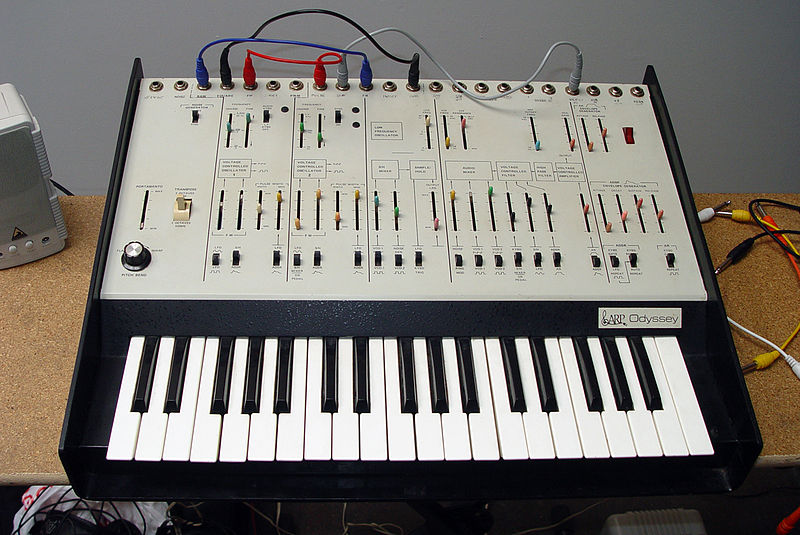
White face ARP Odyssey
Brandon Daniel from Sunnyvale, CA, USA · white ARP odyssey

My setup: ARP Odyssey 2813 with SP-808 and looper.
Chuck Sipperley from Ann Arbor, United States · Flickr
Primary material
Documents and archives
institutional register
- Internet Archive holdings naming ARP Odyssey
Unverified · Internet Archive
reference work
- “ARP Odyssey”, English Wikipedia, consulted as further reading
Reputable secondary · Wikipedia
authority record
- Wikidata, structured authority record Q1638169: ARP Odyssey
Unverified · Wikidata
Notes from the source article
Cited by Wikipedia
Notes from the source article
These works are cited by the source article, in its own numbering. They are recorded as its citations, not as sources VALÉORINE has verified.
- 1.Colbeck, Julian. Keyfax Omnibus Edition. MixBooks. 1996. 0-918371-08-2.
- 2.Vail, Mark. Vintage Synthesizers. Miller Freeman Books. 1993. 0-87930-275-5.
- 3.Reid, Gordon. Korg ARP Odyssey. Sound On Sound. SOS Publications Group.
- 4.arpsynth.com. The resurrection of ARP by Korg. May 2014.
- 5.Arp Odyssey Service Manual. 8.
- 6.ARP Odyssey. Sound On Sound. December 1997.
- 7.Future plc. GForce Software Oddity2 review. Music Radar. 12 February 2015.
- 8.Steele, B. Korg brings the iconic ARP Odyssey synth to iOS. Engaget. Verizon Media Inc.
- 9.Korg. Korg Announces the development of the ARP Odyssey synthesizer.
- 10.Gale, Dave. Review: Behringer Odyssey. MusicTech. BandLab Technologies.
Bibliography printed in the source article · 1
References
Citations
References
Each reference names the institution holding it, so a reader may go to the document itself.
institutional register
Internet Archive holdings naming ARP OdysseyInternet Archive
Partially resolvedreference work
Partially resolvedauthority record
Unverified
The Encyclopedia exists whether or not anything is for sale. Corrections are recorded rather than overwritten, and every version of this record is kept. Published 14 August 2026.
Elsewhere in Collectables
20,755 published records in this field, each with its sources named.
- ArnoldOrganisation
- Arnold Palmer Tournament GolfWork
- ArnoltOrganisation
- Around the World in 80 DaysWork
- ARP String EnsembleTerminology
- arpa jarochaTerminology
- arpeggioneTerminology
- Array mbiraTerminology
Best supported in this field
For owners
Own an object connected with ARP Odyssey?
A specialist will read what you send and tell you what the house can establish, what it cannot, and whether the object is suited to sale. There is no charge and no obligation. The object stays with you throughout; nothing is shipped to us unless it is arranged in writing beforehand.