
Arnold Böcklin
Arnold Böcklin (ˈaʁnɔlt ˈbœklin; 16 October 182716 January 1901) was a Swiss Symbolist painter. His five versions of the Isle of the Dead inspired works by several late Romantic composers.
Also recorded as Arnold Bocklin · A. Böcklin · Arnold Boecklin · a. bocklin
Arnold Böcklin
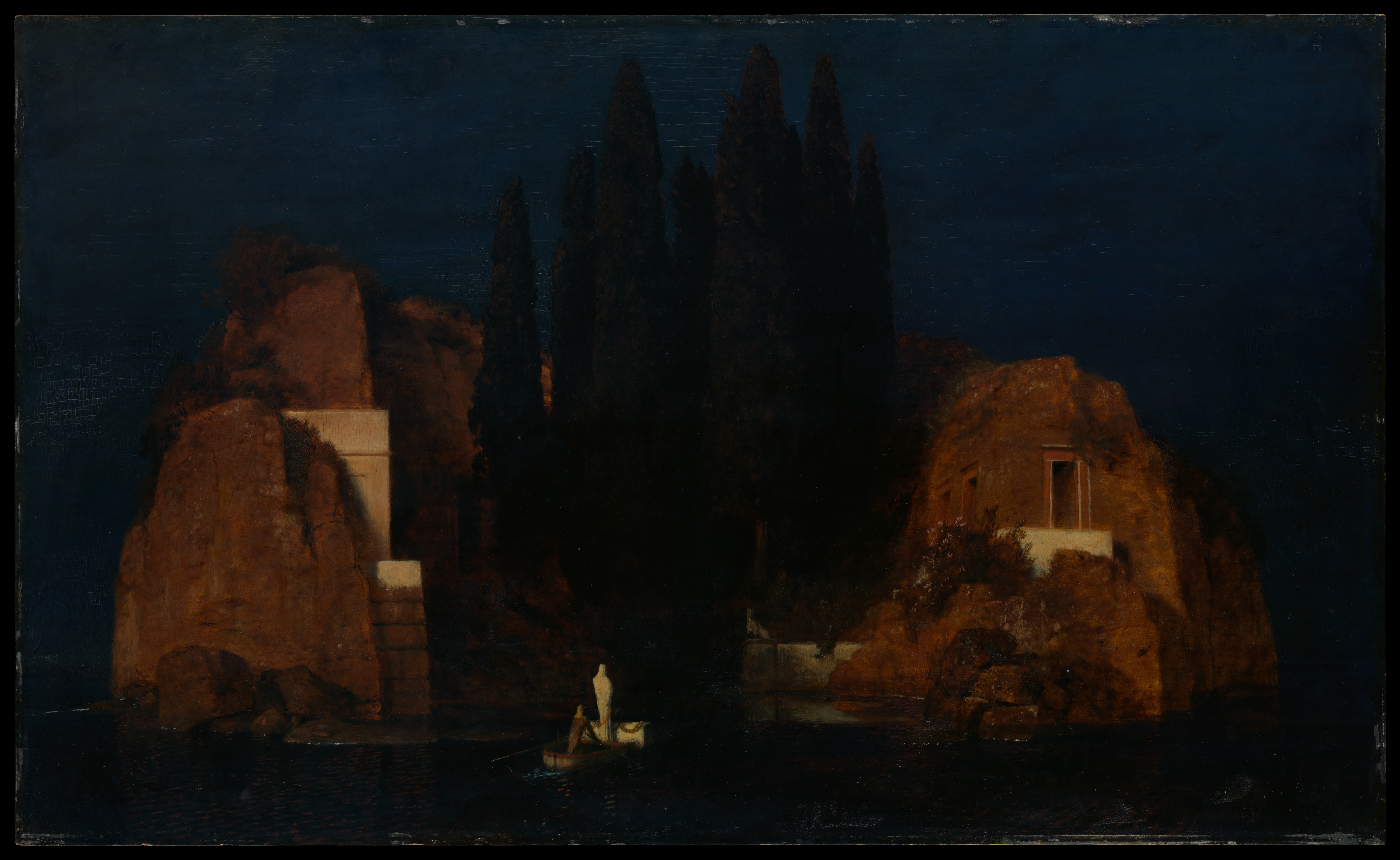
Arnold Böcklin · The Metropolitan Museum of Art, New York · Reisinger Fund, 1926 · Public domain (CC0, Met Open Access)
- Name
- Arnold Böcklin
- Born
- 16 October 1827
- Birthplace
- Basel, Switzerland
- Died
- 16 January 1901
- Place of death
- Fiesole, Italy
- Field
- Painting
- Movement
- Symbolism
- Nationality
- Switzerland
- Occupation
- painter · sculptor · university teacher · draftsperson · designer
- Fields
- history painting · landscape painting · portrait
- Known for
- Faun whistling to a Blackbird · Self-Portrait with Death Playing the Fiddle · Isle of the Dead
VALÉORINE Encyclopedia
VALÉORINE documentary reading
Documentary summary
Arnold Böcklin (ˈaʁnɔlt ˈbœklin; 16 October 182716 January 1901) was a Swiss Symbolist painter. His five versions of the Isle of the Dead inspired works by several late Romantic composers.
Admitted source layer · organised and presented by VALÉORINE
Reference Check
Propose documentary evidence for Arnold Böcklin. A contribution is never written directly as fact: identity, source, rights and evidence gates still decide.
Sign in to contribute
Documentary evidence
Documentary basis
Authority files
gnd · 300127820 · wikidata · Q123071 · wikipedia · Arnold Böcklin
In this article
Key facts
Key facts
• Name — Arnold Böcklin • Born — 16 October 1827 • Birthplace — Basel, Switzerland • Died — 16 January 1901 • Place of death — Fiesole, Italy • Resting Place — Cimitero degli Allori, Florence • Field — Painting • Movement — Symbolism • Works — Isle of the Dead
Biography
Biography
Arnold Böcklin was born in Basel. His father, Christian Frederick Böcklin (b. 1802), was descended from an old family of Schaffhausen, and engaged in the silk trade. His mother, Ursula Lippe, was a native of the same city. Arnold studied at the Düsseldorf academy under Schirmer, and became a friend of Anselm Feuerbach. He is associated with the Düsseldorf school of painting. Schirmer, who recognized in him a student of exceptional promise, sent him to Antwerp and Brussels, where he copied the works of Flemish and Dutch masters. Böcklin then went to Paris, worked at the Louvre, and painted several landscapes. After serving his time in the army, Böcklin set out for Rome in March 1850. The many sights of Rome were a fresh stimulus to his mind. These new influences brought allegorical and mythological figures into his compositions. In 1856 he returned to Munich, and remained there for four years. His first fiancée died young. A second woman declined to marry. In Rome, he married Angela Rosa Lorenza Pascucci in 1853. The couple had fourteen children, but five died in childhood and another three died before Böcklin. He himself nearly succumbed to typhoid in 1859.
Career
Career
• Illustration — Roger Freeing Angelica, 1873 He then exhibited the Great Park, one of his earliest works, in which he treated ancient mythology. Of this period are his Nymph and Satyr, Heroic Landscape (Diana Hunting), both of 1858, and Sappho (1859). These works, which were much discussed, together with Lenbach's recommendation, gained him appointment as professor at the Weimar academy. He held the office for two years, painting the Venus and Love, a Portrait of Lenbach, and a Saint Catherine. He returned to Rome from 1862 to 1866, and there gave his fancy and his taste for violent colour free play in his Portrait of Mme Böcklin, and in An Anchorite in the Wilderness (1863), a Roman Tavern, and Villa on the Seashore (1864). He returned to Basel in 1866 to finish his frescoes in the gallery, and to paint, besides several portraits, The Magdalene with Christ (1868), Anacreon's Muse (1869), and A Castle and Warriors (1871). His Portrait of Myself, with Death playing a violin (1872), was painted after his return again to Munich, where he exhibited Battle of the Centaurs, Landscape with Moorish Horsemen and A Farm (1875). From 1876 to 1885 Böcklin was working at Florence, and painted a Pietà, Ulysses and Calypso, Prometheus, and the Sacred Grove. From 1886 to 1892 he settled at Zürich, after which he resided at San Domenico, near Florence. From this period are the Naiads at Play, A Sea Idyll, and War. • Illustration — Grave of Arnold Böcklin, Cimitero degli Allori, Florence, Italy Böcklin died on 16 January 1901 in Fiesole, Tuscany. He is buried in the Cimitero degli Allori in the southern suburb of Florence, Italy.
Symbolism
Symbolism
• Illustration — Villa by the Sea Influenced by Romanticism, Böcklin's symbolist use of imagery derived from mythology and legend often overlapped with the aesthetic of the Pre-Raphaelites. Many of his paintings are imaginative interpretations of the classical world, or portray mythological subjects in settings involving classical architecture, often allegorically exploring death and mortality in the context of a strange, fantasy world. Böcklin is best known for his five versions (painted 1880 to 1886) of the Isle of the Dead, which partly evokes the English Cemetery, Florence, which was close to his studio and where his baby daughter Maria had been buried. An early version of the painting was commissioned by a Madame Berna, a widow who wanted a painting with a dreamlike atmosphere. Clement Greenberg wrote in 1947 that Böcklin's work "is one of the most consummate expressions of all that is now disliked about the latter half of the nineteenth century."
In music
In music
Böcklin's paintings, especially Isle of the Dead, inspired several late-Romantic composers. • Gustav Mahler's song Des Antonius von Padua Fischpredigt (St. Anthony's Sermon to the Fish) from his Des Knaben Wunderhorn song cycle, which also appears as the Scherzo movement in Mahler's Symphony No. 2 (Mahler) was inspired by Böcklin's 1892 painting, St. Anthony Preaching to the Fish. • Hans Huber's second symphony is entitled Böcklin-Sinfonie / "Sieh es lacht die Au'", Op. 115 (1897) • Andreas Hallén, a Swedish Romantic composer, wrote a symphonic poem Die Toteninsel in 1898. • In 1891, Portuguese pianist José Vianna da Motta composed two pieces on Böcklin's paintings Meeresidylle and Im Spiel der Wellen. • Böcklin's Das Gefilde der Seligen (Elysium) appears on the cover of Felix Weingartner's eponymous tone-poem, Op.21 (1897). • In 1903, Austrian, later American, composer Karl Weigl composed a tone poem for piano "Die Toteninsel". • Sergei Rachmaninoff wrote his symphonic poem Isle of the Dead in 1909. He was also inspired by Böcklin's painting Die Heimkehr ("The Homecoming" or "The Return") when writing his Prelude in B minor, Op. 32, No. 10. • Heinrich Schulz-Beuthen composed a symphonic poem after the Isle of the Dead (1909?) • Felix Woyrsch composed 3 Böcklin Phantasies (Die Toteninsel, Der Eremit, Im Spiel der Wellen), Op. 53 (1910). • In 1913 Max Reger composed a set of Four Tone Poems after Böcklin with the movements "Der geigende Eremit", "Im Spiel der Wellen", "Die Toteninsel", and "Bacchanal". • In Mark Robson's film Isle of the Dead (1945), Disney composer Leigh Harline's somber score makes use of Sergei Rachmaninoff's music. • Fulvio Caldini composed L'isola di Böcklin, his Op.85 for electronic instruments (2001).
Other
Other
The Schriftgiesserei Otto Weisert foundry designed an Art Nouveau typeface in 1904 and named it "Arnold Böcklin" in his honor. Adolf Hitler was fond of Böcklin's work, at one time owning 11 of his paintings. Roger Zelazny's novel Isle of the Dead features a planet-building character inspired by the painting to create an Isle of the Dead on one of his worlds, and an Ace books edition features a cover painting by Dean Ellis that is deliberately reminiscent of Böcklin's work. Yemelyan Yaroslavsky, Academician of the Academy of Sciences of the Soviet Union, opened his 1942 laudatory article on Dmitry Shostakovich's Seventh Symphony with an allusion to Böcklin's painting "War".
Works
Works
• Illustration — Alexander Michelis, 1846 • Illustration — Moonlit Landscape, 1849 • Illustration — Campania Landscape, 1851 • Illustration — Italian Landscape, 1858 • Illustration — The Shepherd's Lament, 1866 • Illustration — Idyll, 1866 • Illustration — Boy and Girl Picking Flowers, c.1866 • Illustration — Self-portrait with Death playing the fiddle, 1872 • Illustration — Venus Anadyomene, 1872 • Illustration — The Muse Euterpe, 1872 • Illustration — Mourning under the Cross, 1876 • Illustration — The Elysian Fields, 1877 • Illustration — Honey Moon, 1878 • Illustration — Ocean Breakers (The Sound), 1879 • Illustration — Summer Day, 1881 • Illustration — Odysseus and Calypso, 1882 • Illustration — Will-o'-the-Wisp, 1882 • Illustration — Playing in the Waves, 1883 • Illustration — The Hermit, 1884 • Illustration — The Sanctuary of Hercules, 1884 • Illustration — Self-portrait with the wine glass, 1885 • Illustration — The Homecoming, 1887 • Illustration — Odysseus and Polyphemus, 1896
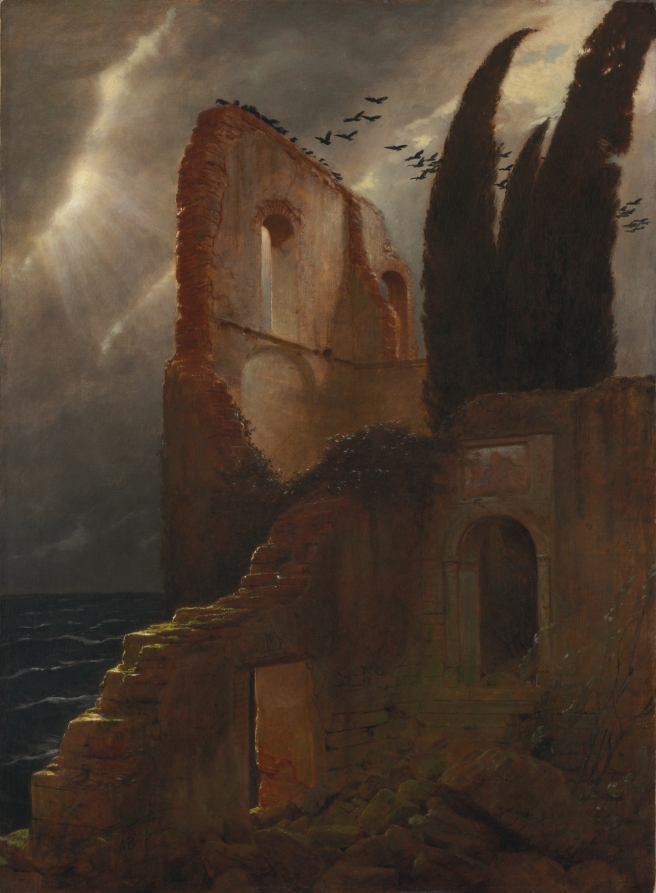
Ruin by the Sea, 1881, by Arnold Böcklin
Arnold Böcklin · The Cleveland Museum of Art · Mr. and Mrs. William H. Marlatt Fund
Life and career
Dated record
Life and career
Explore 1827–1903
The full dated record · 3 entries
1827
Arnold Böcklin was born in 1827.
1901
Arnold Böcklin died at convent of San Domenico.
1903
Arnold Böcklin: Aus den Tagebüchern (1903) is digitised and catalogued by Internet Archive.
Legacy
• Illustration — Isle of the Dead (Die Toteninsel): Third version, 1883. Alte Nationalgalerie, Berlin. • Illustration — The Island of Life (Die Lebensinsel), 1888. Kunstmuseum Basel, Basel. During his lifetime, Böcklin achieved considerable recognition, especially in central Europe, and influenced younger artists such as Hans Thoma. After his death in 1901 his reputation declined rapidly as modern art styles made the literary character of his paintings seem old-fashioned. Despite this, his work was a significant influence on Giorgio de Chirico – who said "Each of Böcklin's works is a shock" – and was admired by Surrealist painters such as Max Ernst and Salvador Dalí. A general revival of interest in Böcklin began only in the 1960s. When asked who was his favorite painter, Marcel Duchamp controversially named Arnold Böcklin as having a major influence on his art. Whether Duchamp was serious in this assertion is still debated. H. R. Giger created a picture called Homage à Böcklin, based upon Isle of the Dead. Museums holding several works by Böcklin include the Kunstmuseum Basel and the Kunsthaus Zürich.
Primary material
Documents and archives
Institutional database
- Wikidata, structured authority record Q123071: Arnold Böcklin
Scholarly · Wikimedia Foundation
authority file
- Gemeinsame Normdatei 300127820, Tondichtungen nach Arnold Böcklin.
General reference · Deutsche Nationalbibliothek
reference work
- “Arnold Böcklin”, English Wikipedia, consulted as further reading
Reputable secondary · Wikipedia
Notes from the source article
Cited by Wikipedia
Notes from the source article
These works are cited by the source article, in its own numbering. They are recorded as its citations, not as sources VALÉORINE has verified.
- 1.This cites: * His life, written by Henri Mendelssohn * F. Hermann, Gazette des Beaux-Arts (Paris, 1893) * Max Lehrs, Arnold Böcklin, Ein Leitfaden sum Verständniss seiner Kunst (Munich, 1897) * W. Ritter, Arnold Böcklin (Gand, 1895) * Katalog der Böcklin Jubiläums Ausstellung (Basel, 1897).
- 2.Arnold Böcklin Biography, Life & Quotes.
- 3.Burroughs, Bryson. "The Island of the Dead by Arnold Böcklin." The Metropolitan Museum of Art Bulletin, Vol. 21, No. 6 (Jun., 1926), pp. 146–148.
- 4.Greenberg, Clement. Nation. 3/22/1947, Vol. 164 Issue 12, p340–342.
- 5.Clegg, Elizabeth (2003). "Böcklin, Arnold". Grove Art Online.
- 6.Holzhey, Magdalena (2005). Giorgio de Chirico, 1888–1978: the Modern Myth. Köln: Taschen. p. 11. .
- 7.Sharp. The essential guide. The Art Institute of Chicago. 234. 2013. 978-0-86559-255-1.
- 8.Rose, Steve. Alien designer HR Giger: 'I am afraid of my visions'. The Guardian. 14 May 2014.
- 9.BBC. Alien monsters: The terrifying visions of HR Giger. BBC Arts. 28 September 2016.
- 10.Jonathan Yungkans: Liner notes to the complete Benno Moiseiwitsch Rachmaninoff recordings 1937–43
- 11.Ates Orga: Liner notes to Demidenko plays Rachmaninov
- 12.Vinocur, John. "The Burlesque, and Rigor, of Arnold Böcklin." New York Times. 12 January 2002.
- 13."...And Call Me Roger"": The Literary Life of Roger Zelazny, Part 2, by Christopher S. Kovacs. In: The Collected Stories of Roger Zelazny, Volume 2: Power & Light, NESFA Press, 2009.
- 14.Великая Отечественная война советского народа против гитлеровской Германии - Ярославский Емельян Михайлович. 1942.
References
Citations
References
Each reference names the institution holding it, so a reader may go to the document itself.
Institutional database
Wikidata, structured authority record Q123071: Arnold BöcklinWikimedia Foundation
Institutional witnessauthority file
Gemeinsame Normdatei 300127820, Tondichtungen nach Arnold Böcklin.Deutsche Nationalbibliothek
Secondary witnessreference work
Secondary witness
Further particulars
Held on the record
Further particulars
Open the remaining particulars
The authorities additionally record the headings Arnold Bocklin, A. Böcklin, Arnold Boecklin, a. bocklin and professor a. bocklin. His recorded languages were German and Italian. His recorded confession was reformed. Böcklin worked in painting. His work is associated with Symbolism. He was employed by Bauhaus-Universität Weimar. He worked at Basel, Weimar, Florence and Düsseldorf. Böcklin received Bavarian Maximilian Order for Science and Art.
Identity and origins
Career and activity
Recognition and collections
Work by Arnold Böcklin is
Belvedere, Städel Museum, Art Institute of Chicago and Thyssen-Bornemisza Museum
The Encyclopedia exists whether or not anything is for sale. Corrections are recorded rather than overwritten, and every version of this record is kept. Published 14 August 2026.
Elsewhere in Sculpture
6,174 published records in this field, each with its sources named.
- Arnau CadellArtist
- Arne DurbanArtist
- Arne Vinje GunnerudArtist
- Arnold BelkinArtist
- Arnold HaukelandArtist
- Arnold LakhovskyArtist
- Arnold MachinArtist
- Arnold ZadikowArtist
Best supported in this field
For owners
Own a work by Arnold Böcklin?
A specialist will read what you send and tell you what the house can establish, what it cannot, and whether the object is suited to sale. There is no charge and no obligation. The object stays with you throughout; nothing is shipped to us unless it is arranged in writing beforehand.