
Anne-Louis Girodet
Anne-Louis Girodet de Roussy-Trioson (an lwi ʒiʁɔdɛ də ʁusi tʁijozɔ̃; or de Roucy), also known as Anne-Louis Girodet-Trioson or simply Girodet (29 January 17679 December 1824), was a French painter and pupil of Jacques-Louis David, who participated in the early Romantic movement by including elements of eroticism in his paintings. Girodet is remembered for his precise and clear style and for his paintings of members of the Napoleonic family.
Also recorded as Anne Louis Girodet-Trioson · Anne-Louis Girodet-Trioson · Anne Louis De Roussy Girodet-Trioson · Anne-Louis Girodet- Trioson
Anne-Louis Girodet
Anne-Louis Girodet · Wellcome Collection, London · Wellcome Collection · Public Domain Mark
- Name
- Anne-Louis Girodet de Roussy-Trioson
- Born
- 29 January 1767
- Birthplace
- Montargis, Orléanais, France
- Died
- 9 December 1824
- Place of death
- Paris, France
- Field
- Painting
- Movement
- Neoclassicism, Romanticism
- Nationality
- France.
- Occupation
- painter, writer, printmaker and illustrator.
- Fields
- history painting, religious painting, mythological painting and portrait.
- Movements
- Neoclassicism and Romanticism.
- Known for
- Anne-Louis Girodet - Pygmalion & Galatée, The Entombment of Atala, Portrait of Hortense de Beauharnais, Queen of Holland and Portrait of Benjamin de Rolland.
VALÉORINE Encyclopedia
VALÉORINE documentary reading
Documentary summary
Anne-Louis Girodet de Roussy-Trioson (an lwi ʒiʁɔdɛ də ʁusi tʁijozɔ̃; or de Roucy), also known as Anne-Louis Girodet-Trioson or simply Girodet (29 January 17679 December 1824), was a French painter and pupil of Jacques-Louis David, who participated in the early Romantic movement by including elements of eroticism in his paintings. Girodet is remembered for his precise and clear style and for his paintings of members of the Napoleonic family.
Admitted source layer · organised and presented by VALÉORINE
Note VALÉORINE
No house-authored Note is published until its assertions and sources pass the VALÉORINE evidence contract. The documentary article remains available in full while that enrichment is being consolidated.
Documentary enrichment in progress · no unsupported statement published
Reference Check
Propose documentary evidence for Anne-Louis Girodet. A contribution is never written directly as fact: identity, source, rights and evidence gates still decide.
Sign in to contribute
Documentary evidence
Evidence Panel
not yet certified
- Identity
- resolved
- Independent source families
- 0
- Admitted assertions
- 0
- Open conflicts
- 0
Authority files
wikidata · Q433434 · wikipedia · Anne-Louis Girodet de Roussy-Trioson
In this article
Key facts
Key facts
• Name — Anne-Louis Girodet de Roussy-Trioson • Birth Name — Anne-Louis Girodet de Roussy-Trioson • Born — 29 January 1767 • Birthplace — Montargis, Orléanais, France • Died — 9 December 1824 • Place of death — Paris, France • Resting Place — Père Lachaise Cemetery • Field — Painting • Movement — Neoclassicism, Romanticism • Works — Ossian receiving the ghosts of the fallen French Heroes, 1801; The Funeral of Atala, 1808; Portrait de Chateaubriand méditant sur les ruines de Rome, after 1808
Early career
Early career
Girodet was born at Montargis. Both of his parents died when he was a young adult. The care of his inheritance and education fell to his guardian, a prominent physician named Benoît-François Trioson, "médecin-de-mesdames", who later adopted him. The two men remained close throughout their lives and Girodet took the surname Trioson in 1812. In school he first studied architecture and pursued a military career. He changed to the study of painting under a teacher named Luquin and then entered the school of Jacques-Louis David. At the age of 22 he successfully competed for the Prix de Rome with a painting of the Story of Joseph and his Brethren. From 1789 to 1793 he lived in Italy and while in Rome he painted his Hippocrate refusant les presents d'Artaxerxes and Endymion-dormant (now in the Louvre), a work which gained him great acclaim at the Salon of 1793 and secured his reputation as a leading painter in the French school. • Illustration — Scene from a Deluge (Une scène de déluge), 1806, Louvre, Paris • Illustration — The Sleep of Endymion (Le Sommeil d'Endymion or Effet de lune), 1791, Louvre Once he returned to France, Girodet painted many portraits, including some of members of the Bonaparte family. In 1806, in competition with the Sabines of David, he exhibited his Scène du déluge (Louvre), which was awarded the decennial prize. In 1808 he produced the Reddition de Vienne and Atala au tombeau, a work which won immense popularity, by its fortunate choice of subject – François-René de Chateaubriand's novel Atala, first published in 1801 – and its remarkable departure from the theatricality of Girodet's usual manner. He would return to his theatrical style in La Révolte du Caire (1810).
Later life
Later life
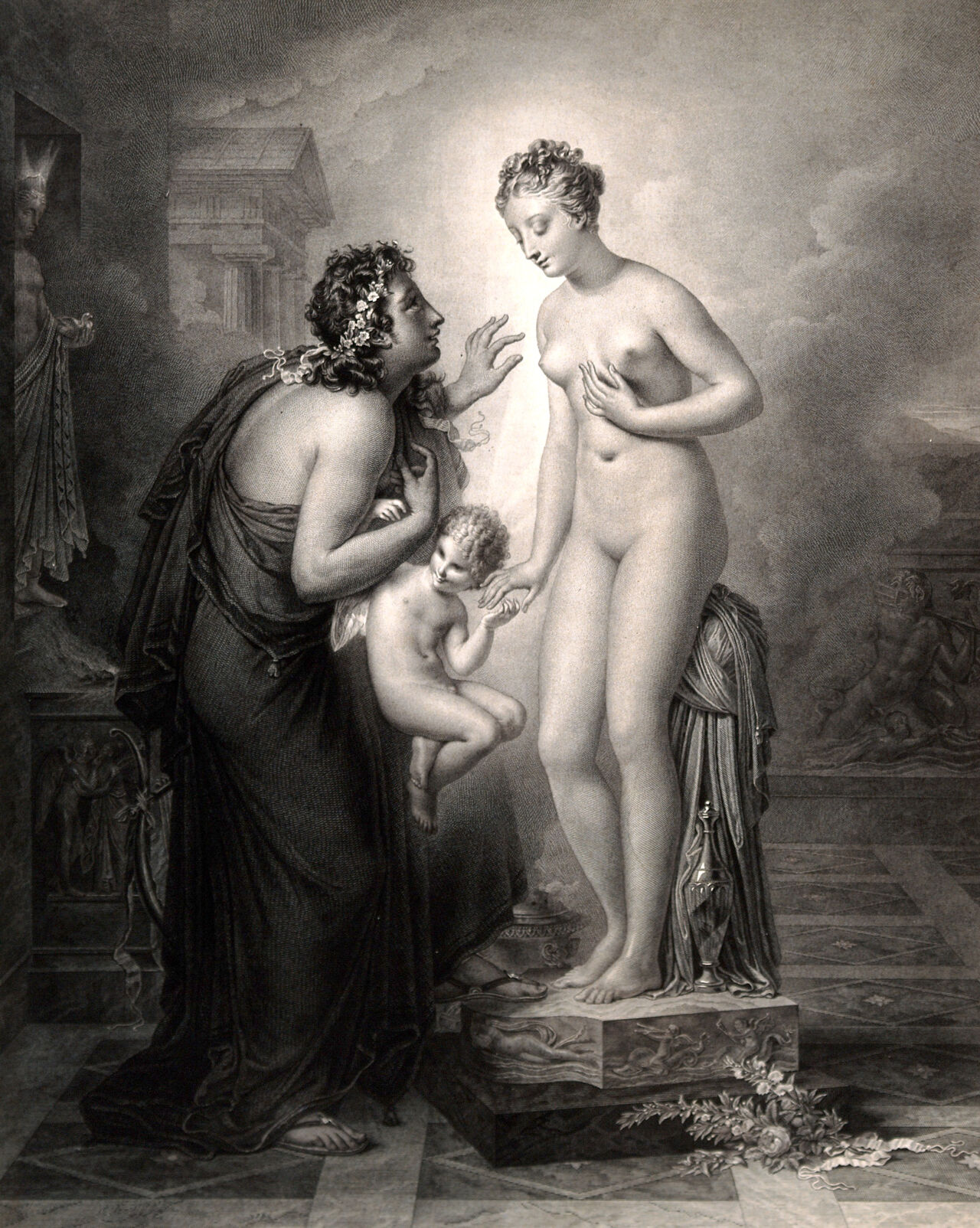
• Illustration — Self-portrait from 1824, Musée des Beaux-Arts d'Orléans • Illustration — The Funeral of Atala (Funérailles d'Atala or Atala au tombeau), 1808, Louvre Girodet was a member of the Academy of Painting and of the Institut de France, a knight of the Order of Saint Michael, and officer of the Legion of Honour. Among his pupils were Hyacinthe Aubry-Lecomte, Augustin Van den Berghe the Younger, François Edouard Bertin, Angélique Bouillet, Alexandre-Marie Colin, Marie Philippe Coupin de la Couperie, Henri Decaisne, Paul-Emile Destouches, Achille Devéria, Eugène Devéria, Savinien Edme Dubourjal, Joseph Ferdinand Lancrenon, Antonin Marie Moine, Jean Jacques François Monanteuil, Henry Bonaventure Monnier, Rosalie Renaudin, Johann Heinrich Richter, François Edme Ricois, Joseph Nicolas Robert-Fleury, and Philippe Jacques Van Brée. In his forties his powers began to fail, and his habit of working at night and other excesses weakened his constitution. In the Salon of 1812 he exhibited only a Tête de Vierge; in 1819 Pygmalion et Galatée showed a further decline of strength. In 1824, the year in which he produced his portraits of Cathelineau and Bonchamps, Girodet died on December 9 in Paris. At a sale of his effects after his death, some of his drawings realised enormous prices. • Illustration — Tomb at Père Lachaise
Analysis of the works
Analysis of the works
Girodet was trained in the neoclassical style of his teacher, Jacques-Louis David, seen in his treatment of the male nude body and his reference to models from the Renaissance and Classical antiquity. However, he also deviated from this style in several ways. The peculiarities which mark Girodet's position as the herald of the romantic movement are already evident in his Sleep of Endymion (1791, also called Effet de lune or "effect of the Moon"). Although the subject matter and pose are inspired by classical precedents, Girodet's diffuse lighting is more theatrical and atmospheric. The androgynous depiction of the sleeping shepherd Endymion is also noteworthy. These early romantic effects were even more notable in his Ossian, exhibited in 1802. Girodet portrayed recently killed Napoleonic soldiers being welcomed into Valhalla by the fictional bard Ossian. The painting is striking for its inclusion of phosphorescent meteors, vaporous luminosity, and spectral protagonists. The same coupling of classic and romantic elements marks Girodet's Danae (1799) and his Quatre Saisons, executed for the king of Spain (repeated for Compiègne), and shows itself to in his Fingal (Leuchtenberg collection, St. Petersburg), executed for Napoleon in 1802. Girodet can be seen here combining aspects of his classical training and traditional education with new literary trends, popular scientific spectacles, and a consummate interest in the strange and the bizarre. In this way his work announces the rise of a romantic aesthetic which prizes individuality, expression, and imagination over an adherence to classical academic precedents.
Gallery
Gallery
• Illustration — Brutus condemns his sons to death (Brutus condamne ses fils à mort), 1785 • Illustration — The Oath of the Horatii (Le Serment des Horaces, copy after David's original), 1786, Toledo Museum of Art, Ohio • Illustration — Coriolanus Taking Leave of His Family, 1786 • Illustration — The Death of Tatius (La mort de Tatius), 1788, Musée des Beaux-Arts d'Angers • Illustration — Joseph Recognised by His Brothers, 1789, École nationale supérieure des Beaux-Arts, Paris • Illustration — Hippocrates Refusing the Gifts of Artaxerxes, 1792, Museum of the History of Medicine • Illustration — Portrait of a Youth (Portrait d'une jeunesse), c. 1795, Smith College Museum of Art, Northampton, Massachusetts • Illustration — Portrait of Giuseppe Fravega (ministre of the Ligurian Republic in Paris), 1796, Musée des beaux-arts de Marseille • Illustration — Benoît-Agnès Trioson regardant des figures dans un livre, 1797, Musée Girodet, Montargis • Illustration — Portrait of Jean-Baptiste Belley, 1797, Palace of Versailles • Illustration — Danaé,1798, Museum der bildenden Künste, Leipzig • Illustration — Portrait of Mlle. Lange as Danae, 1799, Minneapolis Institute of Arts, Minnesota • Illustration — The Meeting of Orestes and Hermione, c. 1800 • Illustration — Benoît-Agnes Trioson, 1800, Louvre, Paris • Illustration — Ossian receiving the Ghosts of the French Heroes, c. 1801, Château de Malmaison • Illustration — Napoleon Bonaparte, Premier Consul, Palais de l'Elysée • Illustration — Portrait of Dominique-Jean Larrey (military surgeon in Napoleon's army), 1804, Louvre • Illustration — Portrait of the Katchef Dahouth, Christian Mameluke, 1804, Art Institute of Chicago • Illustration — Charles Marie Bonaparte (father of Napoléon Bonaparte), 1806 • Illustration — Study for Portrait of an Indian, c. 1807, Metropolitan Museum of Art, New York • Illustration — Madame Erneste Bioche de Misery, 1807, National Gallery of Canada, Ottawa • Illustration — Napoleon Receiving the Keys of Vienna, 1808 • Illustration — Portrait of Chateaubriand, 1809, Musée d'Histoire de la Ville et du Pays Malouin, Saint-Malo • Illustration — Portrait of Hortense de Beauharnais, Queen of Holland, wife of King Louis Napoleon, c. 1809, Rijksmuseum, Amsterdam • Illustration — Sketch for The Revolt of Cairo, c. 1809, Cleveland Museum of Art • Illustration — The Revolt of Cairo, oil and Indian ink on paper, c. 1810, Art Institute of Chicago • Illustration — The Revolt of Cairo, 1810 • Illustration — Portrait of Charles-Louis Balzac, 1811, Dallas Museum of Art • Illustration — Napoleon I in Coronation Robes (Napoléon en costume impérial), c. 1812, Bowes Museum, England • Illustration — Portrait of Prosper de Barante, 1814, Musée d'art Roger-Quilliot, Clermont-Ferrand • Illustration — Allegory of Victory, c. 1815, Château de Compiègne • Illustration — Aurora, c. 1815, Château de Compiègne • Illustration — Minerva between Apollo and Mercury, c. 1815, Château de Compiègne • Illustration — Jacques Cathelineau, généralissime vendéen, 1816, Musée d'art et d'histoire de Cholet • Illustration — Charles-Melchior Arthus, Marquis de Bonchamps, 1816, Musée d'art et d'histoire de Cholet • Illustration — Pygmalion et Galatée, 1819, Château de Dampierre • Illustration — Head of a Woman in a Turban, c. 1820, Hermitage Museum, Saint Petersburg • Illustration — Portrait de Madame Reizet assise, 1820 • Illustration — Portrait of Madame Reiset, 1823, Metropolitan Museum of Art • Illustration — Portrait of Jacques-Joseph de Cathelineau (1787–1832), son of the généralissime • Illustration — Capaneus, Leader of The Seven against Thebes (Tête du Blasphémateur), study for Les sept chefs devant Thèbes, Nationalmuseum, Stockholm • Illustration — Undated portrait of François-René de Chateaubriand • Illustration — Portrait du Docteur Trioson donnant une leçon de géographie à son fils, undated, Musée Girodet, Montargis • Illustration — Portrait of Joachim Murat (?), Hermitage Museum
Work and production
Work and production
Works recorded as notable number 4: Anne-Louis Girodet - Pygmalion & Galatée, The Entombment of Atala, Portrait of Hortense de Beauharnais, Queen of Holland and Portrait of Benjamin de Rolland. His recorded genres are history, religious, mythological and portrait.
Identity
Identity
Anne-Louis Girodet is classed in the genre mythological painting. Recorded with the occupation illustrator. Recorded as painter, writer, printmaker and illustrator.
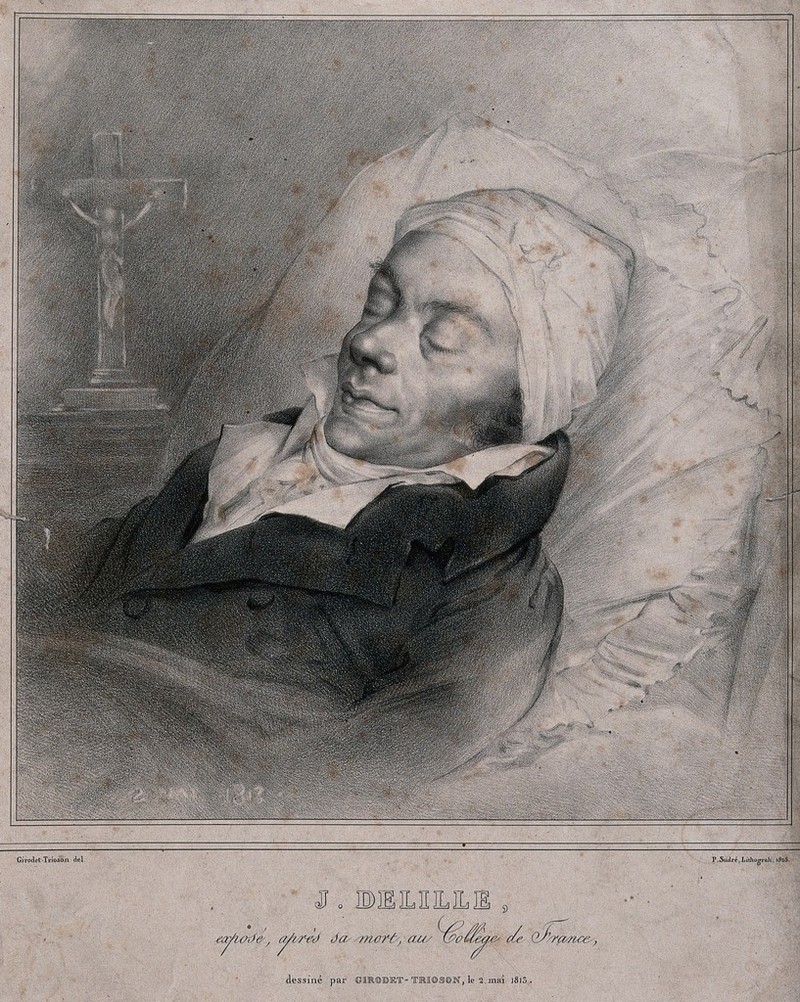
Jacques Delille lying in state in the Collège de France in Paris. Lithograph by Jean Pierre Sudré, 1825, after a drawing by A.L. Girodet de Roucy-Trioson, 1813., 1825, by Anne-Louis Girodet
Anne-Louis Girodet · Wellcome Collection, London · Wellcome Collection
![Hippocrates refusing the gifts of Artaxerxes. Engraving by Raphael Massard, 1816, after A.L. Girodet-Trioson, 1792., [1816], by Anne-Louis Girodet](https://iiif.wellcomecollection.org/image/L0074544/full/800,/0/default.jpg)
Hippocrates refusing the gifts of Artaxerxes. Engraving by Raphael Massard, 1816, after A.L. Girodet-Trioson, 1792., [1816], by Anne-Louis Girodet
Anne-Louis Girodet · Wellcome Collection, London · Wellcome Collection
Life and career
Dated record
Life and career
The full dated record · 2 entries
1767
Anne-Louis Girodet born at Montargis.
1824
Anne-Louis Girodet died at Paris.
Posthumously published work
• Illustration — Bust of the painter (1827) by Jean-Baptiste Roman, Louvre Girodet produced a vast quantity of illustrations, amongst which may be cited those for the Didot editions of the works of Virgil (1798) and Racine (1801–1805). Fifty-four of his designs for the works of the ancient Greek poet Anacreon were engraved by M. Châtillon. Girodet used much of his time on literary composition. His poem Le Peintre (rather a string of commonplaces), together with poor imitations of classical poets, and essays on Le Génie and La Grâce, were published posthumously in 1829, with a biographical notice by his friend Coupin de la Couperie. Delecluze, in his Louis David et son temps, has also a brief life of Girodet. Girodet: Romantic Rebel was the first retrospective in the United States devoted to the works of Anne-Louis Girodet de Roussy-Trioson; the exhibition was initiated by the Cleveland Museum of Art and organised by the Musée du Louvre and the Réunion des Musées Nationaux, Paris, in collaboration with the Art Institute of Chicago, the Metropolitan Museum of Art, New York, and the Montreal Museum of Fine Arts, in cooperation with the Musée Girodet, Montargis. The exhibition assembled more than 100 seminal works (about 60 paintings and 40 drawings) that demonstrated the artist's range as a painter as well as a draftsman. The exhibit was shown at the Art Institute of Chicago (11 February–30 April 2006), Musée du Louvre (22 September 2005–2 January 2006), the Metropolitan Museum of Art (24 May–27 August 2006) and the Montreal Museum of Fine Arts (12 October 2006–21 January 2007).
Primary material
Documents and archives
scholarly publication
- The developing child in three portraits by Anne-Louis Girodet
Scholarly · Crossref registry
reference work
- “Anne-Louis Girodet de Roussy-Trioson”, English Wikipedia, consulted as further reading
Reputable secondary · Wikipedia
authority record
- Wikidata, structured authority record Q433434: Anne-Louis Girodet
Unverified · Wikidata
References
Citations
References
Each reference names the institution holding it, so a reader may go to the document itself.
scholarly publication
The developing child in three portraits by Anne-Louis GirodetCrossref registry
Verifiedreference work
Partially resolvedauthority record
Unverified
People, houses and institutions
Knowledge graph
People, houses and institutions
Teachers, collaborators, publishers and institutions recorded against this person, each on a stated basis.
Died at
1- ParisPlace
Established from a fact already recorded on a verified source.
Further particulars
Held on the record
Further particulars
Open the remaining particulars
Anne-Louis Girodet studied at Académie royale de peinture et de sculpture. He trained under Jacques-Louis David. Each of those relationships is stated by the authority record rather than inferred from style.
His recorded language was French. Girodet worked in painting. His work is associated with Neoclassicism and Romanticism. He was employed by Beaux-Arts de Paris. He belonged to Académie des beaux-arts. He worked at Florence. Girodet received Knight of the Legion of Honour and Prix de Rome. Connected to 2 other published records in the VALÉORINE Encyclopedia.
Identity and origins
Career and activity
Recognition and collections
Work by Anne-Louis Girodet is
Minneapolis Institute of Art, Museo del Prado, Art Institute of Chicago and The Nelson-Atkins Museum of Art
Within the Encyclopedia
The Encyclopedia exists whether or not anything is for sale. Corrections are recorded rather than overwritten, and every version of this record is kept. Published 14 August 2026.
Elsewhere in Illustration
5,224 published records in this field, each with its sources named.
- Anne PätzkeIllustrator
- Anne PrattIllustrator
- Anne RenaudIllustrator
- Anne StokesIllustrator
- Annemarie van HaeringenIllustrator
- Annet SchaapIllustrator
- Annette AllcockIllustrator
- Annette LemieuxIllustrator
Best supported in this field
For owners
Own a work by Anne-Louis Girodet?
A specialist will read what you send and tell you what the house can establish, what it cannot, and whether the object is suited to sale. There is no charge and no obligation. The object stays with you throughout; nothing is shipped to us unless it is arranged in writing beforehand.