
Ann Hamilton
Ann Hamilton (born 1956) is an American visual artist who emerged in the early 1980s, known for her large-scale multimedia installations. After receiving her BFA in textile design from the University of Kansas in 1979, she lived in Banff, Alberta, and Montreal, Quebec, Canada before deciding to pursue an MFA in sculpture at Yale in 1983. From 1985 to 1991, she taught on the faculty of the University of California at Santa Barbara.
Ann Hamilton
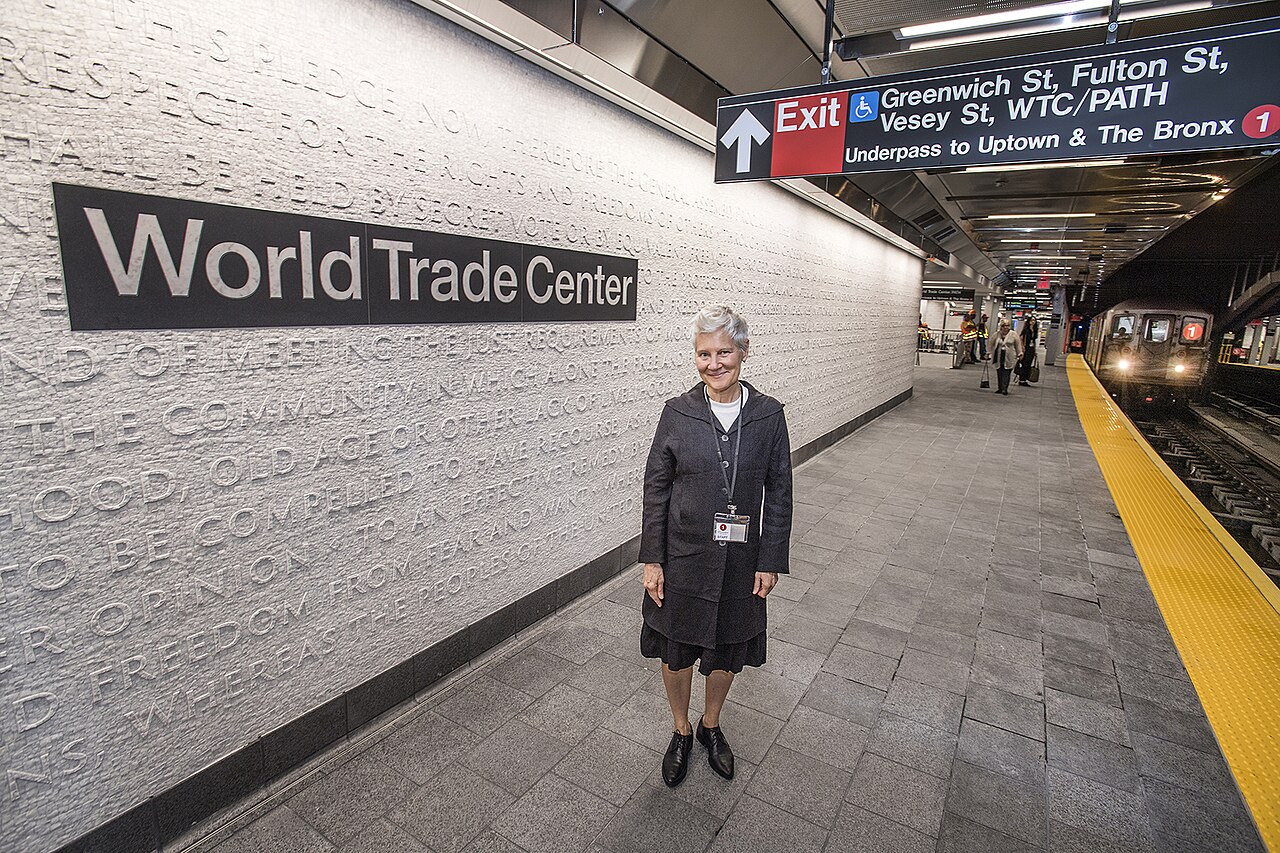
Metropolitan Transportation Authority of the State of New York from United States of America · New WTC Cortlandt 1 Station · CC BY 2.0
- Name
- Ann Hamilton
- Birthplace
- Lima, Ohio, U.S.
- Known for
- * Installation
- Training
- University of Kansas, Lawrence, KSBFA in Textile Design; Yale University, New Haven, CTMFA in Sculpture
- Movement
- Installation art
- Born
- 1956. · Lima.
- Nationality
- United States.
- Fields
- visual arts.
- Education
- Yale University, University of Kansas and St. Lawrence University.
- Honours
- Ohio Women's Hall of Fame, Anonymous Was A Woman Award, MacArthur Fellows Program, National Medal of Arts, Guggenheim Fellowship and Heinz Award.
- Languages
- English.
VALÉORINE Encyclopedia
VALÉORINE documentary reading
Documentary summary
Ann Hamilton (born 1956) is an American visual artist who emerged in the early 1980s, known for her large-scale multimedia installations. After receiving her BFA in textile design from the University of Kansas in 1979, she lived in Banff, Alberta, and Montreal, Quebec, Canada before deciding to pursue an MFA in sculpture at Yale in 1983. From 1985 to 1991, she taught on the faculty of the University of California at Santa Barbara.
Admitted source layer · organised and presented by VALÉORINE
Reference Check
Propose documentary evidence for Ann Hamilton. A contribution is never written directly as fact: identity, source, rights and evidence gates still decide.
Sign in to contribute
World of VALÉORINE
Documentary connections
Only confirmed graph relationships appear here. Images are shown only when their identity and reuse rights both pass the documentary gate.
Educated At · outgoing
St. Lawrence University
Organisation
Citizen Of · outgoing
United States
Place

Educated At · outgoing
University of Kansas
Organisation
self-made in Houston, Texas

Educated At · outgoing
Yale University
Organisation
https://www.flickr.com/photos/paul_lowry/2426552339/in/set-72157604635151268/
Documentary evidence
Documentary basis
Authority files
wikidata · Q4766433
In this article
Biography
Biography
Hamilton worked across photographer, professor, sculptor, printmaker and conceptual artist and 4 further recorded occupations. This article rests on 23 catalogued photographs, 18 published texts, 2 digitised documents and 36 scholarly references drawn from named institutional registers. Every statement below returns to a source shown in the evidence panel; where the record is silent or divided, the article says so instead of resolving it.
Ann Hamilton studied at Yale University, University of Kansas and St. Lawrence University. The recorded working language is English. The field of work recorded is visual arts. Employment is recorded with Ohio State University and University of California, Santa Barbara. Works named in the authority record are CHORUS. Work by Ann Hamilton is recorded in the collections of Minneapolis Institute of Art, Museum of Modern Art, Tate, Whitney Museum of American Art and Art Institute of Chicago. Distinctions recorded are Ohio Women's Hall of Fame, Anonymous Was A Woman Award, MacArthur Fellows Program and National Medal of Arts.
Key facts
Key facts
• Name — Ann Hamilton • Birthplace — Lima, Ohio, U.S. • Known for — * Installation • textiles • sculpture • video • performance • photography • printmaking • Training — University of Kansas, Lawrence, KSBFA in Textile Design; Yale University, New Haven, CTMFA in Sculpture • Movement — Installation art
Personal life
Personal life
Ann Hamilton was born in Lima, Ohio. She attended St. Lawrence University from 1974–1976; University of Kansas, BFA in Textile Design, 1979; Yale School of Art, MFA in Sculpture, 1985. Currently she resides in Columbus, Ohio, with her husband Michael Mercil, also an artist.
Themes and inspiration
Themes and inspiration
• Illustration — Hamilton in 2019 Though Hamilton studied textile design throughout her undergraduate career, she pointedly decided to focus on sculpture instead of weaving as a concentration in graduate school. She claims that, when making that decision, she was “interested in the relationships between things in space. And more important than the things themselves is the way they come into relation.” While in Canada, and while teaching at UC Santa Barbara, Hamilton began creating an interdisciplinary art with textiles "weaved" with photography and performance; often resulting in different elements combined in an image or includes textiles like pressed shirts or work uniforms. In addition to her educational background. She identifies herself as a reader: of space, of objects, of literary criticism, of poetry, and even of dictionaries; thus, the act of reading, words, and books often make their way into her installations, videos, and created objects. Her work also explores themes of humanity, from gender and the body to suffering and power. As a conceptual artist working with video, sound, and interactive installation, the elements of time, change, and decay also play roles in her work. Hamilton's installations are meant to be experienced with all the senses, often incorporating elements like sound and smell that urge the viewer to connect with and engage the work on a multi-sensory level. Her works also often respond to the spaces and cities in which they are created, using objects that reflect the history and identity of the culture.
1984–1990
1984–1990
suitably positioned One of Hamilton's first installations, suitably positioned, 1984, set the tone for her later works, encompassing many of her artistic methods: installation, object-making, photography, and performance. For this piece, she constructed a suit made of a men's thrift-store suit and toothpicks. She then stood, wearing the suit, for the duration of the installation within the studio with viewers walking around the artist without interacting with her. The suit was originally made as a part of a work titled room in search of a position, which, after exhibition, Hamilton believed didn't reach pictorial success and decided to rethink her use of these made objects. However, Hamilton later incorporated the toothpick suit into an installation titled suitably positioned, which finally created a connection between the object, a suit, and the figure, herself within the suit. This installation was directly associated with her body object series. body object series While working on suitably positioned, Hamilton began to think about her subject matter differently, hoping to create an installation that "demonstrates a relation instead of making a picture of a relation." This thinking led Hamilton to begin creating her body object series, a collection of photographs first produced in 1984 with further editions produced in 1987, 1994, and 2006. Working with photographer Bob McMurtry on the series, Hamilton shot photographs of herself wearing constructed objects like her toothpick suit. The coverings of the body in these photographs represent what Hamilton calls, "the articulation of the self at the boundaries of the body." privation and excesses In San Francisco, Hamilton exhibited privation and excesses as a part of the Capp Street Project in 1989. The artist used $7,500 worth of pennies to cover a large portion of the gallery floor stuck to the surface by a thin coating of honey. In a chair on the edge of the field of honey and pennies, a figure (sometimes the artist herself) sat, wringing their hands in a hat full of honey. palimpsest In collaboration with Kathryn Clark, the palimpsest installation was part of a group exhibition at The New Museum of Contemporary Art, New York, "Strange Attractors: Signs of Chaos" in 1989. The installation was organized into two zones, one that demonstrated memory lost and the other memory experienced. The first was in the museum's street-side window-display space, whose back and side walls were covered with block-printed texts, using shoe polish as ink. On a tall stool, under a broken strand of nichrome wire, a felt hat sat upended covered in beeswax and graphite. The second part of the installation was a room that visitors could enter, filled with the scent of beeswax and the sound of paper fluttering. The inner walls of the enclosed space were covered with small pieces of faded newsprint with handwritten memories, each attached with a single tack, constantly rustling from a fan affixed above the doorway. In the center of the room stood a vitrine made of steel and glass, inside which there were two cabbages, reminiscent of cerebral hemispheres, being devoured by a colony of snails.
1991–2000
1991–2000
indigo blue indigo blue, one of Hamilton's best-known works was first exhibited in a garage near the public market in Charleston, South Carolina, in 1991. She created the piece as a commissioned work as a part of the Places with a Past exhibition within the Spoleto Festival, in which artists chose a site and responded to both the historical and current context of the city. The installation was an homage to labor, respectfully commenting on and remembering the process of manual work through sculptural elements like a pile of 47,000 blue work uniforms and sacks full of soybeans hanging on a wall. Behind the stacked uniforms, a writer sat at another table, applying an eraser and saliva to small, blue-covered books, working one by one from back to front to remove the writing within, leaving the eraser shavings to accumulate within the books throughout the duration of the installation. This action of erasing the past served as another memory of labor, and the names embroidered on the shirts echoed the history of the laborers living in the city. The back wall held the hanging bags of soybeans that slowly spilled and began to sprout from the humid air within the space, calling attention to the atmosphere of South Carolina. The title of the exhibition, as well as the incorporation of blue objects, likewise referenced Charleston's history and indigo's economic significance as a plant and dye in the city. The work was later acquired and exhibited by the San Francisco Museum of Modern Art in 2007. tropos In 1993 she performed her piece tropos at Dia Center for the Arts. The Greek word tropos indicates a turn, physically or figuratively. For the art piece, Hamilton covered the entire warehouse floor with varying colored interwoven horse hair. She sat at a small table, located in the middle of the room. While sitting at the table, she studiously burned each word from a book with an electric heated coil. Allegheny Riverfront Park (1993–2001) Between this time period, numerous designers and artists including Ann Hamilton came together to create a new park design for Allegheny Riverfront Park in Pittsburgh, Pennsylvania. This park would include a lower level that would be thirty five feet wide and nearly a mile long, as well as an upper level that would travel along Fort Dusquesne Boulevard. While knowing that the city had traffic, the artists wanted to keep true to the busy city aspect as well as create beauty in nature. They would create a board walk with trees following all the way down, stone edge that would be used as places to sit, overall the artists intended to create a peaceful place with a beautiful view of the city.
2001–2010
2001–2010
the picture is still This video was exhibited in Taura, Japan in 2001. To create the video, Hamilton used a small surveillance camera positioned very near a black-and-white photograph of her son, over which she moved her hand in a continuous, slow motion. Because of the camera's position, the small lens, and the movement of her hand, which she calls "hand-seeing," the image in the video is often abstract and out of focus, a blur of mouths and noses. The artist claims that the movement illustrates that "the picture is still...as in not moving...but also as in 'still here'...the way history haunts and inhabits the present." human carriage The Solomon R. Guggenheim Museum's 2009 exhibition The Third Mind invited various American artists to contemplate and represent the ways in which Asian literature, art, and philosophy are incorporated into, changed by, and transform American cultural trajectories. Hamilton participated in the exhibition, creating an installation entitled human carriage. The artist's installation reflected her interests in humanity, language, text, and physical material and referenced the movement and transmission of cultural information and identity through the use of books and a manual mechanism of travel. The artist tied together cross-sections of book volumes, which she called "book weights," that were stored in piles at the top of the museum. The book weights were then attached to a pulley system "carriage" operated by a "reader" at the top of the museum who manually returned the carriage to the bottom of the rotunda where the bound books accumulated in a pile. Along the building's existing spiral ramps, Hamilton also constructed a spiraling pipe that acted as a travel mechanism for a smaller bell carriage that housed Tibetan cymbals. Prior to each book weight's descent, the "reader" released this bell carriage so that it slid along the pipe, filling the space with ringing as it spiraled through the rotunda before meeting the books at the end of the ramp.
2011–2018
2011–2018
the event of a thread In 2012, Hamilton exhibited her installation the event of a thread at the Park Avenue Armory in New York City. The installation featured a white curtain punctuated by large swings that spanned the 55,000 square feet of space. The installation, like many of Hamilton's works, changed over time, involving the audience in an interconnected, multi-sensory experience of space. For this installation, the artist involved the use of radios in paper bags that were available for viewers to carry around; the audio on these radios was broadcast by two actors from the theater company SITI who read selections of text by various authors at one end of the room. On the other end, a writer sat at a desk, writing sentences. The artwork changed day to day; the murmurs, cell phone rings, and laughs of the viewers, as well as the sounds of reading, writing, and cooing pigeons, while the viewers’ swinging swayed the curtain. The audience was able to interact the space in ways such as: swinging, looking in through a window, lying on the ground, or walking through the exhibition. the common S E N S E Hamilton was commissioned by museum director Sylvia Wolf to create new works for a museum-wide exhibition at the Henry Art Gallery in Seattle called the common S E N S E. Hamilton drew from collections at the Burke Museum of Natural History and Culture and holdings in the University of Washington Libraries Special Collections to create an exhibition about animals, the commonalities we share with animals, and our uses to animals. Cortlandt Street subway station project The New York City Metropolitan Transportation Authority Arts and Design Program commissioned Hamilton to create an art project as a part of the reconstruction of Manhattan's Cortlandt Street subway station that was destroyed on September 11, 2001. This project, to be completed by 2018, is similar to her previous work, VERSE, in that it weaves together words, but in this specific case uses texts from notable historical documents like the Declaration of Independence and the Universal Declaration of Human Rights. The text is white and appears upon or within the surface of the white walls of the station, covering up to 70 percent of the walls' surface. As in much of her work, Hamilton intends this project to be experienced rather than simply viewed. Intended for each person travelling through the station to have a different relationship with these words. O N E E V E R Y O N E Hamilton photographs numerous different people of all different races and ethnicity through a semi-transparent membrane or window. The only time the view could see an image clearly was when the person would touch the membrane. On two opposite sides, Hamilton would instruct the subject to move how she wanted, solely relying on her voice to instruct them. Hamilton feels as if this relates to the medical field in always waiting for answers, check ups, and having a semi blinded sense of what is going on and just relying on a voice, no physical person.
Select exhibitions
Select exhibitions
Hamilton has exhibited around the world, including: • The Museum of Contemporary Art, Los Angeles (1988) • Dia Center for the Arts, New York (1993) • Tate Gallery, Liverpool (1994) • The Museum of Modern Art, New York (1994) • The Art Institute of Chicago (1995) • The Stedelijk Van Abbemuseum, Eindhoven, The Netherlands (1996) • The Musee d'art Contemporain, Lyon, France (1997) • Akira Ikeda Gallery, Taura, Japan (2001) • The Wanas Foundation, Knislinge, Sweden (2002) • The Hirshhorn Museum and Sculpture Garden, Washington D.C. (2003, 1991) • MASS MoCA, North Adams, Massachusetts (2003) • Historiska Museet, Stockholm, Sweden (2004) • La Maison Rouge Fondation de Antoine Galbert, Paris, France (2005) • Contemporary Art Museum, Kumamoto, Japan (2006) • The Guggenheim Museum, New York (2009) • The Pulitzer Arts Foundation, St. Louis (2010) • Spencer Museum of Art, Lawrence, KS (2013) • The Fabric Workshop and Museum, Philadelphia, PA (2016)
Select works
Select works
• the event of a thread (2012) • VERSE (2011) • stylus (2010) • human carriage (2009) • The Meditation Boat (2005–2009) • tower · Oliver Ranch (2007) • voce (2006) • phora (2005) • corpus (2004) • Teardrop Park, a collaboration with Michael Mercil and Michael Van Valkenburgh (2004) • LEW wood floor at the Seattle Public Library (2004) • lignum (2002) • Allegheny Park, a collaboration with Michael Mercil and Michael Van Valkenburgh (1993-2001) • the picture is still (2001) • ghost....a border act (2000) • myein (1999) • mattering (1997) • lineament (1994) • tropos (1994) • indigo blue (1991/2007) • privation and excesses (1989) • still life (1988)
Selected group exhibitions
Selected group exhibitions
• Rites of Spring, Twining Gallery, New York, 1985 • Elements, Whitney Museum of American Art at Philip Morris, New York, 1987 • Stranger Attractors: Signs of Chaos, New Museum of Contemporary Art, New York, 1989 • New Works for New Spaces, Wexner Center for the Visual Arts, Columbus, Ohio, 1990
Permanent public installations
Permanent public installations
• Mess Hall, Headlands Center for the Arts, Sausalito, California, 1989 • San Francisco Public Library Commission (collaboration with James Freed, Kathy Simon, and Ann Chamberlain), 1990 • Pittsburgh River Front Park (collaboration with Michael Van Valkenburgh, Michael Mercil, and Matthew Urbansky), 1994
Recognition
Recognition
• Hamilton has been the recipient of the 14th Annual Heinz Award in the Arts and Humanities, • United States Artists Fellowship, • Bessie Award in 1988, • National Endowment for the Arts Visual Arts Fellowship, • Anonymous Was a Woman Award, • Louis Comfort Tiffany Foundation Award, • Skowhegan Medal for Sculpture, • Guggenheim Memorial Fellowship, • MacArthur Fellows Program "Genius Grant", In 2014, Ohio State University announced that it was compiling an archive called the Ann Hamilton Project Archive, which will maintain images of more than 35 of Hamilton's installations. And in September 2015, Hamilton received the National Medal of Arts.
Identity
Identity
Ann Hamilton is recorded as having received Ohio Women's Hall of Fame, Anonymous Was A Woman Award and MacArthur Fellows Program. Established in Library of Congress under n92121019. Established in RKDartists under 135394. Established in Discogs under 348228. Established in FAST under 314501. Career and activity. Hamilton worked in visual arts. She was employed by Ohio State University and University of California, Santa Barbara. She belonged to American Academy of Arts and Letters.
Life and career
Dated record
Life and career
Explore 1956–2022
The full dated record · 12 entries
1956
Ann Hamilton born at Lima.
1993
Receives MacArthur Fellows Program.
1993
Ann Hamilton received MacArthur Fellows Program in 1993.
1999
Receives Ohio Women's Hall of Fame.
1999
Ann Hamilton received Ohio Women's Hall of Fame in 1999.
2008
Receives Heinz Award.
2008
Ann Hamilton received Heinz Award in 2008.
2011
Receives Anonymous Was A Woman Award.
2011
Ann Hamilton received Anonymous Was A Woman Award in 2011.
2014
Receives National Medal of Arts.
2014
Ann Hamilton received National Medal of Arts in 2014.
2022
KAHNOP • TO TELL A STORY is dated 2022.
Reception
How Ann Hamilton was received and recognised. Hamilton received Anonymous Was A Woman Award in 2011. Hamilton received Ohio Women's Hall of Fame in 1999. Hamilton received MacArthur Fellows Program in 1993. Hamilton received National Medal of Arts in 2014. Hamilton received Guggenheim Fellowship. Hamilton received Heinz Award in 2008.
Where the work is held
Recognition and collections
Ann Hamilton received Ohio Women's Hall of Fame, Anonymous Was A Woman Award, MacArthur Fellows Program, National Medal of Arts, Guggenheim Fellowship and Heinz Award.
Awards
Heinz Award in the Arts and Humanities (2008), United States Artists Fellowship (2007), Environmental Design Research Association Place Design Award (2002), American Society of Landscape Architects Design Award (2002), the Larry Aldrich Foundation Award (1998), Progressive Architecture Citation Award (1997), the Wexner Center for the Arts Residency (1995), NEA Visual Arts Fellowship (1993), MacArthur Fellowship (1993) Skowhegan Medal for Sculpture (1992), the Louis Comfort Tiffany Foundation Award (1990), Award in the Visual Arts 9 (1990), the Guggenheim Memorial Fellowship (1989), and the Bessie Award, New York Annual Award in the Performing Arts (1988).
Notes from the source article
Cited by Wikipedia
Notes from the source article
These works are cited by the source article, in its own numbering. They are recorded as its citations, not as sources VALÉORINE has verified.
- 1.Simon, Joan. Ann Hamilton: Inscribing Place. Art in America. June 1999.
- 2.Ann Hamilton, Distinguished Professor | College of Arts and Sciences
- 3.Ann Hamilton — Making, and the Spaces We Share. On Being.
- 4.St. James Press. Contemporary women artists. 1999. 1-55862-372-8.
- 5."Ohio State art professor Ann Hamilton to get national medal", The Columbus Dispatch, Columbus, OH.
- 6.Simon, Joan. Ann Hamilton: An Inventory of Objects. Gregory R. Miller & Co., LLC. 2006. 0974364851.
- 7.Tate Gallery. Ann Hamilton: Mneme. 10. 1994. 185437138X.
- 8.Dobrzynski, Judith H. Representing America in a Language of Her Own. The New York Times. May 30, 1999.
- 9.ANN HAMILTON: the event of a thread : Program & Events : Park Avenue Armory. Park Avenue Armory.
- 10.Artspace, Incorporated. Artspace. 1989.
- 11.Art Digest Incorporated. Arts Magazine. 1990.
- 12.Simon, Joan. Ann Hamilton. Harry N. Abrams. 2002. 0810941600.
- 13.Bruce, Chris. Ann Hamilton Sao Paulo/Seattle. Henry Art Gallery, University of Washington. 1992.
- 14.Sean Kelly announcement for Spoleto Festival, New York, 1992.
- 15.Ann Hamilton, indigo blue, 1991/2007 · SFMOMA
- 16.Hamilton, Ann. Ann Hamilton : tropos, 1993 : October 7, 1993-June 19, 1994, Dia Center for the Arts. Dia Center for the Arts. 1995. 0944521274.
- 17.Ann Hamilton Studio. www.annhamiltonstudio.com.
- 18.Monica E. McTighe. Framed Spaces: Photography and Memory in Contemporary Installation Art. UPNE. 151–. 2012. 978-1-61168-251-9.
- 19.The Third Mind: American Artists Contemplate Asia, 1860–1989. www.guggenheim.org.
- 20.Guggenheim Museum. The Third Mind: American Artists Contemplate Asia, 1860-1989.
- 21.Joan M. Marter. The Grove Encyclopedia of American Art. Oxford University Press. 1–. 2011. 978-0-19-533579-8.
- 22.Smith, Roberta. The Audience as Art Movement: Ann Hamilton at the Park Avenue Armory. The New York Times. December 6, 2012.
- 23.Phaidon Press. Great women artists. 170. 2019. 978-0714878775.
- 24.Time Stopped—And Then Suddenly Rushed Again Toward Us. The Huffington Post. December 6, 2012.
- 25.Touchy, feely: Ann Hamilton's wondrous exhibition at the Henry. The Seattle Times. 2014-10-23.
- 26.Dunlap, David W. At Cortlandt Street Subway Station, Art Woven from Words. The New York Times. April 29, 2015.
- 27.O N E E V E R Y O N E — About. O N E E V E R Y O N E.
- 28.Hamilton, Ann. Biography.
- 29.Ann Hamilton: the capacity of absorption • MOCA
- 30.Dia | Program | Ann Hamilton: tropos
- 31.‘mneme’, Ann Hamilton, 1994–6 | Tate
- 32.Projects 48: Anne Hamilton | MoMA
- 33.1998 - Musée d'art contemporain de Lyon
- 34.Akira Ikeda Gallery: Ann Hamilton "the picture is still"
- 35.The Wanås Foundation | Independent Collectors. February 18, 2016.
- 36.VERSE – Ohio State University Libraries
- 37."CEN Public Art", Seattle Public Library, Retrieved July 11, 2014.
- 38.Prestel Verlag. After the Revolution: Women Who Transformed Contemporary Art. 163–. 4 November 2013. 978-3-641-10821-2.
- 39.Arts Manitoba Publications. Border Crossings. 2000.
- 40.Hillstrom, Laurie Collier. Contemporary women artists. St. James Press. 1999. 9781558623729.
- 41."The Heinz Awards: Ann Hamilton", The Heinz Awards, Retrieved July 10, 2014.
- 42."Anonymous Was A Woman Award, Past Winners" , Anonymous Was A Woman Award. Retrieved March 5, 2016.
- 43."Ann Hamilton – MacArthur Foundation", MacArthur Foundation, Retrieved July 10, 2014.
- 44."Ann Hamilton Project Archive Created at Ohio State", Ohio State University, Retrieved July 11, 2014.
- 45.National Medal of Arts Awardees Include John Baldessari, Ann Hamilton. artforum.com.
- 46.Hamilton, Ann. The body and the object: Ann Hamilton, 1984–1996. Wexner Center for the Arts, Ohio State University. January 1, 1996. 1-881390-13-6.
- 47.Simon, Joan. Ann Hamilton. Harry N. Abrams, Inc. 280. 2002. 0-8109-4160-0.
- 48.Simon, Joan. Ann Hamilton: An Inventory of Objects. Gregory R. Miller & Co., LLC. 312. 2006. 0-9743648-5-1.
Bibliography printed in the source article · 3
- Hamilton, Ann. The body and the object: Ann Hamilton, 1984–1996. Wexner Center for the Arts, Ohio State University. January 1, 1996. 1-881390-13-6.
- Simon, Joan. Ann Hamilton. Harry N. Abrams, Inc. 280. 2002. 0-8109-4160-0.
- Simon, Joan. Ann Hamilton: An Inventory of Objects. Gregory R. Miller & Co., LLC. 312. 2006. 0-9743648-5-1.
References
Citations
References
Each reference names the institution holding it, so a reader may go to the document itself.
authority record
General reference
People, houses and institutions
Knowledge graph
People, houses and institutions
Teachers, collaborators, publishers and institutions recorded against this person, each on a stated basis.
Studied at
1- Yale UniversityOrganisation
Established from a fact already recorded on a verified source.
The Encyclopedia exists whether or not anything is for sale. Corrections are recorded rather than overwritten, and every version of this record is kept. Published 16 August 2026.
Elsewhere in Prints
4,138 published records in this field, each with its sources named.
- Angus MacLiseEngraver
- Aniello PortioEngraver
- Anita KleinEngraver
- Anker SmithEngraver
- Ann MikolowskiEngraver
- Anna BassEngraver
- Anna FabriEngraver
- Anna Letycia QuadrosEngraver
Best supported in this field
For owners
Own a work by Ann Hamilton?
A specialist will read what you send and tell you what the house can establish, what it cannot, and whether the object is suited to sale. There is no charge and no obligation. The object stays with you throughout; nothing is shipped to us unless it is arranged in writing beforehand.