
André Le Nôtre
André Le Nôtre (French pronunciation: [ɑ̃dʁe lə notʁ]; 12 March 1613 – 15 September 1700), originally rendered as André Le Nostre, was a French landscape architect and the principal gardener of King Louis XIV of France. He was the landscape architect who designed the gardens of the Palace of Versailles; his work represents the height of the French formal garden style, or jardin à la française. Prior to working on Versailles, Le Nôtre collaborated with Louis Le Vau and Charles Le Brun on the park at Vaux-le-Vicomte.
Also recorded as André Nostre · André Le Nostre · André Lenôtre · Andre Nostre
André Le Nôtre
Franck devedjian · CC BY-SA 4.0
- Born
- 1613.
- Died
- 1700.
- Nationality
- France.
- Occupation
- landscape architect, architect, gardener, designer and garden designer.
- Known for
- Gardens of Versailles.
VALÉORINE Encyclopedia
VALÉORINE documentary reading
Documentary summary
André Le Nôtre (French pronunciation: [ɑ̃dʁe lə notʁ]; 12 March 1613 – 15 September 1700), originally rendered as André Le Nostre, was a French landscape architect and the principal gardener of King Louis XIV of France. He was the landscape architect who designed the gardens of the Palace of Versailles; his work represents the height of the French formal garden style, or jardin à la française. Prior to working on Versailles, Le Nôtre collaborated with Louis Le Vau and Charles Le Brun on the park at Vaux-le-Vicomte.
Admitted source layer · organised and presented by VALÉORINE
Note VALÉORINE
André Le Nôtre (1613–1700) was a French architect, designer and garden designer, among other activities. The architect was born and died in Paris.
André Le Nôtre was a member of Académie Royale d'Architecture. The architect was active in castle park and landscape architecture.
Works include Gardens of Versailles. Languages used include French. André Le Nôtre received Order of Saint Lazarus and Order of Saint Michael.
Composed from admitted, traceable facts · 26 September 2026
VALÉORINE
Reference Check
Propose documentary evidence for André Le Nôtre. A contribution is never written directly as fact: identity, source, rights and evidence gates still decide.
Sign in to contribute
Documentary evidence
Documentary basis
Authority files
wikidata · Q273849 · wikipedia · André Le Nôtre
In this article
Early life
Early life
His other works include the design of gardens and parks at Bicton Park Botanical Gardens, Chantilly, Fontainebleau, Saint-Cloud and Saint-Germain. His contribution to planning was also significant: at the Tuileries in Paris he extended the westward vista, which later became the Avenue des Champs-Élysées within the Axe historique.
André Le Nôtre was born in Paris, a family of gardeners. Pierre Le Nôtre, who was in charge of the Tuileries Garden in 1572, may have been his grandfather. André's father Jean Le Nôtre was also responsible for sections of the Tuileries gardens, initially under Claude Mollet, and later as head gardener, during the reign of Louis XIII. André was born on 12 March 1613, and was baptised at the Église Saint-Roch. His godfather at the ceremony was an administrator of the royal gardens, and his godmother was the wife of Claude Mollet. The family lived in a house within the Tuilieries, and André thus grew up surrounded by gardening, and quickly acquired both practical and theoretical knowledge. The location also allowed him to study in the nearby Palais du Louvre, part of which was then used as an academy of the arts. He learned mathematics, painting and architecture, and entered the atelier of Simon Vouet, painter to Louis XIII, where he met and befriended the painter Charles Le Brun. He learned classical art and perspective, and studied for several years under the architect François Mansart, a friend of Le Brun.
Career
Career
In 1635, Le Nôtre was named the principal gardener of the king's brother Gaston, Duke of Orléans. On 26 June 1637, Le Nôtre was appointed head gardener at the Tuileries, taking over his father's position. He had primary responsibility for the areas of the garden closest to the palace, including the orangery built by Simon Bouchard. In 1643 he was appointed "draughtsman of plants and terraces" for Anne of Austria, the queen mother, and from 1645 to 1646 he worked on the modernisation of the gardens of the Palace of Fontainebleau. He was later put in charge of all the royal gardens of France, and in 1657 he was further appointed Controller-General of the Royal Buildings. There are few direct references to Le Nôtre in the royal accounts, and Le Nôtre himself seldom wrote down his ideas or approach to gardening. He expressed himself purely through his gardens. He became a trusted advisor to Louis XIV, and in 1675 he was ennobled by the King. He and Le Brun even accompanied the court at the Siege of Cambrai (1677). In 1640, he married Françoise Langlois. They had three children, although none survived to adulthood.
Vaux-le-Vicomte
Vaux-le-Vicomte
André Le Nôtre's first major garden design was undertaken for Nicolas Fouquet, Louis XIV's Superintendent of Finances. Fouquet began work on the Château de Vaux-le-Vicomte in 1657, employing the architect Louis Le Vau, the painter Charles Le Brun, and Le Nôtre. The three designers worked in partnership, with Le Nôtre laying out a grand, symmetrical arrangement of parterres, pools and gravel walks. Le Vau and Le Nôtre exploited the changing levels across the site, so that the canal is invisible from the house, and employed forced perspective to make the grotto appear closer than it really is. The gardens were complete by 1661, when Fouquet held a grand entertainment for the king. But only three weeks later, on 10 September 1661, Fouquet was arrested for embezzling state funds, and his artists and craftsmen were taken into the king's service.
Versailles
Versailles
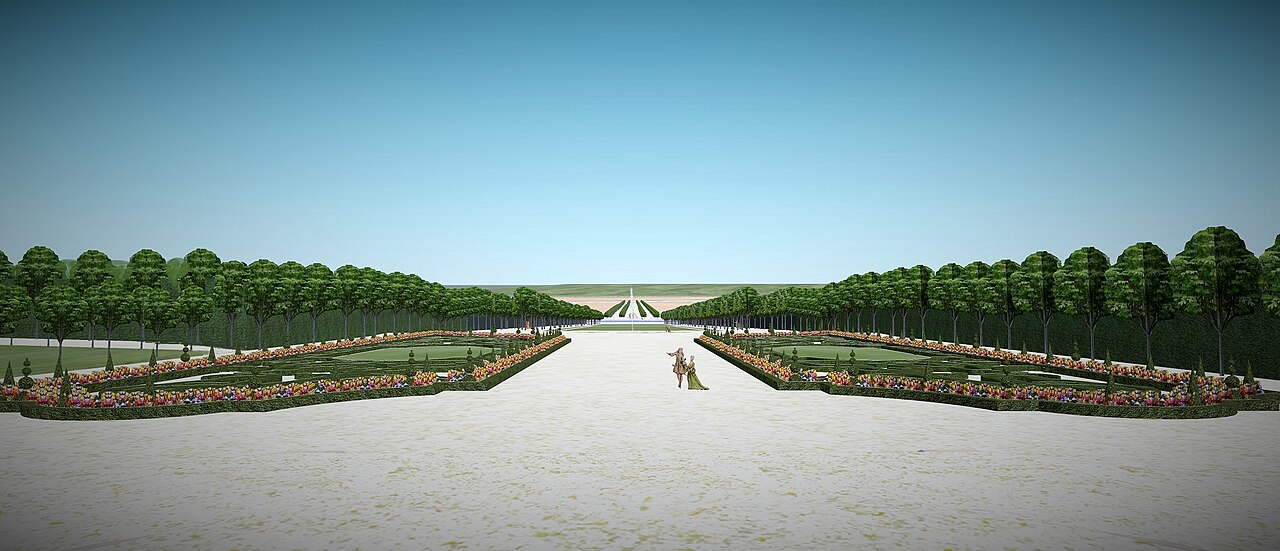
From 1661, Le Nôtre worked for Louis XIV to build and enhance the garden and parks of the Palace of Versailles. Louis extended the existing hunting lodge, eventually making it his primary residence and seat of power. Le Nôtre also laid out the radiating city plan of Versailles, which included the largest avenue yet seen in Europe, the Avenue de Paris. In the following century, the Versailles design influenced Pierre Charles L'Enfant's master plan for Washington, D.C. See, L'Enfant Plan.
France
France
In 1661, Le Nôtre was also working on the gardens at the Palace of Fontainebleau. In 1663 he was engaged at the Château de Saint-Germain-en-Laye, and the Château de Saint-Cloud, residence of Philippe I, Duke of Orléans, where he would oversee works for many years. Also from 1663, Le Nôtre was engaged at the Château de Chantilly, the property of the Prince de Condé, where he worked with his brother-in-law Pierre Desgots until the 1680s. From 1664 he was rebuilding the gardens of the Tuileries, at the behest of Colbert, Louis's chief minister, who still hoped the king would remain in Paris. In 1667 Le Nôtre extended the main axis of the gardens westward, creating the avenue which would become the Champs-Élysées. Colbert commissioned Le Nôtre in 1670, to alter the gardens of his own Château de Sceaux, which was ongoing until 1683.
Abroad
Abroad
Le Nôtre's most impressive design other than Versailles is the gardens of Bicton Park Botanical Gardens in Devon, England which can still be visited today. In 1662, he provided designs for Greenwich Park in London, for Charles II of England. In 1670 Le Nôtre conceived a project for the Castle of Racconigi in Italy, and between 1674 and 1698 he remodelled the gardens of the Palace of Venaria, and the Royal Palace of Turin. In 1679, he visited Italy.
Final works
Final works
Between 1679 and 1682, he was involved in the planning of the gardens of Château de Meudon for François-Michel le Tellier, Marquis de Louvois, and in 1691 redid the garden of the Hôtel de Saint-Aignan in Paris. His work has often been favorably compared and contrasted ("the antithesis") to the œuvre of Capability Brown, the English landscape architect.

Comparaison à la même échelle des perspectives de Villeneuve et de Versailles
Franck devedjian

Coupe du bosquet du Grand Jet à Chantilly, pour expliquer la proportion des jets d'eau
Franck devedjian
Notes from the source article
Cited by Wikipedia
Notes from the source article
These works are cited by the source article, in its own numbering. They are recorded as its citations, not as sources VALÉORINE has verified.
- 1.Hazlehurst 1980, p. viii: The orthography Le Nôtre "is a child of the eighteenth century; the substitution of ô for os was not in widespread use until the fourth decade of the eighteenth century. It was, therefore, a spelling that the great landscape architect would never have recognized as his own." See also Circumflex in French.
- 2.Garrigues, p. 282.
- 3.Jules Guiffrey, p. 3.
- 4.Guiffrey, p. 5.
- 5.Guiffrey, p. 9.
- 6.Guiffrey, p. 18.
- 7.Guiffrey, p. 22.
- 8.Encyclopædia Britannica Inc. André Le Nôtre. Encyclopædia Britannica. 12 March 2012.
- 9.Hazlehurst 1980, pp. 5, 303–323. Pierre Desgots married Le Nôtre's sister Elisabeth, and their son, Claude Desgots, became Le Nôtre's disciple and successor (see Mariage 1999, p. 30).
- 10.Hazlehurst 1996, p. 164.
- 11.Gady 2008, p. 128.
- 12.Encyclopædia Britannica Inc. Lancelot Brown. Encyclopædia Britannica. 2007.
- 13.Château de Chenailles in the Loiret: "It welcomed the Kings of France and its park of 14 hectares was designed by Le Nôtre."
Bibliography printed in the source article · 9
- Gady, Alexandre (2008). Les Hôtels particuliers de Paris du Moyen Âge à la Belle Époque. Paris: Parigramme. .
- Garrigues, Dominique. Jardins et jardiniers de Versailles au Grand Siècle. Editions Champ Vallon. 2001. 2-87673-337-4.
- Guiffrey, Jules. André Le Nostre (1613–1700). Book Guild. 1986. 0-86332-151-8.
- Hazlehurst, F. Hamilton (1980). Gardens of Illusion: The Genius of André Le Nostre. Nashville, Tennessee: Vanderbilt University Press. .
- Hazlehurst, F. Hamilton (1996). "Le Nôtre , André", vol. 19, pp. 162–164, in The Dictionary of Art, edited by Jane Turner. London: Macmillan.
- Mariage, Thierry. The World of André Le Nôtre. University of Pennsylvania Press. xi. 1999. 0-8122-3468-5.
- Thompson, Ian. The Sun King's Garden: Louis XIV, André Le Nôtre And the Creation of the Gardens of Versailles. London: Bloomsbury Publishing, 2006 (hardcover, ).
- Reviewed by Peter Parker in the Telegraph, 1 October 2006.
- Reviewed by John Adamson in the Telegraph, 2006.
References
Citations
References
Each reference names the institution holding it, so a reader may go to the document itself.
reference work
Secondary witnessreference work
Secondary witness
The Encyclopedia exists whether or not anything is for sale. Corrections are recorded rather than overwritten, and every version of this record is kept. Published 14 August 2026.
Elsewhere in Modern design
3,254 published records in this field, each with its sources named.
- Ana PenyasDesigner
- Anastasiya NemolyaevaDesigner
- Anatole LapineDesigner
- André HellerDesigner
- André LurçatDesigner
- André MareDesigner
- Andrea BoscoliDesigner
- Andrea BranziDesigner
Best supported in this field
For owners
Own a work by André Le Nôtre?
A specialist will read what you send and tell you what the house can establish, what it cannot, and whether the object is suited to sale. There is no charge and no obligation. The object stays with you throughout; nothing is shipped to us unless it is arranged in writing beforehand.