
ambon
The ambon or ambo (meaning "pulpit"; Slavonic: amvón) in its modern usage is a projection coming out from the soleas (the walkway in front of the iconostasis) in an Eastern Orthodox, Oriental Orthodox and Eastern Catholic church. The ambon stands directly in front of the Holy Doors. It may be either rounded or square and has one, two, or three steps leading up to it. • Illustration — An iconostasis with a rounded stone ambon of two steps (Beloiannisz, Hungary).
Also recorded as ambo
ambon
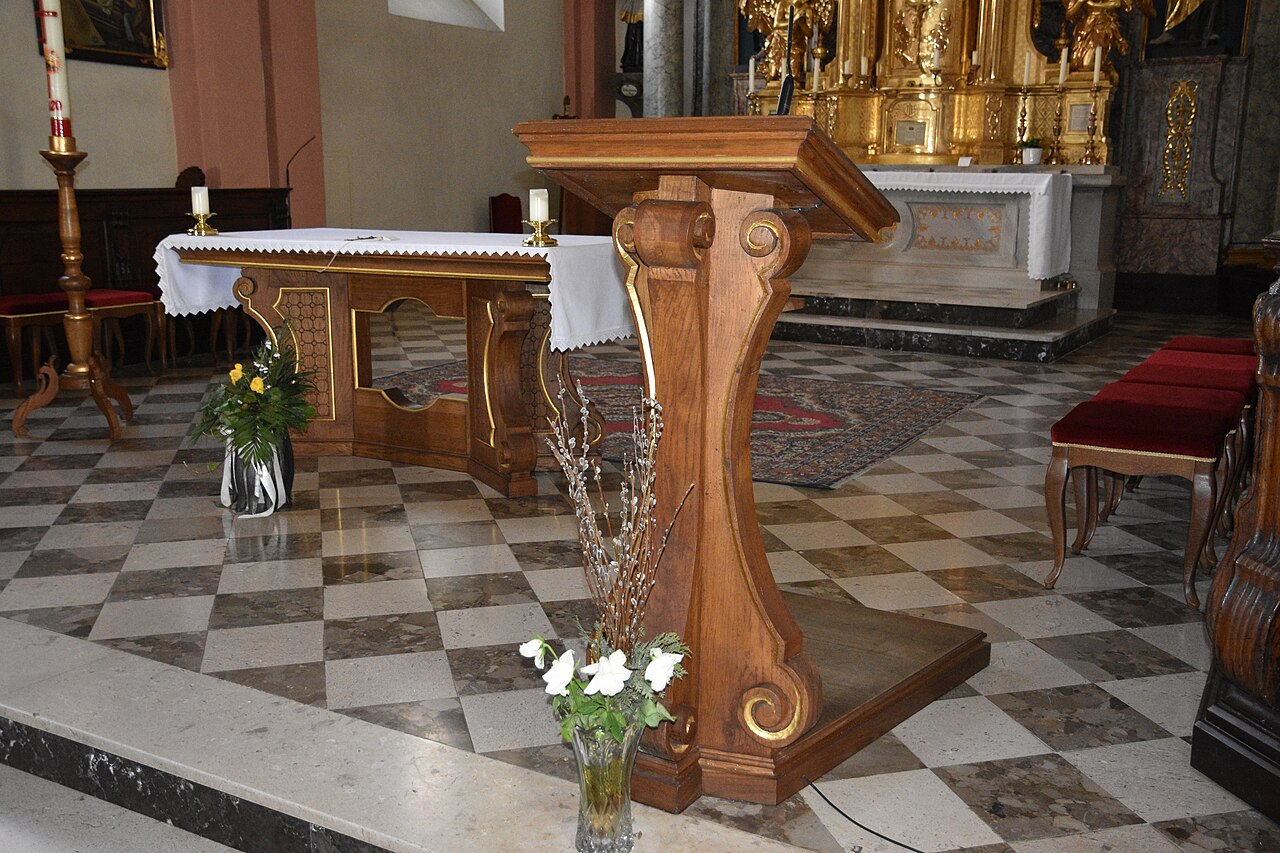
Nxr-at · CC BY-SA 4.0
- Field
- liturgical furniture · pulpit
Reference Check
Propose documentary evidence for ambon. A contribution is never written directly as fact: identity, source, rights and evidence gates still decide.
Sign in to contribute
World of VALÉORINE
Documentary connections
Only confirmed graph relationships appear here. Images are shown only when their identity and reuse rights both pass the documentary gate.


Documentary evidence
Documentary basis
Authority files
gnd · 4079745-4 · wikidata · Q221326
In this article
History
History
Originally the ambon was an elevated platform, somewhat variable in location within the church (but typically found toward the center of the nave, or somewhat forward from there), where the scriptures were read during the Divine Liturgy. It is still so used for celebrations of the Liturgy of St James. It is a development from the bimah in the Jewish synagogue. In the Russian Orthodox Church, during Hierarchical services, the bishop will stand upon a raised platform (kafedra) in the center of the nave like the bimah of old. Originally used in both the East and West, the structure has almost disappeared in the Western Rites. In early Western churches the ambon was known also as the gradus, lectorium, or lectricium, and from it have developed the lectern and the pulpit. It took the form of a raised stand, approached by steps, for preaching and often for readings. In the West, there were often two ambons, one on the north (for the reading or chanting of the Gospel) and one on the south (for the Epistle) side of the choir or presbytery. Remnants of the ambo may be found at the Basilica of St Clement in Rome and in St Mark's Basilica in Venice. In the Roman Catholic Church the stand from which the Gospel is read is formally called the "ambo" (not "ambon"). It is normally in the form of a lectern or pulpit, and located near the front of the chancel.
Usage
Usage
• Illustration — Ancient ambon outside Hagia Sophia in Constantinople (Istanbul, Turkey) The ambon is the platform from which the deacon reads the Gospel and says the litanies, and the priest gives the dismissal during the Divine Services. The ambon is considered to be a part of the altar (i.e., the sanctuary), so normally only the clergy will go up onto the ambon. The exception is that the faithful will step up onto the ambon when they come forward to receive Holy Communion. During the Rite of the Churching of Women, the newborn infant is taken by the priest up onto the ambon (provided the child has been baptized by this time—otherwise, this ceremony will wait until after the baptism). If the child is female, the priest lays her in front of the icon of the Theotokos; if it is a male, the priest takes the child around the Holy Table (altar). In some Greek Orthodox parishes, there is an ambo to the side (usually the Liturgical North, opposite the Bishop's throne) of the Iconostasis. It retains only a few of the functions of the ancient ambo, whereas the solea retains the other functions. The Epistle and Homily are read from this ambon (similar to a western pulpit), whereas the Gospel is read from the Solea. The practice of vesting the Bishop in the center of the nave is retained in parishes without chairs or pews. If the parish has chairs and pews, then the vesting of the Bishop occurs near the iconostasis, sometimes on the solea/ambon itself. The last public prayer of the Divine Liturgy is the "Prayer Before the Ambon" (Greek: euche opisthambonos), originally a prayer of thanksgiving said as the clergy descended the ambon at the end of the service. In ancient times, there was a large collection of Prayers Before the Ambon, written for the different Feast Days of the church year and for those occasional services (Weddings, Funerals, etc.) that called for a celebration of the Divine Liturgy. In some Orthodox Churches this more extensive collection of prayers is used. • Illustration — Contemporary Greek Ambon, which is similar to the Western pulpit, and retains only some of the functions of the ancient ambon (Volos, Greece).
Text attribution
Licensing
Text attribution
Part of the biographical narrative on this page reuses licensed material. Its origin, revision and licence are recorded here.
The biographical narrative on this page is based on the Wikipedia article Ambon (liturgy), revision 1359493642 (EN edition), by its contributors. VALÉORINE has edited that text and built its own documentary record around it. The reused material is available under CC BY-SA 4.0, and this page's reuse of it is offered under the same licence. Everything else on this page — the chronology, the holdings, the evidence, the plates and the connections — is VALÉORINE's own record. Sources and licences.
Notes from the source article
Cited by Wikipedia
Notes from the source article
These works are cited by the source article, in its own numbering. They are recorded as its citations, not as sources VALÉORINE has verified.
References
Citations
References
Each reference names the institution holding it, so a reader may go to the document itself.
authority record
General reference
Connections
Knowledge graph
Connections
Each connection was recorded deliberately, with the basis for it kept on the internal record.
Broader subject
1- pulpitTerminology
Established from a fact already recorded on a verified source.
The Encyclopedia exists whether or not anything is for sale. Corrections are recorded rather than overwritten, and every version of this record is kept. Published 14 August 2026.
Elsewhere in Furniture
924 published records in this field, each with its sources named.
- altazimuth mountTerminology
- Altıkulaç SarcophagusTerminology
- Amathus sarcophagusTerminology
- Amazon LockerTerminology
- Ambon of Henry IITerminology
- ambryTerminology
- Ancient Egyptian coffinTerminology
- ancient furnitureTerminology
Best supported in this field
For owners
Own an object connected with ambon?
A specialist will read what you send and tell you what the house can establish, what it cannot, and whether the object is suited to sale. There is no charge and no obligation. The object stays with you throughout; nothing is shipped to us unless it is arranged in writing beforehand.