
Ahiram sarcophage
The Ahiram sarcophagus (also spelled Ahirom; Phoenician: Phnx) was the sarcophagus of a Phoenician King of Byblos (c. 1000 BC), discovered in 1923 by the French excavator Pierre Montet in tomb V of the royal necropolis of Byblos. The sarcophagus is famed for its bas relief carvings, and its Phoenician inscription.
Ahiram sarcophage
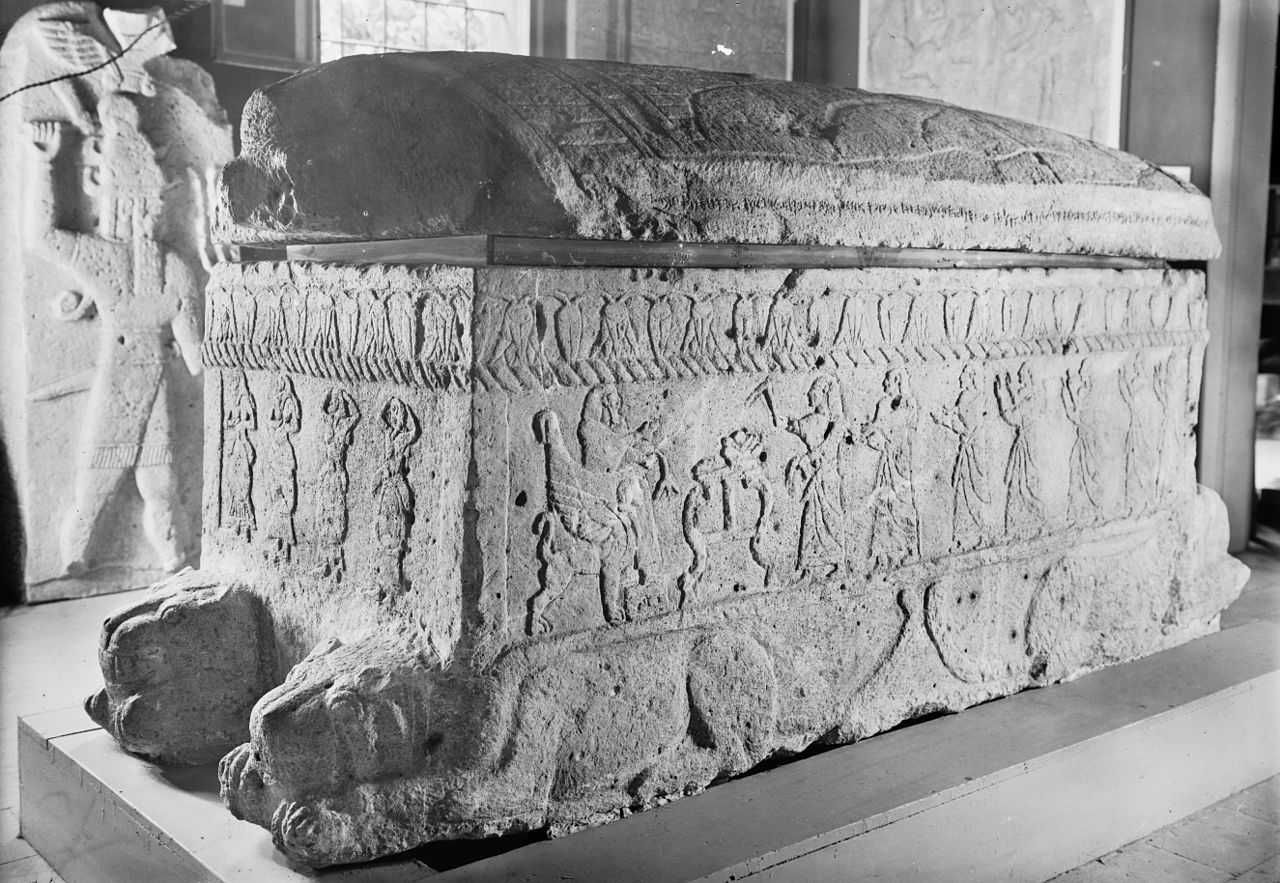
Matson Photo Service, photographer, published in 1936 · This image is available from the United States Library of Congress 's Prints and Photographs division under the digital ID matpc.03491. This tag does not indicate the copyright status of the attached · Public domain
- Name
- Ahiram sarcophagus
- Region
- Ahiram sarcophage is situated in Lebanon.
- Related practice
- limestone.
VALÉORINE Encyclopedia
VALÉORINE documentary reading
Documentary summary
The Ahiram sarcophagus (also spelled Ahirom; Phoenician: Phnx) was the sarcophagus of a Phoenician King of Byblos (c. 1000 BC), discovered in 1923 by the French excavator Pierre Montet in tomb V of the royal necropolis of Byblos. The sarcophagus is famed for its bas relief carvings, and its Phoenician inscription.
Admitted source layer · organised and presented by VALÉORINE
Reference Check
Propose documentary evidence for Ahiram sarcophage. A contribution is never written directly as fact: identity, source, rights and evidence gates still decide.
Sign in to contribute
Documentary evidence
Documentary basis
Authority files
wikidata · Q1972397
In this article
Overview
Overview
One of five known Byblian royal inscriptions, the inscription is considered to be the earliest known example of the fully developed Phoenician alphabet. The Phoenician alphabet is believed to be the parent alphabet for a wide number of the world's current writing systems; including the Greek, Latin and Cyrillic Alphabets, and the Hebrew, Arabic and Urdu Abjads. For some scholars it represents the terminus post quem of the transmission of the alphabet to Europe. Ahirom is not attested in any other Ancient Oriental source.
Key facts
Key facts
• Name — Ahiram sarcophagus • Material — Limestone • Writing — Phoenician language • Created — c. 1000 BC • Discovered — 1923 • Location — National Museum of Beirut • Id — KAI 1
Discovery
Discovery
• Illustration — The Ahiram sarcophagus as it was found The sarcophagus was found following a landslide in the cliffs surrounding Byblos (in now modern-day Lebanon) in late 1923, which revealed a number of Phoenician royal tombs. The tomb of Ahirom was ten metres deep.
Sarcophagus
Sarcophagus
The sarcophagus of Ahiram was discovered by the French archaeologist Pierre Montet in 1923 in Byblos. Its low relief carved panels make it "the major artistic document for the Early Iron Age" in Phoenicia. Associated items dating to the Late Bronze Age either support an early dating, in the 13th century BC or attest the reuse of an early shaft tomb in the 11th century BC. The major scene represents a king seated on a throne carved with winged sphinxes. A priestess offers him a lotus flower. On the lid two male figures face one another with seated lions between them. These figures have been interpreted by Glenn Markoe as representing the father and son of the inscription. The rendering of figures and the design of the throne and a table show strong Assyrian influences. A total absence of Egyptian objects of the 20th and 21st dynasties in Phoenicia contrasts sharply with the resumption of Phoenician-Egyptian ties in the 22nd Dynasty of Egypt.
Dating
Dating
The date remains the subject of controversy, according to Glenn E. Markoe, "The Emergence of Phoenician Art". The Ahiram inscription is generally dated to ca. 1000 BCE, as Edward M. Cook notes: "Most scholars have taken the Ahiram inscription to date from around 1000 B.C.E.". Cook analyses and dismisses the date in the thirteenth century adopted by C. Garbini, which was the prime source for early dating urged in Bernal, Cadmean Letters. Also, traces of an erased early Proto-Byblian inscription are visible on the monument. Others, on the basis of objects found near the sarcophagus, think of a later date, around 850 BCE. Arguments for a date in the mid-9th to 8th century BC for the sarcophagus reliefs themselvesand hence the inscription, toowere made on the basis of comparative art history and archaeology by Edith Porada, and on the basis of paleography among other points by Ronald Wallenfels.
Inscriptions
Inscriptions
An inscription of 38 words is found on parts of the rim and the lid of the sarcophagus. It is written in the Old Phoenician dialect of Byblos and is the oldest witness to the Phoenician alphabet of considerable length discovered to date: • Text — Transliteration — Translation • (text on head side) — Phnx — ʾrn 𐤟 z pʿl 𐤟 [pl]s (?) bʿl (or [ʾ]t (?) bʿl) 𐤟 bn ʾḥrm 𐤟 mlk gbl 𐤟 — This coffin [Pil]sibaʿal (or: [I]ttobaʿal) has made, the son of Aḥirom (Aḥiram), King of Byblos, • Phnx — lʾḥrm 𐤟 ʾbh 𐤟 k šth (?) 𐤟 bʿlm 𐤟 — for Aḥirom, his father, as he laid him down for eternity. • (text along the side of the lid) — Phnx — wʾl 𐤟 mlk 𐤟 bmlkm 𐤟 — And when(?) a king among the kings (any king) • Phnx — wskn 𐤟 bs nm 𐤟 — or a governor among the governors (any governor) • Phnx — wtmʾ 𐤟 mḥnt 𐤟 ʿly 𐤟 gbl 𐤟 — or a commander of the army [will rule] over Byblos (or: [marches] against Byblos), • Phnx — wygl 𐤟 ʾrn 𐤟 zn 𐤟 — and would remove (or: disclose) this coffin, • Phnx — tḥtsp 𐤟 ḥṭr 𐤟 mšpṭh 𐤟 — then his imperial scepter shall break (lit.: the staff of his legal power shall be defoliated), • Phnx — thtpk 𐤟 ksʾ 𐤟 mlkh 𐤟 — the throne of his kingship (his royal throne) shall overturn, • Phnx — wnḥt 𐤟 tbrḥ 𐤟 ʿl 𐤟 gbl 𐤟 — and peace shall depart from Byblos. • Phnx — whʾ 𐤟 ymḥ spr z 𐤟 — And as to him, [if] he shall erase this inscription, • Phnx — lpp (?) 𐤟 š (?) bl 𐤟 — torn(??) shall be [his] royal robe(??). (The meaning of the last two words LPP and ŠBL is not well known and has to be guessed at; but it is clear that a curse is meant.) The formulas of the inscription were immediately recognised as literary in nature, and the assured cutting of the archaic letters suggested to Charles Torrey a form of writing already in common use. A 10th-century BC date for the inscription has become widely accepted. Halfway down the burial shaft another short inscription was found incised at the southern wall, the Byblos Necropolis graffito. The three-line graffito reads: • (1) ld‘t 𐤟 (2) hn yp? d lk 𐤟 (3) tḥt zn It is usually interpreted as a warning not to proceed further: • (1) Know: (2) here is disaster(?) for you (3) below this. Recently it has been proposed that it is part of some initiation ritual which remains unknown in detail: Concerning knowledge: here and now be humble (you yourself!) ‹in› this basement!"
King Ahiram
King Ahiram
Ahiram himself is not titled a king, neither of Byblos nor of any other city state. It is said that he was succeeded by his son Ithobaal I who is the first to be explicitly entitled King of Byblos, which is due to an old misreading of a text lacuna. According to a new reconstruction of the lacuna the name of Ahiram's son is to be read [Pil]sibaal, and the reading Ithobaal should be disregarded. The early king list of Byblos is again subject to further study.
Heritage designation
Heritage designation
The sarcophagus is on public display in the National Museum of Beirut. The General Directorate of Antiquities of Lebanon assembled a list of inscribed objects from different time periods that together illustrate the evolution of the Phoenician alphabet; the sarcophagus is the oldest of these. This list was the basis of a nomination of the alphabet to the Memory of the World International Register maintained by UNESCO. This was accepted in 2005, recognising the objects as documentary heritage of global importance.
Places
Named by the record
Places
Only places the record itself states, plotted where the house gazetteer settles their coordinates. Nothing is inferred from a name or a nationality.
Ahiram sarcophage is situated in Lebanon.
Country
Ahiram sarcophage is associated with Lebanon.
Country
Literature
• Pierre Montet: Byblos et l'Egypte, Quatre Campagnes des Fouilles 1921–1924, Paris 1928, pp. 228–238, tables CXXVII–CXLI • Ellen Rehm: Der Ahiram-Sarkophag, Mainz 2004 (Forschungen zur phönizisch-punischen und zyprischen Plastik II.1.1; Dynastensarkophage mit szenischen Reliefs aus Byblos und Zypern 1.1) • Reinhard G. Lehmann: Die Inschrift(en) des Ahirom-Sarkophags und die Schachtinschrift des Grabes V in Jbeil (Byblos), Mainz 2005 (Forschungen zur phönizisch-punischen und zyprischen Plastik II.1. Dynastensarkophage mit szenischen Reliefs aus Byblos und Zypern 1.2) • Jean-Pierre Thiollet: Je m'appelle Byblos. Paris 2005. • Michael Browning "Scholar updates translation of ancient inscription", in: The Palm Beach Post, Sunday, July 3, 2005, p. 17A. • Reinhard G. Lehmann: Wer war Aḥīrōms Sohn (KAI 1:1)? Eine kalligraphisch-prosopographische Annäherung an eine epigraphisch offene Frage, in: V. Golinets, H. Jenni, H.-P. Mathys und S. Sarasin (Hg.), Neue Beiträge zur Semitistik. Fünftes Treffen der ArbeitsgemeinschaftSemitistik in der Deutschen MorgenländischenGesellschaft vom 15.–17. Februar 2012 an der Universität Basel (AOAT 425), Münster: Ugarit-Verlag 2015, pp. 163–180
Notes from the source article
Cited by Wikipedia
Notes from the source article
These works are cited by the source article, in its own numbering. They are recorded as its citations, not as sources VALÉORINE has verified.
- 1.Cook, p1
- 2.René Cagnat, Nouvelles Archéologiques, Syria 4 (1923): 334–344
- 3.Pierre Montet, "Les fouilles de Byblos en 1923," L’Illustration 3 (May 3, 1924), 402–405.
- 4.Calligraphy and Craftsmanship in the Ahirom inscription. Considerations on skilled linear flat writing in early first millennium Byblos, Reinhard G. Lehmann
- 5.Torrey, Charles C. The Ahiram Inscription of Byblos. Journal of the American Oriental Society. Journal of the American Oriental Society, Vol. 45. 45. 269–279. 1925. 10.2307/593505.
- 6.Moscati, Sabatino. The Phoenicians. Tauris. 2001. 1850435332.
- 7.Markoe, Glenn E. The Emergence of Phoenician Art. Bulletin of the American Schools of Oriental Research. 279. 13–26. 1990. 10.2307/1357205.
- 8.J. Leclant, "Les relations entre l'Égypte et la Phénicie du voyage de Ounamon à l'expédition d'Alexandre", in The role of the Phoenicians in the Interaction of Mediterranean Civilisations, W. Ward, ed. (Beirut: American University) 1968:11.
- 9.For a recent discussion under aspects of aert history, see Ellen Rehm: Der Ahiram-Sarkophag, Mainz 2004 (Forschungen zur phönizisch-punischen und zyprischen Plastik, hg. von Renate Bol, II.1. Dynastensarkophage mit szenischen Reliefs aus Byblos und Zypern Teil 1.1)
- 10.Bulletin of the American Schools of Oriental Research No. 279 (August 1990):13–26) p. 13.
- 11."On the Linguistic Dating of the Phoenician Ahiram Inscription (KAI 1)", Journal of Near Eastern Studies 53.1 (January 1994:33–36) p. 33 JSTOR.
- 12.C. Garbini, "Sulla datazione della'inscrizione di Ahiram", Annali (Istituto Universitario Orientale, Naples) 37 (1977:81–89)
- 13.Bernal, Martin. Cadmean Letters: The Transmission of the Alphabet to the Aegean and further West before 1400 BC. Eisenbrauns. 1990. 0931464471.
- 14.Martin, Malachi. A Preliminary Report after Re-Examination of the Byblian Inscriptions. Orientalia (Nova Series). 30. 1. 46–78 [47–63]. 1961. 43073578.
- 15.Sass, Benjamin. The swan-song of Proto-Canaanite in the ninth century BCE in light of an alphabetic inscription from Megiddo. Semitica et Classica. 9. 19–42. 2016. 10.1484/J.SEC.5.112723.
- 16.The date remains the subject of controversy, according to Glenn E. Markoe, "The Emergence of Phoenician Art" Bulletin of the American Schools of Oriental Research No. 279 (August 1990):13–26) p. 13.
- 17."Notes on the Sarcophagus of Ahiram," Journal of the Ancient Near East Society 5 (1973:354–72)
- 18."Redating the Byblian Inscriptions," Journal of the Ancient Near East Society 15 (1983:79–118).
- 19.The most recent scholarly book which deals with all aspects of the inscription is Reinhard G. Lehmann, Die Inschrift(en) des Ahirom-Sarkophags und die Schachtinschrift des Grabes V in Jbeil (Byblos), (Mainz), 2005 (Forschungen zur phönizisch-punischen und zyprischen Plastik, hg. von Renate Bol, II.1. Dynastensarkophage mit szenischen Reliefs aus Byblos und Zypern Teil 1.2)
- 20.Donner, Herbert. Kanaanäische und aramäische Inschriften Vol. 1. Harrassowitz. 1 (#1). 2002. 3447045876.
- 21.Krahmalkov, Charles R. Phoenician-Punic Dictionary. Peeters & Departement Oosterse Studies. 2000. 9042907703.
- 22.Jaroš, Karl. Hundert Inschriften aus Kanaan und Israel. Schweizerische Katholisches Bibelwerk. 36–37. 1982. 3720399966.
- 23.Reinhard G. Lehmann: Die Inschrift(en) des Ahirom-Sarkophags und die Schachtinschrift des Grabes V in Jbeil (Byblos), 2005, p. 38
- 24.Reinhard G. Lehmann, Wer war Aḥīrōms Sohn (KAI 1:1)? Eine kalligraphisch-prosopographische Annäherung an eine epigraphisch offene Frage, in: V. Golinets, H. Jenni, H.-P. Mathys und S. Sarasin (Hg.), Neue Beiträge zur Semitistik. Fünftes Treffen der ArbeitsgemeinschaftSemitistik in der Deutschen MorgenländischenGesellschaft vom 15.–17. Februar 2012 an der Universität Basel (AOAT 425), Münster: Ugarit-Verlag 2015, pp. 163–180
- 25.Sometimes a translation is found like "As for him, his inscription will be erased by the sharpness of a chisel." However, this is impossible, because the text speaks of this (Aḥirom's) inscription (SPR Z), not his (the desecrator's) inscription (= SPRH).
- 26.Donner & Röllig (2002), p. 1 (#2).
- 27.by René Dussaud, in Syria 5 (1924:135–57).
- 28.Albright, W.F. The Phoenician inscriptions of the tenth century B.C. from Byblus. Journal of the American Oriental Society. 67. 3. 153–160 [156]. 1947. 10.2307/596081.
- 29.Reinhard G. Lehmann: Die Inschrift(en) des Ahirom-Sarkophags und die Schachtinschrift des Grabes V in Jbeil (Byblos), 2005, pp. 39–53
- 30.Vance, Donald R. Literary Sources for the History of Palestine and Syria: The Phœnician Inscriptions. The Biblical Archaeologist. The Biblical Archaeologist, Vol. 57, No. 1. 57. 1. 2–19. 1994. 10.2307/3210392.
- 31.UNESCO Memory of the World Programme. [Nomination form:] Lebanon - The Phoenician Alphabet.
- 32.UNESCO Memory of the World Programme. The Phoenician Alphabet.
References
Citations
References
Each reference names the institution holding it, so a reader may go to the document itself.
institutional register
Wikidata, structured authority record Q1972397: Ahiram sarcophageWikimedia Foundation
General reference
The Encyclopedia exists whether or not anything is for sale. Corrections are recorded rather than overwritten, and every version of this record is kept. Published 16 August 2026.
Elsewhere in Furniture
924 published records in this field, each with its sources named.
- advertising columnTerminology
- Aeron chairTerminology
- Aghavrin Mass RockTerminology
- Agnieszka Osiecka Monument in WarsawTerminology
- air mattressTerminology
- airline seatTerminology
- aisle chairTerminology
- al-ArshTerminology
Best supported in this field
For owners
Own an object connected with Ahiram sarcophage?
A specialist will read what you send and tell you what the house can establish, what it cannot, and whether the object is suited to sale. There is no charge and no obligation. The object stays with you throughout; nothing is shipped to us unless it is arranged in writing beforehand.