
Afanasy Grigoriev
Afanasy Grigorievich Grigoriev (21 January 1782 – 13 May 1868) was a Russian Neoclassical architect, who worked in Moscow and its suburbs. Grigoriev is remembered for his refined Empire style mansions, completion of Great Ascension Church (which, unfinished, housed the wedding of Alexander Pushkin in 1831) and assistance to Domenico Gilardi in rebuilding Moscow after the Great Fire of 1812.
Also recorded as Afanasy Grigorievich Grigoriev · Afanasy Grigor’yev · Afanasy Grigor'yevich Grigor’yev
Afanasy Grigoriev

NVO · Self-photographed · CC BY-SA 2.5
- Name
- Afanasy Grigoriev
- Born
- 21 January 1782
- Birthplace
- Vasilievskaya, Tambov Governorate, Russian Empire
- Place of death
- Moscow, Russian Empire
- Nationality
- Russian Empire
- Occupation
- architect · restorer
- Languages
- Russian
VALÉORINE Encyclopedia
VALÉORINE documentary reading
Documentary summary
Afanasy Grigorievich Grigoriev (21 January 1782 – 13 May 1868) was a Russian Neoclassical architect, who worked in Moscow and its suburbs. Grigoriev is remembered for his refined Empire style mansions, completion of Great Ascension Church (which, unfinished, housed the wedding of Alexander Pushkin in 1831) and assistance to Domenico Gilardi in rebuilding Moscow after the Great Fire of 1812.
Admitted source layer · organised and presented by VALÉORINE
Reference Check
Propose documentary evidence for Afanasy Grigoriev. A contribution is never written directly as fact: identity, source, rights and evidence gates still decide.
Sign in to contribute
World of VALÉORINE
Documentary connections
Only confirmed graph relationships appear here. Images are shown only when their identity and reuse rights both pass the documentary gate.
Documentary evidence
Documentary basis
Authority files
wikidata · Q4149256 · wikipedia · Afanasy Grigoriev
In this article
Key facts
Key facts
• Name — Afanasy Grigoriev • Born — 21 January 1782 • Birthplace — Vasilievskaya, Tambov Governorate, Russian Empire • Died — 21 January 1782 • Place of death — Moscow, Russian Empire • Practice — Giliardi Family and independent own practice • Significant Buildings — Khrushyov House (now Alexander Pushkin museum) • Significant Projects — Ershovo Estate (near Zvenigorod) • Illustration — Khrushyov House, now Alexander Pushkin Museum
Biography
Biography
Grigoriev was born a serf, owned by the Kretov family, and acquired freedom at the age of 22. By this time, he was a long-time apprentice to Moscow-based Gilardi family of Swiss architects. Giovanni Gilardi was the chief architect of continuously expanding Moscow Orphanage, Widow's House (public almshouse) and Catherine's Institute; his son, Domenico Gilardi, inherited the family practice and managed rebuilding of these and other public structures after the devastating Fire of 1812. Grigoriev, like Domenico, studied architecture and crafts in Francesco Camporesi workshop in Moscow Kremlin. In 1808-1847, Grigoriev was formally employed by the Widow's House, first as assistance to the Gilardis, then as the chief architect of this institution. Grigoriev worked for (or with) the Gilardis on all of their Moscow projects, growing from an apprentice to lead architect. He and Domenico Gilardi usually receive equal credit on their joint 1820s buildings, including Sukhanovo and Vlakhernskoye-Kuzminki. Grigoriev's own, undisputed, work can be found in Prechistenka Street, where he built two extant, adjacent upper-class houses. The first, a city estate of Alexander Khrushyov, is noted for a complex plan that integrates two different facades - a stern Ionic order facing Prechistenka and an ornate, joyful facade with double Ionic columns and a raised terrace overlooking Khruschyovsky Lane. The building houses Alexander Pushkin museum since 1957. The second, a symmetrical Lopukhin (later Stanitsky) House, also employing Ionic order, houses Leo Tolstoy museum. Both buildings retained all original exterior and some of interior artwork, and are rated as finest examples of Moscow Empire style. His most important project out of Moscow is the Ershovo estate near Zvenigorod. The Trinity Cathedral (1826–1828), destroyed in World War II, was rebuilt in 1990s (photo photo). Grigoriev died in Moscow and was buried at extant Kalitniki Cemetery. Church of this cemetery, sometimes credited to Grigoriev by mistake, was actually built by N.I. Kozlovsky
Buildings
Buildings
Assistant to Giovanni Gilardi: • 1800s-1812: Widows' House improvements, Kudrinskaya Square • 1800s: The Orphanage improvements, Moskvoretskaya Embankment • 1804-1812: Catherine's Institute, Kommuny Square Assistant or partner to Domenico Gilardi: • 1813-1817: Catherine's Institute (completion) • 1817-1819: Moscow State University reconstruction • 1823-1826: Board of Trustees (Опекунский Совет), Solyanka Street • 1829-1831: Usachev House • 1820s: Sukhanovo palace improvements (with Joseph Bové, Adam Menelaws and other architects) Own, undisputed design: • 1814-18??: Khruschyov House (later Seleznyov House), Prechistenka Street, (sculpture by Ivan Vitali) • 1817-1822: Lopukhin House (later Stanitsky House), Prechistenka Street • 1824-1826: Trinity Church in Veshnyaki (www.pravoslavie.ru) • 1826-1828: Trinity Church, Ershovo near Zvenigorod, destroyed 1941, rebuilt 1990s • 1837: Ershovo Palace • 1842-1843: Own house, Milyutindsky Lane, 8 Other work: • 1819-1821: Dokuchaev House, Myasnitskaya Street • 1820s: Razumovsky House, Gorokhovaya Street (reconstruction of a building designed by Adam Menelaws) • 1845: Great Ascencion Church, Nikitskie Gates, Moscow - completion of an earlier work by Joseph Bové and other architects • Illustration — Khrushyov mansion, side portal • Illustration — Lopukhin mansion, now Leo Tolstoy museum • Illustration — Lopukhin mansion, facade • Illustration — Great Ascension Church, by Joseph Bové, completion by Grigoriev

Alexander Pushkin Museum, Moscow, Prechistenka Street, architect: Afanasy Grigiriev, 1820s
NVO · Self-photographed
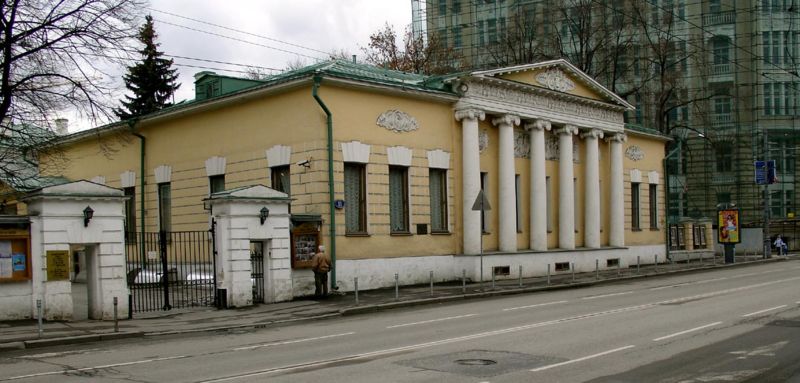
Leo Tolstoy Museum, Moscow, Prechistenka Street, architect: Afanasy Grigiriev, 1820s
NVO · Self-photographed
Places
Named by the record
Places
Only places the record itself states, plotted where the house gazetteer settles their coordinates. Nothing is inferred from a name or a nationality.
Kozlovskiy Uyezd.
Birth place
Moscow.
Death place
Notes from the source article
Cited by Wikipedia
Notes from the source article
These works are cited by the source article, in its own numbering. They are recorded as its citations, not as sources VALÉORINE has verified.
- 1.Александров, Юрий, "Среди дворянских гнезд", "Наше наследие" www.nasledie-rus.ru
- 2.Official site: www.pushkinmuseum.ru
- 3.Russian: "Храмы во имя иконы божией матери "Всех скорбящих радости", www.pravoslavie.ru
- 4.Russian: "Москва и Подмосковье", М, "Искусство", 1979, p.499
References
Citations
References
Each reference names the institution holding it, so a reader may go to the document itself.
reference work
Secondary witnessreference work
Secondary witness
The Encyclopedia exists whether or not anything is for sale. Corrections are recorded rather than overwritten, and every version of this record is kept. Published 16 August 2026.
Elsewhere in Design
11,558 published records in this field, each with its sources named.
- Adrienne GorskaDesigner
- Aed CarabaoDesigner
- Aelius NiconDesigner
- Afaina de JongDesigner
- Afanasy Seredin-SabatinDesigner
- Afarin NeyssariDesigner
- Affonso Eduardo ReidyDesigner
- Afonso ÁlvaresDesigner
Best supported in this field
For owners
Own a work by Afanasy Grigoriev?
A specialist will read what you send and tell you what the house can establish, what it cannot, and whether the object is suited to sale. There is no charge and no obligation. The object stays with you throughout; nothing is shipped to us unless it is arranged in writing beforehand.