
Abraham Bosse
Abraham Bosse (c. 1604 – 14 February 1676) was a French artist, mainly as a printmaker in etching, but also in watercolour.
Also recorded as A. Bosse · Bosse Abrah. · Bossee · [Abraham Bosse]
Abraham Bosse
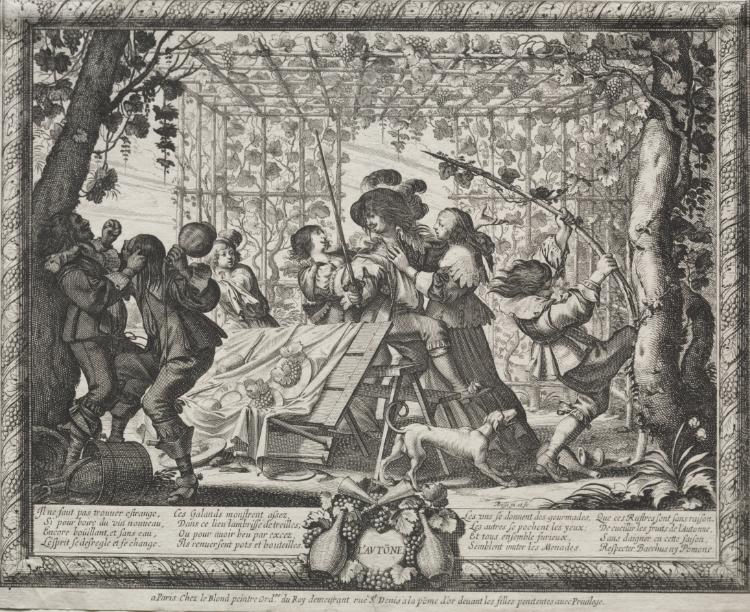
Abraham Bosse · The Cleveland Museum of Art · Dudley P. Allen Fund · CC0
- Name
- Abraham Bosse
- Born
- c. 1604
- Birthplace
- Tours, France
- Died
- 14 February 1676
- Place of death
- Paris, France
- Occupation
- printmaker
- Nationality
- France
VALÉORINE Encyclopedia
VALÉORINE documentary reading
Documentary summary
Abraham Bosse (c. 1604 – 14 February 1676) was a French artist, mainly as a printmaker in etching, but also in watercolour.
Admitted source layer · organised and presented by VALÉORINE
Note VALÉORINE
Abraham Bosse (born 1604) was a copper engraver, draftsperson and etcher, among other activities, of French nationality. The copper engraver worked in Paris.
Composed from admitted, traceable facts · 27 September 2026
VALÉORINE
Reference Check
Propose documentary evidence for Abraham Bosse. A contribution is never written directly as fact: identity, source, rights and evidence gates still decide.
Sign in to contribute
Documentary evidence
Evidence Panel
not yet certified
- Identity
- resolved
- Independent source families
- 0
- Admitted assertions
- 0
- Open conflicts
- 0
Authority files
wikidata · Q326215 · wikipedia · Abraham Bosse
In this article
Key facts
Key facts
• Name — Abraham Bosse • Born — c. 1604 • Birthplace — Tours, France • Died — 14 February 1676 • Place of death — Paris, France • Occupation — printmaker • Illustration — Engravers and etchers at work, 1643
Life
Life
• Illustration — Valet de Chambre from a series of etchings of trades, Les Metiers 1635 He was born to Huguenot (Calvinist) parents in Tours, France, where his father had moved from Germany. His father was a tailor, and Bosse's work always depicted clothes in loving detail. He married Catherine Sarrabat at Tours in 1632. He remained a Huguenot, dying before the Revocation of the Edict of Nantes, but was happy to illustrate religious subjects to Catholic taste.
Work
Work
Roughly 1600 etchings are attributed to him, with subjects including: daily life, religion, literature, fashion, technology, and science. Most of his output was illustrations for books, but many were also sold separately. His style grows from Dutch and Flemish art, but is given a strongly French flavour. Many of his images give informative detail about middle and upper-class daily life in the period, although they must be treated with care as historical evidence. His combination of very carefully depicted grand interiors with relatively trivial domestic subjects was original and highly influential on French art, and also abroad — William Hogarth's engravings are, among other things, a parody of the style. Most of his images are perhaps best regarded as illustrations rather than art. • Illustration — Watercolour of a ball by Abraham Bosse, a similar subject to many of his most famous etchings He was apprenticed in Paris about 1620 to the Antwerp-born engraver Melchior Tavernier, who was also an important publisher. His first etchings date to 1622, and are influenced by Jacques Bellange. Following a meeting in Paris about 1630, he became a follower of Jacques Callot, whose technical innovations in etching he popularised in the famous and much translated Traité des manières de graver en taille-douce [Treatise on Line Engraving] (1645), the first to be published. He took Callot's highly detailed small images to a larger size, and a wider range of subject matter. Unlike Callot, his declared aim, in which he largely succeeded, was to make etchings look like engravings, to which end he sacrificed willingly the freedom of the etched line, whilst certainly exploiting to the full the speed of the technique. Like most etchers, he frequently used engraving on a plate in addition to etching, but produced no pure engravings.
Controversy
Controversy
In 1641, he began to attend classes given by the architect Girard Desargues (1591–1661) on perspective and other technical aspects of depiction. Bosse not only adopted these methods but also published a series of works between 1643–1653 explaining and promoting them. In 1648, Cardinal Mazarin established the Académie Royale de Peinture et de Sculpture. Bosse was made an honorary member in 1651. However his publicising of Desargues' methods embroiled him in a controversy with Charles Le Brun and his followers, who had different methods, and also a belief that "genius" rather than technical method should be the guide in creating artworks. In 1661 Bosse was forced to withdraw from the Academy; he established his own school as an alternative, but it was suppressed by Le Brun.
Etchings & Images
Etchings & Images
• Illustration — Frontispiece for Hobbes' Leviathan • Le jardin de la Noblesse françoise — fashion (partly after Jean de St-Igny)(1629) • Les Cris de Paris (c. 1630) — street cries • Les gardes françoises (1632) • Le mariage à la ville, le mariage à la campagne (1633) — bourgeois vs pastoral weddings • Les métiers (1635?) — The trades • Plates for L'Ariane (1639) • Plates for Le Trésor des merveilles de la Maison Royale de Fontainebleau (1642) • La manière universelle de M. des Argues Lyonnois pour poser l'essieu & placer les heures & autres choses aux cadrans au Soleil (1643), printed by P. de Hayes, Paris • La pratique du trait à preuve de M. des Argues Lyonnois pour la coupe des pierres en Architecture pratiquer la perspective (1643) • De la manière de graver à l'eaux-forte et au burin (1645) • Traité des manières de graver en taille douce sur l'airin par le moyen des eaux-fortes... (1645) The "Manual of Etching". • Manière universelle de M. des Argues pour pratiquer la perspective par petit-pied comme le géométral... (1648) — Manual on perspective • Moyen universel de pratiquer la perspective sur les tableaux ou surfaces irrégulières... (1653) • The famous frontispiece for Leviathan by Thomas Hobbes (1651) was created with input from Hobbes. • Plates for La Pucelle ou la France délivrée (1656) • Des ordres des colonnes (1664) — Architecture • Traité des pratiques géométrales et de perspective (1665)
Gallery
Gallery
• Illustration — alt=Men making shoes The Shoemakers, etching (National Gallery of Art) • Illustration — alt=Valet sorting clothes The Valet, engraving in black on laid paper, 29 x 20.4 cm (11 7/16 x 8 1/16 in.), (National Gallery of Art) • Illustration — alt=Man and woman flirting Adolescence, 1636, engraving and etching (National Gallery of Art) • Illustration — alt=People eating around a dining table Manhood, 1636, engraving and etching (National Gallery of Art) • Illustration — alt=Men working at desks on engravings, in the background art patrons examining framed pictures Engravers, 1642, etching (National Gallery of Art) • Illustration — alt=Children playing a game with balls and a cue stick Childhood, 1636, engraving and etching (National Gallery of Art) • Illustration — alt=Old man by fireplace with two attendants Death, 1636, engraving and etching (National Gallery of Art) • Illustration — alt=Man and two women on balcony overlooking gardens. One woman and the man are sniffing bunches of flowers. There are two dogs at the man's feet. Odoratus, L'Ordorat, engraving in black on laid paper, 24 x 32 cm (9 7/16 x 12 5/8 in.) (National Gallery of Art) • Illustration — alt=Man in the pose of Hercules, carrying club, lion and rooster in background Louis XIII as Hercules, engraving and etching (National Gallery of Art) • Illustration — alt=Portrait of a middle-aged man Michel Larcher, 1647, engraving (National Gallery of Art) • Illustration — alt=Noble men and women in a prison yard. Prisoners beseeching aid. One prisoner is chained at the neck. Gentry Visiting a Prison, engraving with etching, 25.4 x 32.2 cm (10 x 12 11/16 in.) (National Gallery of Art) • Illustration — alt=Five women seated around an altar The Wise Virgins at Prayer, etching on laid paper, plate: 26 x 33 cm (10 1/4 x 13 in.) (National Gallery of Art) • Illustration — alt=Five women napping, seated in front of a fireplace The Foolish Virgins Sleeping, etching on laid paper, plate: 25.4 x 32 cm (10 x 12 5/8 in.) sheet: 29.2 x 36.2 cm (11 1/2 x 14 1/4 in.) (National Gallery of Art) • Illustration — alt=Man seated in a small copse, hands clasped in prayer. Pigs in background. The Prodigal Son as a Swineherd, engraving (National Gallery of Art) • Illustration — alt=A painter with a portrait on an easel. The subject of the portrait stands next to the painter. Le Noble Peintre, 1642, etching on laid paper, plate: 9 7/8 x 12 11/16 in. (25.1 x 32.2 cm), sheet: 26.4 x 33.3 cm (10 3/8 x 13 1/8 in.) (National Gallery of Art) • Illustration — Frontispiece for Callot's "The Penitents", etching and engraving (National Gallery of Art) • Illustration — alt=Five women seated around a fireplace. A prie-dieu is visible. The Wise Virgins before the Fire, etching on laid paper, plate: 26 x 33 cm (10 1/4 x 13 in.) (National Gallery of Art) • Illustration — alt=A sculptor is showing a large work to wealthy patrons. A Sculptor in His Atelier, 1642, etching, plate: 25.8 x 32.5 cm (10 3/16 x 12 13/16 in.) (National Gallery of Art)
Identity
Identity
Abraham Bosse is recorded as printmaker, etcher, painter and draftsperson.
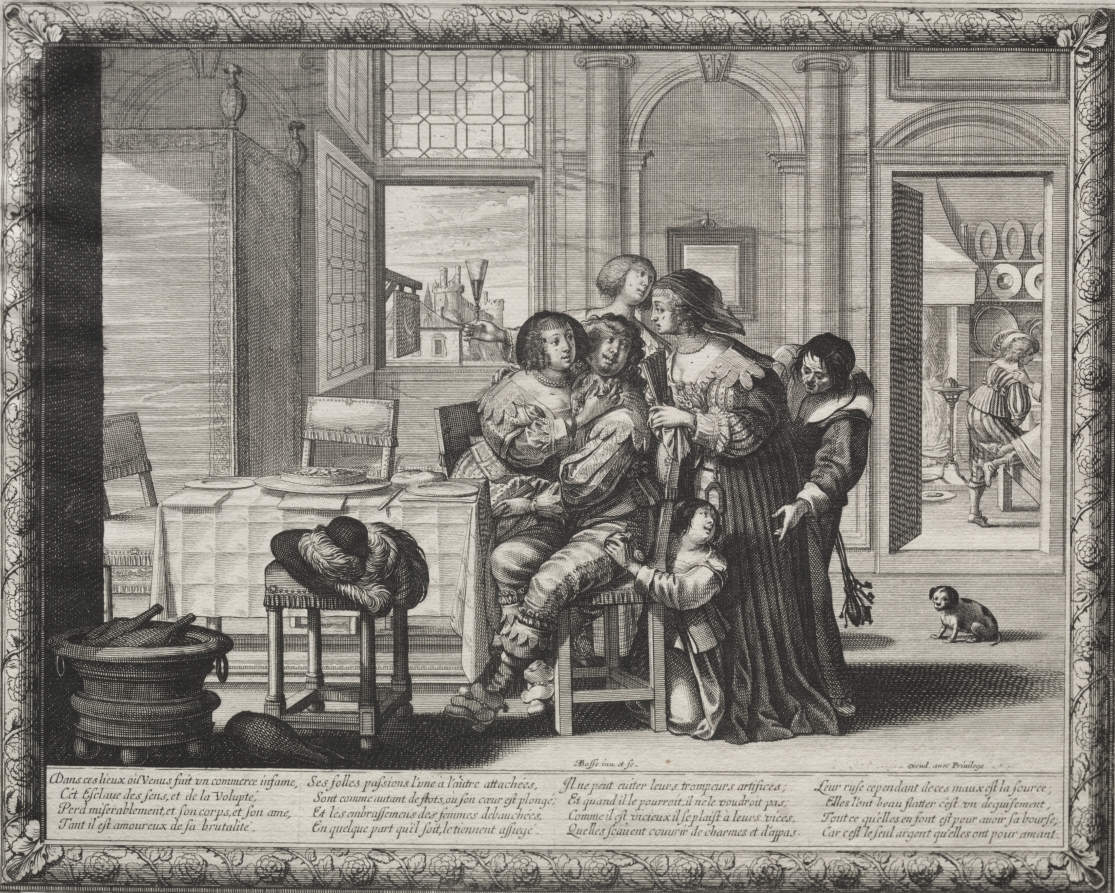
The Prodigal
Abraham Bosse · The Cleveland Museum of Art · Dudley P. Allen Fund
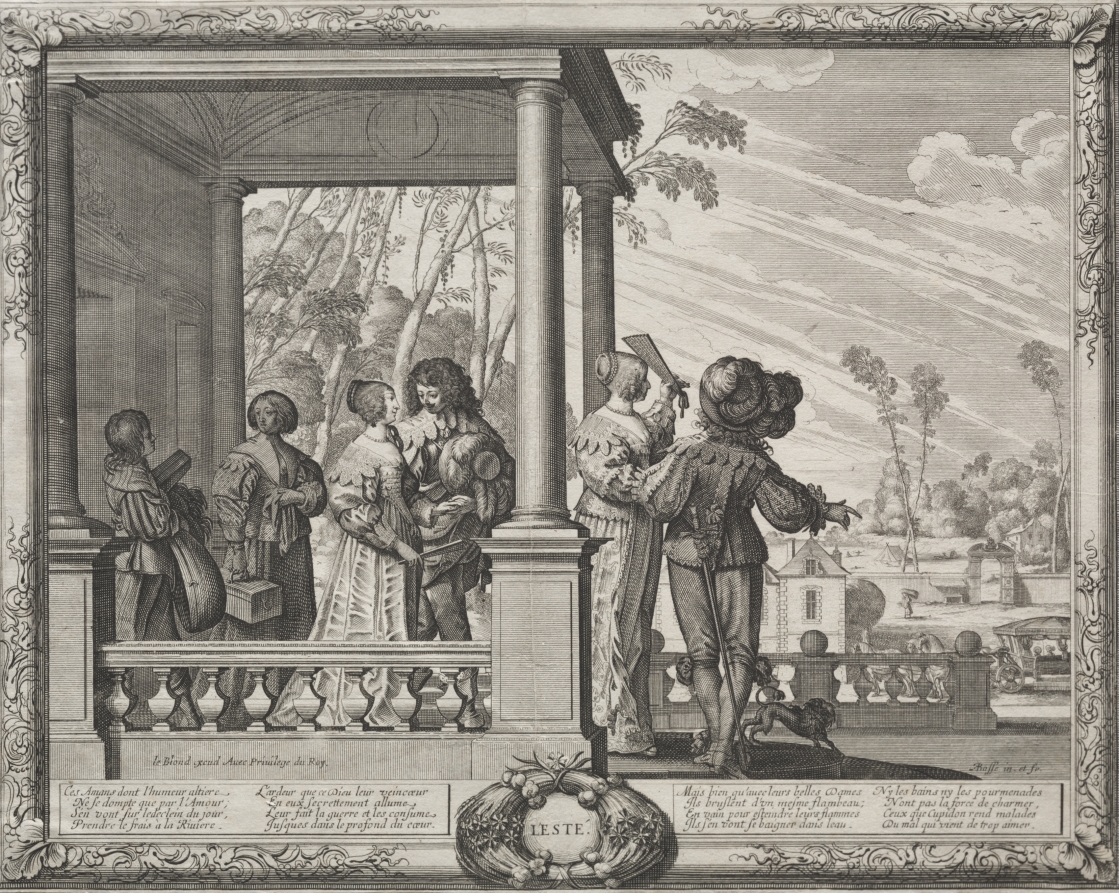
The Four Seasons: Summer, 1635, by Abraham Bosse
Abraham Bosse · The Cleveland Museum of Art · Dudley P. Allen Fund
Life and career
Dated record
Life and career
Explore 1604–1676
The full dated record · 3 entries
1604
Abraham Bosse was born in 1604.
1643
La pratique du trait a preuues de Mr Desargues Lyonnois, pour la coupe des pierres en l'architecture. Par A. Bosse, graueur en taille douce,... (1643) is digitised and catalogued by Internet Archive.
1676
Abraham Bosse died in 1676.
Places
Named by the record
Places
Only places the record itself states, plotted where the house gazetteer settles their coordinates. Nothing is inferred from a name or a nationality.
Abraham Bosse was born at Tours.
Birthplace
Abraham Bosse died at Paris.
Deathplace
Later Collections
Later Collections
• Die Kunst, in Kupfer zu stechen, Ilmer, Osnabrück 1975 (Repr. d. Ausg. Nürnberg 1765) • Radier-Büchlein. Handelt von der Etzkunst, nemlich wie man mit Scheidwasser in Kupfer etzen, das Wasser und wie auch den harten und weichen Etzgrund machen solle, Moos, München 1977, (Repr. d. Ausg. Nürnberg 1689)
Context
Primary material
Context
The circumstances in which Abraham Bosse stands. The Prodigal Son's Father Orders the Best Robe and the Slaughter of the Fatted Calf. The Feast Celebrating the Return of the Prodigal Son. The Foolish Virgins Approaching the Temple. The Prodigal Son Bids Farewell to his Father. Illustration to Jean Desmarets' "L'Ariane". The Prodigal Son in a House of Ill-Repute. The Wise and Foolish Virgins Together. The Wise Virgins Carrying Their Lamps. The Foolish Virgins Wasting Time. The Wise Virgins before the Fire. C'est le portrait de Guillery.
Holdings and surviving copies
Where the work is held
Holdings and surviving copies
Where material relating to Abraham Bosse is held.
Documents and archives
Primary material
Documents and archives
Institutional database
- Wikidata, structured authority record Q326215: Abraham Bosse
Scholarly · Wikimedia Foundation
reference work
- “Abraham Bosse”, English Wikipedia, consulted as further reading
Reputable secondary · Wikipedia
Literature
Literature
Bosse, Abraham, Benezit Dictionary of Artists, 2011
Bosse, Abraham, Oxford Art Online, 2003
Bosse, Abraham, Lexikon des gesamten Buchwesens Online
Notes from the source article
Cited by Wikipedia
Notes from the source article
These works are cited by the source article, in its own numbering. They are recorded as its citations, not as sources VALÉORINE has verified.
- 1.Maxime Préaud, "Célébrations nationales 2004, Arts: Abraham Bosse, graveur en taille-douce et théoricien de l’art français", 2004. Based on recent research, his date of birth has been corrected to 1604 from the traditionally given birth year of 1602. Bosse's apprenticeship contract was found in which it is mentioned that he was aged 16 at the date of signing the contract (16 June 1620).
- 2.Harrison 1996, p. 468. See Commons:Category:Manual of Etching by Abraham Bosse.
- 3.Harrison 1996.
- 4.Benezit 2006.
- 5.Guerriaud, Mathieu. [Abraham Bosse and the dean's engraving] Abraham Bosse et La gravure du Doyen. Revue d'histoire de la pharmacie. LXI. 378/379. 2013-09-01. 0035-2349.
Bibliography printed in the source article · 7
- Benezit (2006). "BOSSE, Abraham", vol. 2, pp. 922–923, in Benezit Dictionary of Artists. Paris: Gründ.
- Dhombres, Jean; Joël Sakharovitch, editors (1994). Desargues en son temps. Paris: Albert Blanchard. .
- Guerriaud, M. (2013), "Abraham Bosse et la gravure du doyen". Revue d’Histoire de la Pharmacie, vol. 378/379, .
- Harrison, Colin (1996). "Bosse, Abraham", vol. 4, pp. 467–469, in The Dictionary of Art, 34 volumes, edited by Jane Turner. New York: Grove. .
- Join-Lambert, S.; J.-P. Manceau (1995). Abraham Bosse, graveur et sçavant. CRDP de la région Centre..
- Join-Lambert, S.; Maxime Préaud, editors (2004). Abraham Bosse, savant graveur. BNF-Musée des Beaux-arts de Tours, diffusion éd. du Seuil. .
- Vuillemin, Jean-Claude (2008). “Abraham Bosse”, vol. 1, pp. 176–179, in Dictionary of Seventeenth-Century French Philosophers, edited by L. Foisneau, 2 vols. London and New York: Thoemmes Continuum. .
References
Citations
References
Each reference names the institution holding it, so a reader may go to the document itself.
Institutional database
Wikidata, structured authority record Q326215: Abraham BosseWikimedia Foundation
Verifiedreference work
Partially resolved
People, houses and institutions
Knowledge graph
People, houses and institutions
Teachers, collaborators, publishers and institutions recorded against this person, each on a stated basis.
Died at
1- ParisPlace
Established from a fact already recorded on a verified source.
The Encyclopedia exists whether or not anything is for sale. Corrections are recorded rather than overwritten, and every version of this record is kept. Published 14 August 2026.
Elsewhere in Prints
4,138 published records in this field, each with its sources named.
- Abraham AllardEngraver
- Abraham B. JacobEngraver
- Abraham BloemaertEngraver
- Abraham BlootelingEngraver
- Abraham BrueghelEngraver
- Abraham de BruynEngraver
- Abraham GenoelsEngraver
- Abraham GoosEngraver
Best supported in this field
For owners
Own a work by Abraham Bosse?
A specialist will read what you send and tell you what the house can establish, what it cannot, and whether the object is suited to sale. There is no charge and no obligation. The object stays with you throughout; nothing is shipped to us unless it is arranged in writing beforehand.