
9K35 Strela-10
The 9K35 Strela-10 (arrow) is a Soviet highly mobile, short-range surface-to-air missile system. It is visually aimed, and utilizes optical/infrared-guidance. The system is primarily intended to engage low-altitude threats, such as helicopters.
Also recorded as SA-13 Gopher · Strela-10
9K35 Strela-10
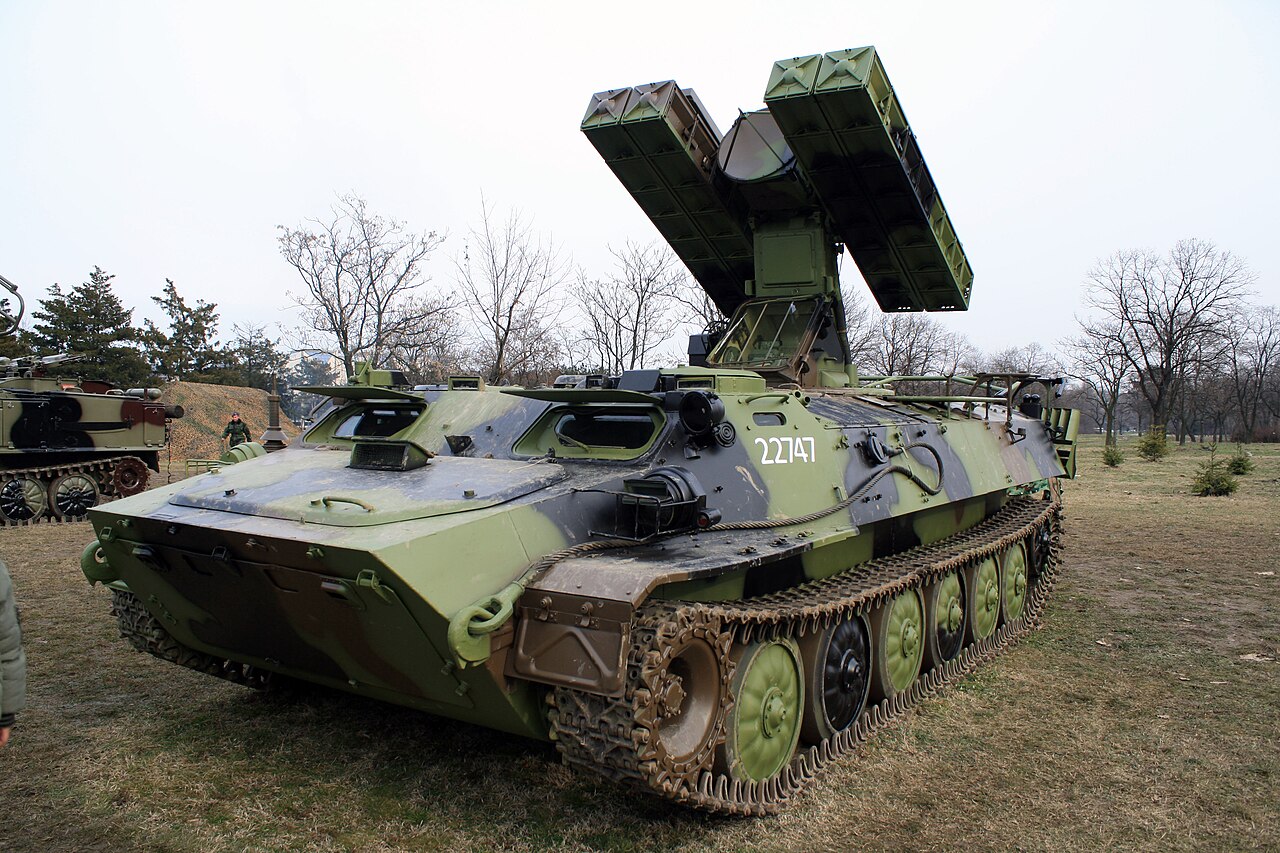
Srđan Popović · CC BY-SA 4.0
- Name
- 9K35 Strela-10 SA-13 Gopher
- Field
- surface-to-air missile · surface-to-air missile system
- Region
- Soviet Union · Russia
VALÉORINE Encyclopedia
VALÉORINE documentary reading
Documentary summary
The 9K35 Strela-10 (arrow) is a Soviet highly mobile, short-range surface-to-air missile system. It is visually aimed, and utilizes optical/infrared-guidance. The system is primarily intended to engage low-altitude threats, such as helicopters.
Admitted source layer · organised and presented by VALÉORINE
Note VALÉORINE
No house-authored Note is published until its assertions and sources pass the VALÉORINE evidence contract. The documentary article remains available in full while that enrichment is being consolidated.
Documentary enrichment in progress · no unsupported statement published
Reference Check
Propose documentary evidence for 9K35 Strela-10. A contribution is never written directly as fact: identity, source, rights and evidence gates still decide.
Sign in to contribute
World of VALÉORINE
Documentary connections
Only confirmed graph relationships appear here. Images are shown only when their identity and reuse rights both pass the documentary gate.

Documentary evidence
Evidence Panel
not yet certified
- Identity
- resolved
- Independent source families
- 0
- Admitted assertions
- 0
- Open conflicts
- 0
Authority files
wikidata · Q633510 · wikipedia · 9K35 Strela-10
In this article
Overview
Overview
"9K35" is its GRAU designation; its NATO reporting name is SA-13 "Gopher".
Key facts
Key facts
• Name — 9K35 Strela-10 SA-13 Gopher • Origin — Soviet Union • Type — Vehicle-mounted SAM system • Is Vehicle — yes • Is Uk — yes • Service — 1976–present • Used By — See list of operators • Wars — *Angolan Civil War • Iran–Iraq War • Persian Gulf War • Afghan Civil War (1989–1992) • Afghan Civil War (1992–1996) • Kosovo War • Syrian Civil War • Russo-Ukrainian War • Russo-Ukrainian war (2022–present) • Second Nagorno-Karabakh War • Designer — KB Tochmash Design Bureau of Precision Engineering • Design Date — 1969–1976 • Manufacturer — Saratovskiy Zenit Machine Plant (Muromteplovoz Joint Stock Company for the 9K35M3-K) • Production Date — 1976–present • Variants — Strela-10, Strela-10SV (Prototype), Strela-10M, Strela-10M2, Strela-10M3, Strela-10M3-K, Strela-10M4 • Spec Label — 9K35 Strela-10M3 • Weight — 12,300 kg • Length — 6,600 mm • Width — 2,850 mm • Height — 2,300 mm (travelling), 3,800 mm (firing) • Crew — 3 (commander, gunner and driver) • Armour — 7 mm • Primary Armament — 4 × 9M333 (or 9M37MD) • Secondary Armament — 1x PKMB machine gun • Engine — YaMZ-238 V diesel • Engine Power — 240 hp • Suspension — torsion bar • Clearance — 0.5 m • Fuel Capacity — 450 litres • Vehicle Range — 500 km • Speed — 61.5 km/h (road) 6 km/h (water)
Development
Development
The 9K35 is the successor of the 9K31 Strela-1 and can also use the Strela-1's missiles in place of the 9M37. Development of the 9K37 Strela-10SV system was initiated on 24 July 1969. The decision to begin the development of a new non-all-weather system was taken despite the simultaneous development of an all-weather hybrid gun/missile system 2K22 "Tunguska", mainly as an economical measure. It was also seen as advantageous to have a system capable of fast reaction times and immunity to heavy radio-frequency jamming. Rather than being mounted on an amphibious but lightly armoured BRDM-2 chassis like the 9K31, the 9K35 is mounted on a more mobile tracked, modified MT-LB, with more room for equipment and missile reloads. Provision for amphibious capability is provided in some variants in the form of polyurethane-filled floats. The Strela-10SV system and its 9M37 missile were tested on the Donguzkom range from 1973 to 1974, but the results were disappointing: the system was found deficient in terms of missile probability of kill and vehicle reliability, among other issues. Acceptance into service was thus delayed until 16 May 1976, by which time improvements had been made to the system. Development of the system continued over the years with Strela-10M, -10M2 and -10M3 variants introducing among other things improved radio communications and better integration with Soviet integrated air defence system air picture data. Improved missiles (9M37M and 9M333) were also developed, and by September 2007, the 9K35M3-K Kolchan variant, mounted on a BTR-60 wheeled chassis, was displayed for the first time at the Moscow Air Show MAKS 2007. The Russian Armed Forces were to receive 72 advanced mobile "night" short-range "Strela-10M4" anti-aircraft missile complexes by 2016. In 2014, the Russian Airborne Troops received the first batch of 18 "Strela-10M4" vehicles. This modernization was intended to extend the service life of the system by 3–5 years. The Strela-10M is expected to be replaced by the Sosna anti-aircraft missile system. The system is based on the MT-LB chassis consisting of 12 Sosna-R 9M337 beam rider missiles with a range of 10 km and altitude of 5 km.
Associated systems and vehicles
Associated systems and vehicles
The 9K35 is a SAM system with electro-optical guidance. It has the capability to use radars for target acquisition and range. Some vehicles have a pintle-mounted PKT 7.62 mm machine gun in front of the forward hatch for close-in protection. Other vehicles have been seen with additional support railings for the system on the rear deck. The following is a list of associated equipment: • 9A34M2, 9A34M3-K: launcher vehicle with 9S86 (NATO designation "SNAP SHOT") range only radar located between the two pairs of missile canisters on the transporter erector launcher and radar (TELAR) (maximum radar range is 450 to 10,000 m). • 9A35M2, 9A35M3-K: launcher vehicle with 9S16 (NATO designation "Flat Box-B") passive radar detection system that gives a 360° azimuth and minimum 40° elevation coverage • 9F624 and 9F624M training simulator • 9S482M7 Control Post • 9U111: a 1,950 kg trailer-mounted 12 kW generator unit, designed to feed power to up to four 9A35M2, 9A35M3-K or 9A34M2, 9A34M3-K launcher vehicles at a distance of up to 30 m by cable while conducting maintenance or training operations. • 9V839M: system checkout vehicle • 9V915M, 9V915M-1: technical maintenance vehicle • MT-LBU with 9S80 (NATO designation "DOG EAR") F/G-band target acquisition radar (maximum range 80 km (50 miles)) • Ranzhir-M 9S737М (GRAU designation 9S737): it is a mobile command center for a mixed grouping of air defense forces, such as the Tor, Tunguska, Strela-10, and Igla.
Key facts
Key facts
• Name — 9M37 • Origin — Soviet Union • Type — Surface-to-air missile • Is Missile — yes • Is Uk — yes • Service — 1976–present • Used By — See Operators • Designer — KB Tochmash Design Bureau • Design Date — 1969–1976 • Manufacturer — Degtyarev plant • Production Date — 1976–present • Variants — 9M37, 9M37M, 9M37MD, 9M333 • Spec Label — 9M333 • Weight — 41 kg • Length — 2190 mm • Diameter — 120 mm • Filling — Frag-HE • Filling Weight — 5 kg • Detonation — contact and laser proximity fuzes • Wingspan — 360 mm • Propellant — single-stage solid propellant rocket motor • Vehicle Range — 5 km • Altitude — 3500 m • Speed — 550 m/s • Guidance — dual-mode passive 'photocontrast'/IR seeker • Illustration — The 9M37 guided missile The Strela-10 system was originally designed to use the 9M37 missile as its primary weapon, but its launch system was designed to be also backwards compatible with the 9M31M missile of the earlier 9K31 Strela-1. Each 9M37 missile is 2,200 mm (7.2 ft) long, weighs 40 kg (88 pounds) and carries a 3.5 kg (7.7 pound) warhead. The maximum speed of the missile is near Mach 2, engagement range is from 800 to 5000 m (0.3–3 miles) and engagement altitude is between 10 and 3500 m (33-11,500 ft). (The ranges define the zone of target intercept, minimum and maximum launch distances are longer for approaching and shorter for receding targets, depending on the target's speed, altitude and flight direction.) Four missiles are mounted on the turret in boxes, ready to launch, and eight more are carried inside the vehicle as reloads. Reloading takes around 3 minutes. The 9M37 was quickly replaced with a slightly improved 9M37M (the main improvement was a more efficient autopilot system for missile flight path control), and later the significantly upgraded 9M333, which introduced the following: • heavier warhead of improved expanding-rod design and larger HE content • new proximity fuzing with 8-ray laser to improve probability of fuzing on near misses of very small targets, such as cruise missiles or UAVs • triple-channel guidance system for more robust countermeasure rejection • improved engine to provide similar performance despite the slight increase in missile length and weight. All missiles—9M31M, 9M37, 9M37M and 9M333—are equipped with optical homing heads utilizing reticle-based photocontrast and/or infrared homing. 9M333 is said to have particularly good countermeasure resistance due to its triple-channel homing head, while the 9M37/9M37M's photocontrast channel is described as back-up method to the IR channel. All main variants—Strela-10SV, Strela-10M, Strela-10M2 and Strela-10M3—can use all aforementioned missile types. The main characteristics of the missiles are listed in the table below, based on source number unless otherwise noted. For comparison purposes, data for nearest western equivalent, the somewhat larger and heavier MIM-72 Chaparral, is also provided. As the photocontrast channel provides effective head-on engagement ability, firing range against an approaching target can be considerably longer than the maximum ranges listed above, likewise maximum firing range would be considerably less than the maximum range of target destruction against a receding target. Definition of range and effective ceiling for MIM-72 is unknown and the figures are therefore not directly comparable. • System — 9K31 Strela-1M — 9K35 Strela-10 — 9K35M Strela-10M3-K — 9K35M Strela-10M4 — MIM-72A Chaparral — MIM-72G Chaparral • Missile — 9M31M — 9M37 — 9M37M — 9M333 — MIM-72A — MIM-72G • year of introduction — 1971 — 1976 — 1981 — 1989 — 1967 — 1982/1990(*) • diameter [mm] — 120 — 120 — 120 — 120 — 127 — 127 • length [mm] — 1803 — 2190 — 2190 — 2230 — 2900 — 2900 • weight [kg] — 32 — 40 — 40 — 42 — 86 — 86 • warhead (HE) [kg] — 2.6 — 3 — 3 — 5 — 11 — 12.6 • fuze — impact and proximity — proximity + impact — proximity + impact — 8-ray laser proximity + impact — impact + radar proximity — impact + directional doppler radar proximity • seeker head — AM-modulated photocontrast (uncooled PbS detector element) — Two-channel: 1) AM-modulated photocontrast (cooled PbS), 2) FM-modulated uncooled IR — Two-channel: 1) AM-modulated photocontrast (cooled PbS), 2) FM-modulated uncooled IR — Three-channel: 1) photocontrast, 2) IR, 3) IRCCM channel — cooled IR of AIM-9D (limited /no forward hemisphere capability) — two-channel: 1) cooled all-aspect IR, 2) UV (forward-hemisphere / long-range homing + IRCCM) • Min. range of target destruction [km] — 0.8 — 0.8 — 0.8 — 0.8 —? —? • Max. range of target destruction [km] — 4.2 — 5.0 — 5.0 — 5.0 — 6..9 (sources vary) — 6..9 (sources vary) • Min. intercept altitude [m] — 30 — 25 — 25 — 10 — 15 — 15 • Max. intercept altitude [m] — 3000 — 3500 — 3500 — 3500 — 3000 — 3000 • speed [m/s] — 420 — 517 — 517 — 517 — 515 (Mach 1.5) — 515 (Mach 1.5) • target max speed [m/s]: approaching / receding —? — 415/310 — 415/310 — 415/310 —? —? (*) Contract for production of MIM-72G by retrofitting new components was awarded in late 1982, with all missile in US service upgraded by the late 1980s. New production of MIM-72G missiles started in 1990.
Angolan Civil War
Angolan Civil War
On 20 February 1988, 31-year-old Major Edward Richard Every from 1 Squadron SAAF, was killed in action when his Mirage F1AZ (serial 245) was shot down by a Cuban Strela-10 surface-to-air missile in Cuatir (near Menongue) while on an attack mission over Southern Angola.
Persian Gulf War
Persian Gulf War
Iraq had several operational Strela-10 systems at the beginning of the 1991 international operation to liberate Kuwait from Iraqi occupation, most if not all of which were organized as part of the battlefield air defence systems of the Republican Guard divisions. During the operation, 27 coalition aircraft are believed to have been hit by Iraqi IR-homing SAMs, resulting in 14 losses. Some of the losses were shot down on the spot, while others, such as OA-10A 77-0197, returned to base only to be lost in a crash landing. Others landed safely, but were written off as total losses. At least two losses are believed to have been due to Strela-10s: on 15 February 1991, an A-10A (78-0722) of 353rd TFS/354th TFW was hit by a SAM believed to be a Strela-10, some 100 km north west of Kuwait City, while attacking Republican Guard targets. Pilot Lt Robert Sweet ejected and was made a prisoner of war. While attempting to protect Sweet on the ground, his wingman Steven Phyllis, flying another A-10A (79-0130), was also hit by what is believed to have been a Strela-10. Phyllis was killed in the incident.
Kosovo War
Kosovo War
During the NATO bombing campaign against the FR Yugoslavia, a Strela-10 hit a United States Air Force A-10 on 11 May 1999.
Syrian Civil War
Syrian Civil War
On 14 April 2018, American, British and French forces launched a barrage of 105 air-to-surface and cruise missiles targeting eight sites in Syria. According to a Russian source, five Strela-10 missiles launched in response, destroying three incoming missiles, However, the US Department of Defense stated in a daily press briefing that no Allied missiles were shot down.
2020 Nagorno-Karabakh war
2020 Nagorno-Karabakh war
The Armenian Air Force employed Strela-10 missile systems during the 2020 Nagorno-Karabakh conflict. During the opening days of the war, several videos released by the Azerbaijani military showed several Armenian 9K33 Osa and Strela-10 vehicles destroyed by Bayraktar TB2 armed drones.
Russo-Ukrainian War
Russo-Ukrainian War
A Strela-10 from the Ukrainian Armed Forces was recorded running over a civilian car in the opening weeks of the war. The driver of the car was uninjured. A Russian Strela-10M guarding Snake Island was destroyed by a Bayraktar TB2 on 30 April 2022. A Ukrainian Strela-10M system was reported destroyed by the Russian Air Force near Lisichansk on 17 June 2022. A Russian source claimed in September 2023 that Russia was using the 9M333 missile in Ukraine.
Wagner Group rebellion
Wagner Group rebellion
A published video showed a Strela-10 targeting and nearly hitting a Russian Army Ka-52 helicopter near Voronezh; the missile was decoyed by flares.
Operators
Operators
• Illustration — Operators
Current operators
Current operators
* •: Unknown amount in service in 2023. •: Unknown amount in service in 2023. •: Unknown amount in service in 2023. •: 200 in service in 2023. •: 3 9K35 Strela-10M3 and 6 9K35 Strela-10CRO in service in 2024. •: 9 in service in 2024. •: Unknown amount in service in 2023. •: Unknown amount in service in 2023. •: 92 in service in 2023 •: Unknown amount in service in 2023. •: Unknown amount in service in 2023. •: In service as of January 2019. * •: Manufactured domestically under designation 1976 model year self-propelled missile launcher Type 10. •: 8 launchers. •: 350. The 9M333 missile was in production as of 2026. 100 Strela-10MNs delivered 2012–2020. •: 18 •: Unknown amount in service in 2023. •: 13 in service as of 2023 •: Unknown amount in service in 2023. •: 20
Former operators
Former operators
•: 16+ launchers prior to the 1992–1996 Afghan Civil War. •: Withdrawn from service. •: Passed on successor states. •: Retired after reunification. •: Withdrawn from service. • Iraq: Some destroyed in combat, all remaining units were written off after the Iraq War in 2003. • Libya: 60+ launchers in 1992, unknown number operational prior to the 2011 Libyan civil war. •: 4, probably withdrawn in 2001–2002. •: Withdrawn from service. •: Passed on to successor states. •: Passed on to successor states.
Context
Primary material
Context
The circumstances in which 9K35 Strela-10 stands. Recorded as a kind of surface-to-air missile system. Manufactured by Saratovsky Zenit Machine Plant. Recorded with a height of 2220. Recorded with a width of 2850. Developed by KB Tochmash. Manufactured by LOMO. The identifiers under which 9K35 Strela-10 may be traced in institutional catalogues. Within the Encyclopedia. Connected to 1 other published record in the VALÉORINE Encyclopedia.
Documents and archives
Primary material
Documents and archives
reference work
- “9K35 Strela-10”, English Wikipedia, consulted as further reading
Reputable secondary · Wikipedia
institutional register
- Wikidata, structured authority record Q633510: 9K35 Strela-10
Unverified · Wikimedia Foundation
References
Citations
References
Each reference names the institution holding it, so a reader may go to the document itself.
reference work
Partially resolvedinstitutional register
Wikidata, structured authority record Q633510: 9K35 Strela-10Wikimedia Foundation
Unverified
Connections
Knowledge graph
Connections
Each connection was recorded deliberately, with the basis for it kept on the internal record.
Broader subject
1- surface-to-air missileTerminology
Established from a fact already recorded on a verified source.
The Encyclopedia exists whether or not anything is for sale. Corrections are recorded rather than overwritten, and every version of this record is kept. Published 14 August 2026.
Elsewhere in Militaria
6,095 published records in this field, each with its sources named.
- 9K31 Strela-1Terminology
- 9K32 Strela-2Terminology
- 9K33 OsaTerminology
- 9K34 Strela-3Terminology
- 9K38 IglaTerminology
- 9K52 Luna-MTerminology
- 9K720 IskanderTerminology
- 9M113 KonkursTerminology
Best supported in this field
For owners
Own an object connected with 9K35 Strela-10?
A specialist will read what you send and tell you what the house can establish, what it cannot, and whether the object is suited to sale. There is no charge and no obligation. The object stays with you throughout; nothing is shipped to us unless it is arranged in writing beforehand.