
60 mm mortar M2
The M2 mortar is a 60 millimeter smoothbore, muzzle-loading, high-angle-of-fire weapon used by U.S. forces in World War II, the Korean War, and the Vietnam War for light infantry support.
Also recorded as US M2 60 mm Mortar · 60mm Mortar M1 · M2 60 mm Mortar
60 mm mortar M2
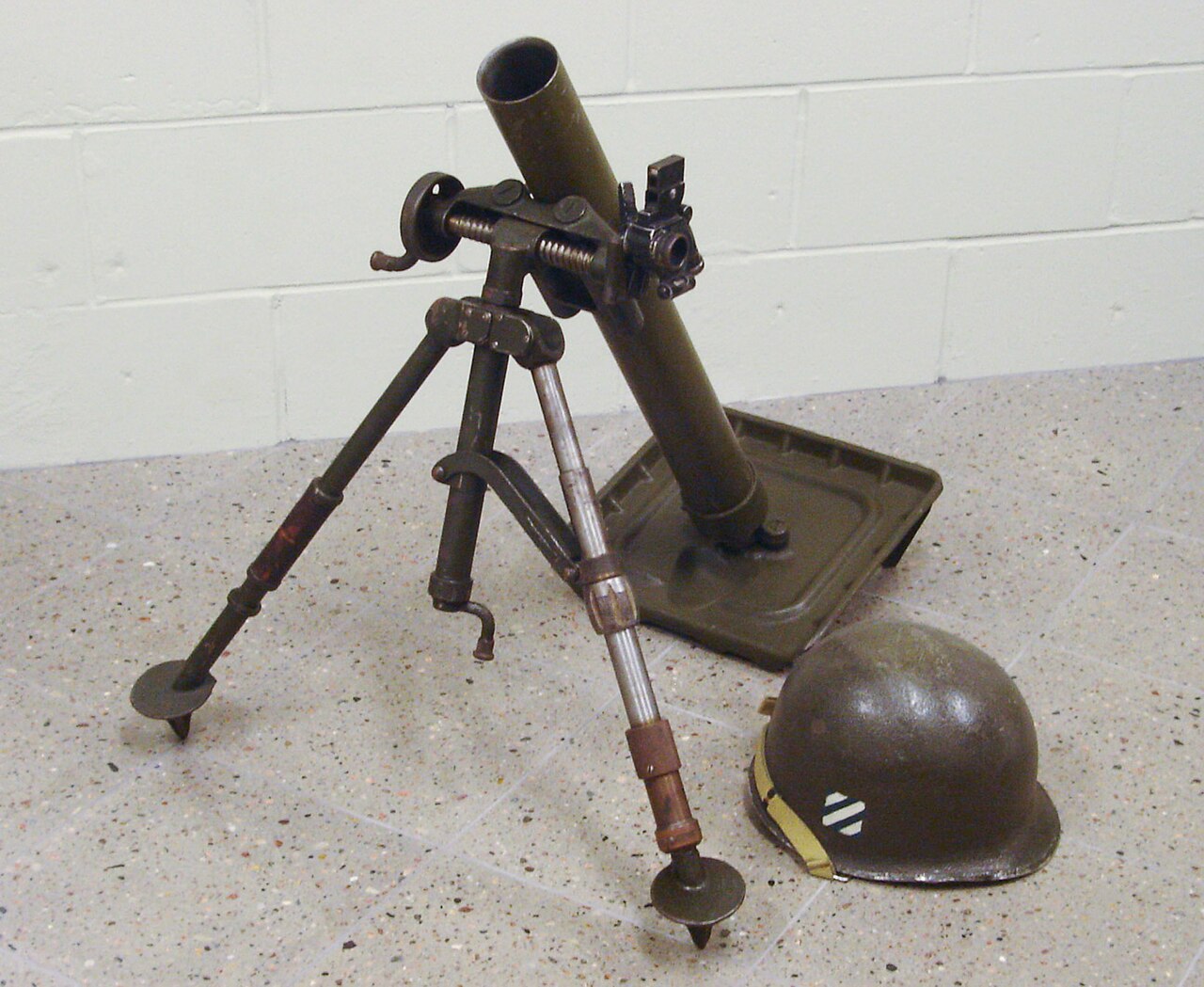
Curiosandrelics · CC BY-SA 3.0
- Name
- US M2 60 mm mortar
- Field
- 60 mm mortar
- Region
- United States
VALÉORINE Encyclopedia
VALÉORINE documentary reading
Documentary summary
The M2 mortar is a 60 millimeter smoothbore, muzzle-loading, high-angle-of-fire weapon used by U.S. forces in World War II, the Korean War, and the Vietnam War for light infantry support.
Admitted source layer · organised and presented by VALÉORINE
Note VALÉORINE
No house-authored Note is published until its assertions and sources pass the VALÉORINE evidence contract. The documentary article remains available in full while that enrichment is being consolidated.
Documentary enrichment in progress · no unsupported statement published
Reference Check
Propose documentary evidence for 60 mm mortar M2. A contribution is never written directly as fact: identity, source, rights and evidence gates still decide.
Sign in to contribute
World of VALÉORINE
Documentary connections
Only confirmed graph relationships appear here. Images are shown only when their identity and reuse rights both pass the documentary gate.
Documentary evidence
Evidence Panel
not yet certified
- Identity
- resolved
- Independent source families
- 0
- Admitted assertions
- 0
- Open conflicts
- 0
Authority files
wikidata · Q1033582
In this article
Key facts
Key facts
• Name — US M2 60 mm mortar • Origin — United States • Type — Infantry mortar • Is Artillery — yes • Used By — United States France Israel South Korea Republic of China China Turkey North Vietnam South Vietnam Vietnam • Wars — World War II Chinese Civil War First Indochina War Korean War Algerian War Portuguese Colonial War Rhodesian Bush War Vietnam War Soviet–Afghan War Iran–Iraq War Lebanese Civil War Nicaraguan Revolution Guatemalan Civil War • Designer — Edgar Brandt • Variants — Type 31 • Weight — 42 lb • Part Length — 726 mm • Crew — 5 (squad leader, gunner, assistant gunner, two ammunition carriers) • Cartridge — 3 lb • Caliber — 60 mm (2.36 in) • Rate — 18 rounds per minute • Velocity — 158 m/s • Max Range — 1.8 km • Elevation — +40° to +85° • Traverse — 7°
History and description
History and description
During the late 1920s, the US Army began examining mortars to act as light infantry support weapons for company level fire support, bridging the gap between medium mortars and hand grenades. In the late 1930s, the War Department eventually settled on a 60 mm design from Edgar Brandt, a French ordnance engineer. The Ordnance Department purchased eight of the French-built weapons in 1938, standardizing them as the Mortar, 60 mm, M1. When production drawings were revised by Watervliet Arsenal to adopt standard American threads, tubes, and plates, the weapon was redesignated the Mortar, 60 mm, M2. In January 1940, the first production contract for 1,500 mortars was issued to the Read Machinery Company of York, Pennsylvania. As requirements rose in 1940, another contract was placed with the Danville, Pennsylvania-based Kennedy-Van Saun Engineering Company. Requirements declined early in 1944, but by the end of the year, demand increased and exceeded existing supply. The War Department ordered Kennedy-Van Saun to increase production, and also added a contract from the Firestone Tire and Rubber Company; production of the M2 during the first eight months of 1945 totaled 30,152, nearly equaling that of the previous three years. Although classed as a light mortar, the M2 had considerable range compared to similar 50 mm and 60 mm-caliber weapons like the British Ordnance SBML two-inch mortar, Soviet RM-38 and related models, and German 5 cm Granatwerfer 36, with its fixed-firing pin design allowing for a high rate of fire by trained crews. Normally employed by weapons platoons of U.S. infantry companies, the M2 is of the usual mortar pattern of the day. It consists of a smoothbore metal tube on a rectangular baseplate, supported by the simple M5 bipod to which are attached elevation and traverse mechanisms. The firing pin was fixed in the base cap of the tube, firing the bomb automatically when it was dropped down the barrel. The weapon was used throughout World War II by the U.S. Army and U.S. Marine Corps. It saw service again in the Korean War, and by French forces in their counterinsurgency campaigns in Indochina and Algeria. The VPA used many M2 mortars captured from France (equipped by the US) and self-produced, equipped to companies and battalions. It was used under designation m/952 by Portugal during the Portuguese Colonial War. During the Vietnam War, the M2 was again used by the U.S. Army and marines, as well as by South Vietnamese forces. Ultimately, the M2 was replaced by the M224 in 1978.
Chinese variants
Chinese variants
China (the Republic of China prior to 1949) also locally produced the M2 mortar, which was designated as the Type 31. After the People's Republic of China was established in 1949, some Type 31s were supplied to North Korea and North Vietnam. It was later modified as the Type 63 and were supplied to Mujahideen rebels during Soviet–Afghan War. A variant called Type 63-1 has been produced under license by the Pakistan Machine Tool Factory Limited and by the Helwan Machine Tools Company in Egypt.
Operation
Operation
Each mortar shell had a screw-on cap in its base. Inside the hollow in the tail, it contained a 20-gauge M5A1 ignition cartridge. This was a paper shotgun shell filled with ballistite powder. The mortar had a firing pin in the bottom of the tube. When the shell was dropped down the tube, the firing pin struck the ignition cartridge in the shell's tail, detonating it. When the cartridge detonated, the explosive gases exited the base of the shell through two bleed holes. This propelled the shell out of the tube in an arc. Unassisted, the mortar shell had a range of about 200 to. To increase the mortar's range, shells were issued with four waterproof cellophane bags of propellant, called increments, fastened to the stabilizing fins with wire clips. The ignition cartridge would ignite the propellant, increasing chamber pressure and the shell's muzzle velocity. All four increments and the ignition cartridge pushed the maximum range to about 2,000 yd at 45 degrees elevation (depending on the shell's length and weight). To reduce the mortar's muzzle velocity, increment charges were removed as needed before firing. This allowed great flexibility in the angle at which shells impacted the target area, allowing the weapon to drop shells behind hills or buildings.
Ammunition
Ammunition
• Illustration — 60 mm mortar shells for the U.S. M2 mortar. Left-to-right: M69 training/practice, M49A2 high explosive, M302 white phosphorus/smoke, M83 illuminating (parachute flare) • Illustration — U.S. Marines firing M2 mortar during the Korean War. August, 1952 The M2 Mortar could fire several types of ammunition. • M49A2 high explosive (HE) with point detonating fuze M52B1 [Total weight, filler weight: of TNT]: An explosive shell used against infantry and other light area targets. It has a minimum range of 200 yd when fired without a boosting charge at a 70° angle and a maximum range of 2017 yd when fired with four boosting charges at a 45° angle. • M49A3 high explosive cartridge (HE) with super-quick point detonating fuze M525 [Weight: 3.05 lb (1.38 kg)]: Often referred to in the field as "HE quick". • M302 white phosphorus cartridge (WP): A "bursting smoke" shell used as a signaling, screening, smoke-producing, and casualty-producing shell. Unlike regular smoke shells of the period, which used a "hot" chemical reaction to generate a smoke cloud, the white phosphorus shell detonates to expose its filler to the air, causing it to spontaneously ignite and generate a thick cloud of white or grey smoke. It also sets combustible materials in its radius of effect on fire, causing secondary smoke sources. If personnel are hit by burning white phosphorus, the fragments will continue to burn inside the wound. They need to be evacuated to a hospital to have the fragments removed under special conditions. • M83 illuminating cartridge (ILL): A pyrotechnic parachute flare shell used in night missions requiring illumination for assistance in observation. • M69 training/practice cartridge (TP) [Weight: 4.43 lb (2.01 kg)]: A shell with a cast iron body, inert filler, and detachable fin assembly used to train recruits in firing the M2 mortar. The cast iron body is reusable and the fin assembly can be replaced if damaged. • M50A3 training/practice cartridge (TP) [Weight 3.15 lb (1.43 kg)]: This practice shell is ballistically matched to the M49A4 HE shell, making it easier for training. They are the same size and weight, only differing in that the M50A3 is inert and emits a puff of white smoke on impact.
Operators
Operators
• Albania • Austria • Australia •: Type 63 • Republic of China • China: Type 31, Type 63 and Type 63-1 • Denmark: designated m/51 • Egypt: Type 63-1 produced under license. • Ethiopian Empire: used by the Kagnew Battalion • France • Greece • Guatemala • Haiti • Indonesia •: Type 63 • Japan • North Korea: Type 31 • South Korea: The Armed Forces was equipped with 579 M2/M19s before the Korean War, and 2,263 were in service with the Army by the end of the war. Began replacing with KM19 in the 1970s. • Lebanon • Mexico • Morocco • Pakistan: Type 63-1 produced under license. • Portugal • Turkey • Thailand • United States • South Vietnam • North Vietnam Type 31 • Republic of South Vietnam • Vietnam: M2, Type 31 and Type 63
Places
Named by the record
Places
Only places the record itself states, plotted where the house gazetteer settles their coordinates. Nothing is inferred from a name or a nationality.
- United States
Primary material
Documents and archives
institutional register
- Internet Archive holdings naming 60 mm mortar M2
Unverified · Internet Archive
authority record
- Wikidata, structured authority record Q1033582: 60 mm mortar M2
Unverified · Wikidata
Notes from the source article
Cited by Wikipedia
Notes from the source article
These works are cited by the source article, in its own numbering. They are recorded as its citations, not as sources VALÉORINE has verified.
- 1.Norris, John and Calow, Robert, Infantry Mortars of World War II, Osprey Publishing (2002), , , p. 15
- 2.U.S. Army M2 60 mm Mortar
- 3.Huon, Jean. L'armement français en A.F.N. Gazette des Armes. 220. 12–16. March 1992.
- 4.Vũ khí Việt Nam trong hai cuộc kháng chiến. www.quansuvn.net.
- 5.Abbott, Peter. Modern African Wars 2: Angola and Mozambique 1961-74. Osprey Publishing. 18. 1998.
- 6.60 mm Type 31 and variants. Jane's Infantry Weapons 1992-1993. 1394. 1992.
- 7.US Department of Defense. North Korea Country Handbook 1997, Appendix A: Equipment Recognition. A-90.
- 8.Rottman, Gordon L. North Vietnamese Army Soldier 1958–75. Osprey Publishing. 32. 10 Feb 2009. 9781846033711.
- 9.60 mm Type 63 mortar. Jane's Infantry Weapons 1992-1993. 1392. 1992.
- 10.NORINCO 60 mm Type 63-1 mortar. Jane's Infantry Weapons 2002-2003. 1306–1307. 2002.
- 11.FT60-D-2 (Abridged) "Firing Tables for Mortar, 60-mm, M2" - Firing Shell, H.E., M49A2 WITH Fuze, P.D., M52B1 (Plastic) - Cartridge, Ignition, M5A1 - Weight of Fuzed Projectile 2.73 lb. [2 lbs., 12 oz.]
- 12.Mortar - 60 mm. defence.gov.au. March 2015.
- 13.Directorate General of Defence Purchase. TENDER NOTICE P.4 SEC. dgdp.gov.bd.
- 14.Wiener, Friedrich. The armies of the NATO nations: Organization, concept of war, weapons and equipment. Herold Publishers. 462. 1987.
- 15.Ethiopians in the Korean War: WWII gear used. wwiiafterwwii.wordpress.com self-published source. January 2019.
- 16.Iraqi army equipment 1930-2017. 2. 114.
- 17.Kenji Jyoshima. 陸自車両50年史 (50 Years of JGSDF's Vehicles). Argonauts Publications. 126. October 2007.
- 18.Bak, Dongchan. Korean War: Weapons of the United Nations. Ministry of Defense Institute for Military History. 82–84. March 2021. 979-11-5598-079-8.
- 19.60mm M2 mortar. Jane's Infantry Weapons 2001-2002. 5338–5339. 2002.
- 20.Rottman, Gordon L. Army of the Republic of Vietnam 1955–75. Osprey Publishing. 9. 2010. 9781849081818.
References
Citations
References
Each reference names the institution holding it, so a reader may go to the document itself.
institutional register
Internet Archive holdings naming 60 mm mortar M2Internet Archive
Partially resolvedauthority record
Unverified
The Encyclopedia exists whether or not anything is for sale. Corrections are recorded rather than overwritten, and every version of this record is kept. Published 14 August 2026.
Elsewhere in Militaria
6,095 published records in this field, each with its sources named.
- 6.8 WesternTerminology
- 6.8x51 mmTerminology
- 6×45mmTerminology
- 6×45mm SAWTerminology
- 65 mm L/17 Cannon Model 13Terminology
- 68-Pounder Lancaster gunTerminology
- 6mm ARTerminology
- 6mm ARCTerminology
Best supported in this field
For owners
Own an object connected with 60 mm mortar M2?
A specialist will read what you send and tell you what the house can establish, what it cannot, and whether the object is suited to sale. There is no charge and no obligation. The object stays with you throughout; nothing is shipped to us unless it is arranged in writing beforehand.