
40mm grenade
Illustration — Box full of 40×53 mm high-velocity grenades • Illustration — A 40×46 mm low-velocity training round being fired from an M203 grenade launcher This is a general collection of the world's many types of ammunition for grenade launchers in 40 mm caliber. Several countries have developed or adopted 40 mm-caliber grenade launchers.
Also recorded as 40 mm grenade
40mm grenade

Nickel nitride · CC0
- Field
- cartridge · grenade
VALÉORINE Encyclopedia
VALÉORINE documentary reading
Documentary summary
Illustration — Box full of 40×53 mm high-velocity grenades • Illustration — A 40×46 mm low-velocity training round being fired from an M203 grenade launcher This is a general collection of the world's many types of ammunition for grenade launchers in 40 mm caliber. Several countries have developed or adopted 40 mm-caliber grenade launchers.
Admitted source layer · organised and presented by VALÉORINE
Reference Check
Propose documentary evidence for 40mm grenade. A contribution is never written directly as fact: identity, source, rights and evidence gates still decide.
Sign in to contribute
World of VALÉORINE
Documentary connections
Only confirmed graph relationships appear here. Images are shown only when their identity and reuse rights both pass the documentary gate.

Documentary evidence
Documentary basis
Authority files
wikidata · Q231328
In this article
NATO
NATO
NATO currently uses three standardized 40 mm grenade families: 40 mm low-velocity (LV), 40 mm medium-velocity (MV), and 40 mm high-velocity (HV). Low- and medium-velocity cartridges are used for different hand-held grenade launchers, while the high-velocity cartridge is used for automatic grenade launchers.
40×46 mm LV (40 mm low velocity)
40×46 mm LV (40 mm low velocity)
• Illustration — A 40×46 mm low-velocity cartridge being loaded into an M203 grenade launcher attached to an M16A1 • Illustration — Fired 40 mm low-velocity M781 showing its orange signal chalk 40×46 mm LV (low velocity) is a NATO-standard high–low grenade launcher cartridge meant for hand-held grenade launchers, such as the M79, M203, Milkor MGL, Heckler & Koch AG36 and M320 Grenade Launcher Module. The propellant has low pressure and gives the projectile an average velocity of 78-84 m/s depending on the ammunition type.
40 mm low-velocity ammunition types (NATO)
40 mm low-velocity ammunition types (NATO)
* • Illustration — x150px • HE, high explosive • M381 HE, high explosive Basic high-explosive shell. — • M386 HE, high explosive Basic high-explosive shell. — Missing image • M406 HE, high explosive Basic high-explosive shell. — • Illustration — x100px • M441 HE, high explosive Basic high-explosive shell. — Missing image • AB, air burst • M397, M397A1 AB, air burst Octol filled fragmentation grenade with a time fuze. The A1 has a different fuze from the regular M397. — Missing image • DP, dual purpose • M433 HEDP, high-explosive dual-purpose Shaped charge with ability to damage soft targets and penetrate armor. Armor penetration: 2.5 inches (63 millimeters). — • Illustration — x100px • M433A1 HEDP M433A1 uses the improved M550A1 fuze. The projectile consists of a copper-shaped charge in an explosive-filled steel cup covered with tungsten spherical fragments over-molded with a plastic aerodynamic body. — • MP, multiple projectile • M576 MP-APERS, multiple projectile anti-personnel Buckshot cartridge with twenty 24-grain bullets. — Missing image • IL, illumination • M583A1 Illumination/signal flare, parachute star (white flare) Flare grenade with parachute for illumination and signaling. — • Illustration — x100px • M585 Illumination/signal flare, cluster star (white flare) Grenade containing five nose-ejected, free-falling pyrotechnic star pellets used for signaling. — Missing image • M661 Illumination/signal flare, parachute star (green flare) Flare grenade with parachute for illumination and signaling. — Missing image • M662 Illumination/signal flare, parachute star (red flare) Flare grenade with parachute for illumination and signaling. — Missing image • M992 Infra-red illumination flare Flare grenade with parachute for infrared illumination. — • Illustration — x100px • S, smoke • M676 Smoke canopy (yellow smoke) Smoke grenade with parachute for signaling and marking. — Missing image • M680 Smoke canopy (white smoke) Smoke grenade with parachute for signaling and marking. — Missing image • M682 Smoke canopy (red smoke) Smoke grenade with parachute for signaling and marking. — Missing image • M713 Ground marker (red smoke) Smoke grenade for signaling and marking. — Missing image • M714 Ground marker (white smoke) Smoke grenade for signaling and marking. — Missing image • M715 Ground marker (green smoke) Smoke grenade for signaling and marking. — Missing image • M716 Ground marker (yellow smoke) Smoke grenade for signaling and marking. — Missing image • G, gas • M651 CS gas Tear gas grenade. — Missing image • TB, thermobaric • XM1060 Thermobaric The XM1060 is a 40 mm thermobaric grenade developed by Picatinny Arsenal. — Missing image • P, practice • M781 P, practice Training ammunition consisting of a steel body filled with orange signal chalk capped with a plastic ogive cap. — Besides combat ammo, there is also crowd-control ammunition such as sponge grenades.
40 mm low-velocity ammunition types (Sweden)
40 mm low-velocity ammunition types (Sweden)
Sweden currently operates the M203 grenade launcher (designated Granattillsats 40 mm Automatkarbin in Sweden) and thus uses the 40 mm low-velocity cartridge. Going against Swedish military tradition, the 40 mm low-velocity cartridge currently lacks a specified indigenous designation in Swedish service. Instead only the projectile types have designations. Currently, these projectile types can be found in Swedish service manuals. • HE, high explosive • 40 GSGR HE, high explosive Name: 40 GSGR, abbreviation for 40 mm gevärsspränggranat, Swedish for 40 mm rifle high-explosive grenade. The fuze is designated ÖHKBAR 40 GSGR, an abbreviation for ögonblickligt högkänsligt basanslagsrör + shell designation, Swedish for 'instant high sensitivity base impact fuze'. Description: The type is a high-explosive grenade meant against soft targets. Construction: The shell consists of a fragmentation body outfitted with internal steel balls for extra fragmentation damage. A highly sensitive, zero-delay fuze is located at the bottom of the shell. Marking: The shell has a yellow head and green body. The side of the shell features the marking "ST" in yellow, which stands for stålkulor ('steel balls'). * 40 GSGR data * Cartridge weight — 0.264 kg * Shell weight — 0.19 kg * Primary charge — 3 g PETN * Main charge — 23 g RDX * Propellant — 0.35 g NCGL * High pressure — 70 MPa * Low pressure — 15 MPa * Muzzle velocity — 84 m/s * NEM — 26 g * Sources — Missing image • DP, dual purpose • 40 GPSGR HEDP, high-explosive dual-purpose Name: 40 GPSGR, abbreviation for 40 mm gevärspansarspränggranat, Swedish for "40 mm rifle high explosive anti-tank grenade". Description: The type is a high-explosive dual-purpose grenade meant for use against both soft and lightly protected targets. It is probably equivalent to the American 40 mm M433. Construction: The shell consists of a fragmentation body, a high-explosive charge and a shaped charge. Marking: The shell has a green head and green body. The side of the shell features the marking "RSV" in yellow, which stands for riktad sprängverkan ("shaped charge", lit. "directed explosive effect"). * 40 GPSGR data * Cartridge weight — 0.26 kg * Shell weight — 0.19 kg * Primary charge — 0.33 g CH-6 * Main charge — 43.5 g Comp A5 * Propellant — 0.34 g NCGL * High pressure — 70 MPa * Low pressure — 15 MPa * Muzzle velocity — 78 m/s * NEM — 44.3 g * Sources — Missing image • P, Practice • 40 GÖVNGR 07 P, practice Name: 40 GÖVNGR 07, abbreviation for 40 mm gevärsövningsgranat 07, Swedish for 40 mm rifle practice grenade 07. Description: The type is a practice shell for combat training and practice shooting. Construction: The shell has a steel body with a plastic cap and is filled with red signal chalk. Marking: The shell is colored in NATO blue training color. * 40 GÖVNGR 07 data * Cartridge weight — 0.26 kg * Shell weight — 0.19 kg * Primary charge — - * Main charge — Red signal chalk * Propellant — 0.47 g NCGL * High pressure — 70 MPa * Low pressure — 15 MPa * Muzzle velocity — 78 m/s * NEM — 5 g * Sources — Missing image Mockups and inert types also exist for loading exercises and educational purposes.
40 mm low-velocity ammunition types (Romania)
40 mm low-velocity ammunition types (Romania)
Romanian arms producer ROMARM has produced a version of their 40 mm rifle-mounted grenade launcher, AG-40, chambered in 40×46 mm NATO (then designated AG-40PN). Production of Romanian 40 mm low-velocity ammunition is handled by the arms factory Uzina Mecanica Plopeni, a subsidiary of ROMARM. The projectiles seem to be of Romanian origin based on available information. • HE, high explosive • Grenade 40 NATO Exploziva HE, high explosive Description: Romanian 40×46 mm low-velocity high-explosive cartridge. Construction: The shell is made of steel and has a point fuze. The main explosive charge is located at the bottom of the shell. Below the main explosive charge is a layer of metal balls for extra fragmentation damage. * Grenade 40 NATO Exploziva data * Cartridge length — 112 mm * Cartridge weight — 370 g * Shell weight — 245 g * Muzzle velocity — 75 m/s * Lethal radius — 10 m * Self-destruct — 16-23 s * Sources — Missing image • P, practice • Grenade 40 NATO Inerta P, practice Name: The cartridge is named Inerta (inert), but the cartridge is live. Inert refers to the projectile, which is a solid material projectile. Description: Romanian 40×46 mm low-velocity practice cartridge. Construction: The shell is solid in construction and made of duralumin. * Grenade 40 NATO Exploziva data * Cartridge length — 112 mm * Cartridge weight — 370 g * Shell weight — 245 g * Muzzle velocity — 75 m/s * Lethal radius — - * Self-destruct — - * Sources — Missing image
SAGM fuze
SAGM fuze
The United States Army Armament Research, Development and Engineering Center (ARDEC) began development of a 40 mm smart airburst fuze (proximity fuze) in 2011 to improve the ability of grenade launchers like the M203 and M320 to engage targets in defilade. Called small arms grenade munitions (SAGMs), they double the lethality of the standard M433 grenade round by adding a small "smart" fuze sensor that detonates in the air to hit targets in cover or behind obstacles. The airburst function is similar to the XM25 CDTE, which has an onboard laser system to determine the distance to the target, but SAGMs are considered complementary to the XM25 rather than competing against it, as the XM25 provides low-angle fire while 40 mm launchers fire a lobbing trajectory. Integrated sensors and logic devices scan and filter the environment, then autonomously airburst the fuze without being told by the firer, thereby not requiring the soldier to carry extra weapon accessories. SAGMs enable soldiers to accurately incapacitate personnel targets in defilade at ranges between 50 and 500 meters. The round is engineered with three firing modes: airburst, point detonation, and self-destruct. A successful demonstration occurred in November 2013. Although the SAGM sensor does not need a laser rangefinder or any pre-fire programming sequence, it does require some skill by the user to aim and fire the round correctly so that it can detect the wall or obstruction to detonate in the air. The SAGM was to undergo evaluation in July 2015 and, if successful, transition into an official Army Program of Record by the end of the year. Not only does the fuze burst over walls, but it can detonate when passing cover like trees, bursting just as it senses and passes the trunk. The sort of sensor SAGMs use to differentiate clutter from triggering obstacles is highly classified, but shows airburst reliability of 76 percent.
40×51 mm MV (40 mm medium velocity)
40×51 mm MV (40 mm medium velocity)
40×51 mm MV (medium velocity), also known as 40×51 mm extended range low pressure (ERLP), is a NATO-standard high–low grenade launcher cartridge meant for hand-held grenade launchers. Its purpose is to serve as an intermediate cartridge between the 40×46 mm low-velocity and 40×53 mm high-velocity cartridges and is thus referred to as the 40 mm medium-velocity cartridge. The propellant has medium pressure and gives the projectile an average velocity of 100 m/s depending on the ammunition type. It has a maximum range of 800 meters, exceeding conventional extended range low-velocity variants by up to 375 meters. The 40×51 mm MV cartridge was designed by Rheinmetall Denel Munitions for the US Special Operations Command (USSOCOM) after a 2008 requirement for enhanced range and lethality from hand-held 40 mm grenades. Rheinmetall answered by developing a new family of 40 mm grenades named 40 mm medium velocity and by 2019 the cartridge was undergoing NATO qualification. Besides NATO the cartridge has been ordered by the South African National Defence Force (SANDF) as the cartridge for their next generation multiple grenade launcher, the Milkor Y4. SANDF approved acquisition in February 2018 but deliveries could not be finished until the end of 2020 due to the COVID-19 pandemic.
40×53 mm HV (40 mm high velocity)
40×53 mm HV (40 mm high velocity)
• Illustration — 40 mm high-velocity high-explosive dual-purpose M430A1 cartridge • Illustration — 40×53 mm high-velocity ammunition belt 40×53 mm HV (high velocity) is a NATO-standard high–low grenade launcher cartridge meant for mounted or crew-served automatic grenade launchers, such as the Mk.19 AGL, Mk 47 Striker, HK GMG, STK 40 AGL, and Daewoo K4. The propellant has high pressure and gives the projectile an average velocity of 241 m/s depending on the ammunition type.
40 mm high-velocity ammunition types (NATO)
40 mm high-velocity ammunition types (NATO)
* • Illustration — x150px • HE, high explosive • M383 HE, high explosive High explosive shell filled with composition A5. (Comp 5A = hexogen + graphite according to Swedish manuals). Wound radius: 15 meters. Arms: 18-36 meters — Missing image • M384 HE, high explosive High explosive shell filled with composition A5. (Comp 5A = hexogen + graphite according to Swedish manuals). — Missing image • DP, dual purpose • M430, M430A1 HEDP, high-explosive dual-purpose M430: Shaped charge with ability to damage soft targets and penetrate armor. It arms within 18 to 30 meters of the gun muzzle and has a point-initiating, base-detonating (PIBD) fuze. Armor penetration: 2 in. of steel armor at 0-degree obliquity Inflict personnel casualties: 15 meters from impact M430A1: Has a longer shaped charge than the M430 and penetrates more armor. Armor penetration: 3 in. — • CA, canister • M1001 HVCC, high-velocity canister cartridge Canister shot containing several flechettes. Produces a 3 to 4 ft wide dispersion pattern at 50 m. — Missing image • AB, air burst • XM1176 HEDP-AB, high-explosive dual-purpose air burst Dual purpose shaped charge with programmable fuze for air burst functionality. — • Illustration — x100px • MK285 PPHE/SD, programmable prefragmented high explosive/self-destructible The MK285 is an anti-personnel cartridge designed for the Mk 47 Striker automatic grenade launcher. It consists of an electronic programmable fuze, a pre-fragmented warhead, and a propulsion system. The gun's fire control programs the fuze. The fuze is mechanically armed at approximately 23 meters. The round is programmed to airburst over the target, and the fuze counts down the programmed time via its built-in electronics. If an unprogrammed round is fired, it will detonate on impact. The projectile has a built-in self-destruct and can be fired by any automatic grenade launcher. — Missing image • P, practice • M385, M385A1 P, practice M385: Training round featuring a solid metal projectile. M385A1: Updated M385 featuring an ogive equal to the M430 HEDP round. — Missing image • M918 P, practice. The M918 is a training practice cartridge that has the same muzzle velocity of 790 feet per second (fps), signature, and sound as the HE round. — Missing image • M922, M922A1 Dummy round Trainers use dummy rounds to check weapon function and to train crews. — Missing image • MK281 Mod 0, MK281 Mod 1 P, practice MK281 Mod 0: Training round featuring an impact marker. MK281 Mod 1: Training round featuring a day-night marker. — Missing image
Green ammunition
Green ammunition
The MK281 is a new type of 40 mm target practice grenade ammunition that has been accepted for use by the United States Marine Corps and the United States Army. It is "green" because it is non-toxic and non-dud-producing (since it is a training round), meaning that there is no unexploded ordnance left to clean up on the range, and heavy metals in the fuze do not leak into the ground. The MK281 was introduced into parts of the U.S. Armed Forces due to an executive order mandating the purchase of green ammunition. The MK281 is manufactured by an American subsidiary of the Rheinmetall Group. The United States Army requires a non-dud producing 40 mm training ammunition in both high- and low-velocity variants. The Army awarded four contracts to three United States companies to test designs. The resulting ammunition will not contain explosive energetics and will have day-and-night visible, infrared, and thermal signatures.
40×47 mm (Poland)
40×47 mm (Poland)
• Illustration — Pallad-D wz. 83 40×47 mm was a cartridge caliber produced in Poland for their Pallad wz. 74 rifle-mounted grenade launchers (used with the AK family of rifles in the Polish Army, like the AKM/AKMS, Tantal, and Beryl) and Pallad-D wz. 83 grenade launcher (standalone variant fitted with standard pistol grip and folding stock from the AKMS assault rifle). The construction is similar to the one used in 40×46 mm grenades, but they are not interchangeable.
40×47 mm (Romania)
40×47 mm (Romania)
• Illustration — PA md. 86 assault rifle with 40 × 47 mm AG-40 grenade launcher 40×47 mm is a cartridge caliber produced in Romania for their AG-40 model 77 and model 80 (today AG-40P) rifle-mounted grenade launchers. It features a casing with a high–low system. The propellant has low pressure and gives the projectile an average velocity of 78-120 m/s depending on the ammunition type. Production was originally handled by the arms factory Uzina Mecanica Filiasi; however, production was later moved to the arms factory Uzina Mecanica Tohan Zărnești, today more commonly known as S. Tohan S.A., a subsidiary of ROMARM. Several types of the Romanian 40×47 mm exist: • High explosive • High-explosive fragmentation • Smoke • Incendiary • Tear gas • Practice, featuring a small flash charge and smoke signal. • Inert Tohan currently (2021) offers a 40×47 mm high explosive type called GETZ (Grenadă Explozivă Tohan Zărnești) and an inert version called GITZ (Grenadă Inertă Tohan Zărnești). Both cartridges are 105 mm long, with GETZ weighing 0.260 kg and GITZ 0.200 kg.
40×74.5 mm (Romania)
40×74.5 mm (Romania)
• Illustration — An AGA‑40 grenade launcher 40×74.5 mm is a cartridge caliber produced in Romania for their AGA-40 Model 85 automatic grenade launcher. It features a casing with a high–low system. The propellant has high pressure and gives the projectile an average velocity of 216-223 m/s depending on the ammunition type. The arms factory Uzina Mecanica Plopeni, a subsidiary of ROMARM, handles production. Three ammunition types are known: • A high-explosive grenade producing 150 fragments weighing 0.2 g each, creating a deadly radius of 10 meters upon impact. • A high-explosive dual-purpose grenade capable of penetrating 50 mm of steel armor. • An inert cartridge for loading exercise.
40×56mm (Japan)
40×56mm (Japan)
The standard adopted by the Japan Ground Self-Defense Force in its Type 96 grenade launcher. It is manufactured by Daikin Industries, and the '40 mm anti-personnel light armour-piercing round' (ammunition length 112 mm, weight 371 g) is a multi-purpose grenade with a moulded explosive charge. There is also a '40 mm training round' available.
40 mm VOG-25 (Russia)
40 mm VOG-25 (Russia)
• Illustration — VOG-25 40 mm VOG-25 (Russian Cyrillic: ВОГ-25) (GRAU-Index: 7P17 (Russian Cyrillic: 7П17)) is a unique type of 40 mm grenade designed in the Soviet Union for hand-held grenade launchers, such as the Soviet GP-25 Kostyor and GP-30 Obuvka. Instead of a casing, the VOG-25 is caseless ammunition, featuring its propellant in an expansion chamber at the base of the projectile, functioning more like a mortar round than conventional cased ammunition. Today it is used primarily by the Russian Armed Forces in weapons such as the GP-34, BG-15 Mukha and RG-6. Several types exist, but the most common version is the default VOG-25 high-explosive version. The VOG-25 is 103 mm long, weighs 250 g, and features a 48 g explosive charge. It has a muzzle velocity of 76 m/s and will self-destruct after 14 seconds.
40 mm Metal Storm (Australia)
40 mm Metal Storm (Australia)
Australia based R&D company Metal Storm Limited designed several automatic caseless 40 mm grenade launcher systems based on their own caseless ammunition weapon design prior to entering administration in 2012. Unlike common caseless ammunition and their weapon systems the Metal Storm design lacked a feeding magazine and instead used a superimposed load, stacking the projectiles in front of each other in the barrel with the propellant in between the projectiles. The system lacked moving parts and the propellant was electronically fired. The systems used the same warheads as existing 40mm grenades.
40 mm 7P39 (Russia)
40 mm 7P39 (Russia)
The 40mm 7P39 is a type of caseless grenade used in the Russian AGS-40 "Balkan" automatic grenade launcher. Unlike conventional grenades that use separate casings, propellants, and projectiles, the 7P39 integrates all components into a single unit, eliminating the need for ejected shell casings. This design is tailored for the AGS-40, which fires at up to 400 rounds per minute and has an effective range of approximately 2,500 meters. The 7P39 grenade features a high-explosive fragmentation (HE-FRAG) warhead and is approximately 132 mm in length, weighing around 0.432 kg. It is designed to deliver powerful explosive effects against personnel, vehicles, and fortifications. The 7P39 is not compatible with the VOG-25.

40 mm grenade
Nickel nitride
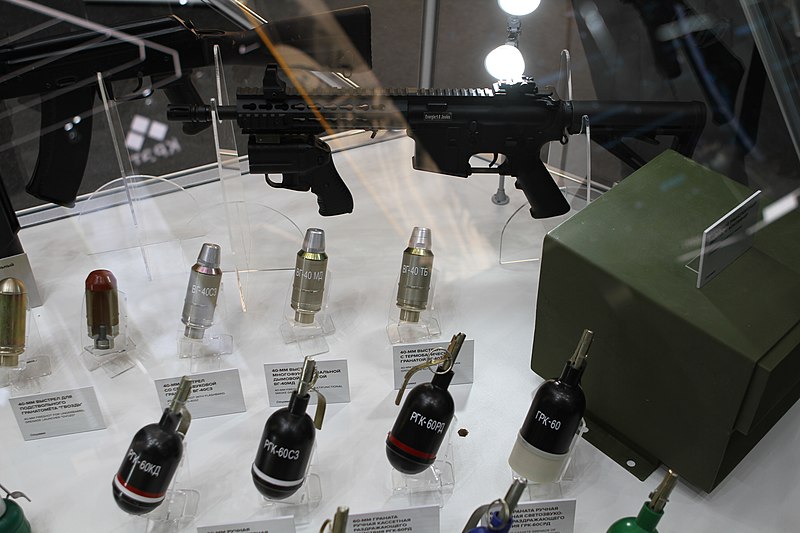
40 mm grenade and hand grenades RGK-60 of Russia
Nickel nitride
Notes from the source article
Cited by Wikipedia
Notes from the source article
These works are cited by the source article, in its own numbering. They are recorded as its citations, not as sources VALÉORINE has verified.
- 1.Grenade Launchers and their Ammunition: International Developments. Small Arms Defense Journal.
- 2.C.I.P. 40 x 46. 30 September 2017.
- 3.M381. bulletpicker.com.
- 4.M386. bulletpicker.com.
- 5.M406. bulletpicker.com.
- 6.M441. bulletpicker.com.
- 7.M397. bulletpicker.com.
- 8.M397A1. bulletpicker.com.
- 9.M433. bulletpicker.com.
- 10.40MM M433 HEDP. nationaldefensecorp.com.
- 11.Oesterheld, Daniel. Smarter Resupply. Army ALT Magazine. 13 April 2023.
- 12.Joint Program Executive Office Armaments & Ammunition. 2025 Product Portfolio Book. 29 April 2025.
- 13.M576. bulletpicker.
- 14.M583A1. bulletpicker.com.
- 15.M585. bulletpicker.com.
- 16.M676. bulletpicker.com.
- 17.M680. bulletpicker.com.
- 18.M682. bulletpicker.com.
- 19.M713. bulletpicker.com.
- 20.M715. bulletpicker.com.
- 21.M716. bulletpicker.com.
- 22.M651. bulletpicker.com.
- 23.XM1060. globalsecurity.org. 2017-06-12.
- 24.M781. bulletpicker.com.
- 25.Granatspruta 92 (Grsp92). soldf.com. 2020-12-09.
- 26.FMV: Försvarets materielverk. AMKAT: Ammunitionskatalog, data och bild. Part 1. 2001.
- 27.FMV: Försvarets materielverk. AMKAT: Ammunitionskatalog, data och bild, 2014. 2014.
- 28."Enhanced grenade lethality: On target even when enemy is concealed". US Army, 4 September 2014
- 29."ARDEC's airburst round to begin evaluation this summer". US Army, 8 December 2014
- 30."New light machine gun: M249 put on weight control". US Army, 6 May 2015
- 31.40-mm granaty Rheinmetall dla RPA. www.milmag.pl. 2020-11-14.
- 32.Rheinmetall – the leading one-stop-shop for 40mm systems. edrmagazine.eu. 2019-09-10.
- 33.Milkor M32 and M32A1 40mm Grenade Launchers. youtube.com. 2019-07-05.
- 34.14001 - Enhancing range and lethality – 40mm Medium Velocity Ammunition and Weapons. proceedings.ndia.org.
- 35.Rheinmetall supplies South African National Defence Force with new 40mm medium-velocity ammunition. rheinmetall-defence.com. 2020-11-13.
- 36.M383. bulletpicker.com.
- 37.Department of the Army. Field Manual 3-22.27 (FM 23.27) MK 19, 40-mm GRENADE MACHINE GUN, MOD 3. November 2003.
- 38.M384. bulletpicker.com.
- 39.US Cartridge, 40mm HEDP, M430, M430A1. bulletpicker.com.
- 40.Department of the Army. Field Manual 3-22.27 (FM 23.27) MK 19, 40-mm GRENADE MACHINE GUN, MOD 3. November 2003.
- 41.40mm M1001 HVCC High Velocity Canister Cartridge. Gd-ots.com.
- 42.40mm High Velocity (HV) High Explosive Dual Purpose Airburst (HEDP-AB) XM1176 Cartridge. govtribe.com. Oct 25, 2018.
- 43.M385. bulletpicker.com.
- 44.M385A1. bulletpicker.com.
- 45.US Cartridge, 40mm Practice, M918. bulletpicker.com.
- 46.Department of the Army. Field Manual 3-22.27 (FM 23.27) MK 19, 40-mm GRENADE MACHINE GUN, MOD 3. November 2003.
- 47.M922. bulletpicker.com.
- 48.M922A1. bulletpicker.com.
- 49.Department of the Army. Field Manual 3-22.27 (FM 23.27) MK 19, 40-mm GRENADE MACHINE GUN, MOD 3. November 2003.
- 50.MK281 Mod 0 and Mod 1 40 mm x 53 Practice. rheinmetall-defence.com.
- 51.Granatspruta 92 (Grsp92). soldf.com. 2020-12-09.
- 52.navweaps.com. 40 mm Mark 19 Grenade MG.
- 53.munitie ag 40 Archives - Romania Military. Romania Military.
- 54.S. TOHAN Sa. Military Products.
- 55.自衛隊装備年鑑 2006-2007 朝雲新聞社 P43
- 56.96式40mm自動てき弾銃.
- 57.Выстрел гранатомётный ВОГ-25. worldweapon.ru. 2002–2006.
- 58.Deadliest weapon ever invented- Metal Storm. youtube.com. 2009-12-22.
- 59.Metal Storm Mortar. youtube.com. 2006-11-24.
- 60.Deadliest Gun Ever Invented - Million Rounds Per Minute - Metal Storm. youtube. 2017-09-10.
- 61.Tecmash AGS-40 (Balkan).
- 62.IDEX 2019: Tecmash unveils AGS-40 grenade launcher. 20 February 2019.
References
Citations
References
Each reference names the institution holding it, so a reader may go to the document itself.
reference work
Secondary witness
Connections
Knowledge graph
Connections
Each connection was recorded deliberately, with the basis for it kept on the internal record.
Broader subject
1- cartridgeTerminology
Established from a fact already recorded on a verified source.
The Encyclopedia exists whether or not anything is for sale. Corrections are recorded rather than overwritten, and every version of this record is kept. Published 16 August 2026.
Elsewhere in Militaria
6,095 published records in this field, each with its sources named.
- 40.6 cm SK C/34 gunTerminology
- 40×47 mm SR grenadeTerminology
- 40CT cannonTerminology
- 40M NimródTerminology
- 41 cm/45 3rd Year Type naval gunTerminology
- 42 cm Gamma MörserTerminology
- 42 cm Haubitze M. 14/16Terminology
- 42 line gun M1877Terminology
Best supported in this field
For owners
Own an object connected with 40mm grenade?
A specialist will read what you send and tell you what the house can establish, what it cannot, and whether the object is suited to sale. There is no charge and no obligation. The object stays with you throughout; nothing is shipped to us unless it is arranged in writing beforehand.