
17 cm Kanone 18
The 17 cm Kanone 18 in Mörserlafette (English: 17 cm Cannon 18 on Mortar Carriage), abbreviated as 17 cm K 18 in MrsLaf, was a German heavy gun used during World War II.
Also recorded as K 18 · 17 cm Cannon 18 on Heavy Howitzer Carriage · Howitzer, Towed, 170 mm, K 18
17 cm Kanone 18
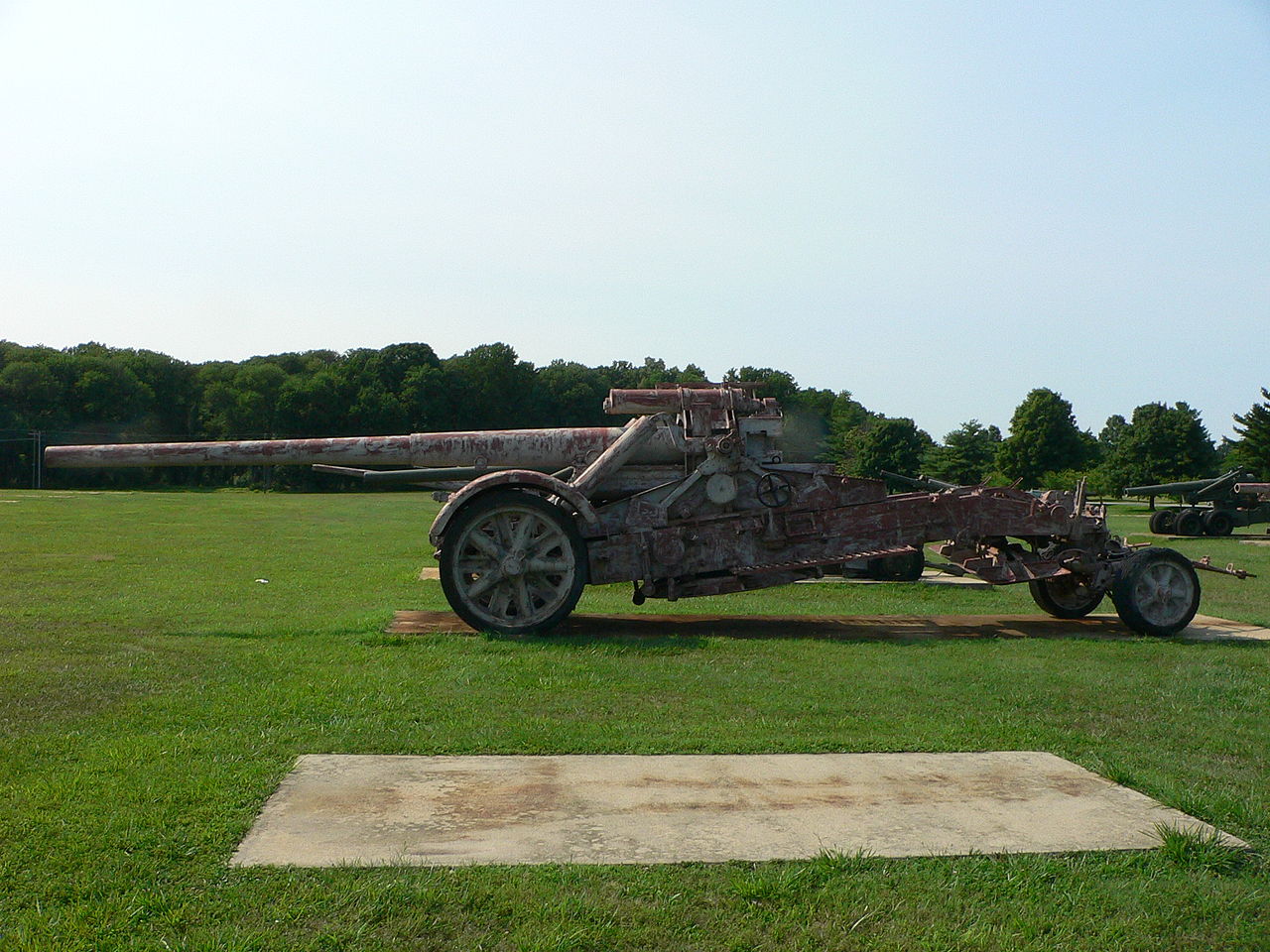
Mark Pellegrini · CC BY-SA 2.5
- Field
- 170 mm artillery, field gun and field howitzer.
- Region
- Germany.
VALÉORINE Encyclopedia
VALÉORINE documentary reading
Documentary summary
The 17 cm Kanone 18 in Mörserlafette (English: 17 cm Cannon 18 on Mortar Carriage), abbreviated as 17 cm K 18 in MrsLaf, was a German heavy gun used during World War II.
Admitted source layer · organised and presented by VALÉORINE
Note VALÉORINE
No house-authored Note is published until its assertions and sources pass the VALÉORINE evidence contract. The documentary article remains available in full while that enrichment is being consolidated.
Documentary enrichment in progress · no unsupported statement published
Reference Check
Propose documentary evidence for 17 cm Kanone 18. A contribution is never written directly as fact: identity, source, rights and evidence gates still decide.
Sign in to contribute
World of VALÉORINE
Documentary connections
Only confirmed graph relationships appear here. Images are shown only when their identity and reuse rights both pass the documentary gate.

Documentary evidence
Evidence Panel
original value insufficient · checked 25 September 2026
- Identity
- resolved
- Independent source families
- 0
- Admitted assertions
- 0
- Open conflicts
- 0
Authority files
wikidata · Q197264 · wikipedia · 17 cm Kanone 18
In this article
Design
Design
The 17 cm K 18 in MrsLaf was a 172.5 mm (6.79 in) towed gun with a barrel 50 calibres long. The 17 cm K 18 in MrsLaf shared the same box trail carriage with the 21 cm Mörser 18. The carriage allowed transport of the weapon over short distances in one piece, whilst for longer distances the barrel was removed from the carriage and transported separately. A series of ramps and winches made removing the barrel a reasonably quick task for its time, but still required several hours. For all of the gun's bulk, a full 360-degree traverse could be achieved by two men.
Dual-recoil mechanism
Dual-recoil mechanism
A notable innovation by Krupp on the 21 cm Mörser 18 and the 17 cm Kanone 18 was the "double recoil" or dual-recoil carriage. The normal recoil forces were initially taken up by a conventional recoil mechanism close to the barrel, and then by a carriage sliding along rails set inside the travelling carriage. The dual-recoil mechanism absorbed all of the recoil energy with virtually no movement of the box trail upon firing, thus making for a very accurate weapon.
Ammunition
Ammunition
Projectiles The 17 cm K 18 in MrsLaf fired three types of separately loaded ammunition. Shell performance The 17 cm K 18 in MrsLaf separately loaded ammunition used four charges. The gun's performance when firing the 62.8 kg (138 lb) 17cm K Gr 38 Hb long-range shell is depicted in the following table:
History
History
In 1939, the 21 cm Mörser 18 began appearing in the Wehrmacht corps-level artillery regiments, replacing the obsolescent World War I-era 21 cm Mörser 16. The gun was able to send a 113 kg (249 lb) HE shell out to a range of 14.5 km (9 mi); however, by 1941, the Wehrmacht was seeking a longer-ranged weapon and Krupp responded by producing a smaller 172.5 mm (6.79 in) calibre increased-velocity weapon utilising the same carriage, with the designation Kanone 18. The 17 cm K 18 in MrsLaf quickly impressed German artillery officers with its range, but the real surprise was the explosive power of the 62.8 kg (138 lb) shell, which was little different from the 113 kg (249 lb) shell of the 21 cm Mörser 18. Production commenced in 1941. In 1942, production of the 21 cm Mörser 18 was halted for almost two years so as to allow maximum production of the Kanone 18. It has been suggested that the gun is the basis for the North Korean M-1978 Koksan but there is no particular evidence for this beyond the calibre.
Operational history
Operational history
The 17 cm K 18 in MrsLaf was employed at the corps and army echelons in order to provide long-range counter-battery support, as well as filling the same basic heavy support role as the 21 cm Mörser 18, the pair becoming the most common weapons used by the Wehrmacht in this role. In 1944, some Allied batteries used captured 17 cm K 18 in MrsLafs when ammunition supplies for their usual guns were disrupted by the long logistical chain from Normandy to the German border. The 17 cm K 18 in MrsLaf was considered a technically excellent long range artillery piece for the German Army, with excellent range and a very effective shell. The gun's greatest weaknesses were that it was expensive to build and required careful maintenance. Additionally, it was quite slow to bring in and out of action, fairly difficult to maneuver and very slow to move off-road. Many were lost when their crews abandoned them when fleeing advancing Allied forces.

Picture taken by myself, Mark Pellegrini, at the United States Army Ordnance Museum (Aberdeen Proving Ground, MD) on August 14, 2007.
Mark Pellegrini

Picture taken by myself, Mark Pellegrini, at the United States Army Ordnance Museum (Aberdeen Proving Ground, MD) on August 14, 2007.
Mark Pellegrini
Notes from the source article
Cited by Wikipedia
Notes from the source article
These works are cited by the source article, in its own numbering. They are recorded as its citations, not as sources VALÉORINE has verified.
- 1.Munition der 17 cm Geschosse. www.michaelhiske.de.
- 2.Chris Bishop (ed), The encyclopedia of small arms and artillery, Koo nr Rochester: Grange Books, 2006, .
- 3.Ian V. Hogg, German artillery of World War Two, London: Frontline Books, 2013, .
- 4.Alexander Ludeke, German heavy artillery guns: 1933–1945, Barnsley: Pen & Sword Military, 2014, .
- 5.David T. Zabecki, "Artillery (1618–present)", Germany at war: 400 years of military history, David T. Zabecki (ed), Santa Barbara: ABC-CLIO LLC, 2014, .
- 6.Mitzer, Stijn. The Armed Forces of North Korea: On the Path of Songun. Helion & Company. 61. 2020. 978-1-910777-14-5.
References
Citations
References
Each reference names the institution holding it, so a reader may go to the document itself.
reference work
Partially resolvedreference work
Partially resolved
Connections
Knowledge graph
Connections
Each connection was recorded deliberately, with the basis for it kept on the internal record.
Broader subject
1- field gunTerminology
Established from a fact already recorded on a verified source.
The Encyclopedia exists whether or not anything is for sale. Corrections are recorded rather than overwritten, and every version of this record is kept. Published 14 August 2026.
Elsewhere in Militaria
6,095 published records in this field, each with its sources named.
- 16-inch howitzer M1920Terminology
- 16-inch M1895 gunTerminology
- 16"/50 caliber Mark 2 gunTerminology
- 17 cm Kanone (E)Terminology
- 17 cm mittlerer MinenwerferTerminology
- 17 cm SK L/40 gunTerminology
- 17 cm SK L/40 i.R.L. auf EisenbahnwagenTerminology
- 17 mm caliberTerminology
Best supported in this field
For owners
Own an object connected with 17 cm Kanone 18?
A specialist will read what you send and tell you what the house can establish, what it cannot, and whether the object is suited to sale. There is no charge and no obligation. The object stays with you throughout; nothing is shipped to us unless it is arranged in writing beforehand.