
12-pounder long gun
The 12-pounder long gun was an intermediary calibre piece of artillery mounted on warships of the Age of Sail. They were used as main guns on the most typical frigates of the early 18th century, on the second deck of fourth-rate ships of the line, and on the upper decks or castles of 80-gun and 120-gun ships of the line. Naval 12-pounders were similar to 12-pound Army guns in the Gribeauval system: the canon lourd de 12 Gribeauval, used as a siege weapon, and the canon de 12 Gribeauval, which was considered a heavy field artillery piece.
12-pounder long gun
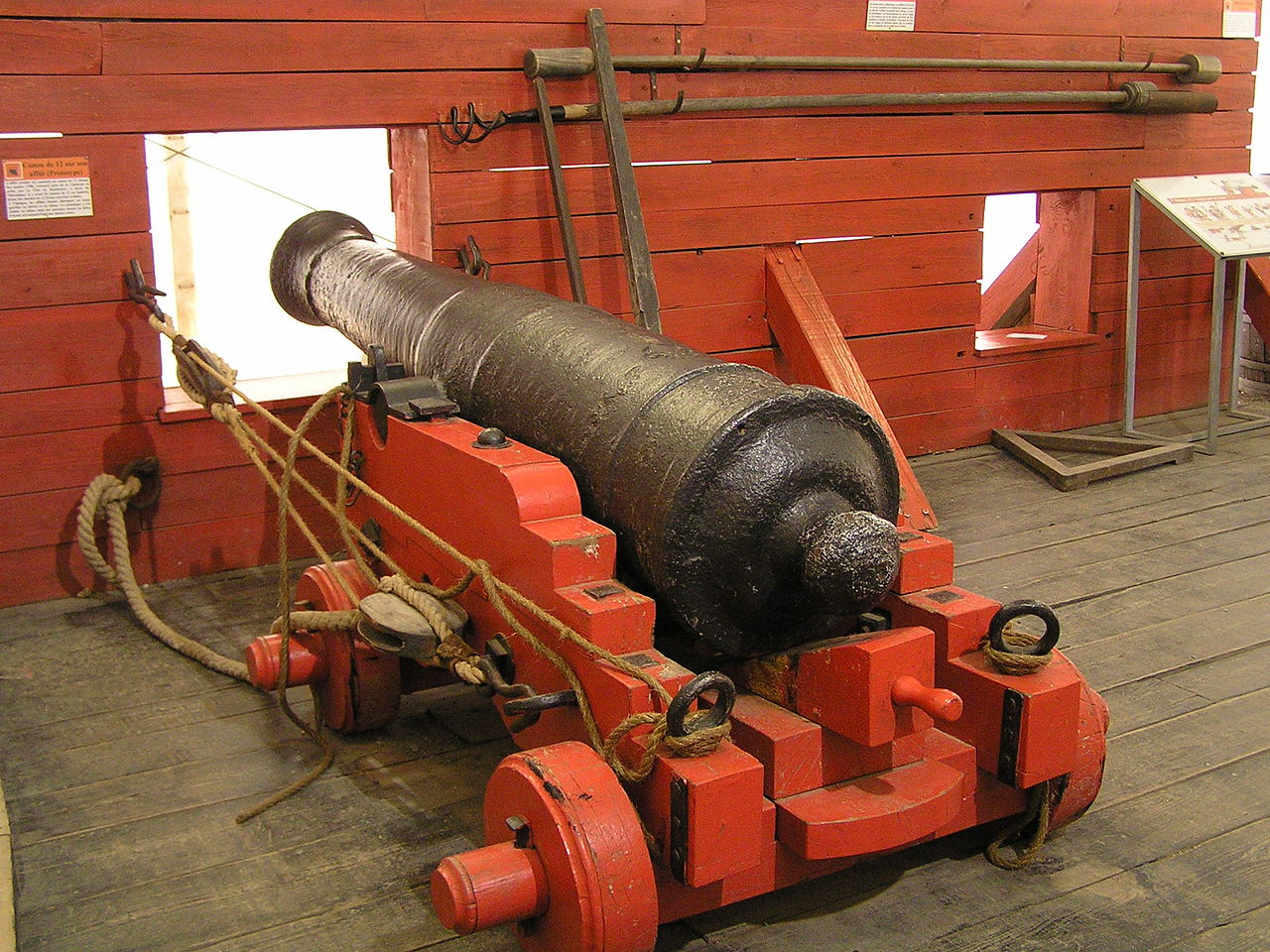
rosier · CC BY-SA 4.0
- Name
- 12-pounder long gun
- Field
- long gun · naval artillery
VALÉORINE Encyclopedia
VALÉORINE documentary reading
Documentary summary
The 12-pounder long gun was an intermediary calibre piece of artillery mounted on warships of the Age of Sail. They were used as main guns on the most typical frigates of the early 18th century, on the second deck of fourth-rate ships of the line, and on the upper decks or castles of 80-gun and 120-gun ships of the line. Naval 12-pounders were similar to 12-pound Army guns in the Gribeauval system: the canon lourd de 12 Gribeauval, used as a siege weapon, and the canon de 12 Gribeauval, which was considered a heavy field artillery piece.
Admitted source layer · organised and presented by VALÉORINE
Reference Check
Propose documentary evidence for 12-pounder long gun. A contribution is never written directly as fact: identity, source, rights and evidence gates still decide.
Sign in to contribute
World of VALÉORINE
Documentary connections
Only confirmed graph relationships appear here. Images are shown only when their identity and reuse rights both pass the documentary gate.


Documentary evidence
Documentary basis
Authority files
wikidata · Q2936469 · wikipedia · 12-pounder long gun
In this article
Key facts
Key facts
• Is Artillery — yes • Is Uk — yes • Name — 12-pounder long gun • Type — naval gun • Used By — France, Spain, Great Britain, Dutch Republic, Sweden, United States, Mysore • Caliber — 120.7 mm • Part Length — 2.430 metres • Weight — 1,470 kg 275 kg (mount) • Cartridge Weight — 5.8 kg
Usage
Usage
As the 12-pounder calibre was consistent with both the French and the British calibre systems, it was a widespread gun amongst nations between the 17th and the 19th century. From the late 18th century, the French Navy used the 12-pounder in three capacities: as main gun on early frigates under Louis XIV, on standard frigates under Louis XV and on light frigates under Louis XVI; as secondary artillery on 64-gun ships; to arm the castles of 80-gun ships of the line; and to equip the third deck of early first-rate ships. Under Louis XIV, frigates were organised into "first-rank frigates", which were small two-deckers comparable in role to the 60-gun ships of the 19th century, and smaller "second-rank" frigates. The first-rank frigates carried the 12-pounder as main artillery on their lower deck. Later, under Louis XV, the frigate took its modern shape with a single artillery deck complemented by smaller pieces on the castles; new heavy frigates were developed to carry 26 12-pounders, with as the lead ship of the series. Hermione was captured by the British in 1757 and was swiftly imitated. A breakthrough towards fielding heavier guns was made in 1772, when the two units of the were built, with 24-pounders intended, but 18-pounders used in practice, and the 12-pounder remained the standard issue on most units. Under Louis XVI, the heavier 18-pounder frigate became predominant, with over 130 units produced, but the French Navy still had around 70 lighter 12-pounder frigates in commission. On 64-gun two-deckers, the 12-gun was used as secondary artillery, to supplement the 24-pounder main batteries. 28 guns were carried on the top gun-deck. Larger units used the 12-pounder to complement the firepower provided by their main and secondary artillery. On 80-gun ships of the and, they armed the forecastle and the poop deck. On capital ships, the 12-pounder was used on the third deck from the reign of Louis XIV, with units like or as typical examples. While the secondary artillery of these 100-gun ships evolved from 18-pounders to 24-pounders, the 12-pounder remained the standard gun on the third deck until 1803, when the ship of the line ship Impérial became the first 120-gun to carry 18-pounders on her third battery. In the Royal Navy, the 12-pounder was used in a similar capacity. The capture of Hermione in 1757 encouraged the British to imitate her design, yielding the and frigates. The 12-pounder also equipped the castles on razeed ships, where 12 pieces were mounted, and the 22-gun secondary battery of 50-gun fourth-rates. Finally, 30 were installed on the third deck of 90-gun second-rates.
Early iron 12-pounders
Early iron 12-pounders
James mentions 4 12-pounder iron guns in the 1720s. Their length varied from 8 1/2 ft (2.6 m) to 10 ft (3.0 m), in 6 in (0.15 m) increments. 24 guns from the reigns of Queen Anne and King George I survive at Fort Prince of Wales in Hudson bay. They are either 9 1/2 ft long weighing between 33 1/2 and 35 cwt, 9 ft long weighing between 32 and 33 1/2 cwt, or 8 ft long weighing 33 1/4 cwt. The mensuration of 1743 gives the weight of the 9 ft 12-pounder gun as 32 hundredweight 2 quarter 3 pounds, and the dimensions there are almost identical with those in Adye's notebook of 1766. In 1780 Walton's notebook mentions, in addition to newer 12-pounders, a 9 1/2 ft gun of 34 hundredweight. The dimensions of this are very similar to those of Armstrong's construction in the early 1700s. Based on these sources, the iron 12-pounders in the early 1700s had the following specifications: • Gun Length (ft) — Weight (cwt) — Notes • 10 —? • 9 1/2 — 34 — Based on Walton's notebook in 1780 • 9 — 32 1/2, 3 lb — Based on mensuration of 1743 • 8 1/2 —? • 8 — 33 1/4 — Based only on a single gun from Fort Prince of Wales The establishment of 1764 specifies 3 types of iron 12-pounder guns: • Gun Length (ft) — Weight (cwt) • 9 — 32 1/2 • 8 1/2 — 31 1/2 • 7 1/2 — 29 1/4 Walton gives dimensions for these guns in his 1780 notebook, and where known, they are very similar to the earlier guns, with only minor differences.
Blomefield's 12-pounders
Blomefield's 12-pounders
Sir Thomas Blomefield developed several iron 12-pounders as part of his system of gun construction from the 1790s onward: • Gun Length (ft) — Weight (cwt) — Method of construction — Uses (as of 1825) • 9 — 34 3/4 — newly cast — chase guns, line of battle ships, garrison • 8 1/2 — 33 1/4 — newly cast — garrison service, battering train • 7 1/2 — 29 1/4 — newly cast — quarter deck, line of battle ships, garrison • 6 — 24 — newly cast — Not used, sometimes bored-up to 24-pounder 22 cwt • 6 — 21 — newly cast — Sometimes bored-up to 24-pounder 21 cwt Both guns of 6 ft were intended exclusively for the land service, and by 1857 the gun of 6 ft 21 hundredweight was the only one mounted in service, presumably in the defense of ditches. The gun of 8 1/2 ft 33 1/4 hundredweight was recommended for siege trains in 1844, as it could dismount artillery while requiring less weight of ammunition and powder than an 18- or 24-pounder gun. At the same time, the gun of 9 ft 34 3/4 hundredweight was recommended for sometimes replacing the 18-pounder in batteries where quick fire was required against storming parties or boat attacks. After the 1820s, the development of larger guns meant the iron 12-pounder declined in use, and in 1859 the Committee on Ordnance recommended that all iron 12-pounders except the gun of 6 ft be declared obsolete. In 1865 though, the guns of 9 and 8 1/2 ft were retained while all others were declared obsolete.
Primary material
Documents and archives
reference work
- “12-pounder long gun”, English Wikipedia, consulted as further reading
Reputable secondary · Wikipedia
authority record
- Wikidata, structured authority record Q2936469: 12-pounder long gun
General reference · Wikidata
Literature
Scholarly footprint
A count of publications is evidence of attention, not of standing, and is given here only as a measure.
Sources and references
Sources and references
• Jean Boudriot et Hubert Berti, L'Artillerie de mer: marine française 1650-1850, Paris, éditions Ancre, 1992 (notice BNF no FRBNF355550752). • Jean Peter, L'artillerie et les fonderies de la marine sous Louis XIV, Paris, Economica, 1995, 213 p..
Notes from the source article
Cited by Wikipedia
Notes from the source article
These works are cited by the source article, in its own numbering. They are recorded as its citations, not as sources VALÉORINE has verified.
References
Citations
References
Each reference names the institution holding it, so a reader may go to the document itself.
reference work
Secondary witnessauthority record
General reference
Further particulars
Held on the record
Further particulars
Open the remaining particulars
12-pounder long gun is connected to 2 other published records in the VALÉORINE Encyclopedia.
Within the Encyclopedia
The Encyclopedia exists whether or not anything is for sale. Corrections are recorded rather than overwritten, and every version of this record is kept. Published 16 August 2026.
Elsewhere in Militaria
6,095 published records in this field, each with its sources named.
- 12 mmTerminology
- 12 mm LefaucheuxTerminology
- 12-inch coast defense mortarTerminology
- 12-inch gun M1895Terminology
- 12.17×42mm RFTerminology
- 12.7 cm SK C/34 gunTerminology
- 12.7 cm/40 Type 89 anti-aircraft gunTerminology
- 12.7 cm/50 Type 3 gunTerminology
Best supported in this field
For owners
Own an object connected with 12-pounder long gun?
A specialist will read what you send and tell you what the house can establish, what it cannot, and whether the object is suited to sale. There is no charge and no obligation. The object stays with you throughout; nothing is shipped to us unless it is arranged in writing beforehand.